
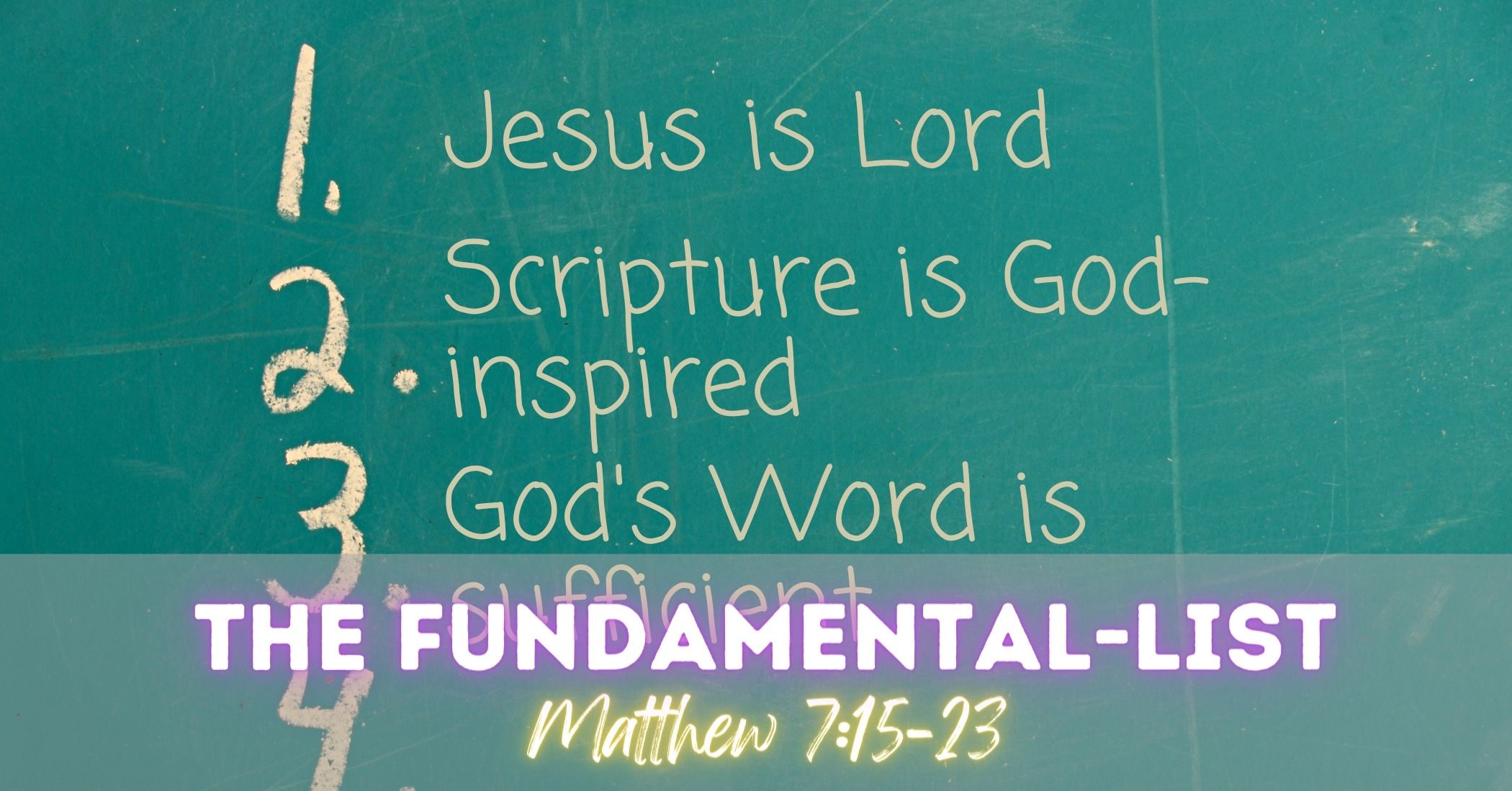
The Fundamental-List
We all have images of perfection.
The perfect career. The perfect school. The perfect spouse. I first met Anne while working at Disneyland. She was smart, funny, attractive, and sweet. She was a sweetheart to boot. It’s no wonder virtually every guy in our department wanted to date her. But I knew something most of them didn’t. She had never seen Star Wars. Not the prequels or the sequels. I’m talking the original Star Wars, the one without the any other words attached to it. It came up in some random conversation we were having when her, my buddy Mark, and I were all hanging out and the thought crossed my mind for the briefest moment – could I date someone who had never seen Star Wars? It was such a defining part of my childhood, what kind of relationship could we have? How would we raise our kids? Of course, all this was predicated on the small trivial detail that she would need to be interested in me. Minor stuff, I know. But we all have these images in our head of what we think things ought to be like. It informs how we look at the world, the relationships we develop, the careers we pursue and even our faith. And when reality doesn’t match our expectations, sometimes we react badly. But is it justified? How much heartache and pain could we avoid if we simply kept things in perspective? Because when we elevate the trivial to be on par with the essential, we often miss out on the richness and possibilities that life has to offer.

This morning, we’re opening with a passage from Titus.
In this letter from the apostle Paul to one of his emissaries, Titus, he spends most of it talking about how to live a Christian life. And even though it’s written in the words of an ancient culture, its lessons of humility, service, and honor are still values we hold today even if we look at the issues differently. It was also clear in this letter to Titus that Paul wanted him to model these expectations and teach those who would listen these lessons as well so they would become living examples of God’s love. In the passage we are about to share, Paul tells Titus to remind the people how to behave but also to remind them to be kind and merciful to those around them.
1 Remind the people to be subject to rulers and authorities, to be obedient, to be ready to do whatever is good, 2 to slander no one, to be peaceable and considerate, and always to be gentle toward everyone.
3 At one time we too were foolish, disobedient, deceived and enslaved by all kinds of passions and pleasures. We lived in malice and envy, being hated and hating one another. 4 But when the kindness and love of God our Savior appeared, 5 he saved us, not because of righteous things we had done, but because of his mercy. He saved us through the washing of rebirth and renewal by the Holy Spirit, 6 whom he poured out on us generously through Jesus Christ our Savior, 7 so that, having been justified by his grace, we might become heirs having the hope of eternal life. 8 This is a trustworthy saying. And I want you to stress these things, so that those who have trusted in God may be careful to devote themselves to doing what is good. These things are excellent and profitable for everyone.
9 But avoid foolish controversies and genealogies and arguments and quarrels about the law, because these are unprofitable and useless. 10 Warn a divisive person once, and then warn them a second time. After that, have nothing to do with them. 11 You may be sure that such people are warped and sinful; they are self-condemned. – Titus 3:1-11 (Old Testament)
These words are as important today as they were back then.
“Remind the people to be subject to rulers and authorities, to be obedient, to be ready to do whatever is good, to slander no one, to be peaceable and considerate, and always to be gentle toward everyone.” Sounds like a great way to live, right? Things we should aspire to. It’s also a living testimony to a loving God. But I can think of recent examples by people who claim to be Christian where that hasn’t happened. The way we behave IS IMPORTANT. It reflects not just on us but the God we say we follow. And as important as that is, the next bit Paul shares is vital to our reflection today. “But avoid foolish controversies and genealogies and arguments and quarrels about the law, because they are unprofitable and useless.” This is where we mess up the most. This is why people call us hypocritical and judgmental and closed-minded. Too often the people of God don’t ACT like the people of God.
Do you know how many different denominations there are in Christianity?
45,000. 45,000 Christian denominations in the world today.[1] And growing. Are there REALLY 45,000 things to fight about? And not just fight about but fight about so badly that we would turn our backs on one another. We’re about to enter into another season of that right now. There are those in the United Methodist Church who feel like they can no longer share a table with us. That there is just too much separating us to work it out. But are these arguments essential to our faith or trivial? Of course, to the people in the middle of it all it FEELS essential. When does it not? When you’re in the middle of a heated argument with someone, doesn’t it ALWAYS feel like you had no other choice? But you do. You always do. You always have a choice. That’s one of the great gifts of God, the freedom to choose. And yet, here we are. On the precipice of another break in the church. But is it a break over something essential or something trivial? Maybe we would do well to listen to John Wesley.

John Wesley, the founder of Methodism, had a saying – “Think and let think.”
Think and let think. Even back in Wesley’s time, the church had an issue with fissures and splits. To be fair, Methodism was never intended to be a split itself, but a revival – going back to the roots – within the Episcopal Church. John Wesley is famously known for never leaving the Episcopal Church even though he is credited (rightfully) as the founder of Methodism. To Wesley, Methodism was a way of being, of living out your faith and not a separate religious movement. But even so, Methodism came under attack and in part as a response to these attacks, Wesley wrote the tract called “The Character of a Methodist” where he sought to define the fundamentals of Methodist belief. He wrote, “the distinguishing marks of a Methodist are not his opinions of any sort. His assenting to this or that scheme of religion, his embracing any particular set of notions, his espousing the judgment of one man or of another, are all quite wide of the point. Whosoever, therefore, imagines that a Methodist is a man of such or such an opinion, is grossly ignorant of the whole affair; he mistakes the truth totally. We believe, indeed, that “all Scripture is given by the inspiration of God;” and herein we are distinguished from Jews, Turks, and Infidels. We believe the written word of God to be the only and sufficient rule both of Christian faith and practice; and herein we are fundamentally distinguished from those of the Romish Church. We believe Christ to be the eternal, supreme God; and herein we are distinguished from the Socinians and Arians. But as to all opinions which do not strike at the root of Christianity, we think and let think. So that whatsoever they are, whether right or wrong, they are no distinguishing marks of a Methodist.”[2] His point was that those things which are not essential tenets of our faith shouldn’t be argued over. We can debate them, we can talk about them, we can offer our opinions, but those things which are not central to who we are should not divide us which is exactly in line with what God tells us in the Bible; “avoid foolish controversies and genealogies and arguments and quarrels about the law, because they are unprofitable and useless.”

These are the only three things Wesley called out that define us as Christians.
Scripture as the inspired Word of God, the sufficiency of Scripture to determine God’s will, and Christ as part of the Holy Trinity. I’ll add one more. Not that Wesley didn’t believe this himself, but because he would have believed it was covered by the other rules, but I think it’s important enough that we call it out. From John 13:34-35, 34 “A new command I give you: Love one another. As I have loved you, so you must love one another. 35 By this everyone will know that you are my disciples, if you love one another.” Pretty much everything in the Bible can be summed up in this verse of Scripture. “Love one another.” These are the beliefs that define what it means to be a Christian. Anything else is simply a matter of interpretation. We don’t have to agree on everything to be united on the big things. We don’t have to adapt every belief someone else has to work together for the good of Christ. But it seems more than ever we cling to the unimportant and abandon what is essential to our faith. Is it any wonder more and more people are leaving the church? Is it that puzzling those outside the church think we’re so behind the times? If we abandon one another over the trivial, how are people to believe we will be there for them when things get tough? A friend of mine once served a church that threatened to split because of a sofa. Seriously. Somebody had donated a sofa that was sitting in the narthex or lobby area, and it had become an eyesore. At one time it was nice and in style, but over the years it had become beat up, the cushions were lumpy, the colors were garish, and half the church hated it. But it had been donated by a member of a prominent family so the other half for one reason or another refused to get rid of it. And in arguing over the couch, they threatened to leave the church. Over a couch. That’s how petty we can become when we forget what is essential to our lives as Christians. We need to keep our hearts focused on what’s important and let go of the rest. We need to focus on what is essential and ignore the trivial. Because when we do that, we can do so much more for each other and for the world – even for people who’ve never seen Star Wars.
Note: While the contents of the sermon are totally original, the sermon title is not. But it was so clever and fit our message so well I used it. I’d give credit to Andy Stanley, Lead Pastor of North Point Community Church, but in HIS message he ALSO said he borrowed it from someone else, too!
[1] https://www.gordonconwell.edu/center-for-global-christianity/research/quick-facts/
[2] http://new.gbgm-umc.org/umhistory/wesley/character/
 Craig's Corner