
Is Barney Biblical?

Barney is BACK!
For fans of the big purple dinosaur, there is MUCH to cheer about. Slated for a 2024 launch, everyone’s favorite Tyrannosaurus Rex will be coming back to television on Max with his friends Billy and Baby Bop – this time as an animated adventure.[1] Also in the works is a Barney movie geared more toward an adult audience, those who fondly remember Barney as they were growing up.[2] But with the current political climate and the fierce backlash against…well, everything, will Barney even make it onto the screen? At a time when we’re banning books and letting people sue school districts and fire teachers for sharing ideas anyone finds offensive, will there be places where kids never hear about dinosaurs at all?[3] I wonder if there will be disclaimers at the beginning of every episode of the new Barney show that say evolution is “only one way creation might have happened.”

When did science and religion become enemies?
Turns out Darwin was responsible for more than introducing us to the idea of natural selection. Up until the 18th century science and religion were buddies. Often referred to as the “handmaiden of theology,” philosophical studies of the natural world were seen as a way to better understand God’s creation.[4] Some of the most brilliant scientific minds came from the halls of the Lord. Robert Grosseteste was not only a Bishop but also one of the first proponents of the scientific method. Roger Bacon, a student of his and himself a Franciscan monk, studied a wide variety of scientific fields including astronomy, mathematics, and alchemy. In fact, for a time he taught at the University of Paris and wrote some truly remarkable works including passages about flying machines and submarines![5] And this was in the 13th century! Copernicus, Kepler, Newton, and even Galileo were all devout religious men who saw their work as honoring God and exploring his wonder.[6] It might surprise you to know that the terms “science” and “religion” didn’t even come into common use until the 19th century.[7] Science was considered part of philosophy and was often referred to as the “natural law.” It was during the Age of Enlightenment in the 17th and 18th centuries that we see this split between science and religion for the first time. Those who focused more on theology started to push back against the findings of natural law. But it wasn’t until Darwin that religious people said, “That’s enough.”
What about Darwin’s discovery sparked the fire between these two camps?
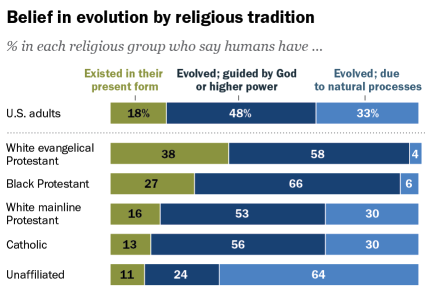
To be fair to Darwin, it wasn’t him personally they were opposed to but his ideas about creation. If evolution was true, then where was God in all of this? But probably more than that, it threatened the church’s power over people’s lives. It threatened the power and influence the church had on society and we see this playing out more and more. As science becomes the new idol we worship, people outside our faith (and even some within) tend to look at religion as something at best behind the times and at worse denying the obvious. The more people of faith push back against the discoveries of science, the more we look out of touch, and it’s hard to reach people for Christ when we fail to meet people where they are. The thing is science is still regarded by the vast majority of Christians as being compatible with our faith. In fact, while 81% of all Americans believe in some form of evolution, 83% of White mainline Protestants and 86% of Catholics believe in it. Even among White evangelical Protestants, the Christian group least likely to believe in evolution, 62% believed.[8]
The debate often centers not on dinosaurs in particular.
But instead on the differences between the Biblical account of creation and the scientific version of it. According to Young Earth Creationists probably the most extreme view on creationism, the Earth is somewhere between 6,000 and 10,000 years old.[9] They even date it to around 4004 B.C.and they believe the Bible literally. God created the earth in six days. There were no dinosaurs. There was no evolution. They take into account the birth of Christ, the ages of his ancestors, and the genealogies described in the Bible and put the Earth at 6,000 years old. But that’s only one Christian account of creation. Most Christians don’t adopt a literal interpretation of the Bible. Instead, they believe the Bible accounts for evolution. These are Theistic Evolutionists and they make up the majority of Christian belief. Evolution is viewed by them as a tool God used to create the Earth; placing God still as creator, but not denying evolution. Instead of the literal six days of creation, they believe those “days” could actually have been thousands or millions of years like it says in 2 Peter 3:8 – “But do not forget this one thing, dear friends: With the Lord a day is like a thousand years, and a thousand years are like a day.” Theistic Evolutionists even believe that the Bible talks about the existence of dinosaurs and they point to the passage from Job 40:15-19 as proof, saying that the behemoth in the passage was actually a dinosaur. Now the Bible doesn’t reference dinosaurs by name because the word “dinosaur” wasn’t a word until 1842. 1842. Long after the Bible was written. But Theistic Evolutionists often point to the description of the behemoth as an indicator that it was more than just a hippopotamus or an elephant.
“Look at Behemoth,
which I made along with you
and which feeds on grass like an ox.
16 What strength it has in its loins,
what power in the muscles of its belly!
17 Its tail sways like a cedar;
the sinews of its thighs are close-knit.
18 Its bones are tubes of bronze,
its limbs like rods of iron.
19 It ranks first among the works of God,
yet its Maker can approach it with his sword. – Job 40:15-19
But here’s the thing.
The story of Genesis was never meant to be an historical account of the beginning of the world. When we spend time focusing on the details of creation, we miss the forest for the trees. The story of creation was not supposed to be a factual accounting of events, but was meant to point us toward God as creator; that God is in control, that God is trustworthy and praiseworthy. That’s what Genesis is about. The power of God. But we get stuck fighting about the first thing that comes up in the Bible. Can’t even get one chapter in without arguing. Now the Bible is vague about creation on purpose. Nowhere does it say how old the Earth is, because it doesn’t matter. You’ll find all throughout Scripture there are many details each author could have included. Like what color was Jesus’ skin? What type of material were his shoes made out of? But none of that is important. The point we’re supposed to come away with after we read Genesis is a deeper sense of awe about God’s might. We’re supposed to read it and realize that we exist because of the grace, mercy, and love of God and really for no other reason. And that’s what the book is about. If you come away with THAT understanding, you come away with a deeper love and appreciation of God than you’ve ever had before.
We get caught up in “foolish controversies” far too often.
And when we ignore the Word of God which tells us not to argue about these things, we end up at odds with one another instead of realizing that with God all things are possible. That we should concentrate on the things that DO matter instead of the things that don’t. It brings to mind for me an episode of Friends where Ross is trying to get Phoebe to believe in evolution and at the end of the episode Phoebe says to him, “Look Ross, I’m not DENYING evolution. I’m just saying it’s one of the possibilities.” And Ross says, “It’s the ONLY possibility.” And Phoebe gets up from her chair and says to him, “Ross, can you open your mind like THIS much. Okay? Wasn’t there a time when the brightest minds in the world believed that the Earth was flat? And up until like 50 years ago you all thought the atom was the smallest thing until you split it open and this whole mess of stuff came out. Now, are you telling me you are so unbelievably arrogant that you can’t admit there’s a TEENY tiny possibility that you could be wrong about this?” And Ross admits, there’s a TEENY tiny possibility he could be wrong. We all could be wrong. But that isn’t the point of the story of creation, and I hope you walk away today understanding that no matter which side of the argument you fall on, the story is about the power, love, and grace of God who created this world for us because he loves us. That’s the point of the story. And as to all opinions that do not strike at the root of Christianity, we think and let think.
[1] https://variety.com/2023/tv/news/barneys-world-dinosaur-animated-series-max-cartoon-network-1235607348/
[2] https://www.theguardian.com/film/2023/jul/04/barney-the-dinosaur-film-daniel-kaluuya
[3] Many states are enacting or attempting to enact legislation to ban the teaching of certain subjects instead of leaving it to professional educators and school board officials. See https://www.npr.org/2022/02/03/1077878538/legislation-restricts-what-teachers-can-discuss
[4] https://www.encyclopedia.com/education/encyclopedias-almanacs-transcripts-and-maps/christianity-history-science-and-religion
[5] https://en.wikipedia.org/wiki/Roger_Bacon
[6] https://www.pbs.org/faithandreason/intro/histo-frame.html
[7] https://plato.stanford.edu/entries/religion-science/#BrieHist
[8] https://www.pewresearch.org/short-reads/2019/02/11/darwin-day/ Statistics were only for Americans who answered the question. Those who responded without an opinion or answered outside the accepted fields were omitted.
[9] https://www.gotquestions.org/young-earth-creationism.html
 Craig's Corner
Genesis is factual. It is important that we acknowledge God created everything according to it’s own kind . That is contrary to what “evolution” teaches. The Bible is both a Holy book and a history book , and archaeologists are discovering a lot of it is just as the Bible describes. Evolution is simply not compatible with scripture. It’s heresy.
The Bible is clearly not a history book in the way we understand history today. You would have to account for the two different versions of creation which cannot be squared. Also the different versions of the Flood. Many of the writers interpreted God’s actions as best they could given their circumstances and knowledge, but the Bible is not inconsistent with evolution either. Have you actually read Genesis? I’d love to know how you reconcile those “historical” differences.