
Do Dogs Go To Heaven?
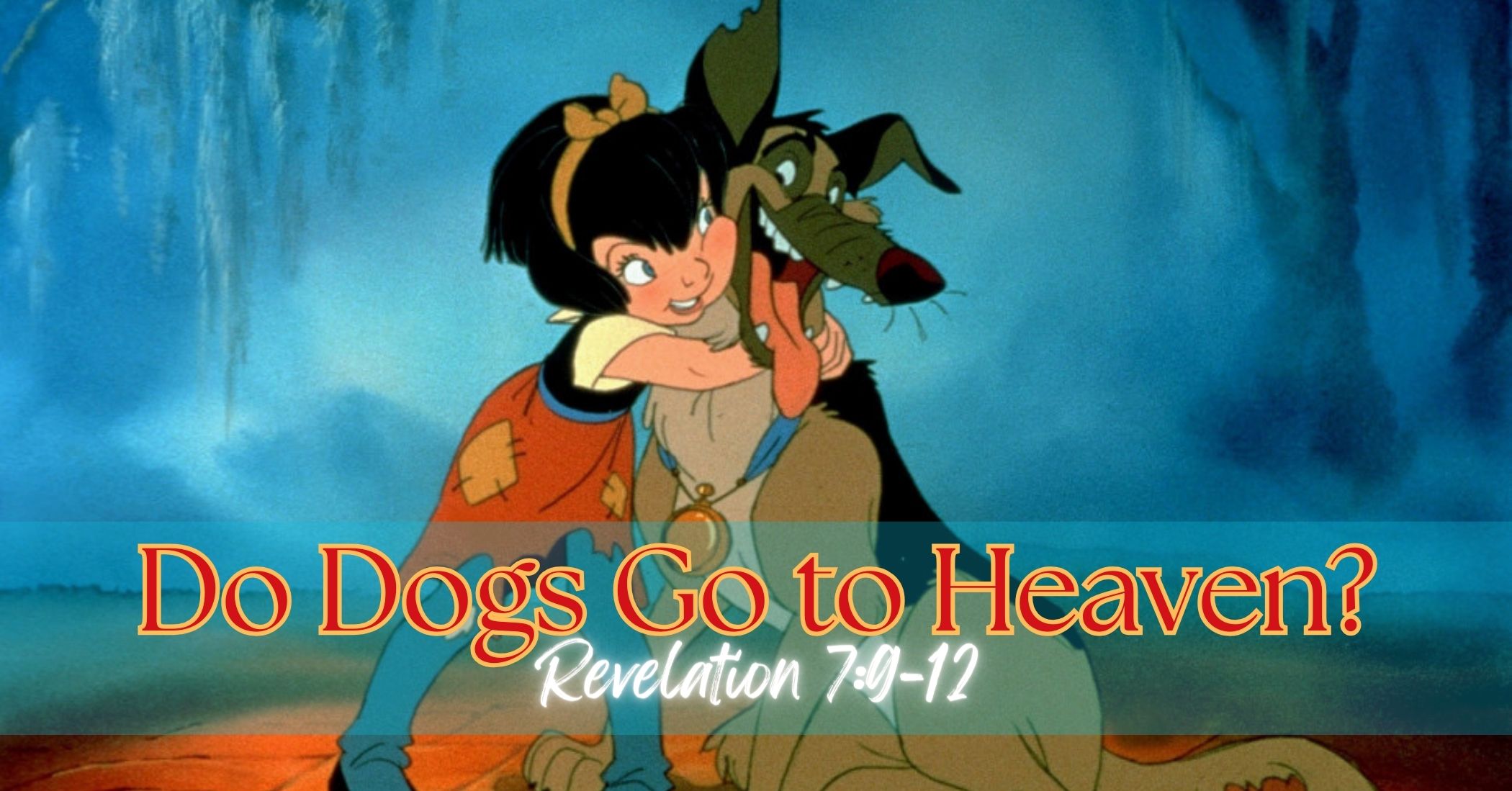
Do dogs go to Heaven when they die?
My oldest daughter, Eve asked me this question on our way to the bus stop one morning. She was about 7 or 8 years old at the time and this was when we were living in Georgia. I was carrying Emma in my arms as we were heading down the hill to the corner where the bus would come and take her to school when the question popped out. “Do dogs go to Heaven when they die?” I wasn’t completely surprised. Just the night before, we found out the cute little dog across the street got hit by a car and didn’t survive. I’m sure that’s how many kids first experience these thoughts about “what happens next.” But the number of questions only grow as we get older. I remember when I was eight years old and my grandmother died, my mom told me she had gone to Heaven and the first question I had in mind was, “How did she get there?” Did she catch a bus? How did she know where to go? Can I visit? Life can be pretty literal when you’re young, and I was looking for concrete answers about a topic that had none.

But every question we ask about death revolves around one central question:
What happens when we die? It’s a question that stays with us because so few people can tell us the answer. Jesus would know best, having done it himself, but he never shared much about it. Lazarus likewise never said a word. Elijah and Moses came back briefly, but didn’t say anything either. The closest we get to answers in the Bible is through John who had a vision of life in the spiritual world. He wrote it down in what we would call the Book of Revelation, but it was so intense and so beyond human understanding that it’s still the hardest book in the Bible to interpret – concepts and images that go beyond human understanding. Now, every once in a while we hear an amazing story like that of Colton Burpo, the young boy whose life inspired the movie and the book Heaven is for Real. And reading stories like that give us hope and allow us to point to something tangible to hold onto. But for every story like Colton’s, there are others who have come back and said there was nothing but darkness and cold and you wonder if we are any closer to an answer.

We’ve tried to prove or disprove the existence of an afterlife using logic and reason.
Which seems weird since logic and reason are based on our knowledge and experience and we simply don’t have enough of either when it comes to the hereafter. Most of these arguments revolve around the existence of God, because if we can prove God exists, it logically follows that all the rest of it is true, including the afterlife. On the other hand, some atheists like to use evolution as an argument against the existence of God which doesn’t make sense because evolution and God are not contradictory beliefs. So, it’s ironic that a popular argument in favor of God comes from an atheist. You probably don’t know the name Fred Hoyle, but you probably do know the theory he came up with – The Big Bang Theory (not to be confused with the TV show of the same name). Interestingly, Hoyle didn’t believe in the Big Bang Theory either. But he also didn’t believe in evolution as Darwin had originally posited.[1] Instead he believed in intelligent design, a concept that something greater than ourselves must have guided the development or even creation of humanity. He didn’t believe in God as we understand God, and might be offended to hear his argument being used in God’s defense. But what he said in defending intelligent design was, “The chance that higher life forms might have emerged in this way (through evolution) is comparable with the chance that a tornado sweeping through a junk-yard might assemble a Boeing 747 from the materials therein.”[2] That’s how infinitesimally small the odds are of human beings ever being created simply by chance. Now there are tons of people who would argue with Hoyle and argue that his analogy was too simple or came at it the wrong way, but Hoyle’s point was simply that it made more sense to believe in a creator than it did to think we happened by accident.

One doctor tried to prove the human body had a soul by weighing patients as they died.
You’ve probably heard this story before. Dr. Duncan MacDougall posited the theory that human beings have souls and that it could be proved at the point of death. He took six dying patients and weighed them right before death and immediately afterward, and he claimed that after the body had ceased functioning, the human body suddenly lost weight that could not be accounted for by normal means. He said that through his experiments, he calculated the human soul weighs ¾ of an ounce or as it is more popularly known today: 21 grams.[3] 21 grams, Dr. MacDougall said, was how much the soul weighed. But the truth is his results over this incredibly small sample varied widely and none of them had a consistency of weight loss. Just one person recorded an actual loss of 21 grams and the rest had completely different results.[4] But MacDougall’s efforts is testimony to our desire to learn about the afterlife.
Scholars have poured over the Bible to find clues to what we can expect when we die.
Jesus tells us God has a house for us in Heaven with many rooms and there is a room reserved there for each of us who believe in Him. John tells us when God creates the New Jerusalem at the end of the age it will have streets of gold and walls of jasper and foundations made of gemstones. But for me, my favorite image in the Bible comes from Revelation 7:9-12. The passage we’re reading is from John’s vision of the end of days before the creation of the New Heaven and New Jerusalem. Now this isn’t an image of the New Heaven, but an image of what John sees as we approach the day of final judgment when God will determine what happens to each of us. And even though this isn’t exactly an image of the New Heaven, to me this is a glimpse of what we can expect when we get there.
9 After this I looked, and there before me was a great multitude that no one could count, from every nation, tribe, people and language, standing before the throne and before the Lamb. They were wearing white robes and were holding palm branches in their hands. 10 And they cried out in a loud voice:
“Salvation belongs to our God, who sits on the throne, and to the Lamb.”
11 All the angels were standing around the throne and around the elders and the four living creatures. They fell down on their faces before the throne and worshiped God, 12 saying: “Amen! Praise and glory and wisdom and thanks and honor and power and strength be to our God for ever and ever. Amen!” – Revelation 7:9-12
This is often how I imagine Heaven to be.
Filled with people of every type from every nation. A multitude of every race, color, gender, age, and size. A crowd so large they cannot be counted. A place where all of God’s children live in unity with one another. And I think the reason we debate so much about what Heaven looks like and how you get there and what we can expect is because we are not sure if we are going to be there. Our beliefs about Heaven are often exclusive to our belief in God. Catholics believe that it is a combination of faith and good works that earn you a place in Heaven. Mormons believe Heaven consists of three levels and only believers of the Mormon faith get into the best level to be with God. And Jehovah’s Witnesses believe it all doesn’t matter. God has already picked out the 144,000 that will be joining him and too bad for the rest of humanity. Presbyterians and other Calvanist faiths believe we are predestined, kind of like the Jehovah’s Witnesses but with fewer limitations. And so the debate about who is right becomes more important than ever because it involves our eternal destiny. That’s why we worry so much about this stuff. But maybe instead of worrying about how to get into Heaven we should focus instead on living a life that honors Christ.

Sometimes we focus on the wrong things.
If we really want to get into Heaven the last thing we should be worrying about is getting into Heaven. Because worrying about it won’t get us there. There isn’t some magic formula where if you do “X” number of good things you get in. There isn’t some cosmic scale of justice that says if our total good guy points outweigh our bad guy points, we’re in. The only thing that truly matters is our heart for God. Just listen to the words of Jesus himself. He told his disciples, “Therefore I tell you, do not worry about your life, what you will eat or drink; or about your body, what you will wear. Is not life more than food, and the body more than clothes? 26 Look at the birds of the air; they do not sow or reap or store away in barns, and yet your heavenly Father feeds them. Are you not much more valuable than they? 27 Can any one of you by worrying add a single hour to your life?… 31 So do not worry, saying, ‘What shall we eat?’ or ‘What shall we drink?’ or ‘What shall we wear?’ 32 For the pagans run after all these things, and your heavenly Father knows that you need them. 33 But seek first his kingdom and his righteousness, and all these things will be given to you as well. 34 Therefore do not worry about tomorrow, for tomorrow will worry about itself. Each day has enough trouble of its own.” The solution is simple. Put God first. Trust in God and free yourself from worry. The rest will fall into place on its own.
Harvey West is one of the best pastors I know.
He was my senior pastor when I was attending Alpharetta First UMC back in Georgia and I was fortunate enough to take a Bible study class with him. During that class one of the people asked, “How do you know you are saved?” And Harvey said, “I don’t.” That stunned all of us right there. But then he continued. “But I have faith in God and in his Son Jesus Christ. And I believe that faith will save me. And so I don’t worry about it. Instead I focus on trying to live a life that best honors Christ’s sacrifice for me.” Those words have continued to guide me every day of my life and I hope they guide yours as well. And as for the question, “Do dogs go to Heaven?” I think they do. When we read the Scripture we hear from God through the prophet Isaiah that “the wolf and the lamb will feed together, and the lion will eat straw like the ox, and dust will be the serpent’s food. They will neither harm nor destroy on all my holy mountain.” If God will provide space for the wolf and the lamb, the lion and the ox, and even the serpent, surely my former neighbor’s dog is resting comfortably somewhere up there waiting for his human. But either way, I trust in God enough to believe God knows best and no matter what my vision of Heaven is or how we get there, God’s vision will always be better.
[1] http://www.uncommondescent.com/intelligent-design/fred-hoyle-an-atheist-for-id/
[2]http://en.wikiquote.org/wiki/Fred_Hoyle
[3] http://en.wikipedia.org/wiki/Duncan_MacDougall_%28doctor%29#In_popular_culture
[4] http://www.snopes.com/religion/soulweight.asp
 Craig's Corner