
Que Sera Sera

“Everything happens for a reason.”
You’ve probably heard that before. You might have even said it yourself. Usually when something sad or tragic happens, people say these words to help comfort those who are struggling. “Everything happens for a reason.” We say it because it gives us comfort to think this tragedy was somehow important or necessary. That there was a purpose behind it. A grand design. It makes us feel better when we believe a tragedy wasn’t pointless. And we say other things, too. “It was meant to be,” or, “It was his time.” But does everything really happen for a reason? Whenever we use superlatives like “everything” and “always” we should be prepared to have an ounce of skepticism. As you probably already know, rarely is anything that definitive. The same is true for this. Not everything happens for a reason.
Well-meaning Christians have been popping out sayings like this for a long time.
But it isn’t grounded in anything that makes sense. It might seem comforting on the surface, but when you think about it, it breaks down faster than butter in a hot pan. When we tell someone “Everything happens for a reason,” we’re essentially saying God caused it to happen. That it was God that caused them to die or to suffer or go through some unimaginable pain. When I was in high school, my high school chemistry teacher, Mr. McNally, died in a tragic car accident. He was hit by a drunk driver and thankfully his son survived the crash. But Mr. McNally died. His life, which up to that point seemed great, was suddenly over. A much beloved teacher who had inspired many of his students was ripped away from his family, his friends, and his students in a moment. The drunk driver however, not only survived but walked away from the accident. Was there a grand design behind this? If there was then do we blame God for the pain caused that night? If you believe “everything happens for a reason,” this moment of pain was necessary for something bigger in the grand scheme of things. But is that really true? Just because there MAY be a positive outcome from something tragic, did God CAUSE it to happen, or did God create something meaningful out of something bad?

The answer to that question makes a big difference in how we understand God and the world.
When we say “Everything happens for a reason,” we’re really saying God controls our actions and that poses two problems – our responsibility and God’s responsibility. Saying God controls everything poses two problems – our responsibility and God’s responsibility. We have none and God has it all. Adam Hamilton, in his book Half Truth, wrote “If I drink and drive and someone is killed as a result, it must have been the victim’s “time.” Yes, I did a terrible thing, but the devil didn’t make me do it. Instead, God used me to accomplish some greater purpose. I cannot be held responsible for my actions. I was only doing what God willed me to do.”[1] And if we really believe everything happens for a reason, we believe this to be true. We are only carrying out God’s will no matter how hurtful, how obscene, or how violent it may be. Hitler? God’s fault. Terrorism? God’s fault. Cancer? God’s fault. It’s all God’s fault. Which makes the problem of “Everything happens for a reason” clear – it’s all God’s fault. Everything horrible that happens in the world is God’s fault and since we have absolutely no responsibility, why worry about it? It’s what I like to call the “Que Sera Sera” philosophy – whatever will be, will be so it’s not my problem.
Some Christians buy into this.
Maybe not that callously, but they do believe everything is pre-destined, that God has already chosen what you will do and when you will do it. It’s a theology called Calvinism or Reformed Christianity and it says God has already decided everything that will ever happen in the history of the world. God has already chosen who is going to Heaven and who is going to Hell and there’s nothing you can do about it. As Hamilton points out, John Calvin, whom the movement was named after, believed that since God was completely sovereign then “Absolutely everything… happens by God’s will and command.”[2] “If something happens that is not God’s will…then God does not in fact have dominion over everything,” and that would run counter to Calvin’s beliefs.[3] In Calvin’s point of view, human beings are merely puppets of God who’s every action is caused by God. Your breathing at this very moment is caused by God. God didn’t merely make it possible; he coordinated and orchestrated it. And if Calvin is right, then everything does happen for a reason.

As Methodists, we don’t believe this to be true.
We believe in free will. We believe God allows us to choose our path. We believe God created us not to be puppets but to be free creatures. I always think of this bookmark I had as a kid that said, “If you love something set it free. If it comes back to you, it’s yours. If it doesn’t it was never yours to begin with.” It’s an idiom, but within every idiom is a kernel of truth. God sets us free because he hopes we will come to him of our own free will. He wants us to CHOOSE him, is there love if there is no free will? Is there love without a choice?
11 Now what I am commanding you today is not too difficult for you or beyond your reach. 12 It is not up in heaven, so that you have to ask, “Who will ascend into heaven to get it and proclaim it to us so we may obey it?” 13 Nor is it beyond the sea, so that you have to ask, “Who will cross the sea to get it and proclaim it to us so we may obey it?” 14 No, the word is very near you; it is in your mouth and in your heart so you may obey it.
15 See, I set before you today life and prosperity, death and destruction. 16 For I command you today to love the Lord your God, to walk in obedience to him, and to keep his commands, decrees and laws; then you will live and increase, and the Lord your God will bless you in the land you are entering to possess.
17 But if your heart turns away and you are not obedient, and if you are drawn away to bow down to other gods and worship them, 18 I declare to you this day that you will certainly be destroyed. You will not live long in the land you are crossing the Jordan to enter and possess.
19 This day I call the heavens and the earth as witnesses against you that I have set before you life and death, blessings and curses. Now choose life, so that you and your children may live 20 and that you may love the Lord your God, listen to his voice, and hold fast to him. For the Lord is your life, and he will give you many years in the land he swore to give to your fathers, Abraham, Isaac and Jacob. – Deuteronomy 30:11-20
There are tons of Scriptures like this.
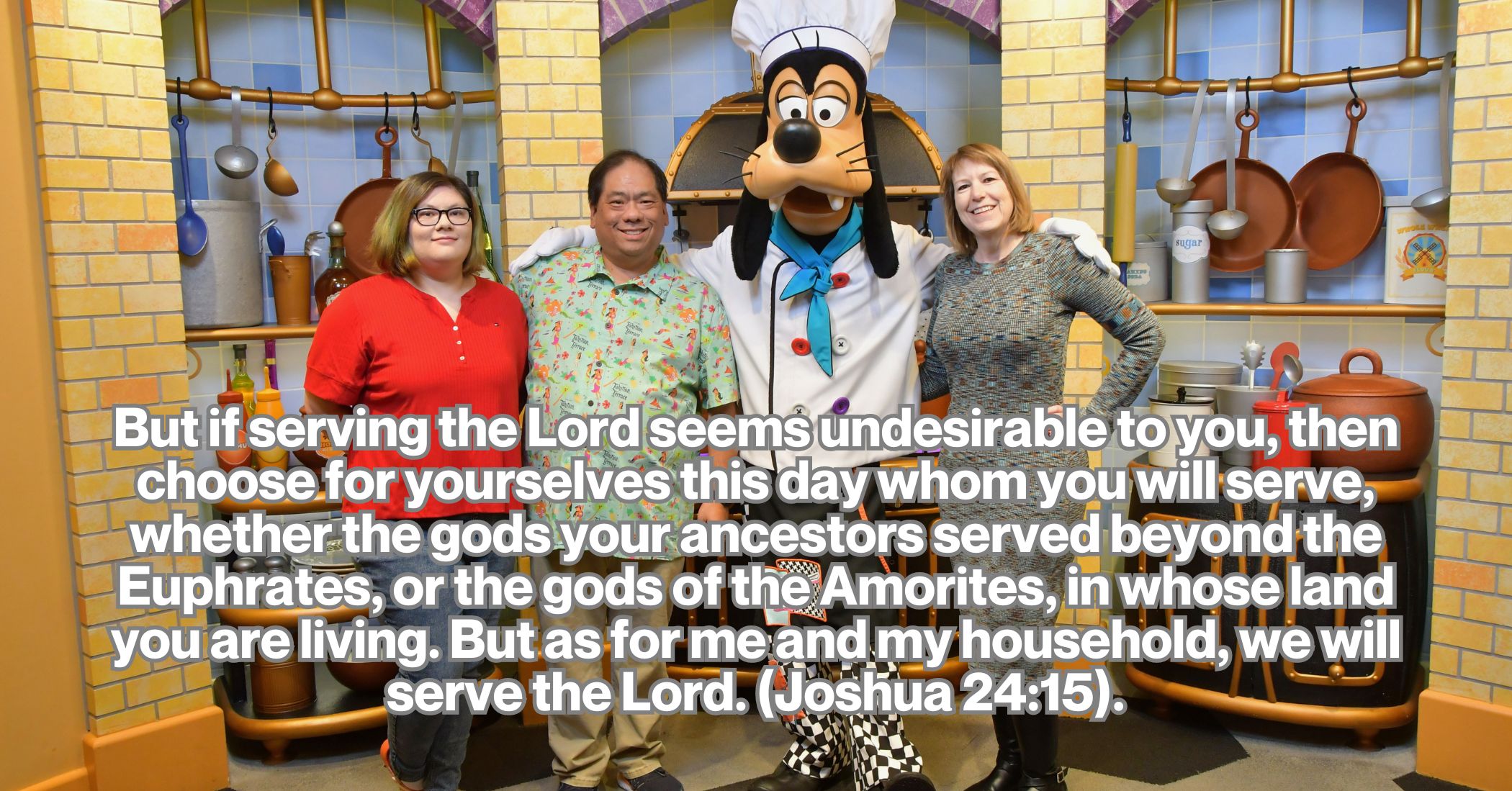
Ones that make it clear we have a choice. Here, Moses is speaking to the people of Israel. He’s just got done talking to them about God’s covenant and tells them God stands ready to offer them his blessing if they simply turn to him. They can choose to follow their own way, but it will be one filled with pain and suffering, and while Moses couches it in terms of God’s wrath, I think we’ve come to understand that it’s not so much God’s wrath as it is the natural consequence of living without God in your life. But it’s a choice! Joshua tells the people of Israel in another time, “15 But if serving the Lord seems undesirable to you, then choose for yourselves this day whom you will serve, whether the gods your ancestors served beyond the Euphrates, or the gods of the Amorites, in whose land you are living. But as for me and my household, we will serve the Lord. (Joshua 24:15).” Again, a choice. And God offers that choice over and over and over again. God never gives up on us, but he never forces us to follow him.
That doesn’t mean God ever stops reaching out to us.
He does. Constantly. Through the people around us, God reaches out to us. Sometimes subtly, sometimes right in our face, but God keeps reaching. It’s what we call prevenient grace in our Methodist tradition – the grace that comes before we even know we need it. Prevenient grace is the grace that God offers us before we even know we need it. And we need it. We need it more than ever. We live in a broken world filled with broken people, but the first step toward fixing it is by first recognizing the problem and turning to the one who can give us the tools to make it better. We are not helpless. We are not puppets. We are beings created in the image of God and God has offered us a chance to make it better. I like what Adam Hamilton said. He wrote, “God gave us a brain, a heart, a conscience, his Spirit, the Scriptures, and the ability to interpret them as guides to help us select the right path.”[4] But ultimately the choice is up to us. God equips us with what we need, but we still get to choose and ultimately live with the consequences of our choices. Mr. McNally died when I was only 16 years old. I never knew back then where my life would lead me today. I don’t believe God caused Mr. McNally to be killed by a drunk driver, but I do believe that God used this tragedy in my life to help me better understand the consequences of the choices we make and to be able to share that with you. God doesn’t cause the calamities in our life, but he can bring blessing out of the deepest pain. Does everything happen for a reason? No, but that doesn’t mean God can’t open up the world to you and through you to serve a higher purpose if we let him. But that choice is up to you.
[1] Adam Hamilton, Half Truths, p. 20
[2] Ibid, p.26.
[3] Ibid, p.26.
[4] Ibid, p.37.
 Craig's Corner