
Won’t You Be My Neighbor?

I wanted to live in Mr. Rogers’ Neighborhood.
Who wouldn’t? Specifically, I wanted his house. I loved “Picture Picture,” Trolley, that awesome stoplight he had in his house. I still want one! It just seemed like such a great place to be. Mister Rogers loved EVERYBODY. He thought you were special just the way you are, and he said it every day. And, he wanted me to be his neighbor! It was in his welcome song. “Won’t you please, won’t you please, please won’t you be my neighbor.” Everyday, I would watch that show and loved how comfortable Mr. Rogers would make me feel. He exemplified everything I would want in a neighbor. He was kind. He was thoughtful. And he always made me feel welcome. No matter who you were, if you’re a boy or girl, Asian or Caucasian, Christian or Muslim, Mr. Rogers welcomed you. And that was really the key. It didn’t matter who you were, Mr. Rogers welcomed you no matter what. You were always invited into his home.
Somewhere along the way, we’ve forgotten what it means to be that kind of neighbor.
Instead, we have grown fearful. Fearful of those who don’t look like us, who don’t act like us, who don’t speak like us. Adding to that fear are vicious untruths about immigrants and their effect on society. They are stealing our jobs! They are committing horrible crimes! They are taking over the country! All of these are false. Jobs that are going to immigrants (both documented AND undocumented) are those that couldn’t or wouldn’t be filled by our own citizens. According to the Stanford Report, “Today, immigrants tend to hold jobs that have few available U.S.-born workers, including positions that require advanced education like those in tech and science, and jobs that require very little education like picking crops by hand, washing dishes, or taking care of the elderly…”[1] Another interesting factoid, a study from the Bush Institute found that immigrants on average are more likely to CREATE jobs than native-born Americans.[2] As for pursuing a life of crime, immigrants (both documented and undocumented) were less likely to commit a crime than those of us who were born in America. More surprising? Ousey and Kubrin did a 20-year study on the subject and found that “communities with more immigration tend to have less crime, especially violent crimes like homicide.”[3] Maybe we’d all be better off if more immigrants came to our shores. Crimes by undocumented immigrants also is a falsehood. A study in Texas found that undocumented immigrants were 37.1% LESS likely to be convicted of a crime.[4] As for fears that immigrants are tearing across our borders, our immigration rates now are about the same as they were over 100 years ago. While it’s true there are more of them, as a percentage of the population it’s still about 14%.[5] What’s changed is where they come from. Up until 1920, nearly 90% of immigrants were from Europe. Now, most come from Mexico with Asia and the rest of Latin America coming in second and third.

We have forgotten we are a country of immigrants.
If the original native people of America had treated us like we are treating those now coming to our shores they likely would have been better off. And we would not have had the opportunities for which so many have fought and died. Why does it seem so difficult for us to love our neighbor as Christ commanded? Perhaps the most famous “love your neighbor” passage in the entire Bible. Most people who have never read the Bible will understand the reference. It’s the parable of the Good Samaritan. We’ve heard of Good Samaritan laws. We’ve heard of people who are selfless being referred to as Good Samaritans. But this is where that phrase came from. Luke recorded this story as Jesus told it to the lawyer to make a point – the key to eternal life is in loving your neighbor. The key to eternal life is in loving your neighbor and Jesus was very specific about how to do that.
25 On one occasion an expert in the law stood up to test Jesus. “Teacher,” he asked, “what must I do to inherit eternal life?” 26 “What is written in the Law?” he replied. “How do you read it?” 27 He answered, “‘Love the Lord your God with all your heart and with all your soul and with all your strength and with all your mind’; and, ‘Love your neighbor as yourself.’” 28 “You have answered correctly,” Jesus replied. “Do this and you will live.”
29 But he wanted to justify himself, so he asked Jesus, “And who is my neighbor?”
30 In reply Jesus said: “A man was going down from Jerusalem to Jericho, when he was attacked by robbers. They stripped him of his clothes, beat him and went away, leaving him half dead. 31 A priest happened to be going down the same road, and when he saw the man, he passed by on the other side. 32 So too, a Levite, when he came to the place and saw him, passed by on the other side. 33 But a Samaritan, as he traveled, came where the man was; and when he saw him, he took pity on him. 34 He went to him and bandaged his wounds, pouring on oil and wine. Then he put the man on his own donkey, brought him to an inn and took care of him. 35 The next day he took out two denarii and gave them to the innkeeper. ‘Look after him,’ he said, ‘and when I return, I will reimburse you for any extra expense you may have.’ 36 “Which of these three do you think was a neighbor to the man who fell into the hands of robbers?” 37 The expert in the law replied, “The one who had mercy on him.” Jesus told him, “Go and do likewise.” – Luke 10:25-37
The one who had mercy on him.
That perhaps is the most telling line in the whole story. Then Jesus tells him, “Go and do likewise.” THIS was the key to everlasting life. To love our neighbor like the Good Samaritan loved this man. A total stranger who could very well have been a robber himself was helped by this Samaritan who had no obligation at all to help. That is the level of engagement Jesus expects from those who follow him; to love your neighbor even if he doesn’t look like you, even if he doesn’t behave like you, even if in other circumstances he would look down on you. Love your neighbor. Had the Samaritan walked by like the priest and the Levite, no one would have thought twice. Probably not even the victim lying there helplessly. Samaritans were shunned by the Jews at the time. They were thought of as heathens. They were looked down upon. And yet, this Samaritan not only bandaged his wounds and treated him, but then took him to a safe place and paid for his well-being. He asked for no thanks in return. He simply did what he knew to be right. He loved his neighbor.
Shouldn’t we do at least as much for those in need?
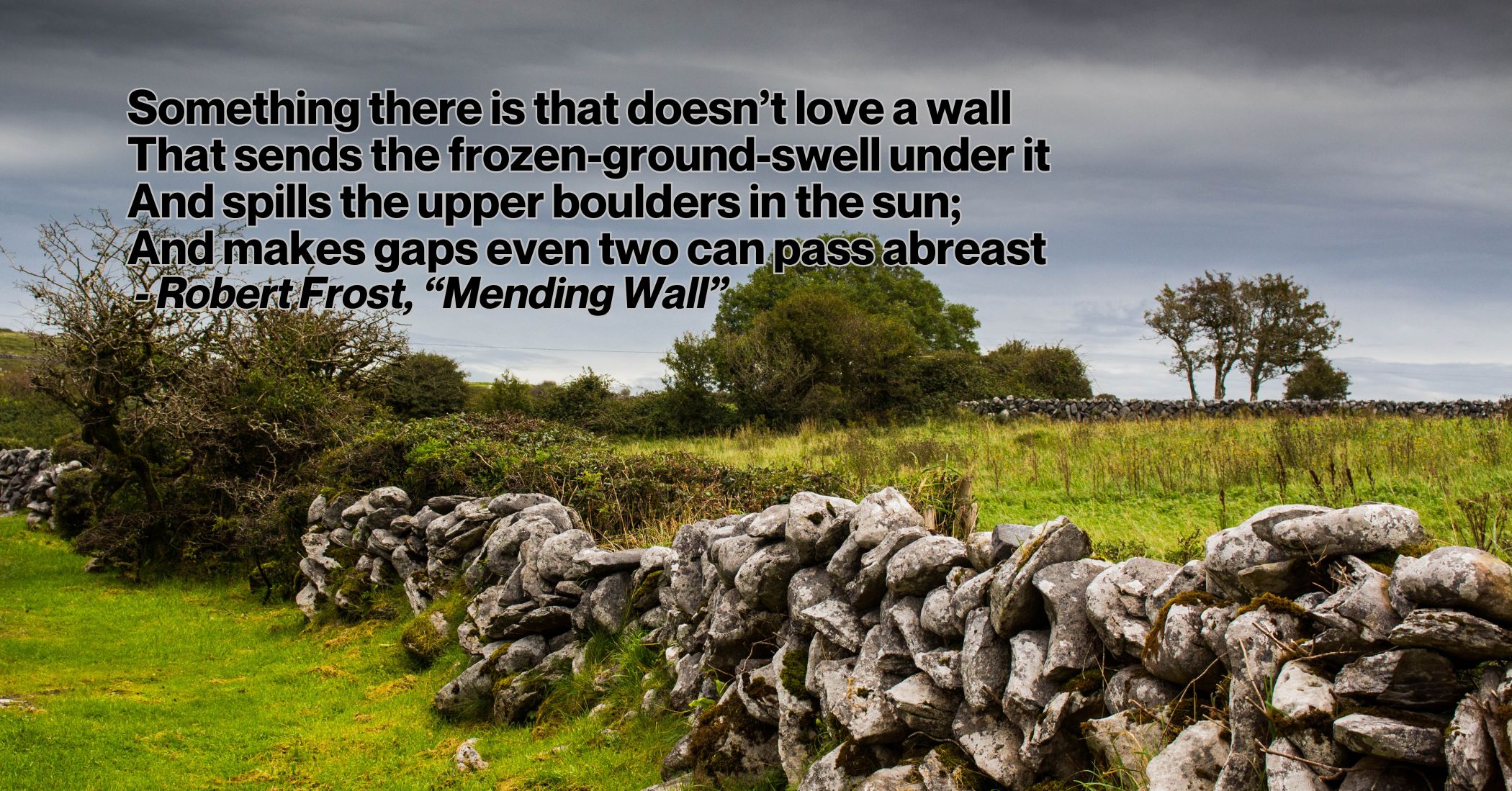
Instead, we talk about border security instead of the land of opportunity. We talk about building a wall instead of how we can help those on the other side of it. It reminds me of Robert Frost’s famous poem, “Mending Wall” in which he writes, “Something there is that doesn’t love a wall, / That sends the frozen ground swell under it / And spills the upper boulders in the sun; / And makes gaps even two can pass abreast…” I think that something is God. God is that something that doesn’t love a wall. God created us for community anot for isolation. More than that, God created us to love our neighbor as an example of our love for God. It’s God that doesn’t love a wall. And yet we build them anyways. Sometimes literally. Funny thing. Did you know that there are between 65,000 and 75,000 illegal Canadian immigrants, too?[6] But nobody talks about them. Over a million Canadian nationals are living in the United States right now. But no one is talking about building a wall to the North. We need to consider whether our objections are really about security or about something else much more sinister that is brewing inside.
Nearly every race that has immigrated to America has experienced this prejudice.
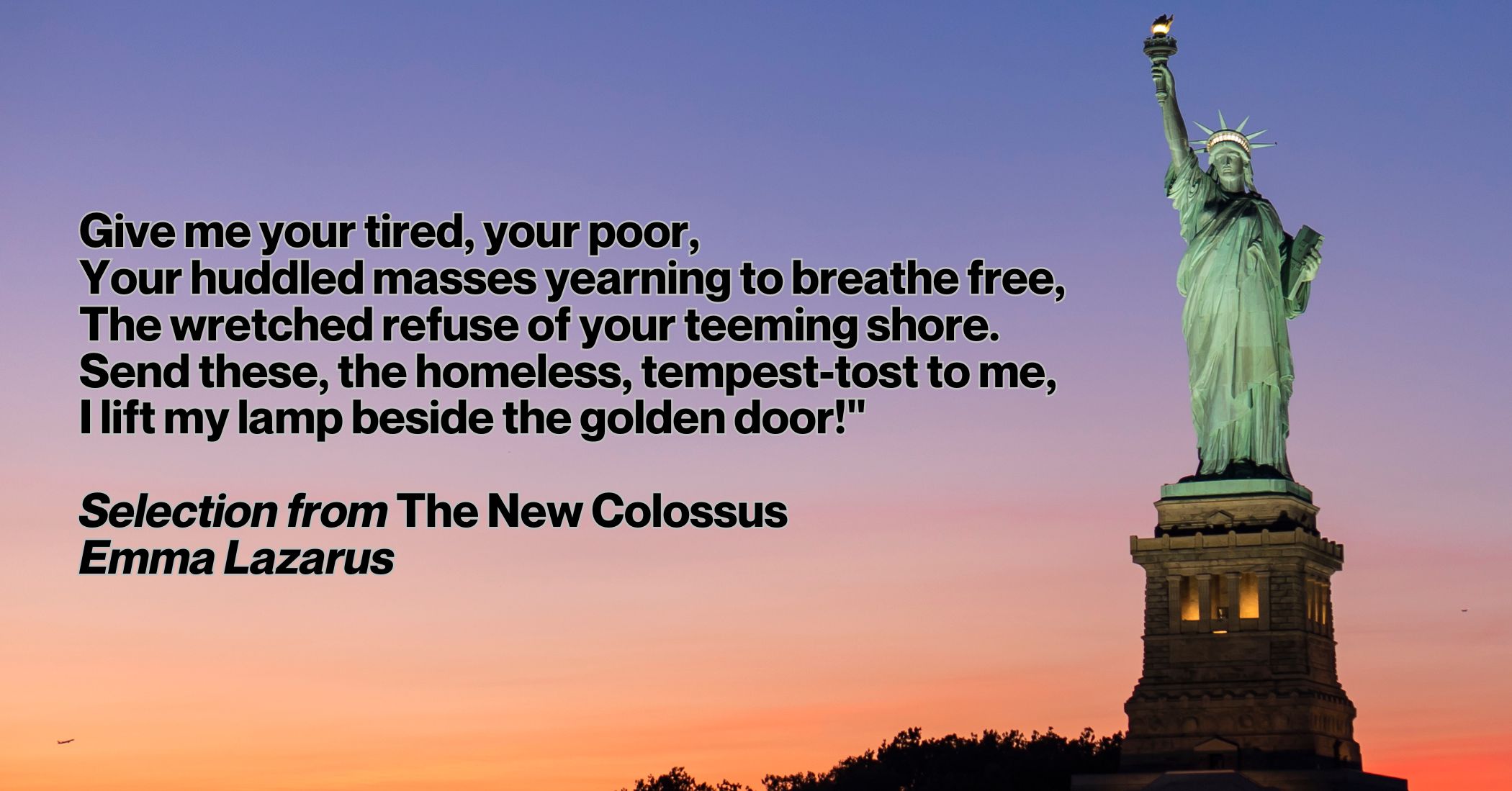
So why haven’t we yet learned from our mistakes? People we happily accept into American society had at one time been shunned like all the rest. While we focus today on immigrants from Mexico and other Latin American countries, the focus used to be on the Japanese and the Chinese and the Germans and the Italians and the Polish and…you get the idea. And with every group of new immigrants irrational cries of stealing jobs and committing crimes were raised as unfounded then as they are now. And let’s not forget the Native Americans rounded up into reservations or African Americans brought over as slaves. Is this the same country that claims to stand for Christians values? Is it the same country that has inscribed on the Statue of Liberty, “Give me your tired, your poor, / Your huddle masses yearning to breathe free?” When I served my first church in tiny Washington, GA, we lived in the parsonage on weekends because it was a three-hour drive one way to get there. And in our heavily Christian neighborhood, we had a neighbor who had on his lawn in the middle or rural Georgia a wooden A-frame sign that read, “Mexicans go home.” The only Mexicans in town by the way were the ones that operated the one Mexican restaurant. Was Mexican immigration an issue in this small rural Georgia town? No. But at least one family decided to lash out anyway. It made me so sad. As Thomas Paine wrote, “These are the times that try men’s souls.”[7] It is not in the times of sunshine and daisies we have to test our beliefs, but in the times of shadow and night. It is when it is darkest that we are truly tested as to the mettle of our beliefs. And if we give in to fear now when the world needs us most to be a bastion for hospitality and love, then what good are we as Christians? Can we be the type of neighbor that our childhood friend Mr. Rogers would be proud of? Let us embrace that spirit of love and hospitality that Fred Rogers shared to the children of the world. Won’t you be my neighbor?
[1] https://news.stanford.edu/stories/2022/06/overturning-immigration-myths
[2] https://www.bushcenter.org/catalyst/immigration/collins-immigration-myths
[3] https://www.washingtonpost.com/politics/2024/02/29/truth-about-illegal-immigration-crime/
[4] https://www.npr.org/2024/03/08/1237103158/immigrants-are-less-likely-to-commit-crimes-than-us-born-americans-studies-find
[5] https://www.pewresearch.org/short-reads/2024/07/22/key-findings-about-us-immigrants/
[6] https://en.wikipedia.org/wiki/Canadian_diaspora
[7] http://www.ushistory.org/paine/crisis/c-01.htm
 Craig's Corner