
Spiritual But Not Religious
I don’t always like to tell people what I do for a living.
I’m not embarrassed. I have one of the greatest jobs in the world. The only way it could get better is to be appointed to Disneyland UMC. But people act differently around a pastor. And it’s not a question you can avoid. When two people meet, one of the first questions they ask is, “So what do you do?” I can’t LIE! It’s in the pastor rulebook. But you can almost FEEL the flow of conversation take a sharp right turn when you say, “I’m a pastor.” Suddenly, they stand up straighter and talk more carefully. I hear the word “sorry” a lot. Either for a swear word they just used or an apology for not coming to church for so long. It’s like they think I’m going to rat them out to God. “Gotta keep an eye on Jane over here, Lord. She doesn’t go to church.” Here’s a hint. He already knows. He doesn’t need me to tell him. Then I hear the reasons why they’ve missed every Sunday since their graduation, and it runs the gamut of excuses from “I usually have to work on Sundays” to “It’s the only day off I get all week.” I understand the “work on Sundays” reason because I used to also (I guess I still do but it’s different now). As for the other excuse, I guess people feel if it’s your only day off you shouldn’t have to spend it with Jesus.

And they’re right. No one should HAVE to go to church.
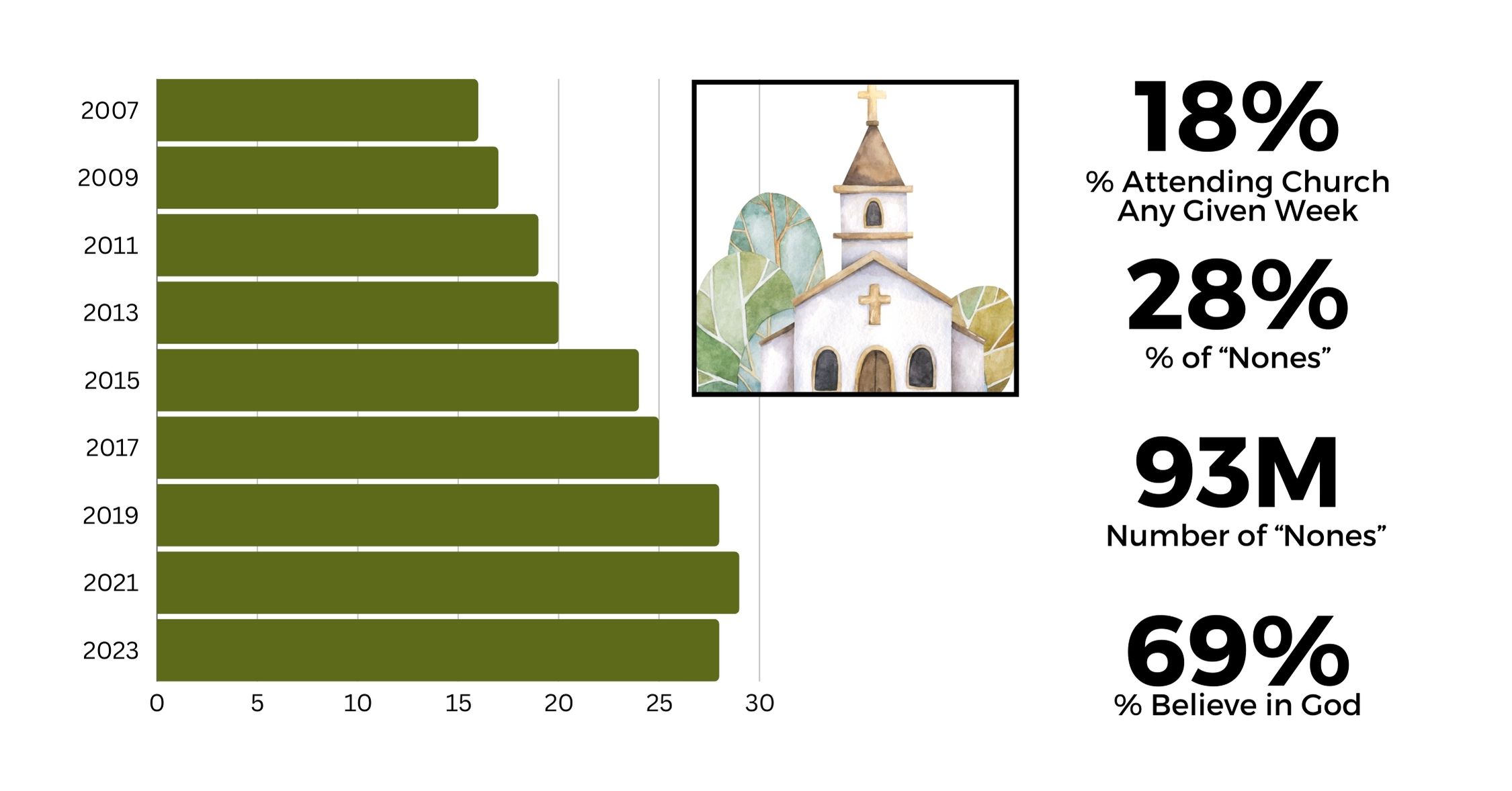
We hope instead it’s something they look forward to. That coming to church is about rejuvenation, instead of something that drains you. Too many people see church as a chore or an obligation instead of a joy. Which is why fewer and fewer people are coming. As of 2018, only about 18% of Americans attend church on any given week so that number is likely even smaller now.[1] But the problem is deeper than that. Not only do they not attend church, they don’t even belong to a church any more. More and more people are considering themselves “religiously unaffiliated,” meaning they don’t identify with any particular religion or denomination. From 2007 to 2024, that number has gone up significantly from about 16% to 28%.[2] The Pew Research Group calls this phenomenon the “rise of the nones.”[3] That’s because when asked what religion this group ascribes to, they answer “none.” That 28% represents about 93 million people. 93 million “nones.” Interestingly, though about 69% of them say they believe in God. 69%![4] You might think with that many “nones” we would be looking at the growth of a new atheism or more agnostics, but most of them still believe in God. Instead, they call themselves “spiritual but not religious.” But why?
The reasons they are “spiritual but not religious” come in a wide-range of answers.
Almost all of them have to do with the church letting people down. Whether it’s hypocrisy, exclusion, being judgmental, too political, or whatever other reason, they perceive the church as a barrier to faith instead of a path to faith. In our own area, 62.6% of our neighbors believe people in the church do not behave as Jesus would behave and that number increased dramatically over a four-year period, more than any other measurement[5] And they aren’t wrong. We don’t behave as Jesus would. But should anyone expect us to? Maybe there is a failure to understand exactly what the church is and why we exist. Our neighbors also think belief in Jesus does not require participation in a church. It’s the #1 thing they believe. More than Jesus’ divinity. More than his resurrection. More than he was the Messiah. But that again just shows a failure to understand why the church exists. And that’s not on society. That’s on us. We have not shown why the community of believers that Christ thought was so important is still important today. Let’s listen to the words of the apostle John. If you have your Bibles or a Bible app on your phone, please go to John 21:15. John 21:15. We’ll be sharing from the Gospel in just a minute. Now, Jesus created the church through Peter. Peter, the exceptionally flawed guy who pulled out a sword when Jesus wanted peace. Peter, the guy who denied Christ three times after swearing he would never deny Christ. It was this Peter that Jesus centered the church. In Matthew 16:18, Jesus says to Peter, “And I tell you that you are Peter, and on this rock I will build my church, and the gates of Hades will not overcome it.” We might just want to ask, “Really, Jesus? With this guy in charge?” But God didn’t make a mistake. For all of Peter’s faults, Peter understood and knew who Jesus was. When Jesus asked the disciples who they thought he was, it was only Peter who said, “You are the Messiah, the Son of the Living God.” Then later, after Jesus is resurrected and appears to the disciples while they are fishing, it is only Peter who jumps out of the boat and runs to Jesus. And it is to Peter that Jesus asks the famous three questions and we will share that together this morning. If you want to follow along, we’ll be reading from John 21:15-17. Hear now the Word of God.
15 When they had finished eating, Jesus said to Simon Peter, “Simon son of John, do you love me more than these?”
“Yes, Lord,” he said, “you know that I love you.”
Jesus said, “Feed my lambs.”
16 Again Jesus said, “Simon son of John, do you love me?”
He answered, “Yes, Lord, you know that I love you.”
Jesus said, “Take care of my sheep.”
17 The third time he said to him, “Simon son of John, do you love me?”
Peter was hurt because Jesus asked him the third time, “Do you love me?” He said, “Lord, you know all things; you know that I love you.”
Jesus said, “Feed my sheep…” – John 21:15-17
Three times, Jesus asks, “Do you love me?”
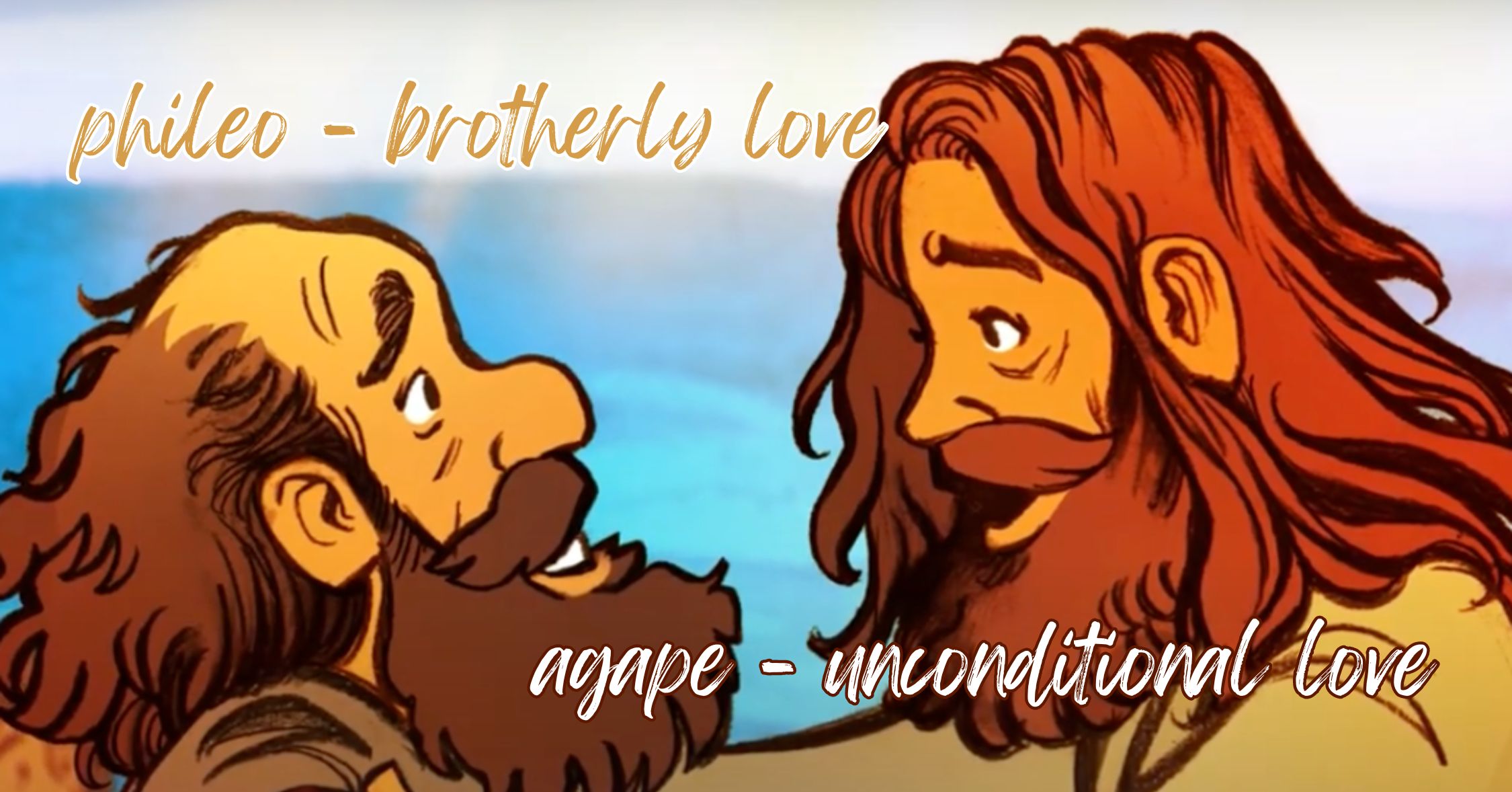
And three times Peter answers, “You know that I love you.” At first glance, you might think “Why is Jesus pestering Peter by asking him the same question over and over? Is he rubbing it in because Peter denied him three times?” But this is when it matters that you know a little Greek (or at least read a really good concordance). Jesus uses a different word for love the first two times. When he asks Peter the question, “Do you love me?” he uses the Greek word agape, an unconditional love – a love deeper than any other kind, but Peter responds each time by using the Greek phileo meaning more of a friendship or brotherly love.[6] They both are saying “love” but with completely different meaning. It must be so disheartening for Jesus that Peter can’t even SAY he has agape love for him, so the third time Jesus asks, he stops using the word agape and instead comes down to Peter’s level and uses the word phileo and Peter is hurt by this. Why? I don’t know. What did Peter expect? He asked you two times in a row Peter! If you didn’t know the difference in translation of the word for “love” you might think Peter was hurt because Jesus had to ask him three times, but instead we know it’s because Jesus came down to his level. Peter is hurt not because of Jesus but from his own inability to love the way Christ loved him. Still, Christ builds the church with Peter as its foundation because Peter is fallible but willing.
That’s what it means to be the church.
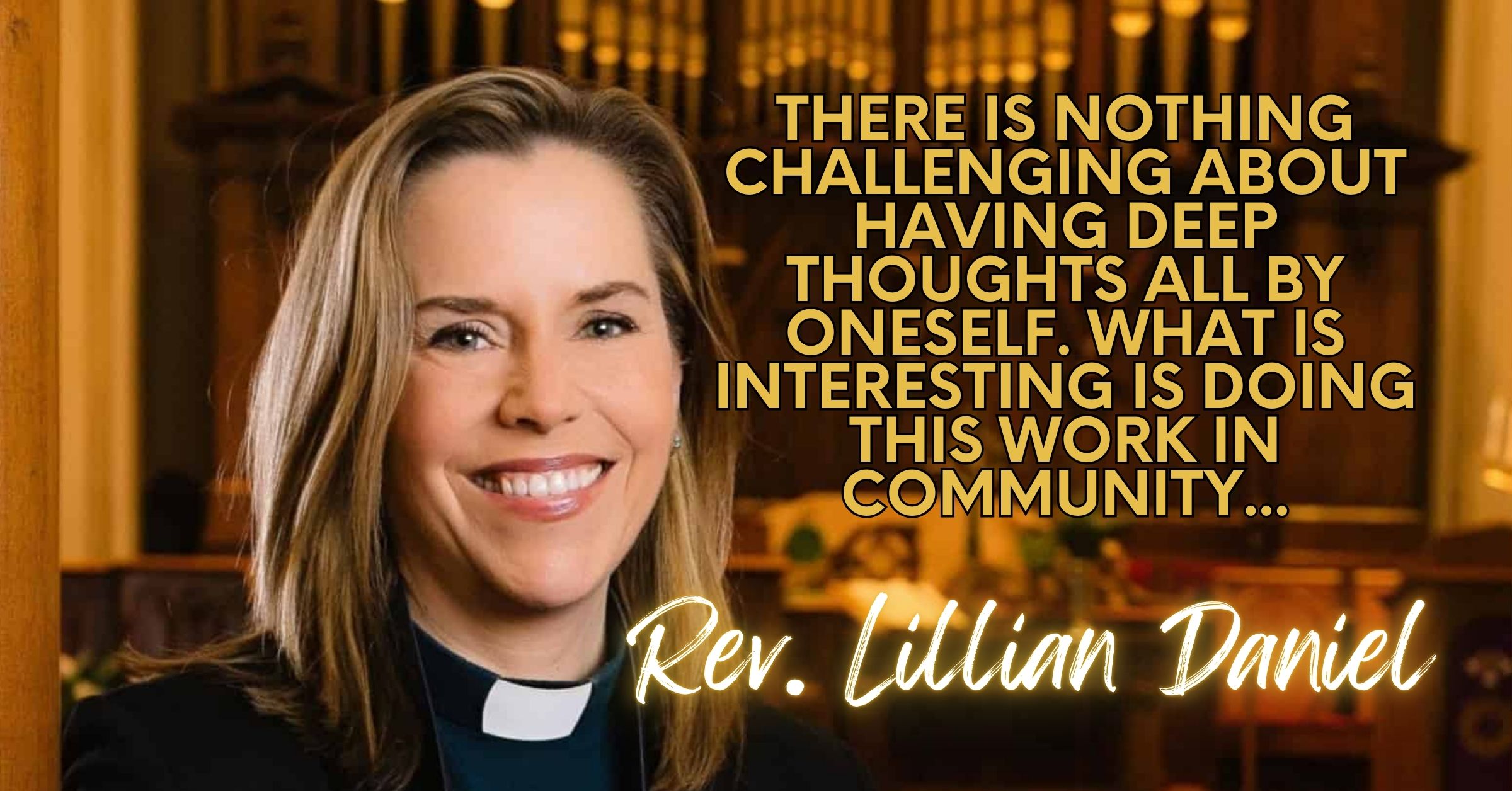
To be fallible but willing. Willing to stick it out. Willing to work on making things better. Willing to grow in our faith. We might mess up. We probably will make mistakes. But if we keep God at the center of our lives and our community we can help to grow the Kingdom of God. People who say they are “spiritual but not religious” are often saying they don’t need anyone else to know God. But some of the most meaningful experiences we will ever have with God come from being part of a community working together to grow in faith and to reach out to the world. Pastor Lillian Daniel said it very well when she said, “There is nothing challenging about having deep thoughts all by oneself. What is interesting is doing this work in community, where other people might call you on stuff, or heaven forbid, disagree with you. Where life with God gets rich and provocative is when you dig deeply into a tradition that you did not invent all for yourself.”[7]
Honestly, I used to think I didn’t need the church.
I completely understand the “spiritual but not religious” attitude because it used to be mine. But I’ve learned that despite all of its faults, people do need the church. Not as an afterthought. Not as a “backup plan.” But we need to be engaged in the life of the church on a regular basis. It helps us to grow deeper in our own faith and gives us opportunities that only come from working together. And there is a comfort and a strength from being in community. When push comes to shove, when a person has their faith truly tested, it isn’t the sunset that’s going to comfort them. It isn’t the beach that’s going to bring them egg rolls. And it isn’t the forest that will pray for them and hold their hand. It’s going to be real people who love God. We are not perfect. We will make mistakes. And to expect anything different is to expect something unrealistic. But Jesus knew what he was doing when he built the church upon the rock of St. Peter. Jesus knew this fallible human being would give us hope that despite our faults, Jesus believes in us. God also knows how much we need one another, and it is for that reason we need the church. Not this building or these chairs or the altar, but the church, the body of Christ. And while the “spiritual but not religious” people are missing out on something wonderful, WE have to do a better job of showing them why. Please consider who you might invite to join us on this journey together. Make it a goal to ask someone to worship or to our upcoming Trick or Treat potluck or to Cookies and Carols. Because honestly, we all need Christ in our lives and we together we are the body of Christ. In the name of the Father and of the Son and of the Holy Spirit. Amen.
[1] https://churchleaders.com/pastors/pastor-articles/139575-7-startling-facts-an-up-close-look-at-church-attendance-in-america.html Gallup shows this number at least double but the reason that isn’t a valid number is because it’s self-reported. When studying actual attendance, ChurchLeaders.com has it right. The Halo Effect creates this false self-reporting and the numbers are much lower. I think that’s evident by the number of people you know who are definitely not in church.
[2] https://www.pewresearch.org/religion/2024/01/24/religious-nones-in-america-who-they-are-and-what-they-believe/
[3] https://www.pewforum.org/2012/10/09/nones-on-the-rise/
[4] https://www.pewresearch.org/religion/2024/01/24/religious-nones-in-america-who-they-are-and-what-they-believe/
[5] MissionInsite report for the Evergreen Valley area 2.5 miles from our church. The numbers changed from 2017 to 2021 from 28.2% to 62.6% in just four years. The number who disagreed dropped from 20.7% to 9.7%.
[6] http://www.gotquestions.org/Jesus-Peter-do-you-love-me.html
[7] http://www.ucc.org/feed-your-spirit/daily-devotional/spiritual-but-not-religious.html
 Craig's Corner