
Do No Harm: The First Rule
Primum non nocere.
That’s a Latin phrase meaning, “First, do no harm.” Every medical professional in the world is familiar with that tenet, so it’s kind of weird it is also the first rule of Methodism. Or is it? Maybe it’s the most important rule of all. Our sermon series this month is going to explore the three General Rules of Methodism and why they are so important to us. If you ask most people they likely don’t know these rules, but it is an important part of our history and the foundation of our beliefs as a church. Once in a while, it’s a good idea to remind ourselves what we believe in, why we are gathering, and what it’s all about. With that in mind, let’s open our Bibles or Bible apps to Matthew 26:47-54. Now this passage takes place right after Jesus was praying in the Garden of Gethsemane and after the Last Supper. We’re nearing the time of Jesus’ death on the cross. He’s about to be betrayed by one of those closest to him, a man who sold him out for money. Judas has arranged for Jesus’ capture by an angry mob and as these events play out, pay close attention to what Jesus does. Hear now the Word of God.
47 While he was still speaking, Judas, one of the Twelve, arrived. With him was a large crowd armed with swords and clubs, sent from the chief priests and the elders of the people. 48 Now the betrayer had arranged a signal with them: “The one I kiss is the man; arrest him.” 49 Going at once to Jesus, Judas said, “Greetings, Rabbi!” and kissed him.
50 Jesus replied, “Do what you came for, friend.”
Then the men stepped forward, seized Jesus and arrested him. 51 With that, one of Jesus’ companions reached for his sword, drew it out and struck the servant of the high priest, cutting off his ear.
52 “Put your sword back in its place,” Jesus said to him, “for all who draw the sword will die by the sword. 53 Do you think I cannot call on my Father, and he will at once put at my disposal more than twelve legions of angels? 54 But how then would the Scriptures be fulfilled that say it must happen in this way?”
The Word of God for the people of God and the people said, “Thanks be to God.” Please be seated.
When we think of great leaders who preached about non-violent social change, some amazing people come to mind like Dr. Martin Luther King and Mahatma Ghandi.
Although one was a Baptist minister and one was a Hindu lawyer, both found inspiration in the life and work of Jesus Christ. Jesus taught and lived the principles of non-violence as we read about in this passage. Even though he knows, HE KNOWS, he is about to be taken to his death, he stops Peter from defending him and says, “…for all who draw the sword will die by the sword.” In this one moment, Jesus makes crystal clear that the people of God must live by higher ideals. As he taught the disciples elsewhere, it isn’t enough to offer an eye for an eye, you have to go beyond that. You have to turn the other cheek. When you offer forgiveness, it isn’t just once or twice, but seventy times seven times! Because if we are really going to be the people of God, if we are going to show the love of Christ to a hurting world, we have to be the first ones to offer forgiveness. We have to be the first ones to come to the table. We have to be the first ones to show there is a better way. We must resist the temptation to return tit for tat, violence for violence because that is the trap that leads us away from God.
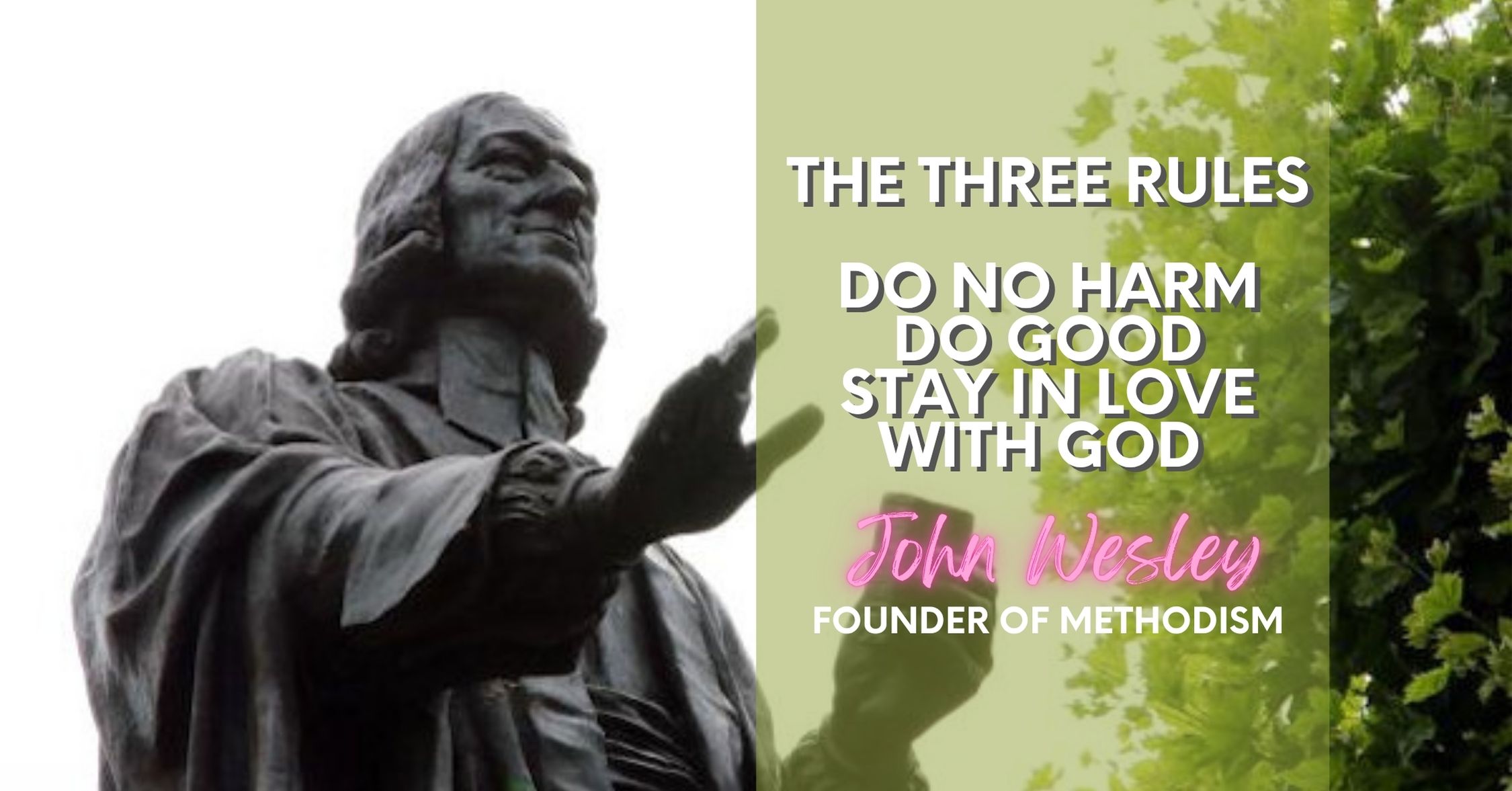
The foundation of the United Methodist Church is found in three simple rules.
Do no harm, do good, and attend upon all the ordinances of God. Bishop Reuben Job summarized it in his book this way, “Do no harm, do good, and stay in love with God.”[1] When John Wesley formed the first Methodist small groups (or “classes” as he called them), this was how they agreed to live; do no harm, do good, and stay in love with God. It sounds simplistic because it is, but it’s still hard to do. That’s why these small groups would meet every week, to help keep each other accountable; to remind each other of their promise to live this kind of life. Because even though in our heads we know what we SHOULD do, it’s not always what we DO. We are not immune to the impulses of human nature. We can call this one of the first 12 step programs because these classes were meant to help us against the temptations we all struggle with.[2] As we explore what Wesley meant by “do no harm,” we come to understand that he meant more than we shouldn’t kick puppies (who would do that?!). Wesley wants us to consider the broader implications of what that means.

“Do no harm” is a broader idea than most of us really consider.
Wesley wanted to make it clear, so he explained in some detail exactly what he meant. When he wrote the General Rules for those small group classes, he included things you would expect. No fighting, no quarreling, no brawling. I’m not sure why John felt the need to call out brawling separate from fighting, but he did. And then he put in other stuff. No getting drunk. No suing your brother. No cheating the system. No working on the Sabbath. Mostly stuff you and I would agree with. My favorite, of course, is not saying anything bad about your pastor. Seriously. He put that in there. Then he added stuff to the list we might not immediately think of as “doing harm” – wearing gold or fancy clothes, needless self-indulgence (I guess as opposed to self-indulgence we need), and singing songs which do not tend to the knowledge and love of God.[3] Does that mean no more Sabrina Carpenter songs? We could argue about some of these all day, but that would be missing the point. Wesley was trying to challenge us to go beyond thinking of harm as something physical and force us to take a step back and think, “Am I doing something to hurt someone else?” Sometimes that hurt can be completely unintentional.
At one of the churches I used to serve, they had a very strong youth group.
These kids would come to church every week because they looked forward to spending time with one another and felt really connected by how long they’d been growing up in church. But as you can imagine, when a group gets that tight, it’s hard for a newcomer to feel like they belong unless the group is intentional about being inclusive and reaching out to them. And while all of these kids had good intentions, they unintentionally left some kids behind, and those kids quietly left the church. When I became pastor, one of the moms came up to me and told me about her daughter who was one of those kids. She told me how alone and isolated it made her daughter feel to never really be included. Her daughter wasn’t asked to help or invited to be part of the group. She wasn’t often invited to be involved in their activities. She told me how her daughter tried to fit in, but just couldn’t crack that shell. And how eventually she told her mom she needed to find another church. As a fellow parent, that made me so sad. Of all places, you would think a church would be the one place where everyone was welcome, but that isn’t always true. These kids weren’t intentionally mean, just thoughtless as we all can be from time to time. We can become so focused on ourselves that we neglect to see what should have been obvious and unintentionally cause other people harm. Everyone does this. Kids and adults alike. The trick is to be mindful in what you do and what you say. Train yourself to consider others and not just yourself. We can avoid a great deal of the world’s problems if we learn to have an eye beyond what we want and what we like.

Be thoughtful.
I think that’s it in a nutshell. Be thoughtful. Consider others before yourself. Think about how your actions AND your words will hurt others. Take time to pause before uttering something painful. Maybe the person you’re talking to said something hurtful or painful or plain stupid and you are so tempted to lash out, but consider before speaking, because the other person probably didn’t. I’ve found in my own life and in the experiences of others, that when people say hurtful things, it’s rarely with careful planning that they do it. Usually, they react because they are angry, mad, or hurt. And we can probably all agree you’re not likely to say something wise or sage in that moment. Sometimes, stepping back from a situation and taking two seconds before reacting is the best possible medicine. I’ve never forgotten the advice Emma gave me one day. I was upset about something and Emma looked at me and said, “Daddy, my teacher told me that when we’re upset we should take three deep breaths and count to ten.” Of course I followed her advice, and by golly it worked. Will that solve every problem? No. I’m sure it won’t. But it probably will avoid a good many more. Of course, there will be times when harm seems inevitable. But in those instances, wouldn’t it be best to be thoughtful – to be intentional about how to do the least amount of harm? I was thinking about the Hippocratic Oath and how part of it is to always remember “warmth, sympathy, and understanding may outweigh the surgeon’s knife or the chemist’s drug.” Sometimes we need those things more than anything else: warmth, sympathy, and understanding. Consider others before yourself and we can turn the world into the kind of place God would be proud of. Primum non nocere. First, do no harm. In the name of the Father and of the Son and of the Holy Spirit. Amen.
[1] As he summarized in his book Three Simple Rules.
[2] https://www.hazeldenbettyford.org/articles/twelve-steps-of-alcoholics-anonymous The 12-step program for AA started in 1935 and was based on religious principles even though today those principles have been broadened to appeal to more people.
[3] https://www.umc.org/en/content/the-general-rules-of-the-methodist-church
 Craig's Corner