
Stay In Love With God: The Third Rule

3.05 seconds.
That’s the world record. Xuanyi Geng from China solved it in 3.05 seconds.[1] At my very best, I could do it in 30 seconds and that’s when I was in junior high. Today, I’m lucky to solve a Rubik’s Cube in 3 minutes let alone 30 seconds. But the world record holder was nearly TEN times faster than me at my best with 3.057 seconds. And he’s only 8 years old. They hold puzzle solving competitions worldwide in every size of cube including solving it one-handed and blindfolded! Can you imagine solving it blindfolded? But the classic is the 3×3. It’s the gold standard in cubing. What got me thinking about the Rubik’s Cube was this great film on Netflix called The Speed Cubers. It was about two guys – Feliks Zemdigs and Max Park – who at one time were each the very best at the 3×3. Felix broke the record ten times and was the first to get sub seven and sub six. When they asked him how he did it, he had one word, “Practice.”
Practice makes perfect.
That philosophy holds true no matter what you’re trying to do. In speedcubing, it also takes talent, skill, and a little bit of luck to break a world record, but overall talent and skill can only take you so far. Whether it’s the Rubik’s Cube or chemistry or basketball or playing music, you need to practice over and over to keep improving. Practice is what takes you over the top. And the same is true for our faith. In our passage this morning, Paul was writing to the church because he was worried they might drift away from their faith. It had happened before. You only have to read the story of Moses to see how Moses’ brother Aaron built an idol to false God while Moses was up on the mountain waiting to bring down the Ten Commandments. People drift away all the time and often it doesn’t take much. And Paul was understandably worried. After all, Christianity was in its infancy and they were still trying to figure everything out. False prophets were likely everywhere and it would have been especially hard for Paul to guide them from far away. They didn’t have ZOOM to gather together from afar, so Paul wrote this letter to encourage them and to offer them a way to stay grounded in their faith. This is what he shares with the church in our passage this morning.
6 So then, just as you received Christ Jesus as Lord, continue to live your lives in him, 7 rooted and built up in him, strengthened in the faith as you were taught, and overflowing with thankfulness.
8 See to it that no one takes you captive through hollow and deceptive philosophy, which depends on human tradition and the elemental spiritual forces of this world rather than on Christ. – Colossians 2: 6-8.

Sometimes it’s hard to believe how little we’ve changed.
Human beings that is. Paul had to battle the same concerns we do today and this topic is no different. He was worried people would drift away from Jesus and his teachings. That they would be “wowed” by something more appealing, something that fit their lifestyle better and would abandon everything they were taught. Again, not hard to believe considering we still do this today. We gravitate toward whatever new trend or philosophy lets us do what we want regardless of whether we should do it. We love to find ways to beat the system. We pride ourselves on it. Kind of like me and Weight Watchers. I had done really well on their traditional plan for a long time and lost about 30 or 40 pounds, but then they switched to this new Fat and Fiber Plan that said you could eat whatever you want as long as you stayed below a certain amount of fat per day and above a certain amount of fiber. They touted it as giving you more flexibility. And it did. In the waistline. Suddenly, I stopped losing weight. The old method was more restrictive, but that really worked for me. I limited myself better. I had one “cheat day” a week. But on this new plan, it was so easy to game the system. I would eat one bowl of refried beans which covered pretty much all my fiber and then ate an entire box of Snackwell cookies which had only 1g of fat – but a TON of sugar and calories. I found a way to game the system. Should I have known better? Of course. What nutrition plan ever would let you eat an entire box of cookies?
Paul had to deal with this basic human frailty.
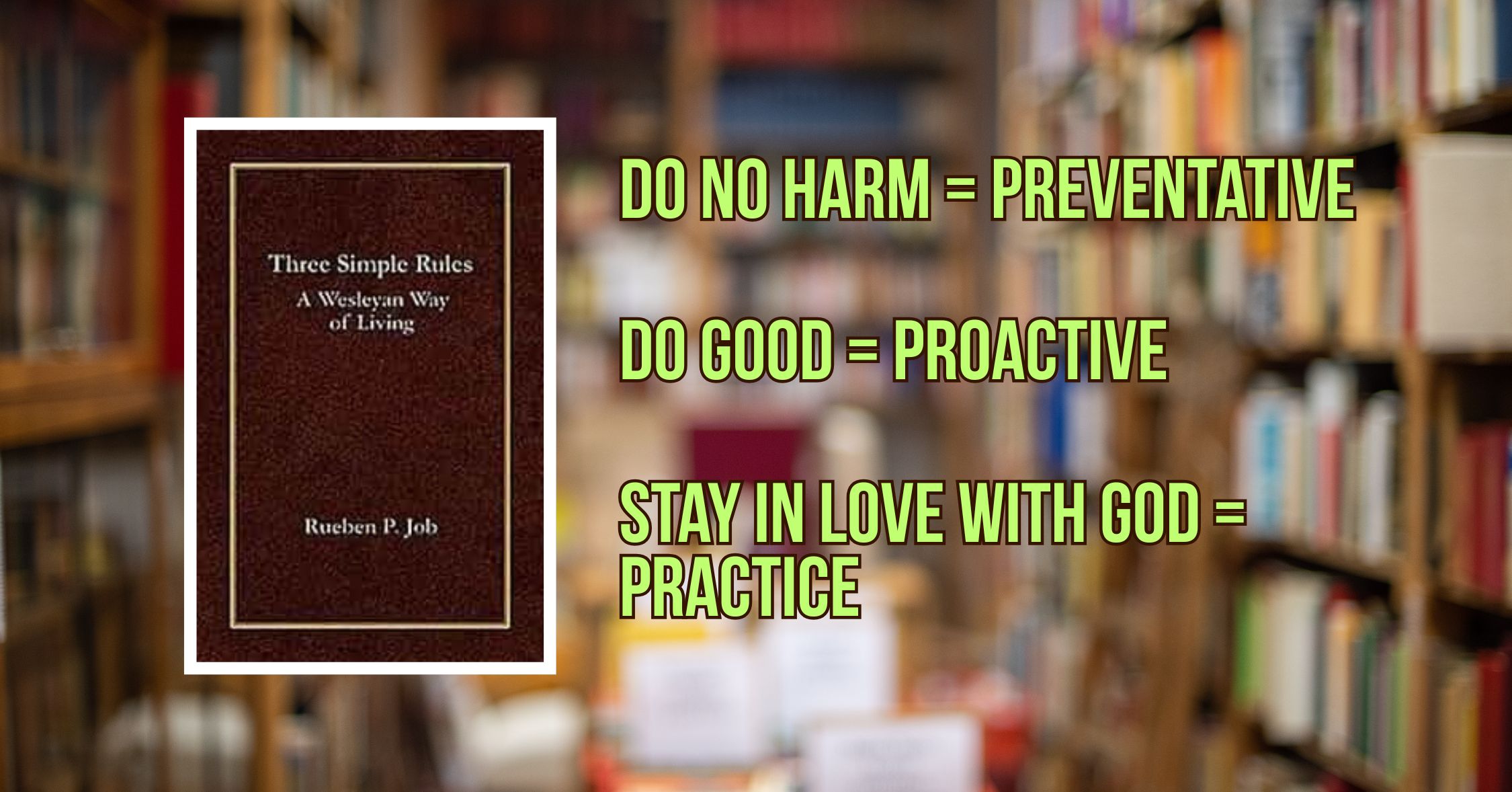
Finding ways to beat the system. Looking for loopholes instead of long-term benefits. Paul wasn’t there to help them in person, to guide them and remind them on a regular basis, so instead he did the only thing he could do. He encouraged them to remember the teachings, to be “rooted” in Christ, to build each other up and strengthen each other’s faith, to remind one another of the truths they had been taught and believed. In essence Paul was trying to teach them to “stay in love with God,” Wesley’s Third Rule. Do no harm, do good, and stay in love with God. For John Wesley, who taught these three rules as the foundation of Methodism, staying in love with God was vital to our faith. If “do no harm” is preventative and “do good” is proactive, then “staying in love with God” requires practice. Like Paul, John Wesley taught this same basic principle. To draw closer to Christ and to maintain your faith, John told those who became part of the Methodist societies they needed to regularly attend to all the ordinances of God. By that he meant they needed to do those everyday things, those regular things, over and over again to infuse God into their lives. That when God became an integral part of who we are, our faith would have a firm foundation. Wesley told them they needed to pray. They needed to read their Bibles. They needed to be in small groups together. They needed to take communion. They needed to go to worship. It’s those everyday routines Wesley felt were most important to keep us connected to God and to one another, and Paul in this passage stresses the same thing. Paul encourages the church to “continue to live your lives in him, rooted and built up in him, strengthened in the faith as you were taught, and overflowing with thankfulness.”
Science backs them up.
Their assumption that maintaining these patterns of behavior would help to make God a part of our everyday lives is true. In different studies, it has been shown that through consistency and repetition we can form new ways of doing things. But it takes time. You may have heard that it takes 21 days to form a new habit, but the truth is it takes much longer. Studies show it takes an average of 66 days.[2] 66 days and that’s just an average. It can take as long as 8 or 9 months. But it can be done. If you want to get in the habit of relying on God, if you want to learn to put your faith and trust in him, you have to make God a part of your everyday life. Things like praying and reading the Bible and going to worship need to be more than a chore but a way of life that you embrace and then it will take hold in you in a deep and meaningful way. And once you have this foundation at your core, you will be open to an even deeper relationship with God. One that opens you up to that “peace that passes all understanding” Paul promises we can have. Staying in love with God, or as Wesley put it, “attending to all the ordinances of God,” takes time but the investment is well worth it.
When I first started praying with others, I hated it.
Not because I didn’t think it was important and not because I didn’t think it was helpful. But because I felt so inadequate about it. It seemed everyone I knew could pray better than I could. But after my Walk to Emmaus, I joined a Day Four group and we’d meet once a week and took turns praying for each other. They were SO eloquent with their prayers. Thoughtful. Not the kind where they just repeat the word “Lord” 40 times in one sentence, but from the heart, sincere, deep prayer. By comparison, I felt my prayers were more along the lines of “God is great, God is good, thank you God for this food.” But they encouraged me regularly and gave me confidence as I kept working on it. And as I kept it up, I felt more comfortable. I was less self-conscious. I worried less about doing a “good” prayer and came to realize it’s not about how fancy my words were or how articulate I was or whether or not I repeated myself a dozen times. It was all about my heart for the Lord. That’s all God really cares about. And at least in that, I am confident. To do anything well takes practice. Like with the Rubik’s Cube, the more we work at it, the better we will be. In our marriages, in our work, as parents – even in our faith. Practice makes perfect.
[1] https://www.worldcubeassociation.org/results/records
[2] http://www.huffingtonpost.com/james-clear/forming-new-habits_b_5104807.html
 Craig's Corner