
Not One Stone on a Stone

“What are we talking about?”
In the film Moneyball, General Manager Billy Beane of the Oakland A’s is about to trade two of his better players to force manager Art Howe to finally play Scott Hatteberg at first base. It’s a move that would be hard to explain because to most people it doesn’t make any sense. Hatteberg is an unknown while they have a proven All-Star caliber player there already. Beane believes in the process he and his right-hand man Peter Brand have put together and wants to see it in action. But a move this drastic? Peter says to him, “What are you doing? This is the kind of move that gets you fired.” Billy looks at his friend and responds, “I don’t think we’re asking the right question. The question we should be asking is ‘Do you believe in this thing or not?’” Peter says, “Yes, I do.” So Billy asks, “Will we win more with Pena or Hatteberg at first base.” Peter pauses and says, “Theoretically? Hatteberg.” Beane looks at him, “Then what are we talking about?”
Change is risky.
Sometimes it doesn’t work. But when things already aren’t working the way we hope, change is often necessary. That doesn’t mean it isn’t hard. But if we hope to succeed, whether in baseball or in life, we need the courage, determination, and persistence to see it through. I love a good underdog film and especially an underdog sports film, and any movie about the Oakland A’s is automatically going to fall into both categories. Still, the reason I love this film so much is because it’s a reflection of exactly what we are going through in the church. Not just our church, but the state of the church across the country. And like Billy Beane, I believe we have to shake it up and do things differently.
Jesus tells us that one day the temple will fall.
He points to the temple buildings, and he says to Peter, John, James and the rest, “Do you see all these things? …Truly I tell you, not one stone here will be left on another; every one will be thrown down.” And the disciples immediately leap to the conclusion that he is talking about the end of the world. But I wonder if Jesus was talking about something completely different. Like most people today, the disciples equated the buildings with their faith. If the buildings fell, then it was a sign the people had lost their faith. But maybe… MAYBE it’s because faith has moved out of the building. And I think this is what Jesus always intended. If the goal of Christianity is to create a world where the love of Christ was evident in each and every person, we wouldn’t need a church building because everywhere we would experience the community of believers. In that kind of world, we wouldn’t need a place to gather on Sunday mornings because everywhere the presence of God would be felt and seen in one another. And you certainly wouldn’t need a pastor because the evidence of God would be part of your everyday life and so clear that you would feel immersed in your faith. I’ve told anyone who would listen that I would love it if I didn’t have a job any longer because it wasn’t needed. Then, I could devote myself to my other passions – travel, food, and Disney.
In some ways, I think we are already seeing this phenomenon.
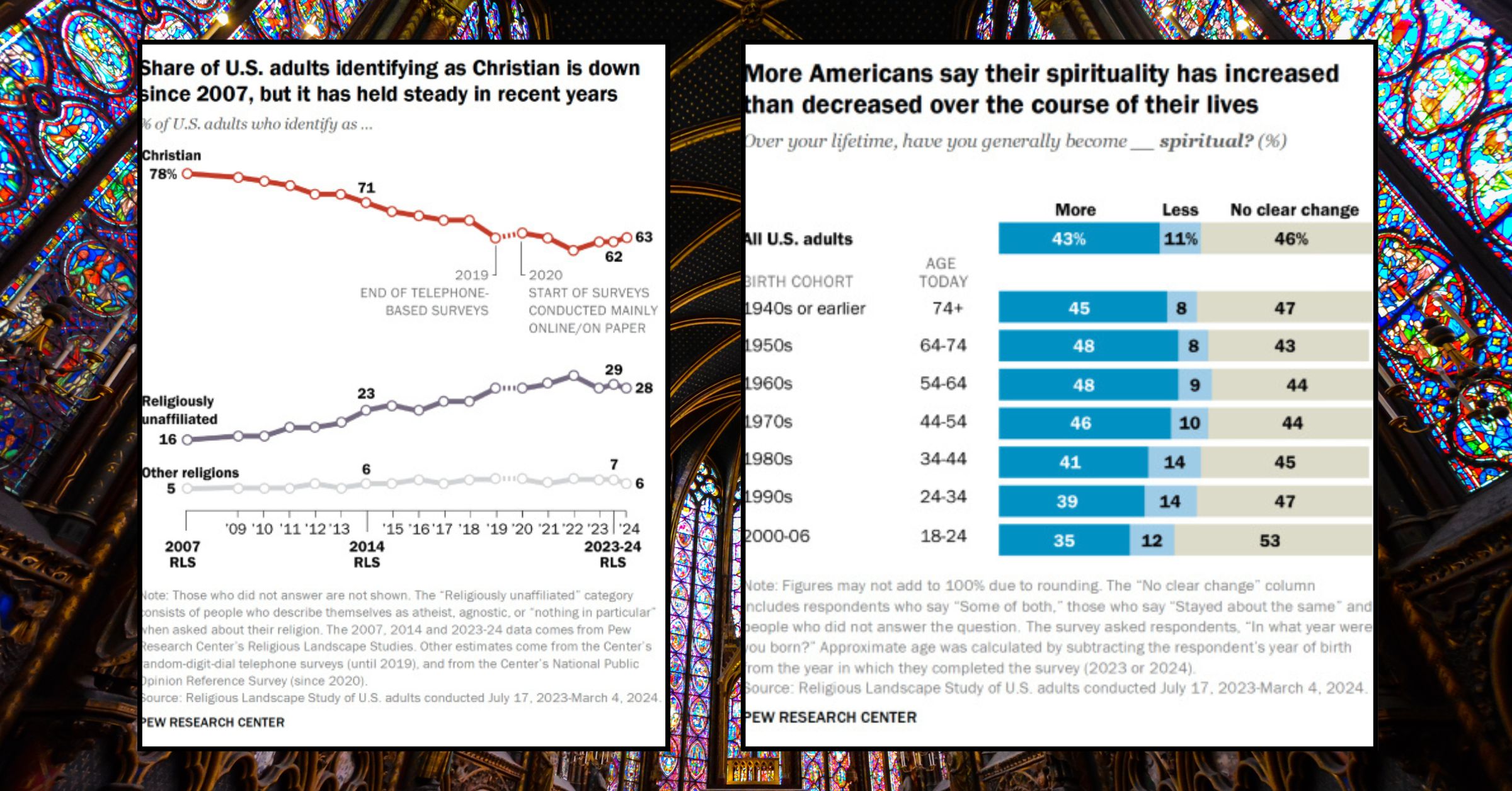
But not in the way Jesus would have hoped. People are leaving the building. But not because they have found Jesus and want to spread the Gospel. They’ve left because they don’t feel Jesus is in organized religion. Church attendance continues to be on the decline, and it doesn’t seem to be getting better. Yet, amazingly, people still consider themselves spiritual. About 7 in 10 fits in this category and 22% say they are “spiritual but not religious.”[1] 83% of all U.S. adults believe they have a soul; 81% believe there is something spiritual beyond the natural world; 74% believe there are some things science cannot possibly explain; and 38% report a connection with a loved one who passed away.[2] And still more and more people are distancing themselves from religion. Over a 16-year period from 2007 to 2023, the number of religiously unaffiliated rose from 16% to 28%.[3] In our own community we see these trends, too. 63.8% of people in our area do not believe you need to be in church to believe in Jesus up from 42.7% just four years before, and to go along with that 62.6% believe that the people in the church do not behave as Jesus would an increase by a whopping 34.4%. At the same time, the number of people who say that faith is very significant in their life has gone up by nearly 15%. And most people in the study believe that God is love and they have a personal relationship with one living God. So, while more people feel that church is increasingly unnecessary, they also feel closer to God.[4]
As most of you know, I’m studying to get my doctorate in ministry.
I wanted to get my doctorate specifically from Emory University because their program focuses on the local church. I’m not just studying theory. The goal of the program is to put theory into practice with the idea that we would come out with a doctorate AND a way to make an impact on our church and community. My focus is on growing the church…but maybe not in the way you might think. In the nearly 20 years I’ve been in ministry, one thought has become crystal clear. The church of today is NOT the church of tomorrow. People are connecting to themselves and to God in different ways. They are not interested in sitting in a building for an hour and listening to someone tell them about God. They want to experience God. Maybe that’s in serving the community. Maybe it’s in a small group. Maybe it’s volunteering at a hospital. But they want to belong to a movement, not a lecture series. Circles not rows.
It’s a cliché thing to say, but it’s true.
I first heard this phrase from Andy Stanley at North Point Community Church in Atlanta, GA. It’s funny because the average worship attendance at North Point is upwards of 30,000 weekly and they most certainly sit in rows.[5] But Andy stresses the idea that “circles are better than rows.” He said, “We are famous for our rows. But the strength of our churches is what happens in circles.”[6] And it’s true. At least it is for me. My most transformative moments in faith took place in small groups. From the time I went to a Men’s Group meeting at Alpharetta First and talked to Steve, to the time we met in small groups during our Walk to Emmaus retreat, to the times I spent with our Sunday School group when Emma was born; those were the moments where it felt I encountered Jesus so clearly. The church made that happen, but it was in small groups and quiet moments where I felt the impact of Jesus’ love the most.
There’s something powerful about a table.
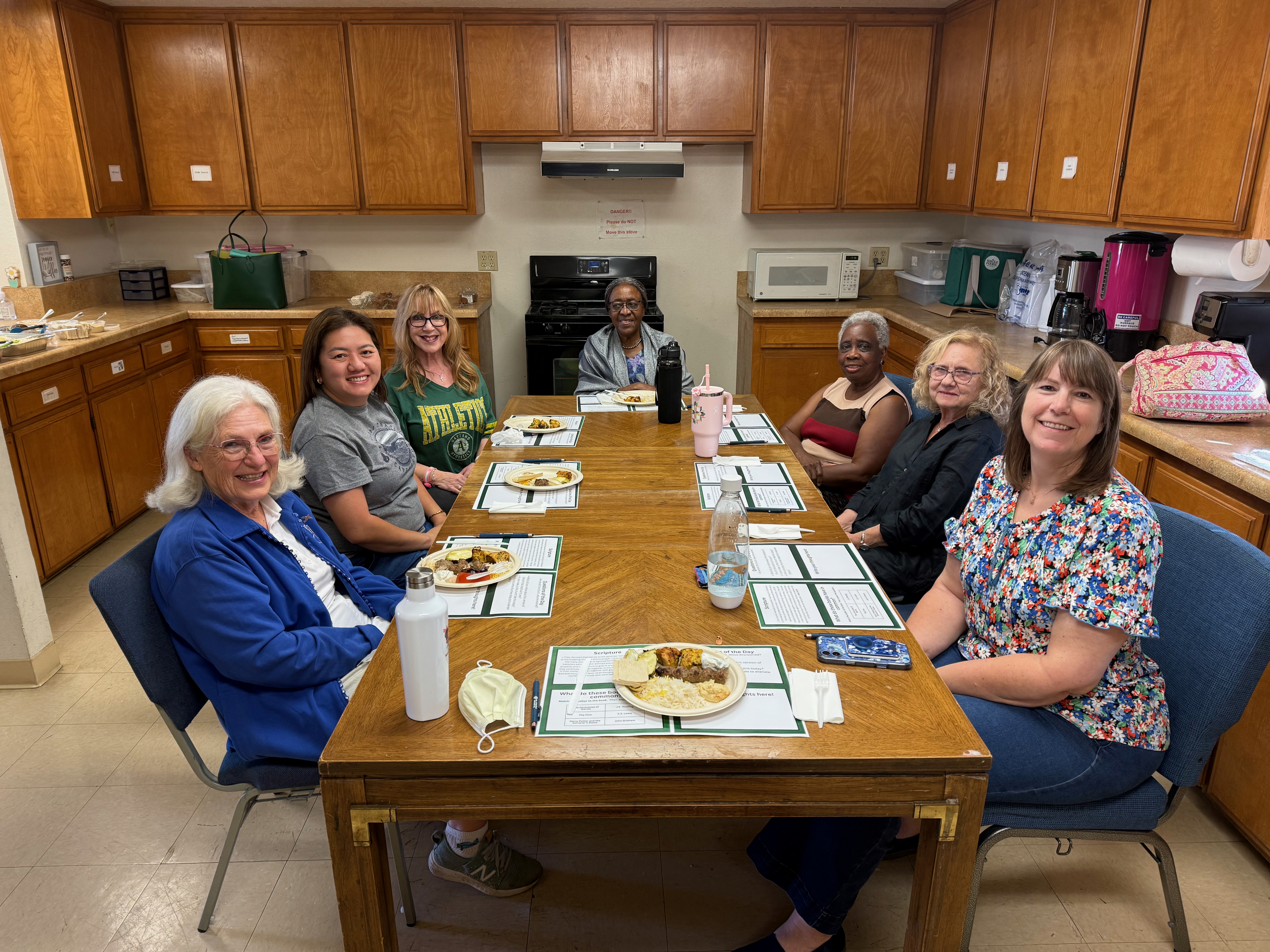
It’s a connection point. It’s a gathering place. It’s where we find sustenance. Tables bring people together in a variety of ways. In church, we come to the table once a month to encounter Jesus. But we develop relationships over a table in so many different places and in so many different ways. After a year of study, consulting with my colleagues, friends, and professors, we’re going to try something different and beginning next year, we are going to launch Faith Dinners. These dinners are aimed at people outside the church. They are completely free to anyone who participates. There will be a very short message but most of the time it will involve people sitting at a table, enjoying a meal and talking about faith. We will have a topic of the day printed on placemats we create each month, and our table leaders will engage these groups in conversation in the hopes we build deeper relationships with those who join us each month. My family and I will donate the money to cover the food each month so it will be a minimal cost to the church. Mostly just space and utilities. At the end of the year, we will evaluate how effective our faith dinners have been, and I’ll write that up as the final project for my doctorate, and of course, I’ll share the results with all of you. We had our first Faith Dinner with just our table leaders last Sunday and every month we will take turns leading the discussion, getting feedback and preparing for our launch next year. We will invite all of you for a dress rehearsal so you can see what it’s all about and I hope it will encourage you to want to take part, either by inviting people to a Faith Dinner, donating toward our effort, or becoming a table leader yourself. But most of all, I hope you keep this effort in your prayers that we might make a difference in our community and lead people to Christ in a new way.
Church hasn’t been working the way we want it to for some time.
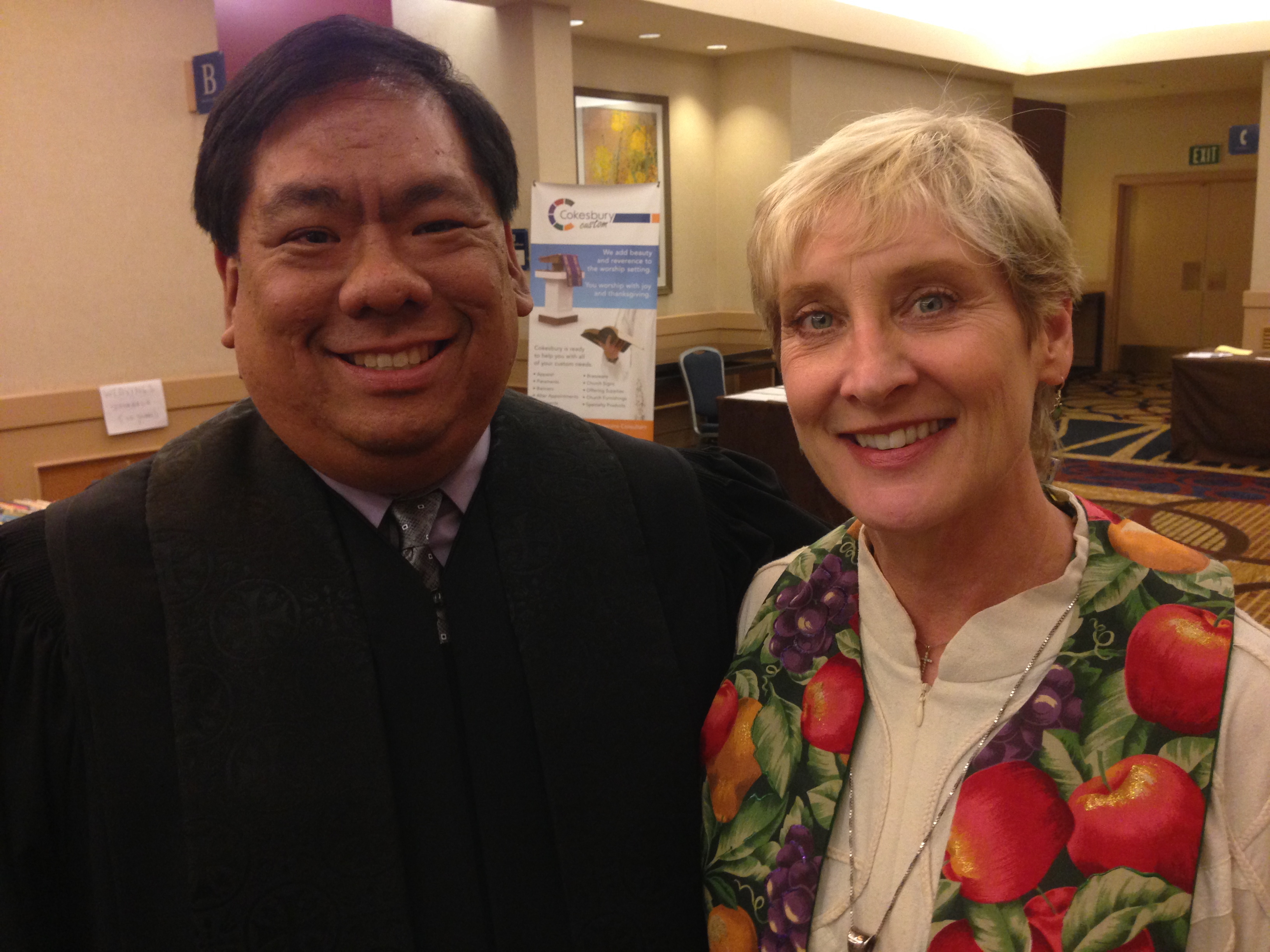
Instead of being the heart of society, we have become part of the fringes of it. Our faith has become synonymous with politics and that would have been the last thing Jesus would have wanted. It’s time for us to re-evaluate what it means to be the church in the world today and do something different to reach people with the love of Christ. My District Superintendent, Debra Brady, encouraged me to find a new way to reach people. She encouraged me to find something I was passionate about and to do THAT and not worry about what anyone else said. That was over seven years ago. I’ve never forgotten that conversation and it was about time to do something about it. Faith Dinners are that something. It may be risky. Maybe no one will come. Maybe no one will be changed. Maybe people will come and eat the food and leave and never feel the love of Christ. Maybe. But I believe they will. And I believe that the only way to reach people for Christ in the coming age is to approach faith from a different angle. What are we talking about? Doing everything we can, the best we can, to reach people for Jesus.
[1] Pew Research Center, “Spirituality Among Americans,” December 7, 2023.
[2] Jason DeRose, “7 in 10 U.S. adults consider themselves spiritual,” All Things Considered, NPR, December 7, 2003.
[3] Pew Research Center, “Religious ‘Nones’ in America: Who They Are and What They Believe,” January 24, 2024.
[4] Mission Insite, The ReligionInsite Report: 2.5 mi Around 3520 San Felipe Road, San Jose, California 95135, United States, (Florence, SC: ACS Technologies, October 10, 2024), 4-5, 7-8, 29.
[5] This number is hard to pin down. Generally, all agree that the number is huge with some as “small” as 28,000 and one as big as 50,000. But most records agree it’s higher than 30,000 per week.
[6] Mark Howell, “Andy Stanley: Circles Are Better Than Rows,” November, 27, 2020.
 Craig's Corner