
If We Are the Body
Everyone say “cheeks!”
In today’s selfie generation it’s important to know how to maximize your smile and the word “cheese” just doesn’t do it anymore. The word “cheeks” gives you a better smile in pictures. It’s true.[1] Not only that, but a “cheeks” smile is more likely to make you feel happier as well. Studies have found that the more we use our upper facial muscles to make a smile, the kind that produces crow’s feet around our eyes, the more likely we are to feel happy. Researchers also did a study where they had people hold a pen in their mouth while looking at some cartoons.[2] The people who held the pen with their teeth, making them smile with their upper facial muscles, thought the cartoons were funnier than the people who held it with their lips, making them pout. Smiling has a positive reaction on our mood. It also makes us less stressed. It’s like the concept “fake it ‘til you make it” – the idea being that faking happiness can help lead us to happiness or at least alleviate us from stress and depression. Are there limits to this superpower though? Sure.[3] But overall, smiling has proven to give us added health benefits and can help “turn that frown upside down.”

John Wesley did the same thing with his faith.
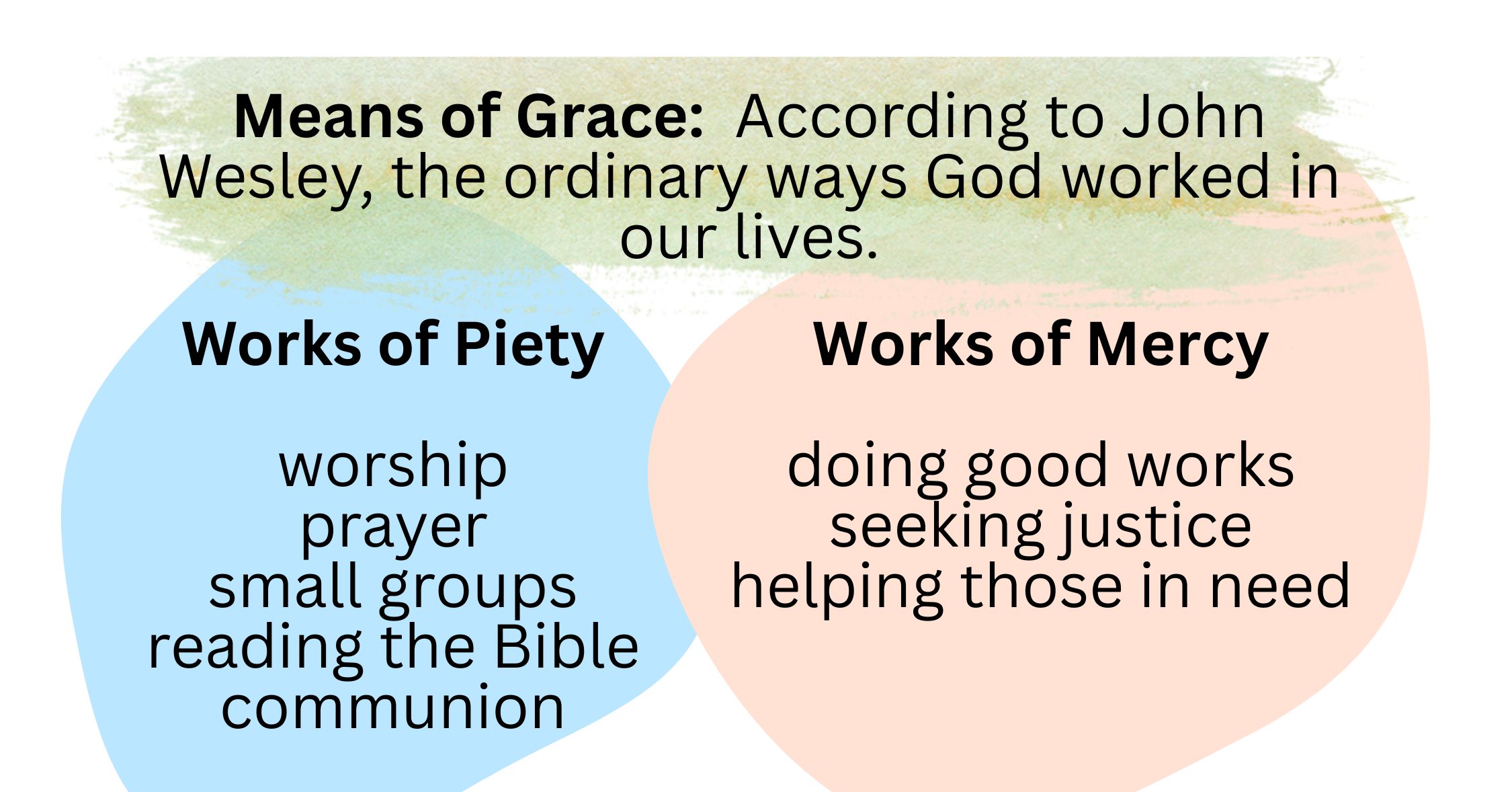
He went through a period of doubt in his own life on his passage back to England from America. The ship he was on went through a heavy storm and his heart was gripped with fear, but a group of Moravians who were also on the ship weathered the storm joyfully. They sang songs and had such a positive attitude John wondered what their secret was; how were they able to face a crisis like this without fear. They told him their faith gave them strength. He admitted to them there were times when his own faith was in doubt and the Moravians told John to simply continue practicing his faith until he felt it again. In essence, to “fake it ‘til you make it.” John was convicted by their words and he continued preaching and teaching and helping others until one day at Aldersgate, John wrote that he “felt his heart strangely warmed.” And in that moment, the solidity of his faith returned and he felt renewed in the Spirit. That’s why John preached so feverently on the means of grace. He felt that the means of grace helped us to stay IN God’s grace. For John, the means of grace were simply the ordinary ways God worked in our lives and he divided them into works of piety and works of mercy.[4] Works of mercy are things like doing good works and seeking justice for the oppressed and addressing the needs of the poor. Works of piety were more personal tasks; reading the Bible, praying, fasting, attending worship, going to Bible study, taking communion, and sharing our faith. Both were essential to stay in the grace of God. Both were important to develop our faith.
The passage we are going to share this morning is what inspired Wesley’s ideas about works of mercy.
Jesus reveals to his followers that eventually everything will come to an end. He points to their holiest of temples and says, “Truly I tell you, not one stone here will be left on another; every one will be thrown down (Matt 24).” The disciples come up to Jesus privately and ask him, “Psst. Tell us Jesus, when is this going to happen?” I don’t know if the disciples were simply curious or scared or trying to get a heads up, but Jesus tells them only that it WILL happen, and says that only God knows the details of when. Instead he encourages them to live a life of readiness – to act as if every day might be the last so that when he DOES return for them, they will be found to be ready. He tells them that on that day when he returns, all of the people of the world will be divided into two groups, the sheep and the goats with the sheep on his right and the goats on his left and the passage we are reading this morning describes what Christ will say to them.
34 “Then the King will say to those on his right, ‘Come, you who are blessed by my Father; take your inheritance, the kingdom prepared for you since the creation of the world. 35 For I was hungry and you gave me something to eat, I was thirsty and you gave me something to drink, I was a stranger and you invited me in, 36 I needed clothes and you clothed me, I was sick and you looked after me, I was in prison and you came to visit me.’
37 “Then the righteous will answer him, ‘Lord, when did we see you hungry and feed you, or thirsty and give you something to drink? 38 When did we see you a stranger and invite you in, or needing clothes and clothe you? 39 When did we see you sick or in prison and go to visit you?’
40 “The King will reply, ‘Truly I tell you, whatever you did for one of the least of these brothers and sisters of mine, you did for me.’
41 “Then he will say to those on his left, ‘Depart from me, you who are cursed, into the eternal fire prepared for the devil and his angels. 42 For I was hungry and you gave me nothing to eat, I was thirsty and you gave me nothing to drink, 43 I was a stranger and you did not invite me in, I needed clothes and you did not clothe me, I was sick and in prison and you did not look after me.’
44 “They also will answer, ‘Lord, when did we see you hungry or thirsty or a stranger or needing clothes or sick or in prison, and did not help you?’
45 “He will reply, ‘Truly I tell you, whatever you did not do for one of the least of these, you did not do for me.’
46 “Then they will go away to eternal punishment, but the righteous to eternal life.” – Matthew 25:34-46
Jesus makes it clear there is a right way and a wrong way of doing things.
The right way is helping those in need. Whether they are hungry or thirsty or needing shelter, we have an obligation as God’s people to help them out. It shouldn’t be conditional on whether or not they share our faith or vote the same way we do. It doesn’t matter if they are righteous Dodgers fans or misguided Giants fans, we are supposed to help everyone who needs it. When we ignore them, we are doing the exact opposite of God’s will and we distance ourselves from God. We become selfish and self-absorbed. We become so focused on the here and now that we forget all about the hereafter. Jesus is telling us in this passage that our faith is more than just words. It’s more than simply showing up. Our faith becomes evident in how we live our lives. And God is watching.
In the book of Acts, Jesus commands us to witness to those all over the world.
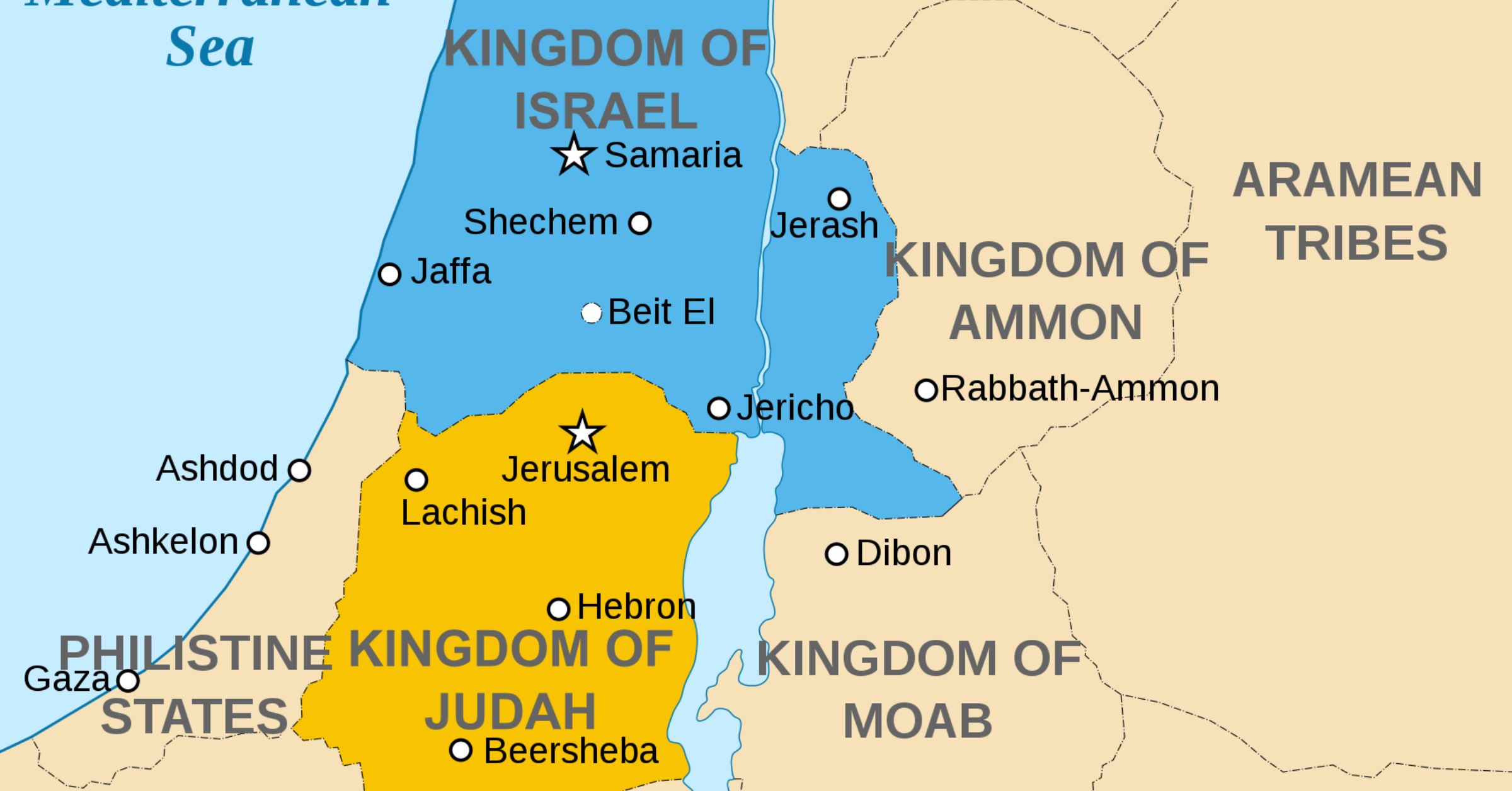
He tells us, “you will be my witnesses in Jerusalem, and in all Judea and Samaria, and to the ends of the earth (Acts 1:8).” It’s interesting that Jesus chose those exact locations, and like many of Jesus’ teachings, these words were carefully chosen. They weren’t random places to make a point. Jerusalem represented those who are like us, those who lived in our communities, those who shared our values, if not our beliefs. Judea was far from Jerusalem and represented those who might be like us but who lived far away. For us that might be the people of our state or maybe even our country. You know the story of the Samaritan woman. She lived close to the Jewish community. They were neighbors but considered outcasts to the Israeli people. But Jesus commanded us to bear witness to them, to the disenfranchised, to the outcasts, to the people on the fringes. Because they were his children, too. And to make sure everyone was covered, Jesus commanded us to take his Word to the ends of the earth. That we weren’t supposed to stop at just the people we knew, the people who were like us, or even the people on the fringes of our society. But we were supposed to take it everywhere else too. That meant we were supposed to be missionaries to the entire world. It doesn’t mean we are all meant to leave our homes and live in a grass hut in some far-off country. Sometimes our mission field is right in our backyard. What it does mean is that you need to find that mission field for yourself and contribute what you can to the mission.
Whenever we do what God wants us to do, our lives get better.
That isn’t an hypothesis, it’s a fact. Scientific study backs us up those claims time and time again. Being grateful helps our marriage.[5] Volunteering makes us feel more satisfied in life. Praying reduces stress. Keeping a gratitude journal makes us happier.[6] So when Wesley proposed works of mercy as part of the means of grace he may have been on to something without even realizing it. Because among the things that cause the most happiness in our lives or give our lives a “happiness” boost, are also means of grace he talked about.[7] I don’t think that’s a coincidence that what God wants us to do not only makes our lives better but brings us closer to him. And that is certainly something worth smiling about. In the name of the Father and of the Son and of the Holy Spirit. Amen.
[1] http://www.theguardian.com/lifeandstyle/2014/dec/22/smiling-wellcome-trust-science-writing-prize
[2] Ibid
[3] http://www.scientificamerican.com/article/how-smiling-can-backfire/
[4] http://www.umc.org/how-we-serve/the-wesleyan-means-of-grace
[5] http://www.dailymail.co.uk/sciencetech/article-3283713/The-secret-happy-marriage-Saying-thank-Study-finds-gratitude-predict-couple-remains-together.html
[6] http://www.huffingtonpost.com/2014/01/07/boost-happiness_n_4532848.html
[7] http://www.huffingtonpost.com/2014/01/07/boost-happiness_n_4532848.html
 Craig's Corner