
And A Little Child Shall Lead Them

Close your eyes and picture in your mind the moment of Christ’s birth.
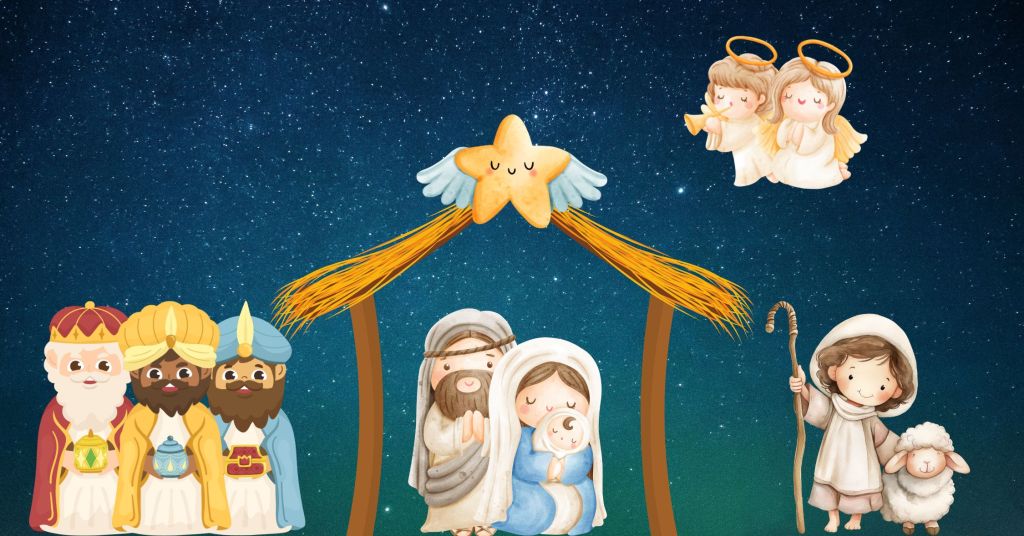
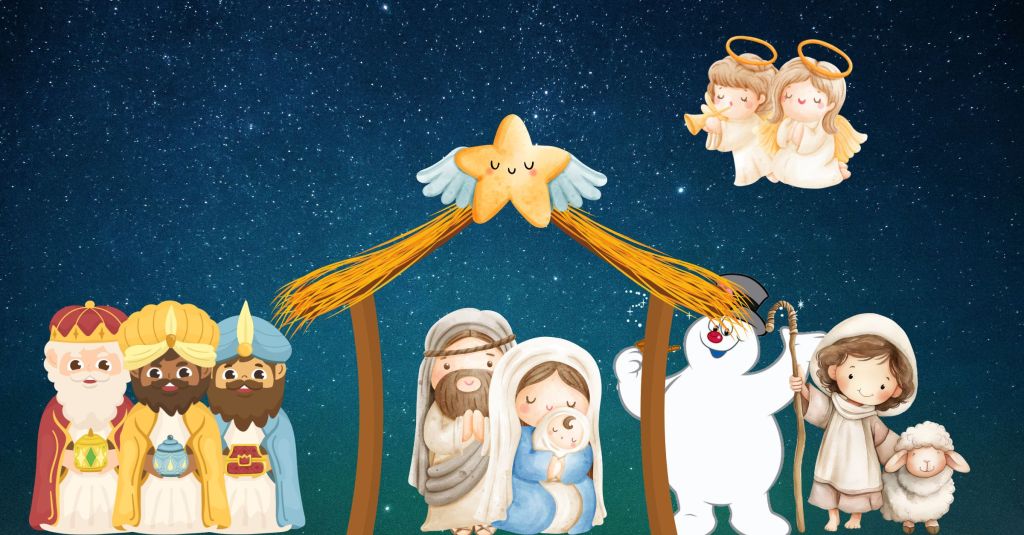
If you are like most people, you probably picture a stable with a wooden manger. In the manger atop a bale of hay is the baby Jesus. And surrounding Jesus are Mary, Joseph, a group of shepherds, and three wise men or kings – Caspar, Balthazar, and Melchior with gifts of gold, frankincense, and myrrh. Around the open stable are horses, sheep, camels, and goats. And atop the stable shines a star so bright it led the wise men to this place surrounded by angels. It’s peaceful and calm and maybe you can hear the gentle cooing of the baby Jesus. This is the traditional Christmas picture we’ve been fed since we were little. You see it in books, on television, in movies. Almost assuredly, you’ll pass by someone’s house with a recreation of the birth of Jesus on their lawn with all of these things – right next to an inflatable Frosty the Snowman who was apparently ALSO present at the birth of Christ. The truth is, most of these images have very little to do with what really happened that night. We are going to be picking up the Christmas story after the angels proclaim the good news of Jesus’ birth to the shepherds in the fields nearby. But before that happens, many other powerful aspects of the Christmas story come into play. Perhaps the strongest of these images is the denial of Joseph and Mary at a local inn.
“There was no room at the inn.”
It’s hard to believe that some cold-hearted innkeeper wouldn’t make room for an obviously expecting woman! But what if we got it wrong? What if there wasn’t a cold-hearted innkeeper AND his wife (see, we’re just going to make the story even worse now, right?)? What if instead the Bible didn’t say “there was no room at the inn” and instead said “there was no guest room available for them?” Could that change the context by which we judge these people? Today, most versions (but not all) of the Bible have the word kataluma more accurately translated to “guest room.” And as Adam Hamilton pointed out in the book The Journey it made more sense that Joseph would have gone to a relative’s house to have the birth of their child, especially as they probably had little money to pay for a room at an inn.[1] Since he and Mary were returning to Joseph’s home town, he likely had friends and relatives living there he could have gone to stay with. But that only changes things slightly, maybe makes it worse! His own family and friends would send them out to a barn? The thing that’s missing here is context. For one, it was likely that every home would have had limited space since the census forced everyone to return. Every home would have been challenged for space as friends and family returned. But more than that, according to Jewish custom, a pregnant woman was considered ceremonially unclean, which made anyone or anything she touched unclean as well. Not just the people, but anything Mary touched, the walls, the floors, the bed would all be considered unclean. In those days, being unclean couldn’t be resolved simply by washing your hands. It took rituals and ceremonies and time spent in preparation. Cleansing a body or a house took a lot of effort and until you did it you couldn’t go to the temple. It might have been the only place their relatives could put them up was in a place outside the home. So there they are, Mary, Joseph, and little baby Jesus lying in a manger. And this is what happens next.

15 When the angels had left them and gone into heaven, the shepherds said to one another, “Let’s go to Bethlehem and see this thing that has happened, which the Lord has told us about.”
16 So they hurried off and found Mary and Joseph, and the baby, who was lying in the manger. 17 When they had seen him, they spread the word concerning what had been told them about this child, 18 and all who heard it were amazed at what the shepherds said to them. 19 But Mary treasured up all these things and pondered them in her heart. 20 The shepherds returned, glorifying and praising God for all the things they had heard and seen, which were just as they had been told.
21 On the eighth day, when it was time to circumcise the child, he was named Jesus, the name the angel had given him before he was conceived. – Luke 1:15-21
What is interesting to me about this story is as much what WASN’T said as what WAS said.
There was no reference to a brightly shining star. There was no reference to the appearance of three wise men or three kings or anyone other than the shepherds. The stable, which we generally imagine to be a wooden barn, is never described in detail. And there definitely wasn’t a little drummer boy present, at least not in the Biblical story. Today, we know it was just as likely, perhaps more so, that Jesus was born in a cave. During those times, it was common for animals to be kept in caves for shelter from the weather which would have provided better protection than a wooden barn. We also know that wise men, and not likely kings, eventually did come to visit Jesus, but Bible experts say it could have been as late as two years later![2] A far cry from the miraculous appearance of three kings with their gifts of gold, frankincense, and myrrh on the night of Jesus’ birth. Most people believe we got the image of three kings based on the number of gifts that were presented to Mary and Joseph, but if you notice, it never says in the Bible how many people were there. The word used to describe the visitors is magoi or magician which could have meant they were priests of another religion or astrologers but not likely to be kings.
But the story as it is in the Bible is a richer story without these things.
A richer story by far than one we may have thought about before. In fact, when we look at Jesus’ birth as it is told in the Gospels, we find out God is counter-cultural. We find out that God is counter-cultural. He never did things the way people expected. God would flip expectations on their head and then exceed the imaginations of what people thought they wanted and did something even more amazing instead. This was the birth of the most powerful, most holy person in the universe, and yet look at the details of his story. They were not details you would expect of someone like Jesus. He was born to a father who wasn’t wealthy and didn’t hold a position of power. He wasn’t a holy man or spiritual leader but a carpenter. His parents were from the tiny town of Nazareth. And when I say tiny, I mean TINY. Hamilton said in his book the town was so small it wasn’t even mentioned among the 63 other villages associated with Galilee in the Hebrew Talmud or the 45 mentioned by the historian Josephus.[3] In fact, there were likely only 100 to 400 people in his entire town. 100 to 400 people. That’s it. You’d be lucky if they had a gas station and a grocery store if that town were around today. In fact, it was such a tiny little town Nathanael insults it when Phillip tells him about Jesus. He says in John 1:46, “Nazareth! Can anything good come from there?” To which Phillip told him to “Come and see.” Three verses later, Nathanael sees the light and exclaims, “Rabbi, you are the Son of God; you are the King of Israel.”

In the passage we read today, God didn’t announce the arrival of Jesus as we would expect.
The angels of Heaven, who did not likely float around in white robes with wings, came first to the shepherds to proclaim the birth of Christ. Shepherds! We just accept that as part of the story of Jesus today, but back then it would have been mind blowing! Shepherds were considered among the lower-class in Jewish society. They were located toward the bottom of the socio-economic ladder because they were “typically uneducated, usually poor,… and smelled like dirty sheep.”[4] They were often looked down upon because of this but also because they would often have their animals graze on other people’s land. Imagine how upset we get today when the neighbors’ dog or cat roams freely around our yard. Now multiple that by the number of sheep in a flock and you get the picture. So why on earth would God reveal himself first to the shepherds? Why not to King Herod or to the Jewish leaders or to the high priest? To us that would make more sense. People would have believed right away had the high priest of the temple proclaimed the birth of the savior!
Yet we see throughout the Bible God uses the meek and not the mighty, the lowly and not the luxurious.
God doesn’t go to the rich and the powerful. He goes to the weak and disenfranchised. But he also uses those who are most open, most willing, and most receptive to his message to share the good news. The high priest would likely have cast doubt about the authenticity of the birth of Christ and we already know how King Herod reacted – with fear, trepidation, anger and resentment. No, God went to the shepherds, to Mary, to Joseph, to a tiny town called Nazareth, and to a cave for a reason. If you look at 1 Cornithians 1:26-31 we hear the words of Paul who sums it up so nicely. “26 Brothers and sisters, think of what you were when you were called. Not many of you were wise by human standards; not many were influential; not many were of noble birth. 27 But God chose the foolish things of the world to shame the wise; God chose the weak things of the world to shame the strong. 28 God chose the lowly things of this world and the despised things—and the things that are not—to nullify the things that are, 29 so that no one may boast before him. 30 It is because of him that you are in Christ Jesus, who has become for us wisdom from God—that is, our righteousness, holiness and redemption. 31 Therefore, as it is written: ‘Let the one who boasts boast in the Lord.’” As we leave here this morning, let us take the time to reflect on the miracle of the Christmas story. Not just the grace and mercy of a God who humbled himself to be amongst us. Not just the astounding and incredible circumstances of Jesus’ birth to a virgin named Mary. But how God comes into our lives in ways we least expect it. God uses our weakness, our faults, and our imperfect selves to share his message of love to a broken world that seeks him. Our story of hope rests not just in the power of God almighty, but that God chooses to use us with all our imperfections and faults and mistakes to share his Word of Love. God knows it is within us to do this work, because after all, he created us in His image. How will you share His story, now and everyday?
[1] Adam Hamilton, The Journey: Walking the Road to Bethlehem, pp. 96-100.
[2] Stephen Miller, The Jesus of the Bible, p. 59.
[3] Hamilton, p. 15.
[4] Hamilton, p. 113.
 Craig's Corner