
Tradition!

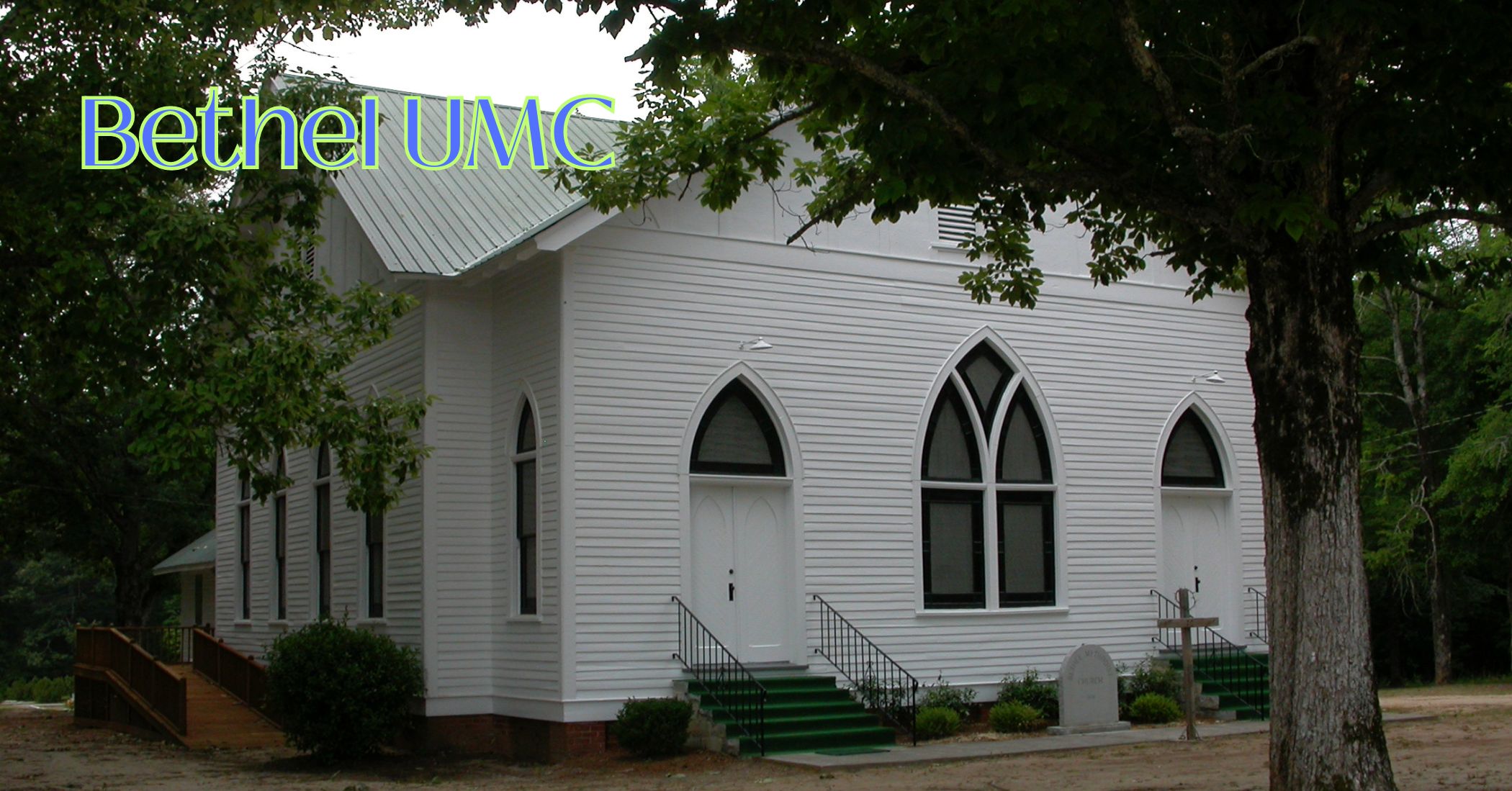
My first church as pastor was a three-point charge in Washington, GA.
That meant I served three different churches in the area – Mt. Zion UMC, Bethel UMC, and Smyrna UMC. All of them were historic churches with a very long and rich history. Mt. Zion actually hosted Bishop Francis Asbury – one of the first and most famous bishops in Methodist history. I would preach twice each week, rotating between them. Bethel had a unique building. It had two entrances spread far apart. Everyone entered on the left and the one on the right was largely left unused. One day I asked about it, curious about the distance between the doors. Why not build it with one central door? And that’s when I heard something new I didn’t know before. Bethel at one time had a partition down the center of the sanctuary. The men would sit on one side and the women on the other. They had separate doors to keep the genders apart from the time they entered the church until they left. They told me you could always tell who the newlyweds were because they would sit on either side of the wall and touch hands over the partition. But the practice of separating the congregation by gender wasn’t something unusual. In fact, it was fairly common.[1] Largely since the 20th century that practice has become outdated in most, but not all, places. Some claim the practice is to allow people to better focus on God instead of each other. Some claim it’s done to protect widows and widowers. But in all honesty, it likely has much more to do with gender politics than anything else. Wanting to keep the women in their place. The Coptic Church of the Southern United States even said as much. It was an “appreciation of the natural order” according to their website.[2] That kind of thing always gets me upset. That’s why most churches today don’t practice this ages old tradition and why it faded away at about the time women received the right to vote. Some traditions are meant to be left behind in time.
A sentiment Jesus would agree with.
At least if we take to heart what we read about him in the Bible. In Matthew’s retelling of the story, our reading today happens soon after the feeding of the 5000 and when the disciples see Jesus walking on water. In his gospel reading, it’s all part of one continuous story and so after Jesus catches Peter from falling and gets in the boat with the rest, they finish crossing over to the other side and he begins healing the sick. That’s when the Pharisees decide to make their move.
Then some Pharisees and teachers of the law came to Jesus from Jerusalem and asked, 2 “Why do your disciples break the tradition of the elders? They don’t wash their hands before they eat!”
3 Jesus replied, “And why do you break the command of God for the sake of your tradition? 4 For God said, ‘Honor your father and mother’ and ‘Anyone who curses their father or mother is to be put to death.’ 5 But you say that if anyone declares that what might have been used to help their father or mother is ‘devoted to God,’ 6 they are not to ‘honor their father or mother’ with it. Thus you nullify the word of God for the sake of your tradition. 7 You hypocrites! Isaiah was right when he prophesied about you:
8 “‘These people honor me with their lips,
but their hearts are far from me.
9 They worship me in vain;
their teachings are merely human rules.’” – Matthew 15:1-9
Their traditions had basically become law.
As I was researching our message today, I came across this explanation. “Ritual washing before meals, which likely included utensils as well as hands, was a prominent example of these traditions.” By that they mean traditions that intended to follow the letter of the law and not the intent of it. “There was nothing wrong with doing it (washing up); however, those details were never part of God’s commands to His people. They were man-made traditions about the law, which were treated as if they carried the weight of the law.”[3] Jesus takes them to task on this and says “…you nullify the word of God for the sake of your tradition. You hypocrites!” The Pharisees and teachers of the law had become so fixated on the letter of the law that they forgot the spirit of the law. That’s what leads Jesus to repeat Isaiah’s prophecy: “These people honor me with their lips, but their hearts are far from me. They worship me in vain; their teachings are merely human rules (Isaiah 29:13).”
It’s the difference between tradition and traditionalism.
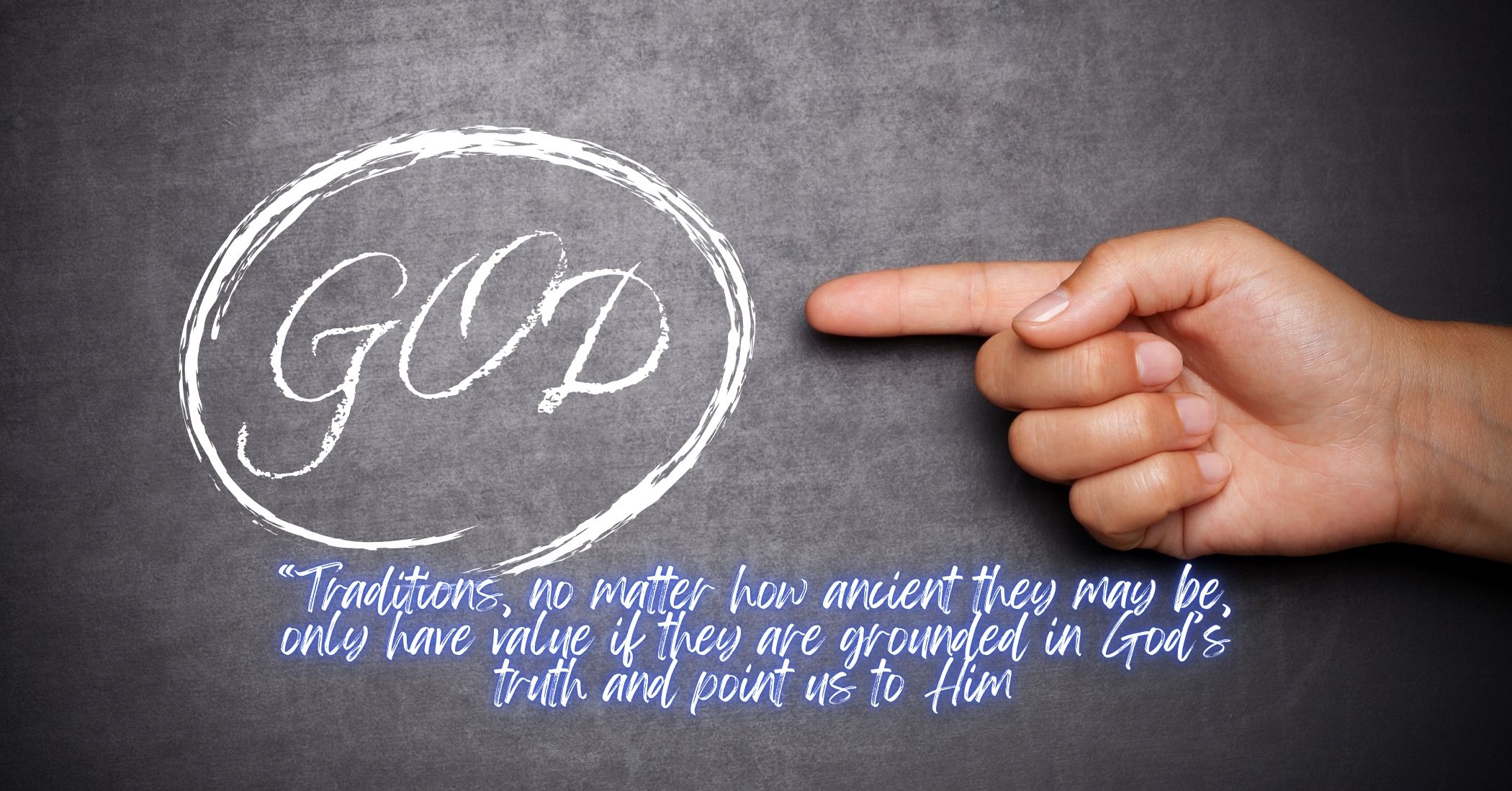
Tradition keeps us grounded in our history and in our past. It can help guide us and keep us focused, and we often take comfort in our traditions. But traditionalism takes traditions one step further. It lifts up tradition to be on equal level with Scripture. But we know that isn’t true. And it is one of the dangers we face when we cling too tightly to them. As one author wrote, “Traditions, no matter how ancient they may be, only have value if they are grounded in God’s truth and point us to Him.”[4] Sometimes we forget that. All we do should point our lives toward Christ. In our earlier reading, we found Jesus healing on the Sabbath. Standing on the outside, it’s easy for us to see Jesus did the right thing (not that Jesus needs our affirmation). But the church leaders and teachers couldn’t see it. They were blinded by their power. They were blinded by their fear. And they were blinded by their love of tradition. “There are six days for work. So come and be healed on those days, not on the Sabbath.” The woman in this story was suffering for eighteen years and an actual miracle was happening before them and all they could focus on was the day of the week? Jesus calls them out, too. “You hypocrites! Doesn’t each of you on the Sabbath untie your ox or donkey from the stall and lead it out to give it water? Then should not this woman, a daughter of Abraham, whom Satan has kept bound for eighteen long years, be set free on the Sabbath day from what bound her? (Luke 13:15-16)”
That’s the funny thing. We can’t always see when we are stuck in the mud.
It might be obvious to everyone around us, but we can’t see it for ourselves. Have you ever lost something and spent all day looking for it and then your spouse comes along and finds it in two seconds? Or have you ever been stuck on a problem at work and can’t figure it out and you step away for a bit and suddenly the answer become clear? That’s the same thing that happens when we hold too tight to tradition. We become so focused on the thing that we forget why we were doing it in the first place. We become rigid as if there is only one way to do something and it sometimes takes someone else to show us the way. Or sometimes we have to take a step back and let go for a moment to see it more clearly.
A while ago I told you the seven last words of a church were, “We’ve never done it that way before.”
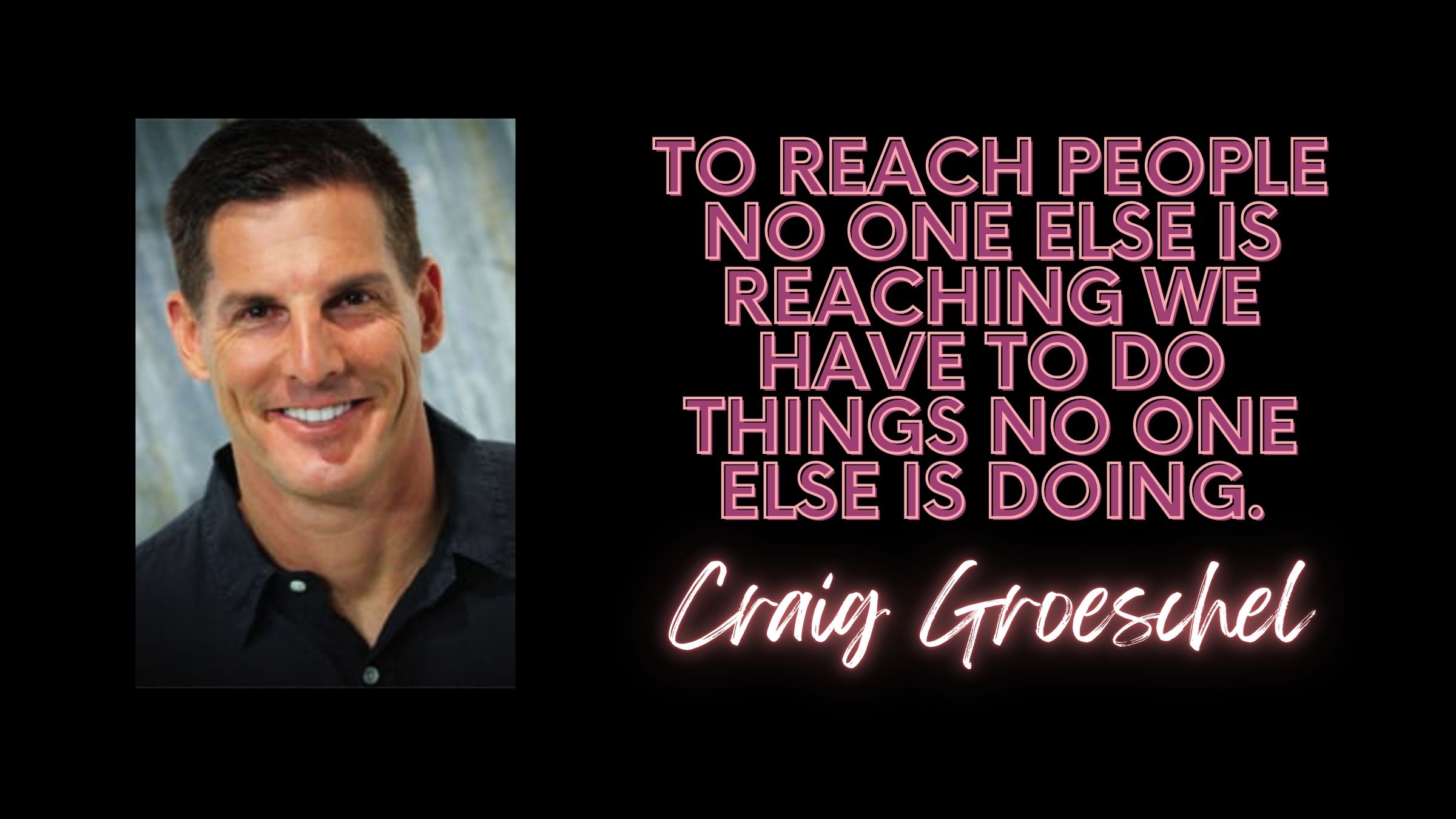
When you hear those words it’s a clear sign we’re holding on too tight to the past and to our traditions. It might also be a true statement. But God challenges us to keep our hearts and minds open to the movement of the spirit and sometimes the spirit wants to take us in new and different ways. The church has been in decline for decades now and we’ve done little to do things differently. I’m often haunted by the words of Craig Groeschel who leads Life.Church. I went to a conference where he was speaking and it felt like he was speaking to me (and not just because we both share the name “Craig”). He said, “To reach people no one else is reaching, we have to do things no one else is doing.” Traditions are great. Like we shared before, they often root us to the foundations of our past, they create community over shared experiences, and they bring us together as a community. It’s only when we elevate them and place them before God and the Holy Spirit that they evolve into something more. Church, if it’s going to be effective in reaching a new generation, likely won’t look the same as it does today. And that’s okay. Let us challenge ourselves to be open to where the Spirit is leading, even if sometimes it scares us a little.
[1] https://oxfordre.com/religion/display/10.1093/acrefore/9780199340378.001.0001/acrefore-9780199340378-e-6
[2] https://www.suscopts.org/q&a/index.php?qid=54&catid=76%C2%A0
[3] If you’re interested, you can read more about this on BibleRef.com: https://www.bibleref.com/Matthew/15/Matthew-15-2.html#:~:text=Pharisees%20and%20scribes%20come%20from,tradition%20above%20God’s%20actual%20commands!
I Believe in Quarks

I believe in quarks.
I believe in quarks even though I have never seen them. I believe in quarks even though NOBODY’s ever seen them. But I believe in quarks, and I’m not alone. Hundreds, if not thousands of scientists worldwide believe they exist. The quark is what scientists believe to be the smallest unit of matter in the universe. Smaller than the molecule, smaller than the atom, and even smaller than the proton, all of which were at one time considered to be the smallest unit of matter in the universe. Now, there’s the quark – even smaller than all of these. Quarks come in six different types that they call “flavors” for some strange reason because they’re not named things like chocolate and strawberry, but instead are called up…, down…, top…, bottom…, charmed…, and strange.. These different flavored quarks combine in different ways to form protons and neutrons which are the basic elements of the atom. But again, no one has ever seen them! So how do we know all of this? How do we even know that quarks exist? You can’t see them, you can’t touch them, they don’t exist by themselves but only in packs of three, why are scientists so sure they’re even there? Because, when they examine the evidence, there is no other logical explanation other than to say quarks exist. They EXPERIENCE the existence of quarks through the observation of the things around them.
We encounter God in much the same way.
We find God, not in seeing him but in the experience of him in our lives. By the power of music to move us. By witnessing his handiwork in the miracle of birth. By his saving grace that makes a heart “strangely warmed.” And in the reading of the Word of God. If you have a Bible or a Bible app on your phone, would you find Acts 17:22-28. Acts 17:22. Like quarks, God is all around us, every day. God surrounds us with his presence. We used to believe that the role of missionaries was to bring God to the people, but God doesn’t need us to bring him to the people. He is already there. Our job is to point out and highlight the work God is already doing among us. That is the biggest difference between those who follow Christ and those who don’t. It’s not that we live in different worlds. It’s that we understand how the world works in a different way. Something that Paul pointed out to the people of Athens in our passage this morning. If you would please rise for the reading of our Scripture passage today – Acts 17:22-28. Hear now the Word of the Lord.
22 Paul then stood up in the meeting of the Areopagus and said: “People of Athens! I see that in every way you are very religious. 23 For as I walked around and looked carefully at your objects of worship, I even found an altar with this inscription: to an unknown god. So you are ignorant of the very thing you worship—and this is what I am going to proclaim to you.
24 “The God who made the world and everything in it is the Lord of heaven and earth and does not live in temples built by human hands. 25 And he is not served by human hands, as if he needed anything. Rather, he himself gives everyone life and breath and everything else. 26 From one man he made all the nations, that they should inhabit the whole earth; and he marked out their appointed times in history and the boundaries of their lands. 27 God did this so that they would seek him and perhaps reach out for him and find him, though he is not far from any one of us. 28 ‘For in him we live and move and have our being.’[b] As some of your own poets have said, ‘We are his offspring.’ – Acts 17:22-28

Without knowing God, the people of Athens knew he was there.
They may not have been able to understand the how and why of God (something we are all challenged by), but they were experiencing God in their lives and wanted to pay tribute to him. When Paul found the altar with the inscription “TO AN UNKNOWN GOD” he knew these people were on the right track and simply needed some guidance. They were already witnessing God’s work in their lives, but they just didn’t have a frame of reference for him. And that’s what Paul did. He gave them that frame of reference. He pointed out to them how God was already at work in the world around them. And he told them that God did all of things so that we might one day find him and believe. He wrote, “God did this so that they would seek him and perhaps reach out for him and find him, though he is not far from any one of us. ‘For in him we live and move and have our being.’” God is here. Now. And he is working in us and through us to reach out to us. Not by speaking to us from a burning bush or passing by us while we look at his backside from the crevice of a mountain. Instead, we experience God in the everyday aspects of our lives.

Like love.
In 1 John 4, the apostle writes to us, “7 Dear friends, let us love one another, for love comes from God. Everyone who loves has been born of God and knows God.” John is pointing out to us that the very act of loving another person is a reflection of God in and through us. Love is an expression of God. And if you think about it, it’s the only thing that makes sense. Because love violates the theory of natural selection. Adam Hamilton in his book Creed put it this way, “When we care for the weak, when we are faithful to a spouse, when we show compassion to the struggling, when we choose to love our enemies, we are acting counter to the laws of natural selection but consistent with an inner law written on our hearts that we intuitively know is the right and good path. I believe that this inner law, which reflects humanity at its best, points to the One in whose image we were created.”[1] Love makes no sense if all we are is a collection of cells and chemicals. If biology alone dictated our actions, we would adhere to natural selection and we would disregard the weak, let the struggle perish, destroy our enemies, and abandon faithfulness. Morality makes no sense in a world ruled by biology, because unless it is advantageous to the advancement of our life or our species, there is no reason that a biological world would do any of those things. The presence of God through the gift of love is what makes us moral creatures who sacrifice the evolutionary advantage for these higher ideals. God guides us and leads us to be his people.

But who cares if there is a God?
If God exists independent of what we do or what we believe, then why does it matter if we believe in him at all? It’s because belief in God shapes and focuses our understanding of everything else in the world. Knowing there is a God encourages us to care for one another. Because we are God’s creation and not just a random mass of quarks, atoms, and molecules, we have value. Believing in God also means we have a responsibility to care for the rest of creation. God made us stewards of the land and everything in it, and if God is real we need to take that seriously. And if there is a God, we need to “Love the Lord your God with all your heart and with all your soul and with all your mind and with all your strength (Mark 12:30).” We need to approach God with “praise, gratitude, and worship.”[2] And that’s only the beginning. As Christians we believe our very salvation rests on knowing and loving God in Jesus Christ. Belief matters.
So we have the Apostles’ Creed.
Not to bore us to death during worship, but to remind us of what we believe because belief matters. Too often we go through worship without understanding why we do the things we do. They become repetitious and lose their meaning. They were written to keep God at the forefront of all we do. We know when we are focused on God, we approach life differently and I hope in a way that not only honors God but makes our life better, too. But we are a forgetful people. We often drift away. We don’t always do a good job of remembering what we’re supposed to be focused on. And so these documents lay out for us in a simple way the core beliefs of our faith. They remind us that God is the creator of the universe, of all that is seen and unseen. And through their words we reaffirm each and every time that we acknowledge the work of God in the world today.

God may be unseen, but he isn’t unknown.
I can’t see the air we breathe, but the fact that I’m alive is a testimony to its existence. In the same way, I can’t see God, but that doesn’t mean I don’t know him. That doesn’t mean that he hasn’t influenced the way I live my life. Or that he hasn’t worked in and through me to affect change in the world. Just because we can’t see something or feel something or touch something doesn’t mean it doesn’t exist. So in the end, I believe in quarks. And I believe in God. Because even though I can’t hear him, see him, or touch him, God has revealed himself to me through the experiences in my life. I have felt the blessed assurance that he has come and died for me. I believe. In the name of the Father and of the Son and of the Holy Spirit. Amen.
[1] Adam Hamilton, Creed, (Abingdon Press, Nashville), 2016, p.29
[2] Ibid, p.32 (this paragraph summarizes Adam’s thoughts on the subject in his book as well)
The God Test

I’m still not quite convinced Paul is alive.
I’ve been a Beatles fan since I was a kid. I discovered my mom’s albums quite by accident while leafing through my parents’ collection when I was about nine years old. She had both the red and blue albums and I must have listened to each of them a hundred times. It helped that some of my closest friends were also Beatlemaniacs. As we got older, we went to Beatles conventions, saw a Beatles cover band, and even collected some of the Apple label Beatles albums. Then one day, I read about this strange conspiracy theory that Paul was dead. According to the theory, he had been replaced with a guy named “Billy Shears,” the name mentioned in the song “With A Little Help From My Friends.” In fact, all of the clues about Paul’s death came straight from Beatles songs, lyrics, and album covers, most specifically Sgt. Pepper’s Lonely Hearts Club Band. There were a lot of clues in that one. You could almost hear John whispering in a creepy voice “I buried Paul.” And when you played the song “Revolution 9” backwards, John could be heard saying, “Turn me on dead man, turn me on dead man.” It was FASCINATING! Paul McCartney was REALLY dead!

But of course, he isn’t.
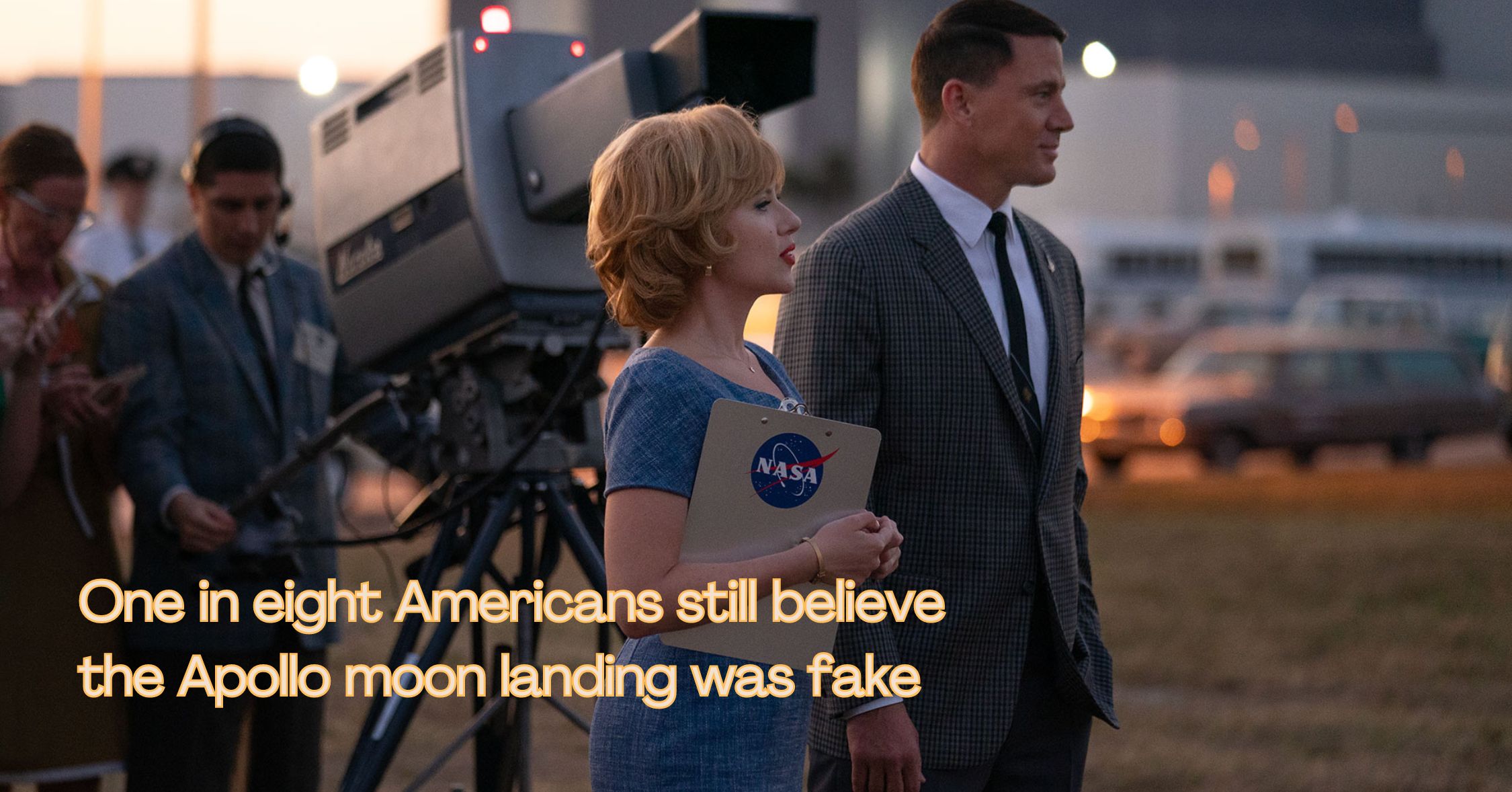
He’s still alive and well, appearing on television and making new music. His Carpool Karaoke with James Corden was fantastic! And he even released another solo album, his 18th, in 2020 – McCartney III – which made it to number one on the Billboard top rock albums charts and where he played all of the instruments. If the guy we think is Paul McCartney isn’t really Paul McCartney, he’s done one heck of a job channeling his talent. After all, this is the guy who wrote “Hey Jude.” So how in the world were so many people convinced it was all a cover up? Why would they believe there was this massive conspiracy that one of the most popular artists the world has ever known would be dead and no one would know about it. And why would the group then leave clues through cryptic messages left on album covers and backward tracking? I don’t know. But it’s not the first time the public has fallen victim to a false conspiracy theory. No matter how outlandish, people still believe in them. Like the belief that the Apollo moon landings were staged. Did you know 1 in 8 Americans still believe they were faked?[1] Despite all of the physical evidence and testimony contrary to it, that’s 12.5% of Americans believe it was faked. Of course, those same people probably believe that Walt Disney is frozen beneath Disneyland in an experimental cryogenic chamber.[2] I still hear that one to this day. Then there’s the very sad conspiracy theory advocating that the Sandy Hook massacre was all a hoax. I can’t imagine how devastating that must be for the families to first suffer the death of their child and then to have people send them hate mail accusing them of perpetuating the hoax. What kind of hate do you have to have in your heart to do that to someone? By the way, that’s only a few of the many outlandish conspiracy theories out there.
And while these are extreme, many of us hold onto false beliefs, too.
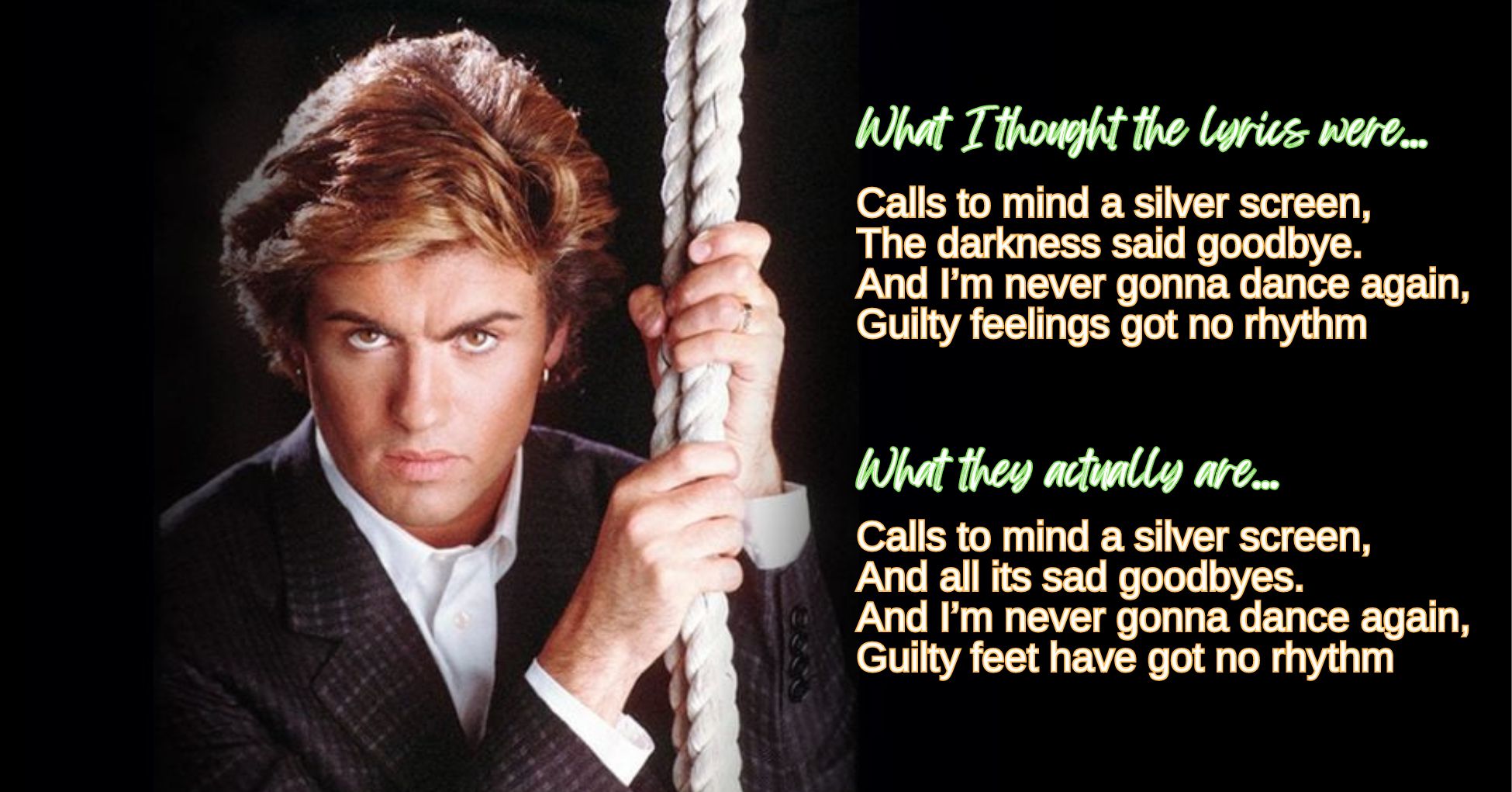
They don’t all have to be as earth-shattering as the ones we just mentioned. Sometimes they are things we believe about people we think we know. Sometimes we simply remember events differently and it colors how we interact with others. Sometimes we get it wrong in the beginning and we never get corrected and so we carry around this belief for a long time. I’ll give you an example that isn’t contentious. I’ve always loved the song “Careless Whisper” by Wham! It’s one of those songs from my high school days that bring back good memories. I don’t know if it’s because I danced with someone to that song or if I imagined dancing with someone to that song (probably the latter), but I’ve sung that song hundreds of times. I knew it like the back of my hand. That is, I thought I did. Just a few days ago, I was watching a musical game show, “Don’t Forget the Lyrics” and I’m singing along to this song and as I watch the lyrics pop up on the screen, I realize I was singing it wrong. It was only a couple of words, but for forty years I’ve sang this song the wrong way! And I would have gone on singing it the wrong way until I died if not for this show. I never even thought to look up the lyrics because I was so sure! Now something like this is silly and minor and who cares if I sang it wrong my whole life? But when it comes to the important stuff that affects how we treat one another or what we think of one another, we need to do a better job of getting it right. So how can we protect ourselves from getting caught up in falsehoods and misinformation? How can we make sure we make informed decisions?
We can take a lesson from the Apostle Paul.
If you think conspiracies are limited to the present day, you need to know they were happening as far back as there were people. Remember when Joseph’s brothers conspired to sell their brother into slavery? Or when Delilah betrayed Samson so the Philistines could enslave him and use them for their entertainment? Or the most famous conspiracy in the Bible, when Judas betrayed Jesus for a mere 30 pieces of silver. But these were ACTUAL conspiracies. What we need to guard against is believing in false ones. Paul knew that people were susceptible to being fooled by those who had agendas of their own. He knew we needed to be prepared to weed out truth from fiction as we hear in this passage.
In the presence of God and of Christ Jesus, who will judge the living and the dead, and in view of his appearing and his kingdom, I give you this charge: 2 Preach the word; be prepared in season and out of season; correct, rebuke and encourage—with great patience and careful instruction. 3 For the time will come when people will not put up with sound doctrine. Instead, to suit their own desires, they will gather around them a great number of teachers to say what their itching ears want to hear. 4 They will turn their ears away from the truth and turn aside to myths. 5 But you, keep your head in all situations, endure hardship, do the work of an evangelist, discharge all the duties of your ministry. – 2 Timothy 4:1-5
It sounds like Paul was writing to us.
Today. Here and now. His words could not be truer. “For the time will come when people will not put up with sound doctrine. Instead, to suit their own desires they will gather around them a great number of teachers to say what their itching ears want to hear. They will turn their ears away from the truth and turn aside to myths.” We believe what we want to believe. And now we have news feeds and social media to give us exactly what we want to hear. Thanks to The Algorithm. Sounds like an awesome name for a super villain. THE ALGORITHM! But we can’t just blame these tech companies for the divides we see in society today. It only feeds us what we want to see already. It’s up to us to seek out the truth for ourselves.

John Wesley used a method that today we call the Wesleyan Quadrilateral.
He believed if we turned to Scripture and used our powers of reasoning, took into account our experiences, and learned from our traditions, then we could better understand the truth of what God is asking from us. We call this the Wesleyan Quadrilateral because it emphasizes a four-fold understanding of God’s will. My Methodism professor in seminary thought it might be better imagined as a three-footed stool where Scripture is the seat upon which everything rests, but it is informed by our reason, our experience, and our tradition. For us and for Wesley, Scripture was always the basis of our understanding of God’s will, but as you can imagine (much like our Constitution), things we encounter today can’t always be found in the Bible. We have to discern from our knowledge of God what God wants for us in those situations we find ourselves that aren’t always covered. Like back then they didn’t have guns, but they had weapons and Jesus told his disciples to put theirs away “for all who draw the sword will die by the sword (Matthew 26:52).” John didn’t have a Facebook account, but he knew you couldn’t just believe everything you heard because he wrote in one of his letters, “Beloved, do not believe every spirit, but test the spirits to see whether they are from God, for many false prophets have gone out into the world.” John’s advice is solid. Test it out in the world. Don’t just rely on your gut or your instinct to see if it’s true because we know those can be highly unreliable. Instead test your theory and see if it matches up to reality. Just on the face of it, what’s more plausible – that California wildfires are caused by many years of drought and increasing temperatures that make our forests like kindling or that there are seriously Jewish space lasers firing at the planet and starting them? That was an actual conspiracy floated out there by Majorie Taylor Greene in Congress. Jewish space lasers. Not everything will be that obviously false. Most of the time there will be a grain of truth or more. Most of the time we will have only received half or less of the available information. It’s up to us to be diligent and refuse to fall victim to those who would divide us.
As Children of God and followers of Christ, we are rooted in Scripture.
But our understanding of Scripture has changed over the centuries as we have better understood what God expects from us. No longer are we so narrow-minded as to think that women cannot be teachers of God’s Word. No longer are we so blinded by racial disparity to think that a person is less based on the color of their skin. No longer do we think God brings forth the storms to punish the LGBTQ community. Because we have grown beyond that. Or at least most of us have. Sadly, there are still, even now, people who cling to these outdated and wrong ways of thinking. That is why we have to heed the words of Paul (not the dead one, the other dead one) to be wary of those who will not listen to sound doctrine. That is why we need to take an approach like John Wesley and examine our beliefs to discern God’s will for our lives. Because as human beings, we are prone to fall off the wagon from time to time. We have to get up, learn from our mistakes, and do better every time we rise again.
[1] https://www.telegraph.co.uk/films/2024/07/07/moon-landing-hoax-conspiracy-theory-apollo/
[2] https://www.pbs.org/newshour/health/how-a-strange-rumor-of-walt-disneys-death-became-legend
Come to the Table
This story is not new.
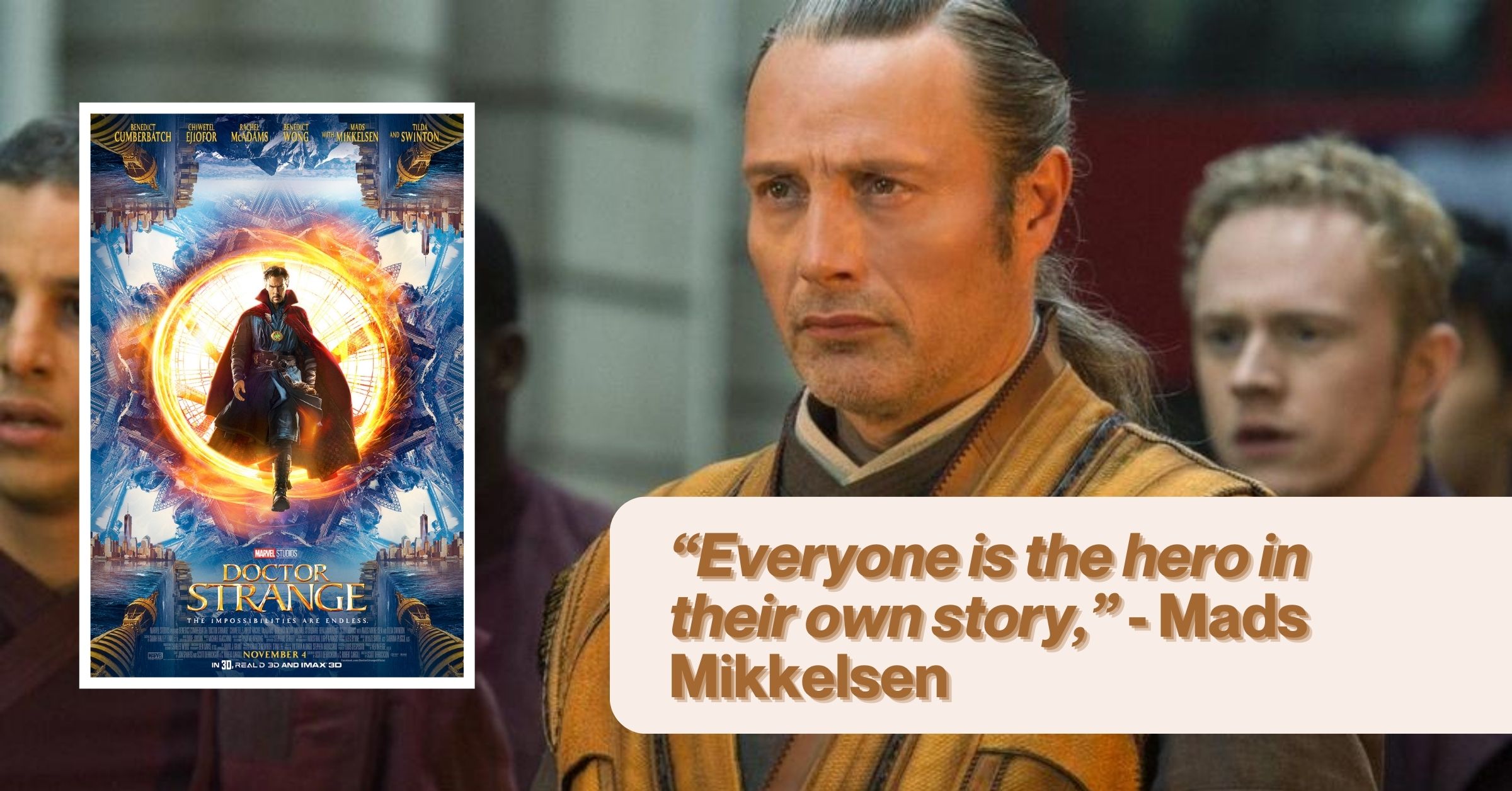
There are two sides. Your side. And their side. Your side is right. Their side is wrong. You wonder to yourself why they believe what they believe. It just doesn’t make any sense. And it’s hard not to see them as monsters. What they stand for will make things worse for everyone. They have such an intractable and yet indefensible position. You can’t understand how any clear-headed person could see the world as they do. Obviously, they are not clear-headed. You feel you have to do whatever is necessary to make things right. Of course, I’m talking about Kaecilius from the movie Doctor Strange. By every stretch of the imagination, Kaecilius is a villain except in his own eyes. Mads Mikkelsen, who plays the character in the film, said something in an interview that stuck with me. Kaecilius doesn’t see it that way. At the presser for the film’s opening he said, “I always play all characters as a hero. I mean, I think we have to look at it that way. The key to any good villain… is that they have a point. It’s not completely crazy what they’re saying. There is a point. Even in Doctor Strange’s eyes he does believe I have a point. Even though it’s for a fraction (of a second), if that.”[1] Everyone is the hero in their own story.
This perspective is important in the waning days of this long presidential season.
Everyone is the hero in their own story. In just a little over two months, it will all be over. All the lying, name calling, accusations, and bitter words will finally come to an end. At least we hope so. After the 2020 election, that wasn’t the case. The hurt, the lies, the attacks that continued after the election culminated on January 6th and we have been living with the consequences ever since. As children of God, we can always hope and pray this time will be different. But even if it is, whichever side “wins” will feel a sense of relief. A sense of victory. A sense that God was on their side. Whoever loses will feel depressed, defeated, and maybe even angry. They might feel Satan himself was working hard against them. And that God’s will was not done. That’s the problem. Both sides think that God is on their side when we know deep down God is on the side of humanity. He doesn’t care who wins. He cares about what we do with the responsibility we’ve been given and how we treat those on the other side. And that’s how we need to look at it. Not as winners and losers but as teammates who disagree. But at the end of the day we all want (or at least we should want) the same thing. To make the world a better place.
How we treat each other and how we come together will say a lot about our faith.
The key is to ask ourselves, “What would Jesus do?” I know it sounds trite, but we can’t go wrong when we model our life on Jesus Christ. If you have a Bible or a Bible app on your phone, please find John 11:35. John 11:35. This is literally the shortest verse in the Bible. If you know much about the history of the Bible itself, you know that there isn’t a uniform way the chapters and verses are assigned. Some verses are extremely long and some are extremely short, but this one is the shortest of all (although according to Wikipedia it is not the shortest when read in the original Greek).[2] I would love to know why whoever assigned the verses to John’s Gospel chose to include only these two words in this verse. Maybe it was because of the impact of this one moment in the life of Christ. Maybe because no more needed to be said. In just two words we understand so much about Jesus. His humanity, his love, and his empathy for all of us. Jesus wept.

But the whole story is much more than these two words.
Earlier, we find out Jesus knows Lazarus is sick but does nothing about it for TWO days. Because we know Jesus and what he can do, we read this and might be a little shocked. After all, he was able to heal a centurion’s son without ever seeing him or visiting him (John 4). If he can do that for a complete stranger, it might seem weird Jesus wouldn’t do the same for this man he knows. But the disciples are relieved. The last time Jesus went to Judea he was nearly stoned to death, and they don’t want a repeat performance. In their minds they probably think Jesus is being prudent or cautious. But what he actually did was wait for an opportunity. He knew he could help Lazarus at any time, but he also needed to help his followers understand who he was – the Son of God. As he approaches the city, Lazarus’ sister Martha hears Jesus is coming. He goes to him and says, “If you had been here, he would not have died.” Jesus hears the pain in her voice, feels her sadness. He comforts her and Martha dashes off to get her sister Mary. When Mary finds Jesus, she falls to her feet crying and says the same thing Martha did, “If you had been here he would not have died.” The grief is palpable to Jesus. He knows this must be the way, but he sees the pain Mary and Martha feel and can’t help but be moved by their sorrow. And he weeps. Jesus doesn’t weep for Lazarus as his family and friends do. He weeps because he empathizes with them. Because he knows the hurt they feel inside. And even if he knows the story will end well, he puts himself in their shoes and know their hurt is real. And then he does the miraculous and brings Lazarus back from the dead. It’s that empathy we seem to be missing in our world today – that ability to put ourselves in someone else’s shoes and understand what they are feeling. We don’t have to agree with them. We don’t have to believe what they believe. But we can be empathic if we choose to be. It’s just that most of the time we don’t choose to be.
Empathy took a nose dive entering the 21st century..
Over a period of 30 years, from 1979 to 2009, researchers found the average empathy score had dropped by 75%.[3] That means 75% of people showed less empathy than they did 30 years before. 75%! In another study of college students comparing empathy before and after the year 2000, it showed a 40% drop after the year 2000. What was most stunning, it wasn’t even hard to fake empathy on the study. The questions were so obvious that anyone who just wanted to SEEM like a nicer person could have easily scored high without even trying.[4] On the survey[5] you’re asked how well a statement describes you, and they give you statements like “I often have tender, concerned feelings for people less fortunate than me” or “When I see someone being taken advantage of, I feel kind of protective towards them.” An empathic person would of course highly identify with those statements. They are SO blatant that it doesn’t even seem to be worth asking and yet 40% of students could not even muster fake empathy. That’s how bad the situation had become. Not only were students less empathic, they couldn’t even pretend to be anymore.

The good news is empathy can be learned.
As evidenced by a recent study after the pandemic by the same team. They found young people today show about the same empathy as did their 1970’s counterparts![6] Our own capacity for empathy can grow too simply by trying.[7] It’s not just an innate trait. It’s something that can be learned with just a little bit of effort. I read an article in TIME magazine that offered four simple ways to help increase your empathy.[8] 1. Stop and listen – take time to really listen to other people. Learn to reflect back people’s feelings. It works. Even when you simply parrot what other people are saying, they often feel heard. And that is something powerful. 2. Ask your barista (or Subway sandwich person or Walmart store clerk) how their life is going. Just engaging other people connects you in different ways and helps you to see them not as stereotypes but as people. Take time to say “hi” to people you don’t know. 3. Read a book. This opens your mind to different thoughts and ideas. Especially when you read fiction books! And 4. Look into people’s eyes. The eyes say a lot about a person and being willing to look in another person’s eyes, creates a connection and can help you to better understand them. It might also feel awkward, but that’s okay.
Everyone is the hero of their own story.
And I’m not saying you need to believe they are right, but simply that if we understand why people think the way they do, we can do something to make the world a better place. Studies have shown that empathic people make better doctors,[9] better leaders,[10] and I’m guessing people you would be more likely to hang out with. I’m also thinking empathic people might be better equipped to lead others to Christ who are very different from themselves. Because the key to helping people find Jesus is to know where they are on the path and we can’t do that if we only see life from our own point of view. We have to get better at seeing others.
One of my favorite episodes of The West Wing is about Ainsley Hayes.
Ainsley is a Republican lawyer in the Democratic Bartlet White House, and Ainsley is very Republican. But President Bartlet decides he wants her in his administration. Despite the arguments from the rest of the staff, he decides he needs to hear the opinions of people who think differently than him and so he invites her to join. Everyone is upset about it, even Ainsley, because this was not how she expected to work for the White House. But she gives it a chance. So when she meets some friends at a restaurant for dinner and they ask her, “Did you meet anyone there who wasn’t worthless?” She tells them, “Don’t say that. Say they’re smug and superior, say their approach to public policy makes you want to tear your hair out. Say they like high taxes and spending your money. Say they want to take your guns and open your borders, but don’t call them worthless. At least don’t do it in front of me. The people that I have met have been extraordinarily qualified, their intent is good, their commitment is true, they are righteous, and they are patriots. And I’m their lawyer.” Often when we dig beneath the surface we realize we’re not truly all that different. We may have our differences ad sometimes those divides are deep, but we can all come to the table together and bring healing to our families, our communities, and our country. We just need to learn to stand in one another’s shoes. In the name of the Father and of the Son and of the Holy Spirit. Amen.
[1] Taken directly from the presser I attended while doing my Disney blog.
[2] https://en.wikipedia.org/wiki/Jesus_wept#cite_note-2
[3] https://www.scientificamerican.com/article/what-me-care/
[4] https://www.psychologytoday.com/blog/born-love/201005/shocker-empathy-dropped-40-in-college-students-2000
[5] You can take the survey for yourself here: https://umichisr.qualtrics.com/jfe/form/SV_bCvraMmZBCcov52?SVID=
[6] https://www.vox.com/future-perfect/24137520/americans-empathy-new-compassion-research
[7] http://www.nytimes.com/2015/07/12/opinion/sunday/empathy-is-actually-a-choice.html?_r=0
[8] http://time.com/3562863/5-ways-to-be-more-empathetic/ They actually offered five ways, but one was for the classroom and for young children only.
[9] http://healthaffairs.org/blog/2014/02/25/empathy-the-first-step-to-improving-health-outcomes/
[10] http://www.huffingtonpost.com/douglas-labier/why-humble-empathic-busin_b_6042196.html
More Than Chicken Soup

In the 70’s, they would have called them hippies.
In the 90’s, they were part of the New Age movement. Today, they are thought of as pioneers. The idea of holistic healing sounded esoteric 50 years ago, but over time science caught up with intuition and we know that good health is about body, mind, AND spirit. True healing is about the integration of all three aspects of what makes you…YOU! We also know that when things are not going well in any one of these three areas, our whole self is impacted. When we are depressed or anxious, it can cause upset stomach, poor sleep, headaches, and a variety of other symptoms. Together, these often bring down our spirit and make us feel disconnected. When our bodies are struggling with illness, it can be taxing on our minds and on our souls as we struggle to battle against the whatever’s invading us. And when our spirit is crushed due to heartbreak or fear or stress, it can manifest in both our bodies and minds. The more we learn, the more integrated and inseparable these three aspects of ourselves seem to be.
That’s what makes the mental health crisis in America so devastating.
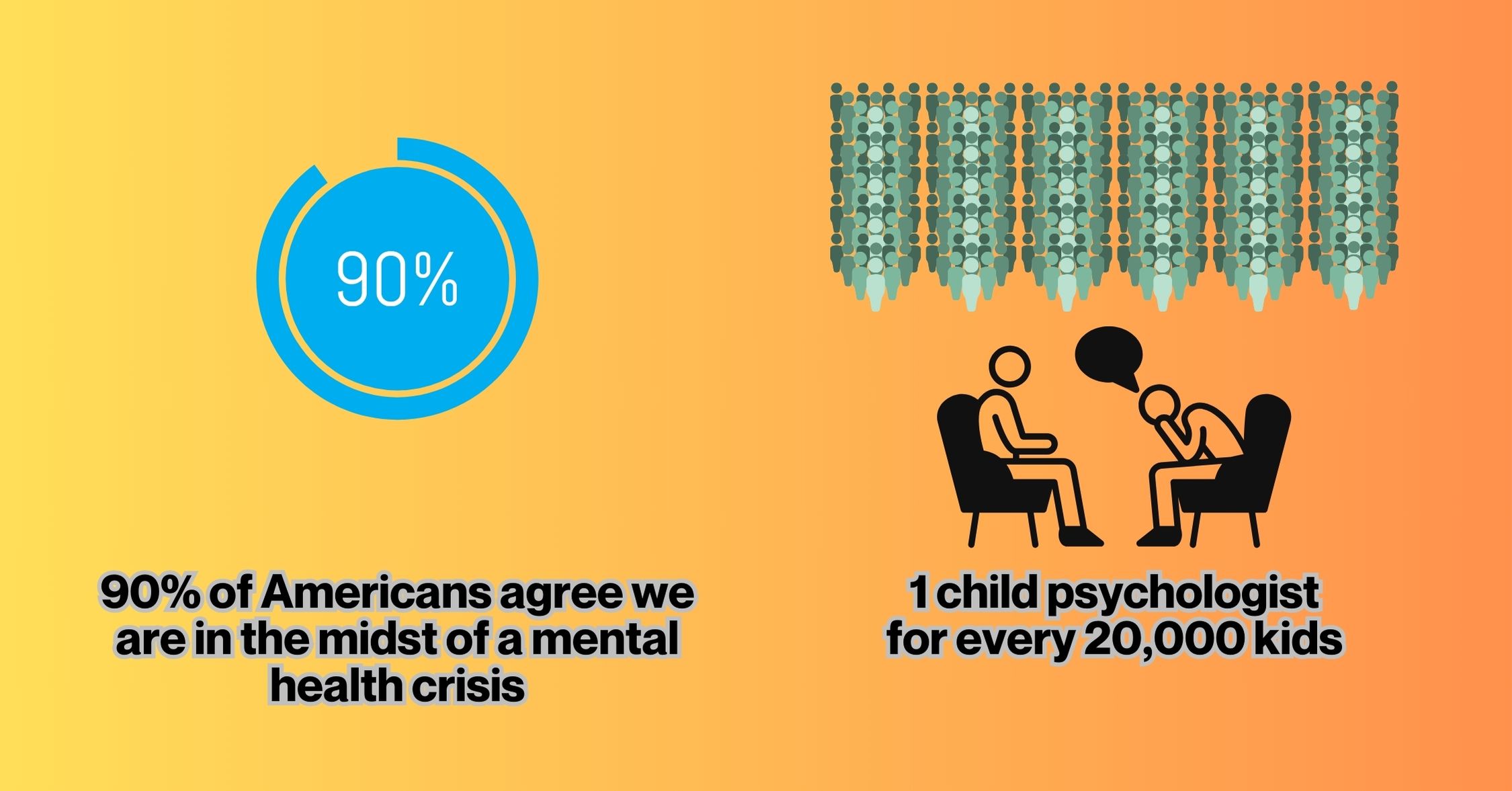
It impacts more than just our mental well-being but invades every aspect of our lives and the lives of those around us. Today, nearly 90% of Americans believe we are in the midst of a mental health crisis with over 50% of adults saying either they or a family member has experienced a severe mental health crisis personally. Those problems range from suicide to self-harm to homelessness to drug overdoses to name just a few.[1] But even those in crisis don’t always get help, even when they want to. One in four adults said they thought they might need mental health services, but didn’t get them.[2] That’s more than 83 MILLION people.[3] Can you imagine that? The biggest impediments to getting care are probably not hard to guess: cost, lack of insurance coverage, and not enough providers.[4] “Sixty percent of psychologists reported having no openings for new patients…” in the latest 2022 survey.[5] It gets even worse for kids. According to the American Psychological Association, half of the children who have a mental health disorder do not get the treatment they need, and this was before the pandemic.[6] It’s no wonder considering that for every 100,000 people under the age of 18, there are only about 5 psychologists trained to help them.[7] Five. That’s one psychologist for every 20,000 children. And those are centralized in usually urban and suburban areas. Children in rural neighborhoods generally don’t have access to any mental healthcare. Again, according to the APA that’s about 80% of the counties in America.[8] This doesn’t even take into account how mental illness contributes to homelessness or drug addiction.[9] It’s going to take more than chicken soup to solve this problem.

As Christians, we have a moral imperative to heal those who need it.
And that imperative is the same whether we are struggling physically, mentally, or spiritually. If you have a Bible or a Bible app with you, please go to the Gospel of Matthew, chapter 10 beginning with the first verse. We’re going to be reading today from Matthew 10:1-8. Now, when this passage takes place, it is still in the early stages of Jesus’ ministry, but already he was doing the miraculous and everywhere he went he did two things – share the Gospel and heal the sick. Share the Gospel and heal the sick. In Matthew 4, soon after he gathers the first of his disciples, the Bible tells us in verse 23, “23 Jesus went throughout Galilee, teaching in their synagogues, proclaiming the good news of the kingdom, and healing every disease and sickness among the people.” In Matthew, we see a real focus on Jesus as healer. From that point in his ministry to the part we’re going to be reading about this morning, Jesus goes on a healing spree. He heals a man with leprosy, a centurion’s servant, a paralyzed man, a dead girl and her mother, two blind men, and a man made mute by demon-possession. He even healed Peter’s mother-in-law! Funny thing, I never pictured Peter being married. But there it is. Anyway, that’s where we pick up in our reading for this morning. Jesus is gathering the twelve disciples together for the first time and sending them out into the world.
1 Jesus called his twelve disciples to him and gave them authority to drive out impure spirits and to heal every disease and sickness. 2 These are the names of the twelve apostles: first, Simon (who is called Peter) and his brother Andrew; James son of Zebedee, and his brother John; 3 Philip and Bartholomew; Thomas and Matthew the tax collector; James son of Alphaeus, and Thaddaeus; 4 Simon the Zealot and Judas Iscariot, who betrayed him.
5 These twelve Jesus sent out with the following instructions: “Do not go among the Gentiles or enter any town of the Samaritans. 6 Go rather to the lost sheep of Israel. 7 As you go, proclaim this message: ‘The kingdom of heaven has come near.’ 8 Heal the sick, raise the dead, cleanse those who have leprosy, drive out demons. Freely you have received; freely give. – Matthew 10:1-8
As always, Jesus was ahead of his time.
He doesn’t focus only on the physical needs of those he heals, but he seeks to heal them holistically by bringing together the physical and spiritual at the same time. Listen again to verses 6-8, “Go rather to the lost sheep of Israel. As you go, PROCLAIM THE MESSAGE: ‘The kingdom of heaven has come near (meaning Jesus).’ Heal the sick, raise the dead, cleanse those who have leprosy, drive out demons….” Proclaim the message and heal the sick. We heard that same theme in Matthew 4 earlier when Matthew tells us that Jesus proclaimed the good news and healed every disease and sickness among the people. And again in chapter 9 where it says in verse 35, “35 Jesus went through all the towns and villages, teaching in their synagogues, proclaiming the good news of the kingdom and healing every disease and sickness.” Healing of both body and spirit went hand-in-hand. Physical healing alone can be a powerful witness to God’s power, but when Jesus healed, he did more than just cure them of their physical ailments. He also brought healing to their souls by giving them the hope we share in Christ. And that is something we as Christians can do in this time of crisis.
When you cast a vote this Fall, I hope you will consider this topic as part of your decision making.
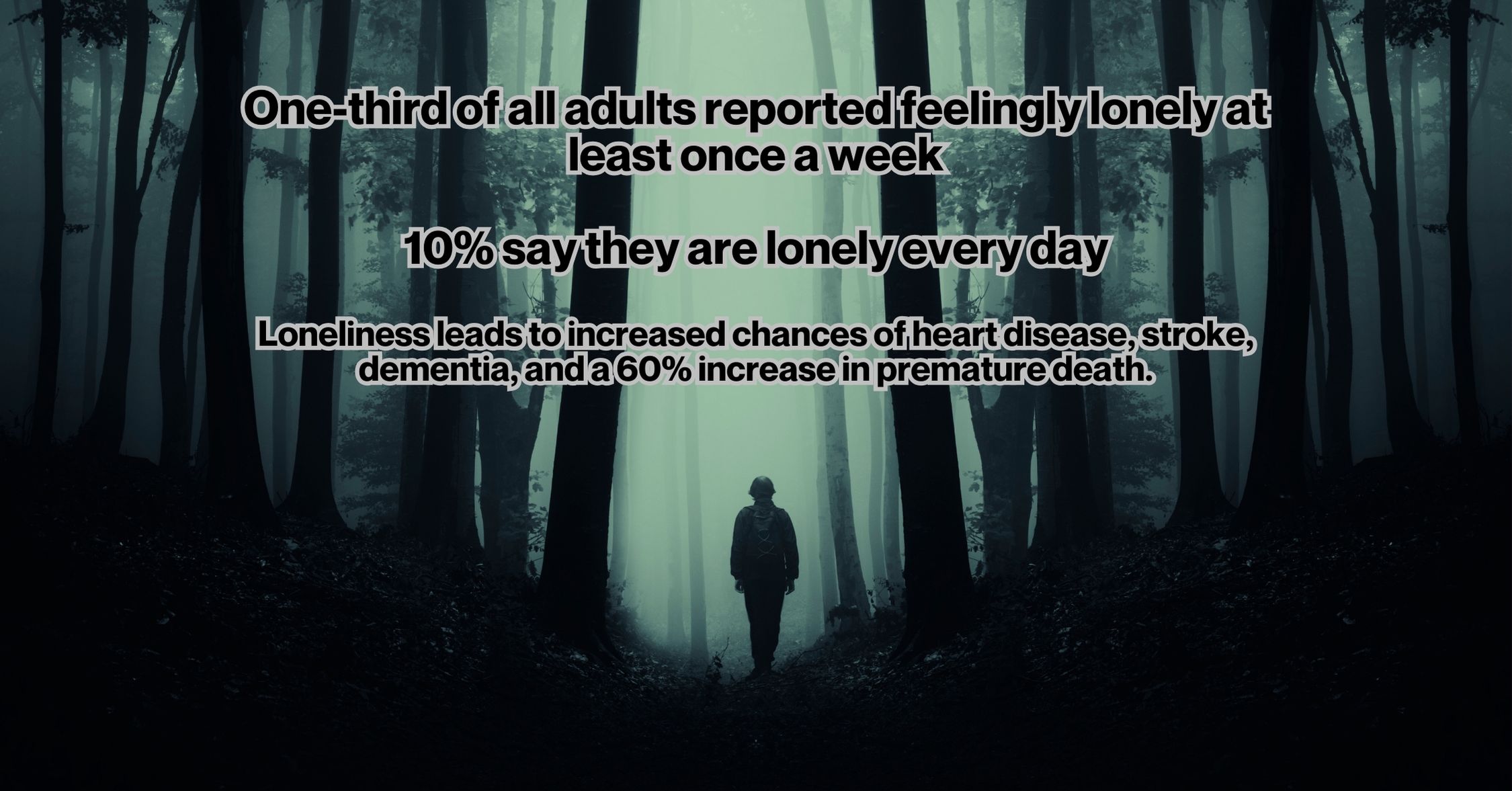
It’s important because some of the solutions to providing better care are beyond our grasp as individuals. But that doesn’t mean we are without tools. Obviously, prayer is a big tool in our tool kit, but the power of presence is often overlooked. You don’t need special training to be a presence in someone’s life. And sometimes just noticing when a person is not behaving the way they normally do is a small but important part in getting them the care they need before it becomes life-threatening. Another way we can help bring healing through presence is through invitation. One of the reasons we have our big events like the “End of Summer Potluck Celebration” and “Cookies and Carols” and the Easter Egg Hunt is to be a presence in our community and let them know we are here for them. But the even bigger reason is for you to have a chance to invite friends and family to come with you to these events and give them an opportunity to feel the loving presence of Christ in our church family. Just last year, the surgeon general declared an epidemic of loneliness and isolation. He said even before the pandemic, “half of U.S. adults reported experiencing measurable levels of loneliness.”[10] A poll by the APA showed that nearly a third of adults reported feeling lonely at least once a week, and 10% say they are lonely every day.”[11] Loneliness, often in the form of social disconnection, can lead to severe mental health challenges. What shocked me was to learn that loneliness can have the same impact on premature death as smoking daily![12] The Surgeon General reported that poor or insufficient connection includes a “29% increased risk of heart disease, a 32% increased risk of stroke, and a 50% increased risk of developing dementia in older adults.” As well as a 60% increase in premature death.[13] But more than that, loneliness leads to other consequences mentally including clinical depression and anxiety. The solution? More connection!
As a church, that is what we do well.
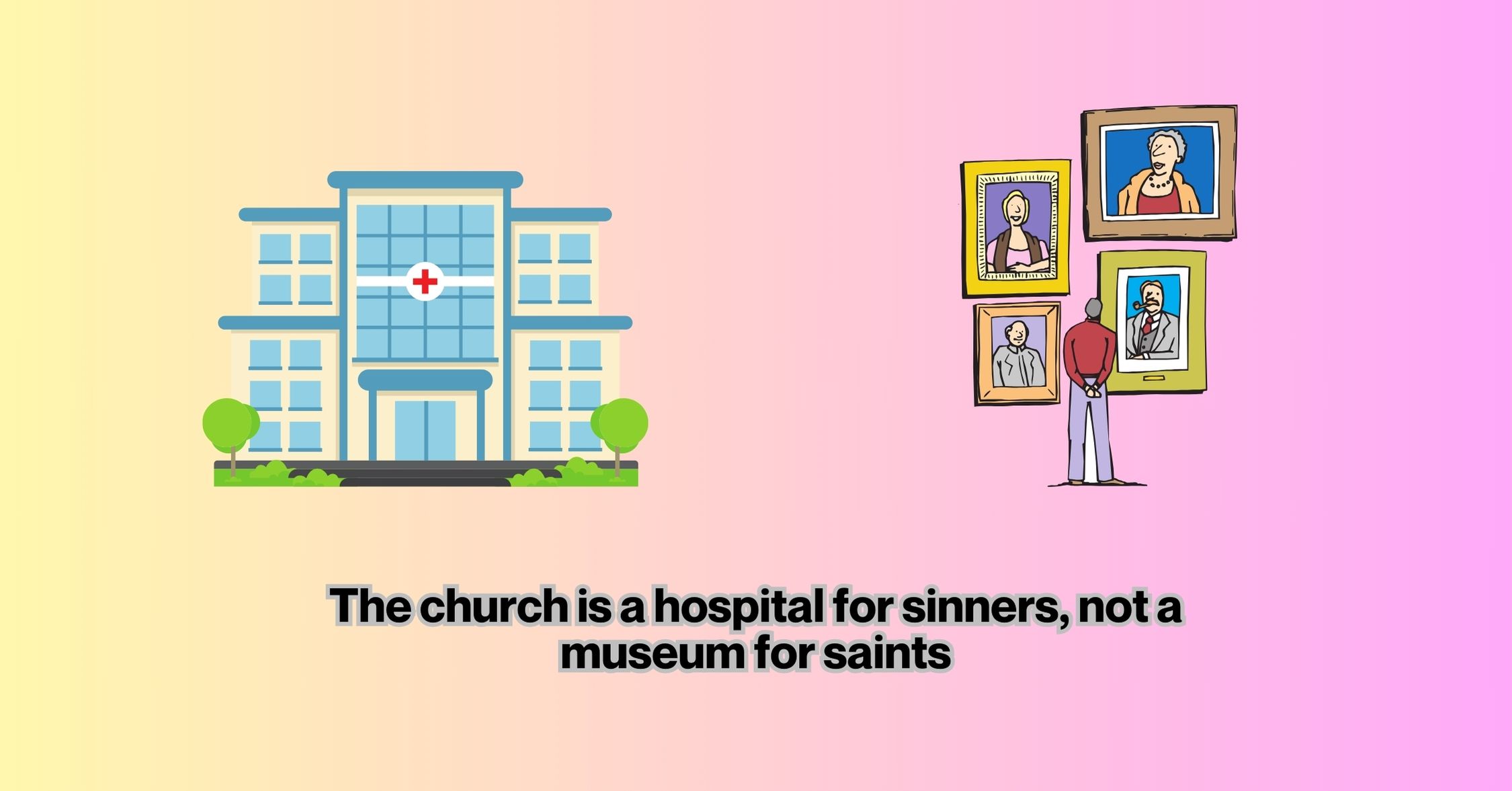
When we are at our best, the church is a community that not only provides social connection but links it to a future hope in Jesus Christ. The healing of mind, body, and soul is helped at least in part by a connection to a healing community like our church. I’m reminded of that famous quote, “the church is a hospital for sinners, not a museum for saints.”[14] We are in the business of healing. Sometimes that takes the form of just being here on Sunday mornings and getting your weekly dose of refreshment in Christ. Sometimes we heal through giving, whether that is through donations or through mission projects. And sometimes, it’s just by being here for one another – whether by prayer, in person, or from a distance. I want to encourage you this week to call, visit, or send a card to someone who might be alone and could use the company. Texting is great for people you keep in touch with regularly, but for a really personal touch a call, visit, or personal card is much better. With so many of us suffering from mental issues, keeping in touch can sometimes save a life. Medicine is certainly a blessing, and we have come so far in so little time. Even in my lifetime, cancer was basically a death sentence when I was a kid, and today so many forms are treatable. My kidney transplant would have been so much more rare if I needed it as a child. But the more we learn, the more we understand that healing is a multi-faceted process that involves more than just the body. Let us bring a light to this problem and do what we can to fight it head on. Because sometimes it takes more than chicken soup.
[1] https://www.kff.org/report-section/kff-cnn-mental-health-in-america-survey-findings/
[2] Ibid
[3] America’s population is 333.3 million people according to Google as of 2022.
[4] https://www.apa.org/monitor/2024/01/trends-pathways-access-mental-health-care and https://www.kff.org/report-section/kff-cnn-mental-health-in-america-survey-findings/
[5] https://www.apa.org/pubs/reports/practitioner/2022-covid-psychologist-workload
[6] https://www.cnn.com/2022/10/06/health/youth-parents-mental-health-kff-poll-wellness/index.html
[7] Ibid.
[8] Ibid.
[9] The problem is SO big we really can’t cover it all here. But if you’re interested in the intersection of these issues, Pew did a nice article summarizing it along with possibilities for solutions.
[10] https://www.hhs.gov/about/news/2023/05/03/new-surgeon-general-advisory-raises-alarm-about-devastating-impact-epidemic-loneliness-isolation-united-states.html
[11] https://www.axios.com/2024/05/24/mental-health-pandemic
[12] Op Cit. hhs.gov article cited in 10.
[13] Ibid.
[14] While a very famous line who ACTUALLY originated it is highly debated. Augustine of Hippo is often credited but there are other sources that quote other people.
Won’t You Be My Neighbor?
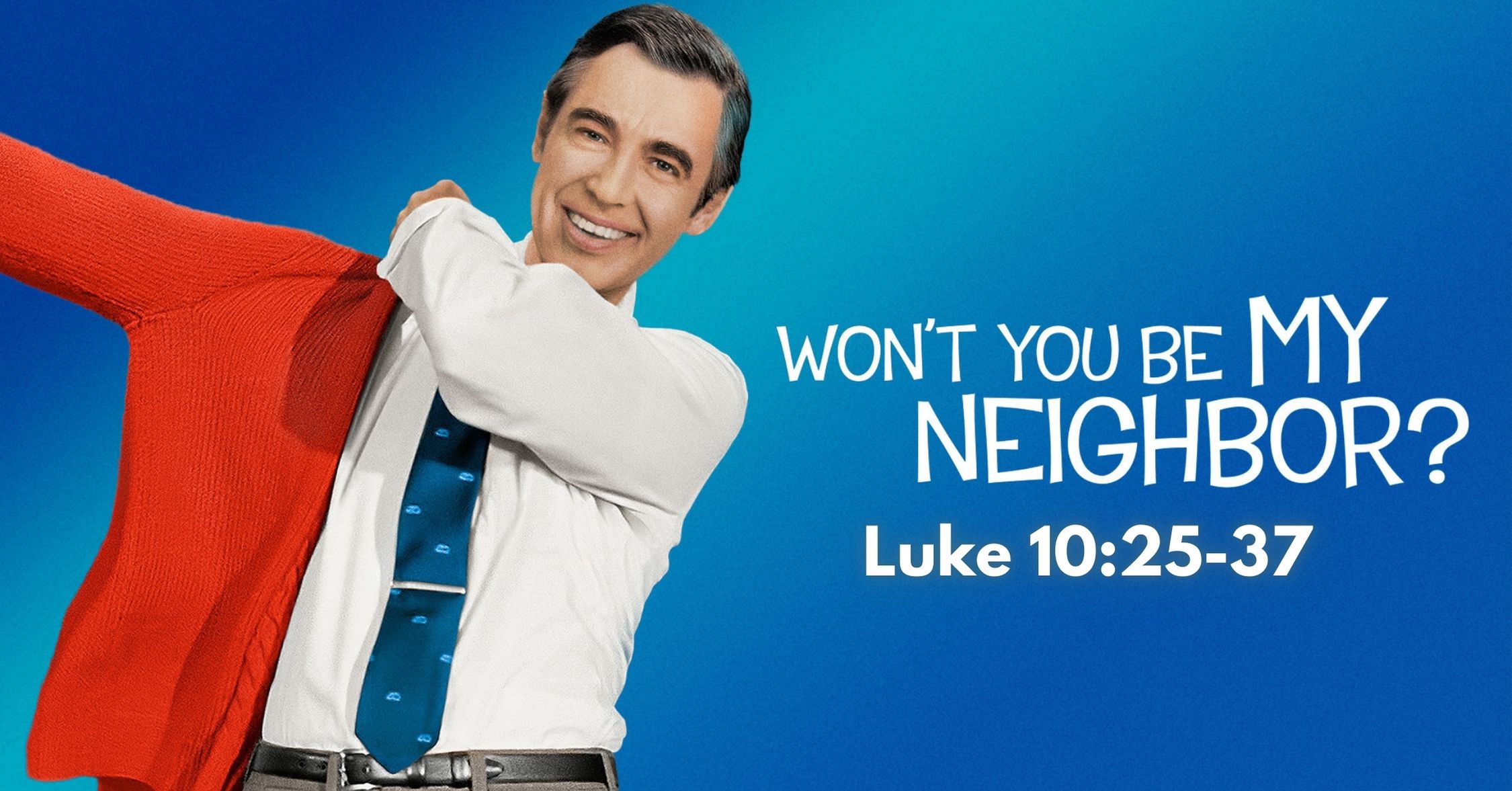
I wanted to live in Mr. Rogers’ Neighborhood.
Who wouldn’t? Specifically, I wanted his house. I loved “Picture Picture,” Trolley, that awesome stoplight he had in his house. I still want one! It just seemed like such a great place to be. Mister Rogers loved EVERYBODY. He thought you were special just the way you are, and he said it every day. And, he wanted me to be his neighbor! It was in his welcome song. “Won’t you please, won’t you please, please won’t you be my neighbor.” Everyday, I would watch that show and loved how comfortable Mr. Rogers would make me feel. He exemplified everything I would want in a neighbor. He was kind. He was thoughtful. And he always made me feel welcome. No matter who you were, if you’re a boy or girl, Asian or Caucasian, Christian or Muslim, Mr. Rogers welcomed you. And that was really the key. It didn’t matter who you were, Mr. Rogers welcomed you no matter what. You were always invited into his home.
Somewhere along the way, we’ve forgotten what it means to be that kind of neighbor.
Instead, we have grown fearful. Fearful of those who don’t look like us, who don’t act like us, who don’t speak like us. Adding to that fear are vicious untruths about immigrants and their effect on society. They are stealing our jobs! They are committing horrible crimes! They are taking over the country! All of these are false. Jobs that are going to immigrants (both documented AND undocumented) are those that couldn’t or wouldn’t be filled by our own citizens. According to the Stanford Report, “Today, immigrants tend to hold jobs that have few available U.S.-born workers, including positions that require advanced education like those in tech and science, and jobs that require very little education like picking crops by hand, washing dishes, or taking care of the elderly…”[1] Another interesting factoid, a study from the Bush Institute found that immigrants on average are more likely to CREATE jobs than native-born Americans.[2] As for pursuing a life of crime, immigrants (both documented and undocumented) were less likely to commit a crime than those of us who were born in America. More surprising? Ousey and Kubrin did a 20-year study on the subject and found that “communities with more immigration tend to have less crime, especially violent crimes like homicide.”[3] Maybe we’d all be better off if more immigrants came to our shores. Crimes by undocumented immigrants also is a falsehood. A study in Texas found that undocumented immigrants were 37.1% LESS likely to be convicted of a crime.[4] As for fears that immigrants are tearing across our borders, our immigration rates now are about the same as they were over 100 years ago. While it’s true there are more of them, as a percentage of the population it’s still about 14%.[5] What’s changed is where they come from. Up until 1920, nearly 90% of immigrants were from Europe. Now, most come from Mexico with Asia and the rest of Latin America coming in second and third.

We have forgotten we are a country of immigrants.
If the original native people of America had treated us like we are treating those now coming to our shores they likely would have been better off. And we would not have had the opportunities for which so many have fought and died. Why does it seem so difficult for us to love our neighbor as Christ commanded? Perhaps the most famous “love your neighbor” passage in the entire Bible. Most people who have never read the Bible will understand the reference. It’s the parable of the Good Samaritan. We’ve heard of Good Samaritan laws. We’ve heard of people who are selfless being referred to as Good Samaritans. But this is where that phrase came from. Luke recorded this story as Jesus told it to the lawyer to make a point – the key to eternal life is in loving your neighbor. The key to eternal life is in loving your neighbor and Jesus was very specific about how to do that.
25 On one occasion an expert in the law stood up to test Jesus. “Teacher,” he asked, “what must I do to inherit eternal life?” 26 “What is written in the Law?” he replied. “How do you read it?” 27 He answered, “‘Love the Lord your God with all your heart and with all your soul and with all your strength and with all your mind’; and, ‘Love your neighbor as yourself.’” 28 “You have answered correctly,” Jesus replied. “Do this and you will live.”
29 But he wanted to justify himself, so he asked Jesus, “And who is my neighbor?”
30 In reply Jesus said: “A man was going down from Jerusalem to Jericho, when he was attacked by robbers. They stripped him of his clothes, beat him and went away, leaving him half dead. 31 A priest happened to be going down the same road, and when he saw the man, he passed by on the other side. 32 So too, a Levite, when he came to the place and saw him, passed by on the other side. 33 But a Samaritan, as he traveled, came where the man was; and when he saw him, he took pity on him. 34 He went to him and bandaged his wounds, pouring on oil and wine. Then he put the man on his own donkey, brought him to an inn and took care of him. 35 The next day he took out two denarii and gave them to the innkeeper. ‘Look after him,’ he said, ‘and when I return, I will reimburse you for any extra expense you may have.’ 36 “Which of these three do you think was a neighbor to the man who fell into the hands of robbers?” 37 The expert in the law replied, “The one who had mercy on him.” Jesus told him, “Go and do likewise.” – Luke 10:25-37
The one who had mercy on him.
That perhaps is the most telling line in the whole story. Then Jesus tells him, “Go and do likewise.” THIS was the key to everlasting life. To love our neighbor like the Good Samaritan loved this man. A total stranger who could very well have been a robber himself was helped by this Samaritan who had no obligation at all to help. That is the level of engagement Jesus expects from those who follow him; to love your neighbor even if he doesn’t look like you, even if he doesn’t behave like you, even if in other circumstances he would look down on you. Love your neighbor. Had the Samaritan walked by like the priest and the Levite, no one would have thought twice. Probably not even the victim lying there helplessly. Samaritans were shunned by the Jews at the time. They were thought of as heathens. They were looked down upon. And yet, this Samaritan not only bandaged his wounds and treated him, but then took him to a safe place and paid for his well-being. He asked for no thanks in return. He simply did what he knew to be right. He loved his neighbor.
Shouldn’t we do at least as much for those in need?
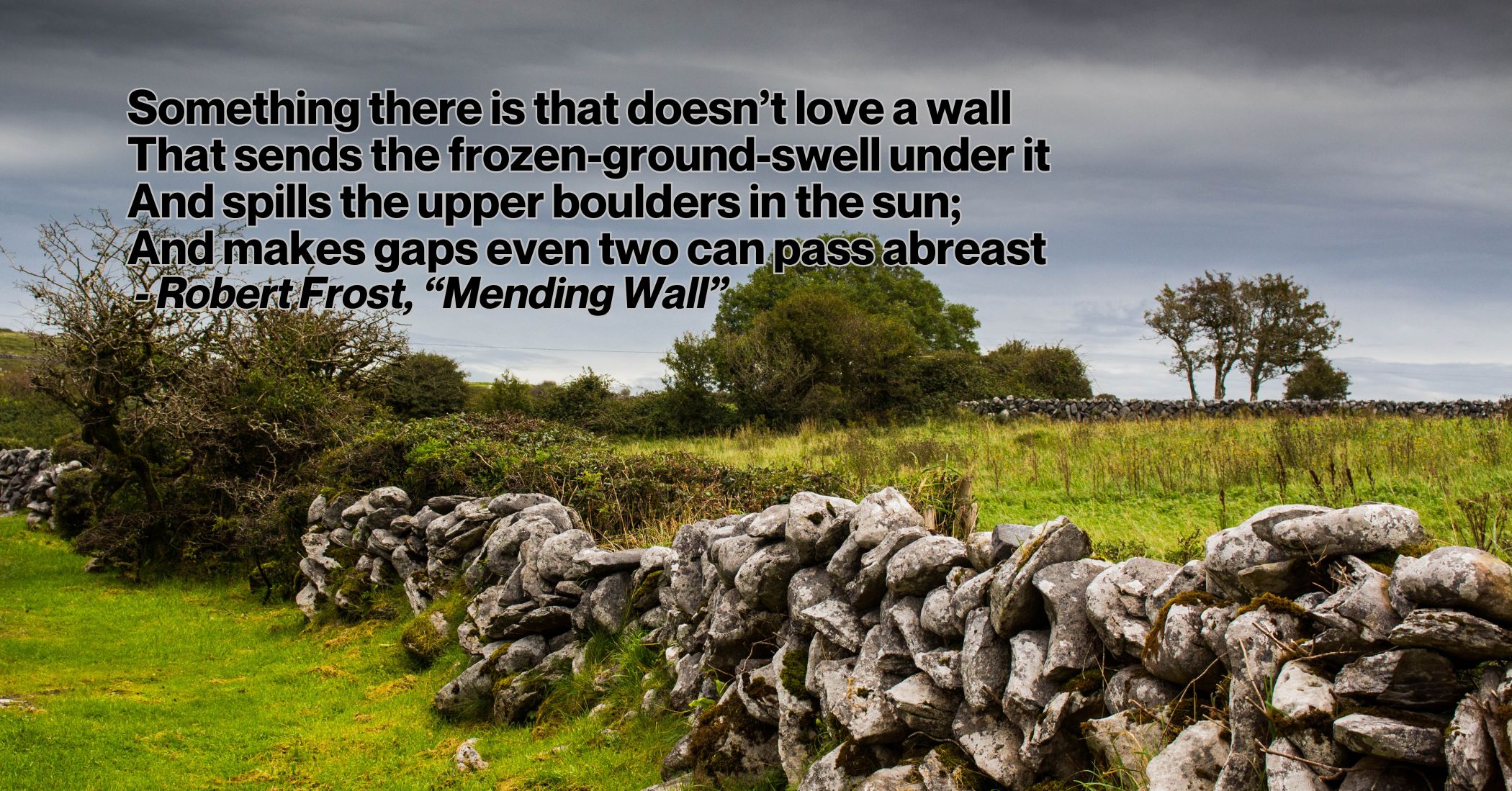
Instead, we talk about border security instead of the land of opportunity. We talk about building a wall instead of how we can help those on the other side of it. It reminds me of Robert Frost’s famous poem, “Mending Wall” in which he writes, “Something there is that doesn’t love a wall, / That sends the frozen ground swell under it / And spills the upper boulders in the sun; / And makes gaps even two can pass abreast…” I think that something is God. God is that something that doesn’t love a wall. God created us for community anot for isolation. More than that, God created us to love our neighbor as an example of our love for God. It’s God that doesn’t love a wall. And yet we build them anyways. Sometimes literally. Funny thing. Did you know that there are between 65,000 and 75,000 illegal Canadian immigrants, too?[6] But nobody talks about them. Over a million Canadian nationals are living in the United States right now. But no one is talking about building a wall to the North. We need to consider whether our objections are really about security or about something else much more sinister that is brewing inside.
Nearly every race that has immigrated to America has experienced this prejudice.
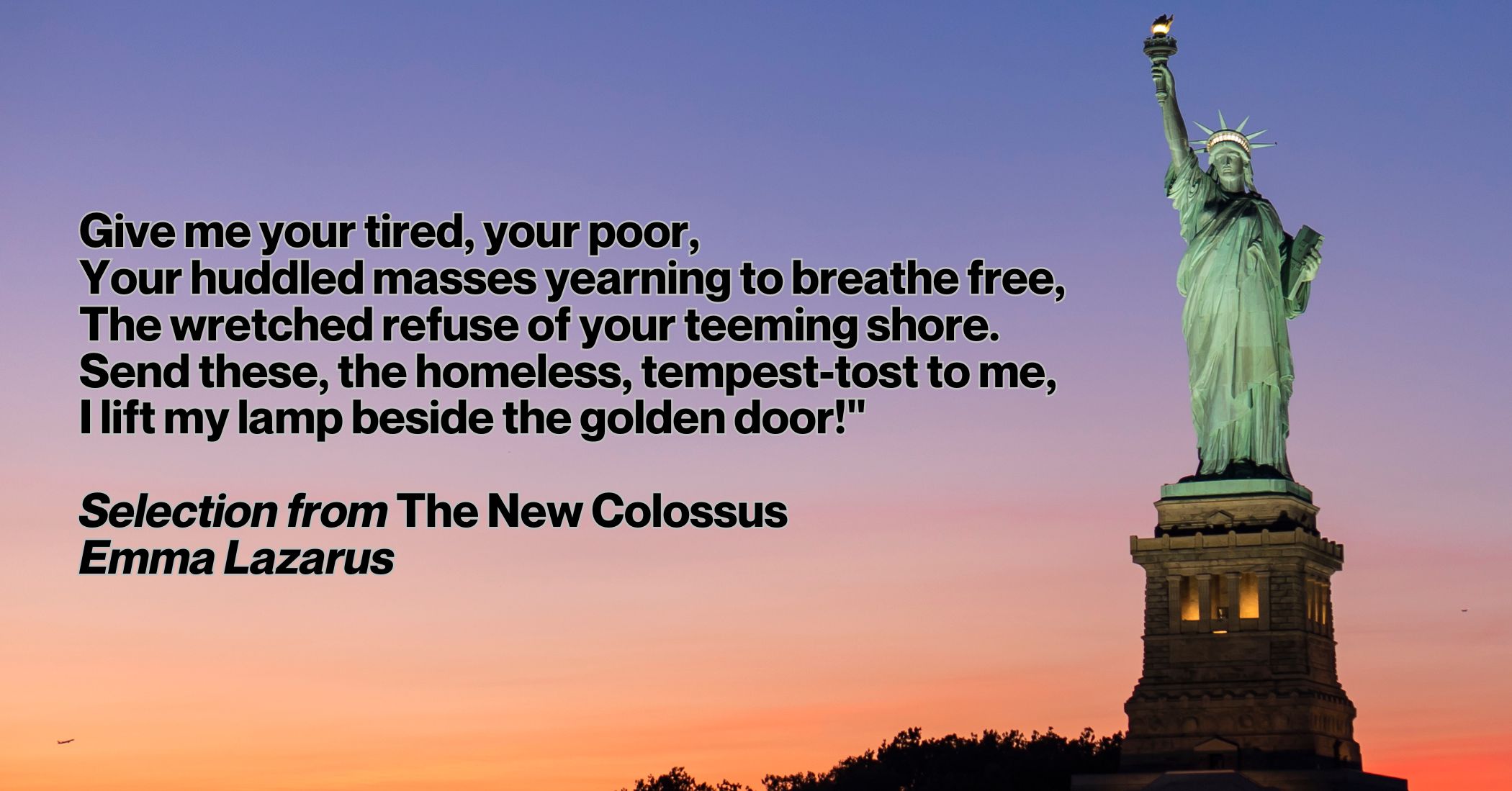
So why haven’t we yet learned from our mistakes? People we happily accept into American society had at one time been shunned like all the rest. While we focus today on immigrants from Mexico and other Latin American countries, the focus used to be on the Japanese and the Chinese and the Germans and the Italians and the Polish and…you get the idea. And with every group of new immigrants irrational cries of stealing jobs and committing crimes were raised as unfounded then as they are now. And let’s not forget the Native Americans rounded up into reservations or African Americans brought over as slaves. Is this the same country that claims to stand for Christians values? Is it the same country that has inscribed on the Statue of Liberty, “Give me your tired, your poor, / Your huddle masses yearning to breathe free?” When I served my first church in tiny Washington, GA, we lived in the parsonage on weekends because it was a three-hour drive one way to get there. And in our heavily Christian neighborhood, we had a neighbor who had on his lawn in the middle or rural Georgia a wooden A-frame sign that read, “Mexicans go home.” The only Mexicans in town by the way were the ones that operated the one Mexican restaurant. Was Mexican immigration an issue in this small rural Georgia town? No. But at least one family decided to lash out anyway. It made me so sad. As Thomas Paine wrote, “These are the times that try men’s souls.”[7] It is not in the times of sunshine and daisies we have to test our beliefs, but in the times of shadow and night. It is when it is darkest that we are truly tested as to the mettle of our beliefs. And if we give in to fear now when the world needs us most to be a bastion for hospitality and love, then what good are we as Christians? Can we be the type of neighbor that our childhood friend Mr. Rogers would be proud of? Let us embrace that spirit of love and hospitality that Fred Rogers shared to the children of the world. Won’t you be my neighbor?
[1] https://news.stanford.edu/stories/2022/06/overturning-immigration-myths
[2] https://www.bushcenter.org/catalyst/immigration/collins-immigration-myths
[3] https://www.washingtonpost.com/politics/2024/02/29/truth-about-illegal-immigration-crime/
[4] https://www.npr.org/2024/03/08/1237103158/immigrants-are-less-likely-to-commit-crimes-than-us-born-americans-studies-find
[5] https://www.pewresearch.org/short-reads/2024/07/22/key-findings-about-us-immigrants/
Cradle to Grave

Who isn’t “pro-life?”
That’s the problem with labels. They are deceiving. If you say you aren’t “pro-life” you sound like a monster. Which is why the opposition doesn’t call itself “anti-life.” They call themselves “pro-choice” because who isn’t pro-choice? Especially in America. What kind of monster lives in America, the bastion of freedom and democracy and doesn’t believe in choice? We get so caught up in labels that we often don’t step back to look at what they mean. And sometimes we get so focused on just one thing we ignore everything else. Like being “pro-life.” What does that mean for us as a Christian? Is being pro-life just about abortion? Or from a Christian perspective, does it encompass so much more?
First, let’s get rid of the myth people WANT abortions.
While we might debate whether people should be able to get one or under what circumstances, nobody WANTS an abortion. People aren’t going around, being promiscuous, and saying, “Oh, if I get pregnant, I’ll just get an abortion.” Nobody is saying that. It is a tough decision every woman must wrestle with when they get one and they certainly don’t need the church to alienate them or stand in judgment over them. Most women who get an abortion never had one before (57%), and the number of abortions per year today is lower than it was in the early 70’s right after Roe v. Wade made it legal and a far cry lower than at its height in 1990.[1] This isn’t an epidemic getting out of control. It really is an issue of morality, and we never do well legislating morality.

But as a Christian, being pro-life should be more than your stance on abortion.
It should encompass everything from the cradle to the grave. Here’s how one critic of the pro-life movement who is a pastor put it:
(He said if someone were truly pro-life) “You would want to do more than prevent abortions.
You’d want to prevent hunger and poverty. You’d want to prevent illiteracy and child mortality and forced prostitution. You’d want to prevent racism and bigotry and homophobia. You’d want kids in the “bad neighborhood” to have great schools and teachers just like your kids have there in the “good neighborhood.” You’d want to support single parents and the terminally ill and the mentally ill by helping them carry their oversized burden.
You’d want religious freedom even for people who aren’t Christian. You’d want LGBTQ people to live and work and worship and love as they desire. You’d want people of color not to have to fear law enforcement and not to be disproportionately incarcerated. You’d want fewer guns in the hands of kids and criminals and those with mental illness. You’d want to prevent violence and workplace termination based on gender identity and sexual orientation. You’d want a living wage for all people who work hard, and healthcare for their children that won’t have to replace their daily meals.
I am a person of Life. That is what my faith calls me to be.”[2]

Life encompasses so much more than the nine months we are in the womb.
And we don’t do a good job of even protecting that. Did you know our country has one of the highest mortality rates among like nations for pregnant mothers?[3] Out of 10 similar countries, we are ranked 10th and overall ranked 55th. If “life” is so important to us, why aren’t we better at it? We also have by far the highest number of gun deaths than any other economically advanced country. We are second overall in total number of gun deaths at 37,040 behind only Brazil.[4] In the show, The West Wing, Toby Ziegler says, “I do know that if you combine the populations of Great Britain, France, Germany, Japan, Switzerland, Sweden, Denmark, and Australia, you’ve got a population roughly the size of the United States. We had 32,000-gun deaths last year and they had 112. Do you think it’s because Americans are more homicidal by nature? Or do you think it’s because those guys have gun control laws?” Today those numbers are much higher for those countries – a total of 4,072 but the United States still has a gun death total more than 8 times all those countries combined. If we truly want to be pro-life, we must realize its more than just reproductive birth rights. It’s a cradle to grave problem and one we need to pay attention to. At least Jesus thinks so.

31 “When the Son of Man comes in his glory, and all the angels with him, he will sit on his glorious throne. 32 All the nations will be gathered before him, and he will separate the people one from another as a shepherd separates the sheep from the goats. 33 He will put the sheep on his right and the goats on his left.
34 “Then the King will say to those on his right, ‘Come, you who are blessed by my Father; take your inheritance, the kingdom prepared for you since the creation of the world. 35 For I was hungry and you gave me something to eat, I was thirsty and you gave me something to drink, I was a stranger and you invited me in, 36 I needed clothes and you clothed me, I was sick and you looked after me, I was in prison and you came to visit me.’
37 “Then the righteous will answer him, ‘Lord, when did we see you hungry and feed you, or thirsty and give you something to drink? 38 When did we see you a stranger and invite you in, or needing clothes and clothe you? 39 When did we see you sick or in prison and go to visit you?’
40 “The King will reply, ‘Truly I tell you, whatever you did for one of the least of these brothers and sisters of mine, you did for me.’
41 “Then he will say to those on his left, ‘Depart from me, you who are cursed, into the eternal fire prepared for the devil and his angels. 42 For I was hungry and you gave me nothing to eat, I was thirsty and you gave me nothing to drink, 43 I was a stranger and you did not invite me in, I needed clothes and you did not clothe me, I was sick and in prison and you did not look after me.’
44 “They also will answer, ‘Lord, when did we see you hungry or thirsty or a stranger or needing clothes or sick or in prison, and did not help you?’
45 “He will reply, ‘Truly I tell you, whatever you did not do for one of the least of these, you did not do for me.’
46 “Then they will go away to eternal punishment, but the righteous to eternal life.”
Whatever you did for the least of these.
Jesus cared about EVERYBODY! He cared about people who were homeless; people who were impoverished; people who were in prison; Jesus cared about the sick and those who were food insecure. And Jesus was critical of those who looked down on others, who treated others without regard for human dignity. He overturned the tables in the temple because of the money lenders and merchants trying to make a profit from God in a Holy space. He often criticized the elders and religious leaders for their lack of compassion and rigid ways of thinking. And he warns us, right there in this passage, that if we behave in the same way, we can expect no different. “…[W]hatever you did not do for one of the least of these, you did not do for me.” We need to treat people as God created them. As Children of God. And we need to do more for people. We need to help and love our neighbor. Not stand in judgment of them.
We are all pro-life.
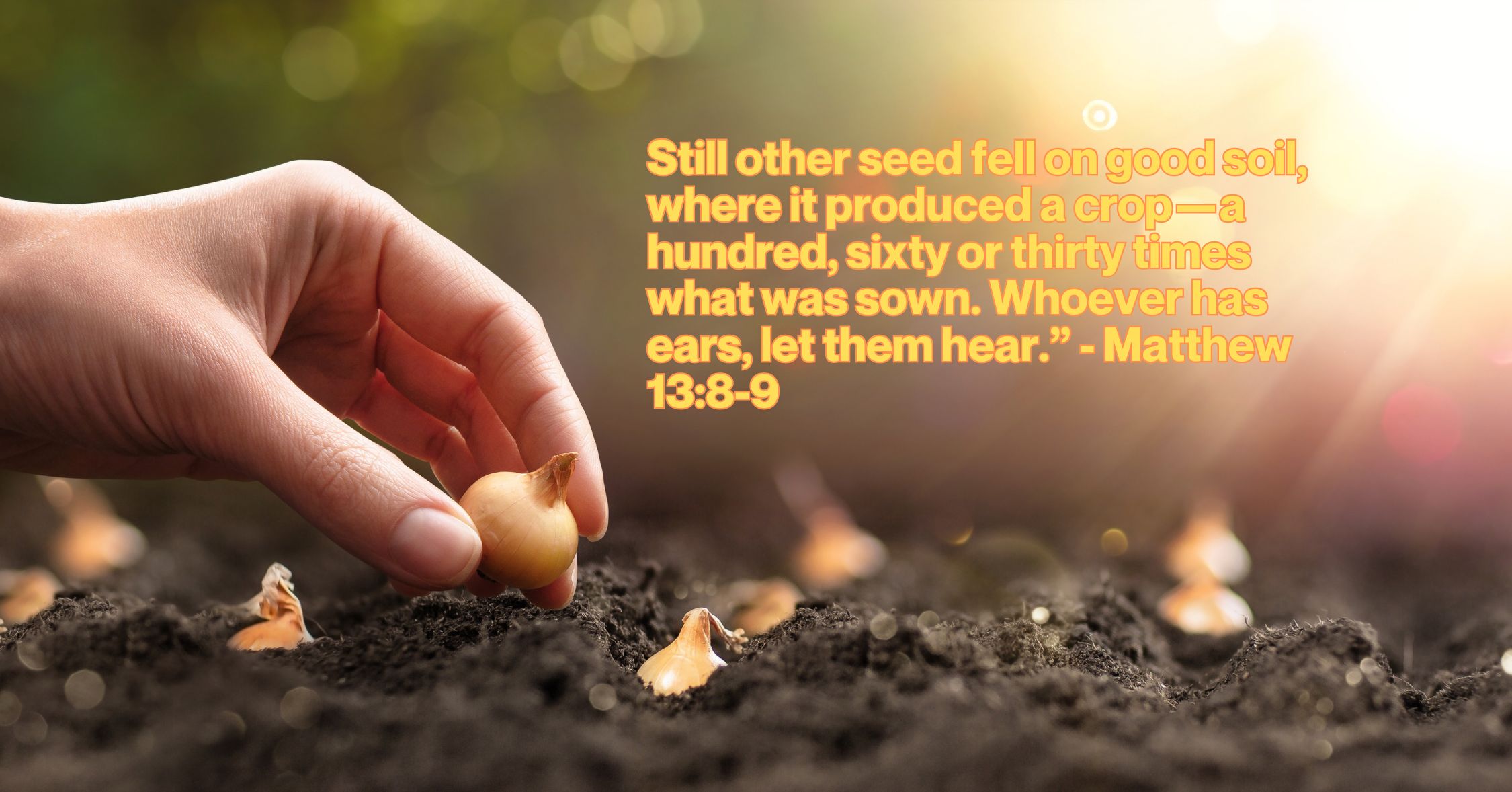
Whether we agree on the legality of abortion is not central to who we are as Christians. We can debate from here to live long day about when life begins and whether legislation works. And you can be a person who hopes for a world without abortion AND STILL be pro-choice. But if we are serious about our faith, we have to do more to love and care for everybody from beginning to end – from the cradle to the grave. We need to work on eliminating poverty, homelessness, and hunger. We need to do a better job of supporting and caring for people in times of trouble like divorce, depression, and illness. And we have to love those who are far from Christ and who may never come to Christ. Our job is to be the farmer who sows the seeds, to do the good work, and let God worry about the seed taking root. If we are to take seriously Christ’s call on our hearts to make disciples in his name, we have to do it from a place of love and not a place of fear or judgment or division. Guard your heart from the things of this world and instead model the love of Christ for all to see. Be an advocate for Life! All life.
[1] According to research done by the Pew Research Group and the Guttmacher Institute. https://www.pewresearch.org/short-reads/2024/03/25/what-the-data-says-about-abortion-in-the-us/
[2] https://www.huffpost.com/entry/white-conservative-christian-friends-i-wish-you-really-were-pro-life_b_12475464
[3] https://www.vox.com/2020/1/30/21113782/pregnancy-deaths-us-maternal-mortality-rate
[4] https://worldpopulationreview.com/country-rankings/gun-deaths-by-country ; https://www.pbs.org/newshour/health/theres-a-new-global-ranking-of-gun-deaths-heres-where-the-u-s-stands
Life on the Spectrum

Life isn’t black and white.
It’s so easy to label people, but that label is often just one aspect of who they are, and maybe not the most important aspect. And maybe not even entirely accurate. When I was at UCLA, I had a roommate named Wayne who was a really nice guy but could be labeled as racist and if you didn’t know him, you would think it was an apt description. He would often stereotype people and made assumptions about them based on those stereotypes. When we first met, I think he was genuinely surprised I didn’t have a pocket protector or wear button-down, short-sleeved shirts. Wayne had opinions about every ethnicity on the planet and none of them good. If you can imagine a stereotype about Asians, Hispanics, African Americans, or some other ethnicity, Wayne thought of it first. We’d stay up late at night talking about life and he would make the most awful comments about someone based only on the color of their skin or the shape of their face. If you didn’t know him, you’d think he was a hard and fast racist, but the funny thing was, I met most of Wayne’s friends and they weren’t at all what I expected. Instead of the sea of monochromatic faces I expected to find, his friends were a rainbow of different colors. White, black, brown, yellow, red…you name it. I couldn’t figure it out until one day he and I were talking, and he made a comment about “all Asians” and then he looked at me and said, “Except for you, Craig. You’re one of the good ones.” I just said, “Thanks, Wayne.” But in that moment, I knew. I knew what the difference was between me and “all Asians.” Wayne knew me, and because he knew me, I was no longer one of “them.”

“They” are evil.
“They” are what is wrong with the world. “They” are going to ruin things for everybody. But really, who are “they?” If you listen to God, “they” are “us.” When you think about the world from a Christian perspective, there is no “they” because every single one of us is part of the family of God. You don’t have to like them all. You don’t have to agree with them all. They might be that strange aunt who always brings Jello salad to the potluck. But in the end, we are united under this one umbrella of Jesus. We forget that. A lot. I hear pastors and politicians who call themselves Christians saying some awful things about “them.” But those identifiers like race, sexual and gender identity, education, wealth, etc. that we like to use are artificial. They are just things we made up to make life simpler. But at what cost? I think we are seeing that cost play out in the political arena today. We have dehumanized the other into a label and dangerously make assumptions about every person under that label. Democrats, so trapped in their ivory towers, they don’t understand the plight of the common person. They are ruining America. Republicans, so closed-minded and secretly racist, they don’t see what a danger they are to Democracy. They are ruining America. Did I get that about right? Those labels extended to every part of our lives. Race, size, gender identity, sexual orientation – you name it and there is probably a stereotype for it. I actually heard someone on NPR saying trans kids were claiming to be trans so they could compete in sports and have a better chance at winning. That defies all logic. A kid would put themselves out there, subject to ridicule, bullying, and harassment, potentially have their life threatened and at the very least get made fun of and stared at to what end? Win a track and field event? Our fears of the other have grown so large that we don’t even regard them as humans. We don’t think of them as one of “us.” And that’s where we need to begin. We need to stop seeing the world in black and white and instead see it for the rainbow of colors that it is.

Black and white thinking can make our lives worse.
Not just for the people who are the targets of our binary thoughts, but for ourselves, too. It can negatively affect your relationships. It can hurt your self-image. It can hold you back from success.[1] When we talk about living on the spectrum, we usually take it to mean being autistic. But more and more people are using this type of framework to talk about all aspects of life. A concrete example is being left or right-handed. Unless you’re missing a limb, most of us make use of both hands. Only about 1% of the population is truly ambidextrous,[2] but how much we can use both hands varies from person to person. Then there are aspects of who we are that are now being understood as being on the spectrum. Researchers studied narcissism – the tendency to focus on oneself at the cost of caring about others – and found that it is what they call a core “dark trait” meaning something we think of negatively but an aspect that we all have in varying degrees.[3] People tend to think that someone either is or isn’t narcissistic but the truth is there is at least a little bit of it in all of us. It’s what psychologists call a “continuous trait.” Today, gender identity and sexual orientation are understood more and more in this way as being fluid instead of static or binary. People aren’t just straight or gay as we can see from the alphabet soup of sexual orientation. And most younger people today understand intrinsically that gender identity is just as fluid even if that is a completely new concept to older generations. Nothing is truly black or white. Not even the colors black and white. According to Adobe, black and white are just shades and not truly colors. But what’s more interesting, when you create the color Rich Black on Adobe using the color code #000000 the software actually adjusts it to include cyan, magenta, and yellow because to our eyes, it is a darker black than black![4]

It’s time to take off the sunglasses and see the world in all its beauty.
As God intended. God made the world with an abundance of diversity and to God each of us is like a snowflake. All of us are his creation, but all of us are unique beings with our own gifts and graces. I think that’s how God sees us. Not as Asian or White or liberal or conservative. God sees us as Cassie and Craig and Gwen and Red and Lorrie and Marilyn… God sees YOU. Not as a sum of your different parts, but God sees YOU as a whole and complete being. We need to do that more often, to think even of those we don’t know (or don’t like all that much) as people beloved by God so we can set aside our differences, embrace the things we have in common, and get to work making the world a better place. We need to stop feeling threatened by what other people do and instead focus on ourselves and our loved ones and make sure WE are living up to the standards God has set for us. Instead of worrying about what “they” are doing, we should focus on doing right ourselves and not standing in judgment of other people. Paul’s letter to the Romans emphasizes this point. In it, there was apparently a dispute over what people ate. I don’t know if it was in the context of communion or just living styles of different churches in Rome or if Paul was just using this as a minor example, but his point was pretty clear. Modeled after Matthew 7:3-5 where Jesus tells the disciples to pull the plank out of their own eye, Paul the churches in Rome to focus on their own account before God instead of worrying about things that ultimately don’t matter.
Accept the one whose faith is weak, without quarreling over disputable matters. 2One person’s faith allows them to eat anything, but another, whose faith is weak, eats only vegetables. 3The one who eats everything must not treat with contempt the one who does not, and the one who does not eat everything must not judge the one who does, for God has accepted them. 4Who are you to judge someone else’s servant? To their own master, servants stand or fall. And they will stand, for the Lord is able to make them stand.
You, then, why do you judge your brother or sister? Or why do you treat them with contempt? For we will all stand before God’s judgment seat. 11 It is written:“‘As surely as I live,’ says the Lord, ‘every knee will bow before me; every tongue will acknowledge God.’”
12So then, each of us will give an account of ourselves to God. Therefore let us stop passing judgment on one another. Instead, make up your mind not to put any stumbling block or obstacle in the way of a brother or sister. 14 I am convinced, being fully persuaded in the Lord Jesus, that nothing is unclean in itself. But if anyone regards something as unclean, then for that person it is unclean.
17 For the kingdom of God is not a matter of eating and drinking, but of righteousness, peace and joy in the Holy Spirit, 18 because anyone who serves Christ in this way is pleasing to God and receives human approval.
19 Let us therefore make every effort to do what leads to peace and to mutual edification.
22So whatever you believe about these things keep between yourself and God. Blessed is the one who does not condemn himself by what he approves. – Selections from Romans 14

Who are we to judge someone else?
Don’t we have enough to worry about on our own without getting in someone else’s way? Paul reminds us of what is important and I love the way he says it, “For the kingdom of God is not a matter of eating and drinking (and you can insert your own petty argument here), but of righteousness, peace and joy in the Holy Spirit, because anyone who serves Christ in this way is pleasing to God and receives human approval. Let us therefore make every effort to do what leads to peace and to mutual edification.” When a new idea doesn’t fit within our life experience, our tendency is to deny it or to treat it as “other.” We condemn it, often without considering it at all. And Paul tells us “…whatever you believe about these things keep between yourself and God.” Today the target of judgment is the LGBTQ community and right now especially transgender kids. I’ve sadly heard Christians condemn their parents or even condemn the kids themselves. And whether you agree or not, I challenge you to hear Paul’s words and then reflect back on other communities Christians have historically attacked as being against the Bible and see where we are now. People of African descent. People of Chinese or Japanese descent. Women. Children. People who had disease. People who were victims of natural disasters. The list is long and sad of how we have condemned these groups and claiming to do so in the name of God. Maybe we should listen to Paul and keep it to ourselves or more importantly, listen to Jesus who told us to pull the plank from our own eye before removing the splinter from another. We have much to learn from each other and when we do so from a place of humility and love, we also share the love of Christ. God created the world in such amazing colors. It would be a shame to limit the beauty of creation with our black and white sunglasses.
[1] https://www.talkspace.com/blog/black-white-thinking-ways-poisons-your-perspective/ ; https://www.healthline.com/health/mental-health/black-and-white-thinking#risks
[2] https://www.healthline.com/health/ambidextrous
[3] https://www.psychologytoday.com/us/blog/darwins-subterranean-world/201601/black-and-white-thinking-in-our-social-worlds
[4] https://www.adobe.com/creativecloud/design/discover/is-black-a-color.html
Horses and Water

You can lead a horse to water, but you can’t make it drink.
How many of you know someone or knew someone who should not be with the person they are with? When I was in college, I had more than one friend in that situation. Almost always a girl. Why? It’s not because women are more gullible or more dependent. It’s because there are so few guys worth it at that age. And I don’t know how much better it gets as you get older. But if you try to tell them how stupid they are for being with that person or if you try to set them up with someone else or if you try to somehow force them to not be with that person, all you’ll do is ruin your friendship. I can tell you from personal experience it just doesn’t work. Even as a parent, you can only say so much. You can point out the facts. You can share from your own experience. But ultimately, your friend or your child or your family member must choose for themselves a better life.
This is true in other facets of life, too.
Addiction comes to mind as the most clear-cut example. Sometimes an intervention works, but if it does it’s only because the person realizes through the intervention how much love and support they have, and it gives them the courage to leave a life of addiction. But you can’t force an addict to stop being addicted. They have to want it for themselves, or it will never last. Torture is another field where forcing someone to do something just doesn’t work. Some people think torture is justified in some situations; sort of a Machiavellian “end justifies the means.” But if you’re trying to get intelligence you can use, you might be surprised to find out torture doesn’t work, regardless of the end OR the means. In the short-term you might get a confession, but the reliability of that confession is suspect – even when the person being tortured WANTS to cooperate! According to Professor O’Mara, an expert in the field, the stress, pain, and fear that comes from torture impairs recall and cognition and can create false memories that the person believes to be true. Torture also encourages lying instead of telling the truth.[1] You can lead a horse to water but you can’t make it drink.

But that doesn’t seem to stop us from trying.
I’ve been really disturbed at how some people who identify as Christian have been trying to impose their own agenda thorough politics and using God as an excuse for it. There is a very good reason why the Founding Fathers created the 1st Amendment. It was to explicitly forbid a national religion from forming, while ensuring people had the freedom to worship whoever and however they chose. And they did that because they themselves were often victims of religious persecution. They didn’t want anyone else to have to go through that. It’s one of the primary reasons this country was formed. But more and more we are edging closer to eradicating that line between church and state. In fact, Rep. Lauren Boebert incorrectly said in public that “The church is supposed to direct the government. The government is not supposed to direct the church.” She went on to say “I’m tired of this separation of church and state junk that’s not in the Constitution. It was in a stinking letter, and it means nothing like what they say it does.”[2] I must admit I was pretty stunned how completely wrong she is about all of this. It actually IS part of the Constitution, and it means EXACTLY what it says.[3] But it illustrates how so many Americans completely misunderstood the intentions of the early founders. They specifically did not want a state religion because so many people who came to America were fleeing religious persecution. They didn’t want to be under the thumb of the church, and they saw how bad it could become when a political leader was also de facto the head of the church, and they didn’t want that to happen here. But more and more self-proclaimed Christians are pushing that boundary and are trying to make America an explicitly Christian nation.
Now, is that a bad thing?
No. Our directive from God almighty is to “make disciples of all nations, baptizing them in the name of the Father and of the Son and of the Holy Spirit…” It’s right there in Matthew 28. We call it The Great Commission. Ideally, the work we do as a church would turn the entire world into a Christian planet, worshipping God together. But not so we can win. Not so we can rub other people’s faces in our Christianity. But to provide an opportunity for everyone to know the love of God. Making laws that force people to accept our faith is not what God intended.

Yet that’s exactly what has been happening, now more than ever. The Oklahoma State Superintendent mandated the Bible be taught to all students in 5th – 12th grade as part of their curriculum regardless of their religious beliefs. He also said he plans to make the Ten Commandments required learning.[4] You might not think that’s such a big deal, but would you feel the same if you lived somewhere that forced you to learn the central tenets of Islam or Buddhism or Hinduism? Suddenly it might seem like a big deal. Louisiana just mandated that all state schools must display the Ten Commandments. According to Gov. Landry who signed it into law, he said, “If you want to respect the rule of law, you’ve got to start with the original lawgiver, which was Moses.”[5] First, that statement is false. The original lawgiver was God and Moses’ documents were not the first laws written for a society. Hammurabi preceded Moses by at least 750 years and King Ur created the Code of Ur-Nammu more than a thousand years before that.[6] And second, there’s no proof displaying the Ten Commandments leads to more moral behavior. We hear stories all the time about corruption within the church – child abuse, embezzlement, and adultery to name just a few. The Ten Commandments haven’t stopped humans from being fallible. And that’s just two examples of many that are being introduced in many areas of our country, both big and small. Believe it or not, the Apostle Paul came across this same problem nearly 2000 years ago. At the time of his writing, non-Jewish people (Gentiles) who wanted to become Christ followers thought they needed to become Jewish to truly be disciples. This wasn’t helped by most of the Apostles who also believed people needed to convert to be followers. The biggest obstacle? Male circumcision. A painful process as a baby, it was even more painful for adults who didn’t have anesthesia to help them. But Paul receives a revelation from God and realizes this attitude isn’t God speaking to his people but human beings imposing their own ideas onto God.
It is for freedom that Christ has set us free. Stand firm, then, and do not let yourselves be burdened again by a yoke of slavery.
2 Mark my words! I, Paul, tell you that if you let yourselves be circumcised, Christ will be of no value to you at all. 3 Again I declare to every man who lets himself be circumcised that he is obligated to obey the whole law. 4 You who are trying to be justified by the law have been alienated from Christ; you have fallen away from grace. 5 For through the Spirit we eagerly await by faith the righteousness for which we hope. 6 For in Christ Jesus neither circumcision nor uncircumcision has any value. The only thing that counts is faith expressing itself through love. – Galatians 5:1-6
You didn’t have to follow Jewish law to be a Christian.
But that was the popular thinking of the time. And it’s completely understandable why so many made that mistake. Even Peter who Jesus said would be the foundation of the church believed that to be true. But Paul points out to us and the church what he also told Peter. It is not adherence to the law that made one a Christian. It was, and I quote, “faith expressing itself through love.” To me that is such a beautiful statement. Paul reminds both the Jewish people and the Gentiles, non-Jewish people who wanted to follow Christ, that you didn’t need to follow Jewish law and customs to give your heart to Christ. You simply had to live out your faith by showing the love of Christ to the world around you. In fact, by trying to follow the law as it was given to the Jewish people long ago, you were instead putting form and function above faith and that isn’t what God wanted.
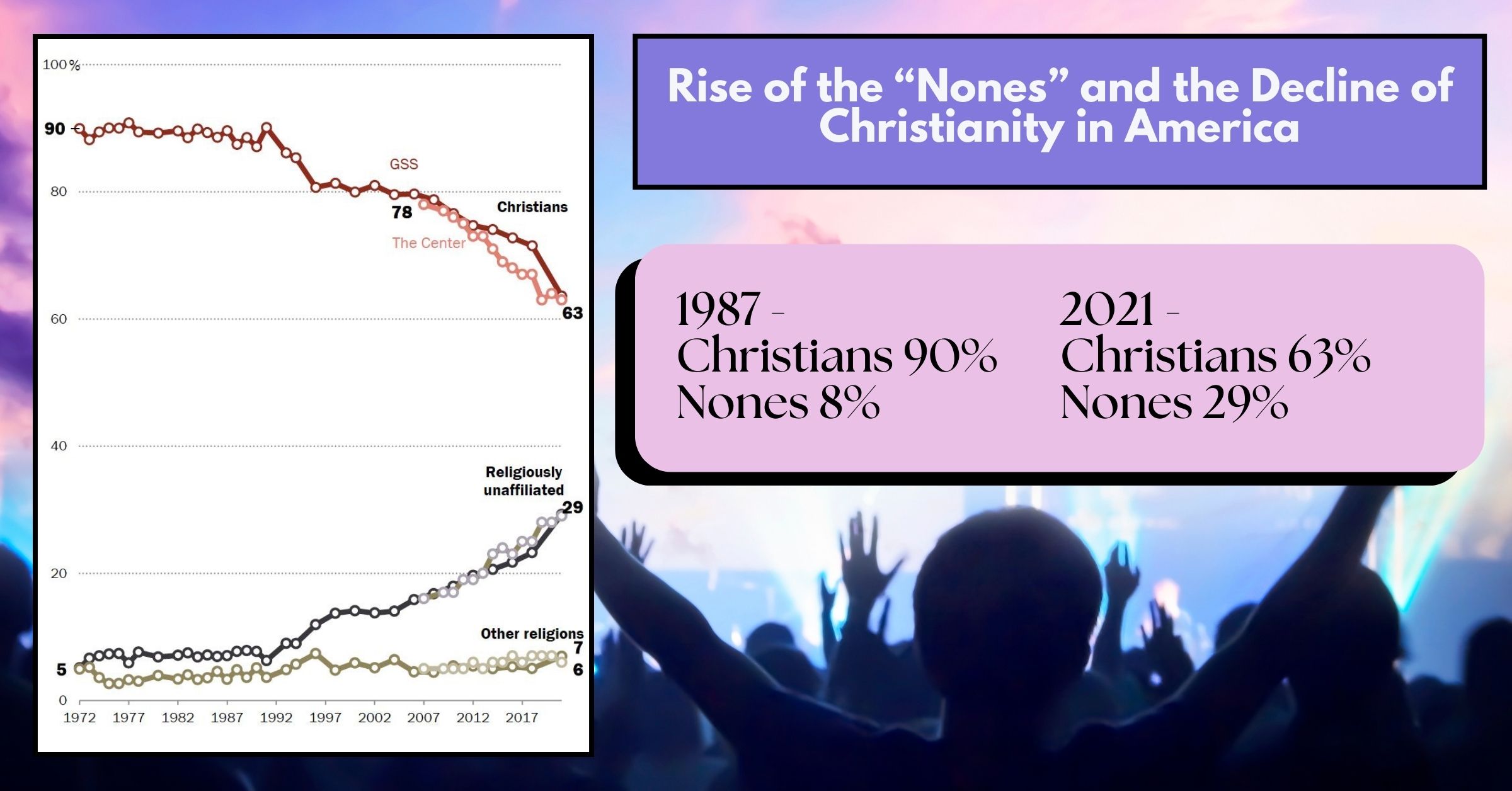
Legislating faith is the easy way out.
You can force people to pray. You can force them to read from your holy book. You can force people to memorize the Ten Commandments. But you can’t make them believe. In fact, likely you’ll do the opposite and statistics prove that to be happening today. The more politicized our faith has become, the more people are leaving in droves. According to a Pew Research study, in 1972, 90% of Americans identified as Christian and that stayed pretty steady until the late 80’s / early 90’s when it started to drop. It went from 90% to 80% in that small window and has been declining ever since. In 2021, only 63% identified as Christian. Meanwhile the number of people who are religiously unaffiliated has gone up during that same timeframe. It was pretty steady from 1972 until the early 90’s at around 5% but today, it’s up to 29% who don’t identify with a religion. We call this group “the Nones.”[7] And it’s not like they’re going to other religions. They’re just not engaging in faith at all. That’s because we haven’t done a very good job of giving them a reason to hang around.
We have to do the hard work again.
Like the early Christians who led by example and out of love, who brought people to Christ in droves, we need to do that again. Christianity was not and should not be a political movement. But it is increasingly become so. We need to reclaim our Christianity. Instead of trying to get the government to force people to adopt our beliefs, we need to do a better job of being better Christians. We need to stop attacking others. We need to find common ground. We need to accept that other people have other beliefs and instead of treating them like “the other” to embrace them and learn from them and trust in God to use us as his instruments to show the world a better way. We need to stop using God as an excuse for our own poor behavior. By leaning on Christ and on Christ’s example for our lives we can change the world again.
[1] https://www.ncbi.nlm.nih.gov/pmc/articles/PMC5325643/#b4
[2] https://www.washingtonpost.com/politics/2022/06/28/lauren-boebert-church-state-colorado/
[3] https://www.archives.gov/founding-docs/bill-of-rights/what-does-it-say
[4] https://www.theguardian.com/us-news/article/2024/jun/27/oklahoma-public-schools-bible-teachings and https://www.akronlegalnews.com/editorial/35317
[5] https://apnews.com/article/louisiana-ten-commandments-displayed-classrooms-571a2447906f7bbd5a166d53db005a62
[6] https://en.wikipedia.org/wiki/List_of_ancient_legal_codes
[7] To be fair, there isn’t one reason for this drop in Christians and equal rise in the Nones, but this change correlates with the increasing politicization of Christianity. https://www.pewresearch.org/religion/2022/09/13/how-u-s-religious-composition-has-changed-in-recent-decades/
What Color is Your Christianity?
What color is your Christianity?
We are still about four months away from Election Day and I’m already tired of hearing about politics. And it’s only going to get worse. As we approach November, we will see more ads, hear more on the news, and come across more billboards, lawn signs, and bumper stickers than we can shake a stick at. And yet, how much does it really matter? According to a Harvard/CAPS poll, more than 70% of voters have already decided who they are going to vote for.[1] And while polls are not always a reliable indicator of reality, it sure feels like this one is true. People have already decided months before Election Day who they are going to punch on their ticket, at least when it comes to the office of the President. Pundits have already divided the country into red and blue states and even red and blue people, but I’m hoping that this coming election season, whether you are a Democrat or Republican, you won’t vote red or blue. Instead, I implore you to vote purple.

Purple isn’t just a combination of red and blue (which ironically it is).
It’s also the color we use to associate with Christ. Purple was a hard color to come by in ancient times. It was obtained by the harvesting of marine snails and was very labor intensive so only royalty or those with authority would wear garments with that color.[2] When Jesus was being crucified, the Roman guards mocked him by putting on a purple robe and a crown of thorns and calling him the “King of the Jews” (John 19:1-5). Because of this and because we believe Jesus to be our one true Lord and Savior, we associate purple with Christ. It’s in that spirit Christians all over the country need to approach not just the coming election but everything we do – with a purple lens. Not with partisan blinders but really being open to where God is leading our country and more importantly his people.
And we forget that too often.
We are ALL God’s children. Democrats and Republicans; Black and White; Christians and Atheists; even Dodgers fans and Giants fans – no matter how misguided Giants fans are – are all equal in the sight of God. God doesn’t say to us he only loves you if you do XYZ or believe this or that. God loves you no matter what and then HOPES you make good choices in life. But his love isn’t contingent on that. Even when you mess up big, God still loves you. And that’s what God expects of us. To love those around us even when we don’t share their thoughts and opinions. Maybe sometimes because we don’t share their thoughts and opinions. We’re supposed to be above the political fray. But instead, it looks we are right in the middle of it with everybody else. When we look at the decline of Christianity, it’s not because the world has grown increasingly agnostic. It’s because Christians haven’t done a very good job of being Christ-like. We’ve become known for being judgmental, hypocritical, and too involved in politics.[3] One young man said, “…twenty years ago, when I was looking at evangelical Christianity from the inside, it seemed like a movement bursting with energy to spread good news to people. Looking at it from the outside today, this message seems to have been lost in exchange for an aggressive political strategy that demonizes segments of society.”[4] Who would want to be part of something like that? If you’re tempted to dismiss this as a young person’s hubris, don’t. It has become our reality and it’s very real.
The solution comes from a story about Jesus’ own life.
In this story below, we find Jesus in Jerusalem. It takes place after he chases out the vendors in the temple court. Jesus is appalled they would desecrate the Holy Temple grounds by turning it into what he called “a den of robbers” (Mark 11:17). But it makes him an even bigger target for the chief priests who are thinking of ways to kill him (Mark 11:18). Jesus’ following is growing and growing because they see the power of his words and his teachings. But take a moment and think about that. These are the religious leaders of the Jewish people and they are so twisted up in a knot they ignore one of the most central tenets of their faith – thou shalt not kill. So when our story takes place, they are trying to publicly humiliate Jesus and this is what happens next.
13 Later they sent some of the Pharisees and Herodians to Jesus to catch him in his words. 14 They came to him and said, “Teacher, we know that you are a man of integrity. You aren’t swayed by others, because you pay no attention to who they are; but you teach the way of God in accordance with the truth. Is it right to pay the imperial tax[b] to Caesar or not? 15 Should we pay or shouldn’t we?”
But Jesus knew their hypocrisy. “Why are you trying to trap me?” he asked. “Bring me a denarius and let me look at it.” 16 They brought the coin, and he asked them, “Whose image is this? And whose inscription?”
“Caesar’s,” they replied.
17 Then Jesus said to them, “Give back to Caesar what is Caesar’s and to God what is God’s.”
And they were amazed at him. – Mark 12:13-17

Jesus is caught in a classic “no win” scenario.
If he tells them to pay the tax, the Pharisees can discredit him by claiming he is saying Rome has greater authority than God! But if he tells them to ignore the tax, the Pharisees can rat on him to the Roman government and telling them Jesus is inciting people to defy the law. Either way he loses. But then Jesus pulls a WOPR. Like the supercomputer in the movie WarGames, Jesus realizes the only way to win is not to play the game.[5] He tells them, “Give back to Caesar what is Caesar’s and to God what is God’s.” In one fell swoop he upholds Roman authority AND God’s at the same time. But what I really like about his answer is he not only escapes their trap but elevates his argument by reminding them we answer to a higher calling. That while we are obligated to live by the rules of our society, we have a greater responsibility to live our lives as children of God because ultimately our allegiance doesn’t belong to a man or a party or even a country. Our allegiance rests solely with God. We are citizens of the Kingdom of God first and foremost and shouldn’t forget it.

In our contentious times, we need to remember more than ever to treat one another with love.
We rely on the idea of an eye for an eye, but Christ calls us to turn the other cheek. The ministry of Christ is radical and humble. It isn’t arrogant or proud. And that’s who we need to be in this election season. When we vote for a person or a bill, we need to remember to do it with love. If the people around us don’t agree how we think or how we vote, we shouldn’t degrade them but instead pray for them and treat them with respect. We need to see the world through the lens of Christ and analyze the issues and ideas through his eyes. I’m reminded at this time of President Carter who said he was greatly influenced by something he heard in a sermon as a young man. The pastor said, “If you were arrested for being a Christian, would there be enough evidence to convict you?”[6] When thinking about the things that matter most to you, consider yourself neither blue nor red but instead the purple of Jesus.
[1] https://thehill.com/homenews/campaign/4750545-poll-decided-voters-presidential-election/
[2] https://carnegiemnh.org/born-to-the-purple/
[3] UnChristian by David Kinnaman, p.34.
[4] UnChristian by David Kinnaman, p. 166.
 Craig's Corner