
A Wrenching Situation

Hi. My name is Emily.
Or it would have been if I had been born a girl. My parents had two names picked out for when I was born. This was way before gender reveal parties. When I was born, you know, back in the Stone Age, you did not know the gender of your child until they were born! So, they had to be prepared. “Emily” if I was a girl and “Brent” if I was a boy. I know, right? How did I end up with “Craig?” I asked my mom that question too and she told me they changed it at the very last instant. I don’t know if they liked the sound of “Craig” better or if I just looked like a “Craig” but “Craig” it was. I like my name. A lot. But there are times I wonder what my life would have been like had I been named “Brent.” Would “Brent” have made different friends? Would people have treated “Brent” differently? Would I have been able to find more coffee cups with my name on it? Those are the questions that plague me. I guess because of this, I have always been fascinated by name changes in the Bible. How did the names people have affect their lives? Some people had their names changed by other people like Daniel who was changed to Belteshazzar by King Nebudchadnezzer. Some people had their names changed by God like Abram and Sarai who became Abraham and Sarah, the “father and mother of all nations.”[1] Naomi, Ruth’s mother-in-law, changed her own name to Mara because she said the Lord had made her life “very bitter.”[2] Although it didn’t really stick. Naomi obviously didn’t know the rule that you can’t give yourself a nickname. But one of the most fascinating name changes is in the story we are going to read together today.

This is the story of Jacob and how he got a new name from God.
You need to know a little back story before getting into the passage though. See, Jacob wasn’t always the most upright kind of guy. When he was younger he had bargained for his brother Esau’s birthright in exchange for a bowl of stew. Technically not illegal, but extortion nonetheless. Then he tricked his father into giving him his brother’s blessing. Back then, blessings were considered to be limited in abundance. You always gave the best blessing to the firstborn and then other minor or lesser blessings to the other children. When Jacob tricked his dad, he received the better blessing and this made his twin brother furious. Esau pledged to kill Jacob and Jacob went on the lamb for his life. He ran away for 22 years.[3] In that time, he settled down, got married, and became quite wealthy. He decided to go back home to his father and to face his brother. He sent out messengers ahead of him to find his brother Esau and tell him that he comes bearing gifts and that he hopes that Esau will look kindly upon him. In response his messengers only tell him that Esau is coming with 400 men, but Jacob does not run away. Instead he sends everything on ahead of him in hopes that it will appease Esau as he spends one final night alone in the camp. This is his story.
22 That night Jacob got up and took his two wives, his two female servants and his eleven sons and crossed the ford of the Jabbok. 23 After he had sent them across the stream, he sent over all his possessions. 24 So Jacob was left alone, and a man wrestled with him till daybreak. 25 When the man saw that he could not overpower him, he touched the socket of Jacob’s hip so that his hip was wrenched as he wrestled with the man. 26 Then the man said, “Let me go, for it is daybreak.”
But Jacob replied, “I will not let you go unless you bless me.”
27 The man asked him, “What is your name?”
“Jacob,” he answered.
28 Then the man said, “Your name will no longer be Jacob, but Israel, because you have struggled with God and with humans and have overcome.”
29 Jacob said, “Please tell me your name.” But he replied, “Why do you ask my name?” Then he blessed him there. 30 So Jacob called the place Peniel, saying, “It is because I saw God face to face, and yet my life was spared.”
31 The sun rose above him as he passed Peniel, and he was limping because of his hip. 32 Therefore to this day the Israelites do not eat the tendon attached to the socket of the hip, because the socket of Jacob’s hip was touched near the tendon. – Genesis 32:22-32
If names are important, Jacob got an interesting one – Israel.
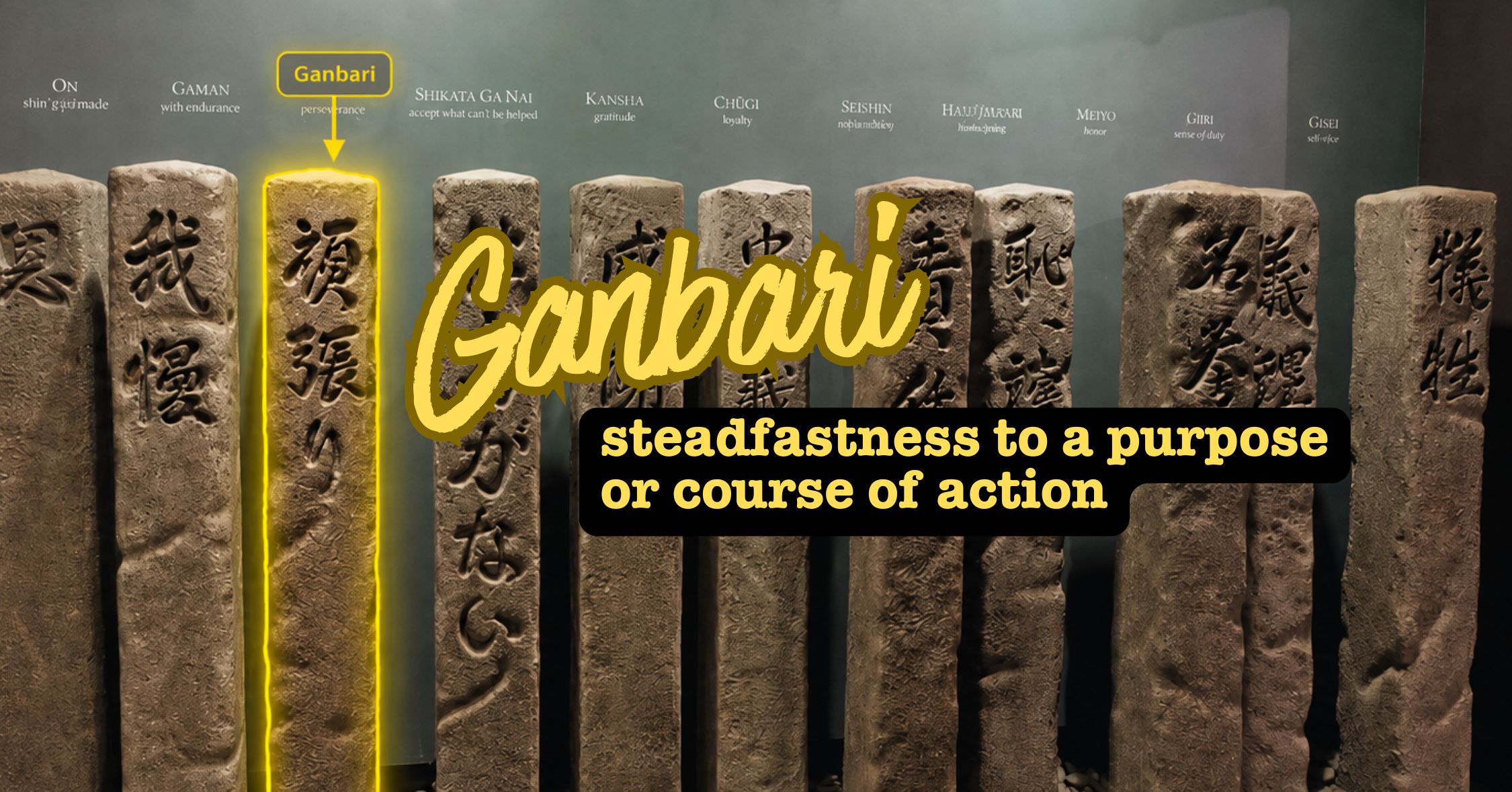
It means, “He who struggled with God and with humans and has overcome.” His name is a reflection of his character but also the character of his people. The people of Israel would be a people marked by struggle. But despite their struggles, they would persevere. It was that perseverance God saw in Jacob the night they struggled. God valued Jacob’s tenacity, his willingness to hold on for a blessing and when God added to his pain and touched Jacob’s hip so that it would be wrenched out of its socket, still Jacob held on. “I will not let go unless you bless me,” Jacob declares to God. And God gave him his blessing. Jacob did exactly what God wants us to do in times of difficulty – hold on to our faith and persevere. The Japanese have a word for this. They call it ganbari. It means “persistence” but it’s also more than that. It’s a “steadfastness to a purpose or course of action.”[4] Ganbari means steadfastness to a purpose or course of action. And that’s what Jacob showed to God. He showed his steadfastness to receive God’s blessing. And through that steadfastness he was able to overcome. His own doubts, his own fears, his possibly bleak future – Jacob was able to face all of that with courage because he felt God’s blessing upon him. The name of “Jacob” did not define who he was. “Jacob” meant “heel-grabber” but also “displacer” both of which defined him for many years.[5] But that’s not who he was and when he showed God who he was God gave him a new name to better reflect his true character, and it would define both himself and his nation.
Your name does not define you.
Do not allow others to name you either. You are simply who you are. God renames many people in the Bible and if you look them up its fascinating. He changed Abram (“exalted father”) to Abraham (“father of all nations”) and he changed his wife Sarai (“my princess”) to Sarah (“THE princess”). According to Dr. Eli Lizorkin-Eyzenberg, this was done to emphasize their lives were changing from a local to a global perspective.[6] But God simply changed their name to reflect who they were. It wasn’t a magic spell to change them into who God wanted them to be. In the same way, you are not bound to be who others perceive you to be or label you. You can choose for yourself who you are.
There are many ways we are given new names.
In some religions, like Judaism, you are given a new name at the moment of conversion, and it is considered a significant moment in your life.[7] Sometimes we choose new names. Something familiar to many immigrants into a new country. My middle name is from my dad, “Kensuke” which is a Japanese name, but his non-Japanese friends had a hard time with that so they just called him Ken, and he began to identify with it. The ladies at the racetrack where he used to go walking liked to call him “Kenny.” But sometimes we are given names out of cruelty, or we are labeled for a mistake we made. “Four Eyes” and “Metal Mouth” are some of the more benign names we can become defined by, but other times it can be extremely personal…or worse. We get called names by people who supposedly love us and know us and the longer it goes on, the more we identify with it. Studies have shown verbal abuse can have awful effects like depression, anxiety, low self-esteem, and social withdrawal.[8] And name-calling is exactly that – a form of verbal abuse. And verbal abuse doesn’t have to be using curse words. It can be telling someone they are worthless or that they couldn’t find someone else. Those are forms of abuse as harmful or more harmful than plain ol’ name-calling.

But that is not who you are.
And I hope you know you are worth more than that. A person who engages in verbal abuse regularly is someone no longer worthy of your time and effort. Many times, they are projecting how they feel deep down about themselves and trying to make themselves feel better by making others feel worse. You don’t need people like that in your life and try not to fall for their lies. You are a child of God, and you are worth more than the heavens. Why else would God send his Son to die for you? In whatever situation you find yourself, other people cannot define who you are. Like Abraham, like Sarah, like Israel, God has a secret name just for you. Have you discovered it yet? What will it be?
[1] http://godwords.org/450/name-changes-in-the-bible/
[2] Ruth 1:20
[3] Approximately based on the timeline from Bible Hub: http://biblehub.com/timeline/
[4] Japanese Cultural Center of Hawaii, Kachikan (Values), 2001.
[5] “Jacob (name),” Wikipedia, 26 May 2026, https://en.wikipedia.org/wiki/Jacob_(name)
[6] Eli Lizorkin-Eyzenberg and Jim Stowe, “What’s the Difference Between Abram/Sarai and Abraham/Sarah?” Israel Bible Center, August 22, 2022, https://weekly.israelbiblecenter.com/the-meaning-of-the-hebrew-names
[7] Chaim Harrison, “6 Tips for Choosing a Jewish Name During Your Conversion,” ReformJudaism.org, accessed 30 June 2026, https://reformjudaism.org/beliefs-practices/lifecycle-rituals/conversion/6-tips-choosing-jewish-name-during-your-conversion
[8] “The Negative Impacts of Name-Calling Across All Ages,” Evolve Counseling Services, accessed 30 June 2026, https://evolvecounselingpa.com/the-negative-effects-of-name-calling-evolve-counseling-services/

