
The Needs of the One
Three words that haunt us: Just. In. Case.
When I was young, I used to carry around this little red plastic box with me every time we went on a trip. It didn’t matter if we were going on vacation or to the doctor’s office. Any drive that involved being in the car for more than an hour, I’d bring this little box with me and inside the box was a little toy and various things to snack on. My mom gave me a hard time about it one day and asked why I brought it with me and I told her, “Because you never know when you might need it.” She kind of rolled her eyes and said, “You’re not going to need it.” Until one day, we did. On one of these little trips, our car broke down. I think it was as simple as the battery needed a jump, but this was before cell phones so you had to physically find a phone, call AAA, and wait by the car hoping the guy could find you. And it’s not like we were the only car in need of help, so we had to wait about an hour or more, and my mom looked over and asked what I had in the box. I opened it up and looked inside. I had both peanut butter and crackers and Cheez and Crackers and my mom asked for the peanut butter one. I handed it over and said, “See? I told you it would come in handy.”

Odds are we never would have needed it.
And truth be told, my mom could’ve survived without it. But there are lots of things we do in life because of those three little words: Just in case. Cassie has a whole box of cords and cables for various things just in case one of ours stops working and we need one right away. When we travel, we always travel in layers just in case the weather isn’t what we expected. We have high-powered flashlights, portable chargers, and non-wi-fi games downloaded just in case the power goes out. My parents’ house used to look like a Costco before there was a Costco just in case something happened. I still remember growing up and my parents had a whole case of Dennison’s Chili con Carne with Beans sitting in the closet. If I needed to make a quick chili and rice meal, I wouldn’t go to the pantry, I’d go into my parent’s bedroom and fish one of those out.
But it’s wise to be prepared “just in case.”
The Boy Scouts even made that their motto: Be Prepared. Robert Baden-Powell who founded the Boy Scouts reportedly was once asked “Prepared for what?” and he replied, “Why, for any old thing.”[1] What he wrote in Scouting for Boys which would later develop into the Boy Scouts Handbook was “you are always in a state of readiness in mind and body to do your duty.”[2] That same sentiment is reflected in the Bible. And speaking of the Bible and being prepared, if you have one or if you have the Bible app on your phone, would you please go to today’s reading which is Luke 15:1-7. Luke is in the New Testament and it’s the third of the four Gospel readings. While you’re looking that up, let me set the stage for you. In Matthew 25,[3] we read this story about the ten virgins where some of them rushed out without taking oil with them and the others brought jars of oil “along with their lamps (4).” But because the bridegroom was a long time in coming, the ones who hadn’t been prepared saw their lamps starting to go out and had to rush back to get more oil and missed the opportunity when the bridegroom did arrive. God asks us to do the same thing. Be prepared in mind, body, and spirit for “any old thing” that might arise. Which leads us to our reading for the day. If you’ll please rise as we share from the Gospel of Luke, chapter 15, verses 1-7. Hear now the Word of the Lord.
The Parable of the Lost Sheep
1Now the tax collectors and “sinners” were all gathering around to hear him. 2But the Pharisees and the teachers of the law muttered, “This man welcomes sinners and eats with them.”
3Then Jesus told them this parable: 4″Suppose one of you has a hundred sheep and loses one of them. Does he not leave the ninety-nine in the open country and go after the lost sheep until he finds it? 5And when he finds it, he joyfully puts it on his shoulders 6and goes home. Then he calls his friends and neighbors together and says, ‘Rejoice with me; I have found my lost sheep.’ 7I tell you that in the same way there will be more rejoicing in heaven over one sinner who repents than over ninety-nine righteous persons who do not need to repent.
The Word of God for the people of God and the people said, “Thanks be to God.” Please be seated.

To Jesus, one lost sheep was more important than the ninety-nine who were found.
It’s not because Jesus didn’t care about the 99, but because he knew they were safe. A shepherd could leave the flock secure in the knowledge the flock would look out for each other, but the lost sheep was all on its own. It had no protection, it didn’t have any direction, and it was in constant danger from predators. A good shepherd felt safe leaving the flock behind and instead could focus on the sheep who had wandered off. Now imagine applying the same thought process to God’s church. In this parable, Jesus is asking his people to do the same, to focus not on the found but on the lost. To help those who don’t know Jesus discover what life could be like with him. I was never a fan of the word “lost” when referring to people outside the church because it seems like we are talking down to them, but then I realized the term “lost” is not a judgment on them, but an indictment on us. They didn’t lose us. WE lost them. WE could have done more. WE should have done better. Jesus saw it as our responsibility to welcome them into the beloved community and show them what a life with Christ could be like.
Are we willing to do that?
Are we willing to make sacrifices if it means welcoming new people into God’s beloved community? I know you’re going to say yes, some of you emphatically! But really pray about this because embracing change is always – ALWAYS – the biggest hurdle for any church. Remember the saying “the church is a hospital for sinners, not a museum for saints?”[4] It means that church exists not to preserve our traditions but to do whatever is necessary to help people get to know the living God. Because God meant for the church to be an ever-changing, ever-evolving dynamic community designed to adapt to the world around it to preserve the spirit of God’s intent – to love the world in a way that reflects the love of Christ. And now more than ever it’s important to keep that in mind. Because when we stop doing the WORK of the church and worry about the WALLS of the church, we become observers and not believers.

Put yourself in their shoes.
You haven’t been to church in X many years, maybe ever. And for sure, you’ve never been in this church. You don’t know the liturgy – you don’t even know what liturgy means! You don’t know their traditions. You don’t know the people. Like in any new relationship you’re a little guarded. Okay, let’s face it – you’re a LOT guarded! You’ve made the brave and bold step to try this “faith thing” out for yourself, but you’re looking to see if it’s a good fit for you. The last thing you want is to have a lot of attention drawn to yourself, but you don’t want to go unnoticed either. You want someone to welcome you and guide you and show they care without being overbearing. And if any of these things go wrong, you might never come back. So we always have to be prepared to welcome people in a way to make them feel like we care, like we thought about them before they ever walked in the door. Lots of thoughtful minds have done research on this and what they found was interesting. The Lewis Center for Church Leadership found that 70% of newcomers do not like being recognized in worship and explicitly warns against the practice.[5] Thom Rainer, noted church consultant reported that 89% of visitors found a stand-and-greet time uncomfortable and more surprising that 58% of church members thought so too.[6] One person even said, “I would rather have a root canal than be subjected to a stand and greet time.”[7] Have you ever wondered why every week I make sure to introduce myself? That’s because you never who is watching. Even if there’s no one in the room who is new to our church, we regularly have about 11 or 12 people watching us on our YouTube channel all throughout the week. And for those people, the internet is the new front door of the church. If they witness a service that feels uncomfortable to them, we won’t even get the chance to welcome them in person. For that reason, I typically don’t wear a robe or a suit because studies have shown removing clothing barriers or expectations you have to be in your Sunday best helps people feel comfortable coming as who they are.[8] A lot of intentionality goes into planning Sunday worship because we always want to be prepared for whoever may be thinking about joining our community.
Be mindful of the one.
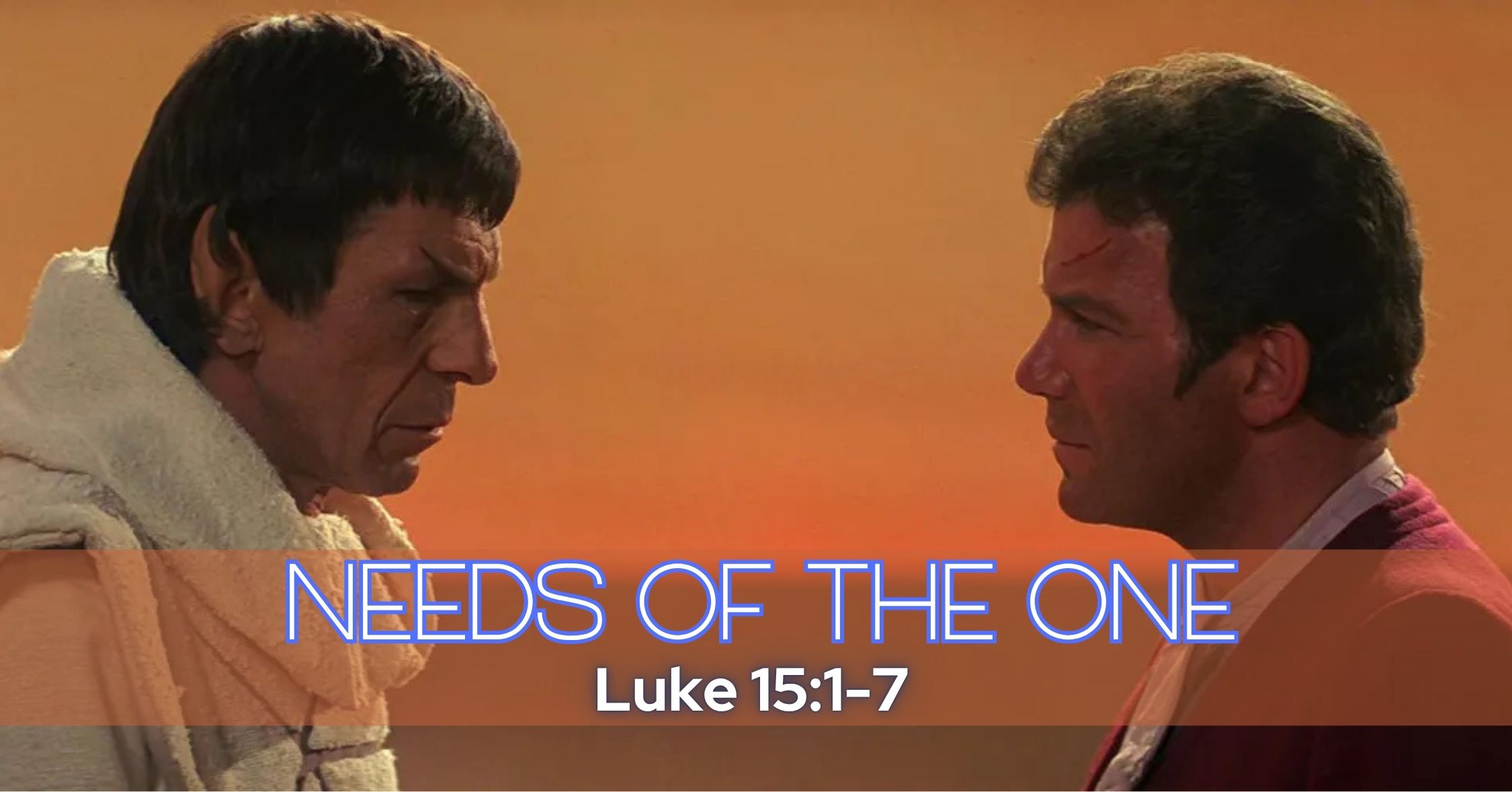
That person or family who comes through the doors for the first time. The ones watching us online who may be thinking about diving in and joining us on our journey of faith. Pray about it. Pray that God would bring those who need him to our doors and pray that we are prepared to welcome them as they need. This all reminds me of one of my favorite Star Trek movies, Star Trek III: The Search for Spock. At the end of the film, Spock is brought back from certain death and his friends, Kirk, Bones and the rest have sacrificed everything to do it. Their ship. Their careers. Their futures. Spock suffered some memory loss from the experience so as he approaches the group he says to Kirk, “My father says…you came back for me. Why would you do this?” And Kirk responds, “Because the needs of the one outweigh the needs of the many.” There are so many in the world who need to know the lifechanging power Christ can have on your life. And to bring that to them, what are we prepared to do? Like Spock, we want them to wonder what kind of people would do this for me? What kind of people would love a stranger in such a way? The answer? The kind that knows the love of Jesus is real. In the name of the Father and of the Son and of the Holy Spirit. Amen.
[1] https://onscouting.org/2017/05/08/be-prepared-scout-motto-origin/
[2] Ibid.
[3] Maybe one of the greatest chapters in the Bible for what it means to be Christian in my mind. You get these three great stories (Parable of the Ten Virgins, Parable of the Talents, and the story of the sheep and the goats) which all try to emphasize how we should act in the world. Be prepared, be dutiful toward God instead of ourselves, and to treat others as if they were Christ.
[4] Often quoted as coming from St. Augustine although no evidence in his writings shows he said this.
[5] https://www.churchleadership.com/wp-content/uploads/2016/02/50_Ways_to_Build_Strength_in_Welcoming_New_People.pdf
[6] https://churchanswers.com/blog/how-the-stand-and-greet-time-disappeared-in-churches-and-how-to-replace-it/
[7] https://christianleaders.org/mod/page/view.php?id=35174
[8] James K. Wellman Jr., Katie E. Corcoran, and Kate Stockly-Meyerdirk, “‘God Is Like a Drug…’: Explaining Interaction Ritual Chains in American Megachurches,” Sociological Forum 29, no. 3 (September 2014): 659, https://doi.org/10.1111/socf.12108

