
Que Sera Sera

“Everything happens for a reason.”
You’ve probably heard that before. You might have even said it yourself. Usually when something sad or tragic happens, people say these words to help comfort those who are struggling. “Everything happens for a reason.” We say it because it gives us comfort to think this tragedy was somehow important or necessary. That there was a purpose behind it. A grand design. It makes us feel better when we believe a tragedy wasn’t pointless. And we say other things, too. “It was meant to be,” or, “It was his time.” But does everything really happen for a reason? Whenever we use superlatives like “everything” and “always” we should be prepared to have an ounce of skepticism. As you probably already know, rarely is anything that definitive. The same is true for this. Not everything happens for a reason.
Well-meaning Christians have been popping out sayings like this for a long time.
But it isn’t grounded in anything that makes sense. It might seem comforting on the surface, but when you think about it, it breaks down faster than butter in a hot pan. When we tell someone “Everything happens for a reason,” we’re essentially saying God caused it to happen. That it was God that caused them to die or to suffer or go through some unimaginable pain. When I was in high school, my high school chemistry teacher, Mr. McNally, died in a tragic car accident. He was hit by a drunk driver and thankfully his son survived the crash. But Mr. McNally died. His life, which up to that point seemed great, was suddenly over. A much beloved teacher who had inspired many of his students was ripped away from his family, his friends, and his students in a moment. The drunk driver however, not only survived but walked away from the accident. Was there a grand design behind this? If there was then do we blame God for the pain caused that night? If you believe “everything happens for a reason,” this moment of pain was necessary for something bigger in the grand scheme of things. But is that really true? Just because there MAY be a positive outcome from something tragic, did God CAUSE it to happen, or did God create something meaningful out of something bad?

The answer to that question makes a big difference in how we understand God and the world.
When we say “Everything happens for a reason,” we’re really saying God controls our actions and that poses two problems – our responsibility and God’s responsibility. Saying God controls everything poses two problems – our responsibility and God’s responsibility. We have none and God has it all. Adam Hamilton, in his book Half Truth, wrote “If I drink and drive and someone is killed as a result, it must have been the victim’s “time.” Yes, I did a terrible thing, but the devil didn’t make me do it. Instead, God used me to accomplish some greater purpose. I cannot be held responsible for my actions. I was only doing what God willed me to do.”[1] And if we really believe everything happens for a reason, we believe this to be true. We are only carrying out God’s will no matter how hurtful, how obscene, or how violent it may be. Hitler? God’s fault. Terrorism? God’s fault. Cancer? God’s fault. It’s all God’s fault. Which makes the problem of “Everything happens for a reason” clear – it’s all God’s fault. Everything horrible that happens in the world is God’s fault and since we have absolutely no responsibility, why worry about it? It’s what I like to call the “Que Sera Sera” philosophy – whatever will be, will be so it’s not my problem.
Some Christians buy into this.
Maybe not that callously, but they do believe everything is pre-destined, that God has already chosen what you will do and when you will do it. It’s a theology called Calvinism or Reformed Christianity and it says God has already decided everything that will ever happen in the history of the world. God has already chosen who is going to Heaven and who is going to Hell and there’s nothing you can do about it. As Hamilton points out, John Calvin, whom the movement was named after, believed that since God was completely sovereign then “Absolutely everything… happens by God’s will and command.”[2] “If something happens that is not God’s will…then God does not in fact have dominion over everything,” and that would run counter to Calvin’s beliefs.[3] In Calvin’s point of view, human beings are merely puppets of God who’s every action is caused by God. Your breathing at this very moment is caused by God. God didn’t merely make it possible; he coordinated and orchestrated it. And if Calvin is right, then everything does happen for a reason.

As Methodists, we don’t believe this to be true.
We believe in free will. We believe God allows us to choose our path. We believe God created us not to be puppets but to be free creatures. I always think of this bookmark I had as a kid that said, “If you love something set it free. If it comes back to you, it’s yours. If it doesn’t it was never yours to begin with.” It’s an idiom, but within every idiom is a kernel of truth. God sets us free because he hopes we will come to him of our own free will. He wants us to CHOOSE him, is there love if there is no free will? Is there love without a choice?
11 Now what I am commanding you today is not too difficult for you or beyond your reach. 12 It is not up in heaven, so that you have to ask, “Who will ascend into heaven to get it and proclaim it to us so we may obey it?” 13 Nor is it beyond the sea, so that you have to ask, “Who will cross the sea to get it and proclaim it to us so we may obey it?” 14 No, the word is very near you; it is in your mouth and in your heart so you may obey it.
15 See, I set before you today life and prosperity, death and destruction. 16 For I command you today to love the Lord your God, to walk in obedience to him, and to keep his commands, decrees and laws; then you will live and increase, and the Lord your God will bless you in the land you are entering to possess.
17 But if your heart turns away and you are not obedient, and if you are drawn away to bow down to other gods and worship them, 18 I declare to you this day that you will certainly be destroyed. You will not live long in the land you are crossing the Jordan to enter and possess.
19 This day I call the heavens and the earth as witnesses against you that I have set before you life and death, blessings and curses. Now choose life, so that you and your children may live 20 and that you may love the Lord your God, listen to his voice, and hold fast to him. For the Lord is your life, and he will give you many years in the land he swore to give to your fathers, Abraham, Isaac and Jacob. – Deuteronomy 30:11-20
There are tons of Scriptures like this.
Ones that make it clear we have a choice. Here, Moses is speaking to the people of Israel. He’s just got done talking to them about God’s covenant and tells them God stands ready to offer them his blessing if they simply turn to him. They can choose to follow their own way, but it will be one filled with pain and suffering, and while Moses couches it in terms of God’s wrath, I think we’ve come to understand that it’s not so much God’s wrath as it is the natural consequence of living without God in your life. But it’s a choice! Joshua tells the people of Israel in another time, “15 But if serving the Lord seems undesirable to you, then choose for yourselves this day whom you will serve, whether the gods your ancestors served beyond the Euphrates, or the gods of the Amorites, in whose land you are living. But as for me and my household, we will serve the Lord. (Joshua 24:15).” Again, a choice. And God offers that choice over and over and over again. God never gives up on us, but he never forces us to follow him.
That doesn’t mean God ever stops reaching out to us.
He does. Constantly. Through the people around us, God reaches out to us. Sometimes subtly, sometimes right in our face, but God keeps reaching. It’s what we call prevenient grace in our Methodist tradition – the grace that comes before we even know we need it. Prevenient grace is the grace that God offers us before we even know we need it. And we need it. We need it more than ever. We live in a broken world filled with broken people, but the first step toward fixing it is by first recognizing the problem and turning to the one who can give us the tools to make it better. We are not helpless. We are not puppets. We are beings created in the image of God and God has offered us a chance to make it better. I like what Adam Hamilton said. He wrote, “God gave us a brain, a heart, a conscience, his Spirit, the Scriptures, and the ability to interpret them as guides to help us select the right path.”[4] But ultimately the choice is up to us. God equips us with what we need, but we still get to choose and ultimately live with the consequences of our choices. Mr. McNally died when I was only 16 years old. I never knew back then where my life would lead me today. I don’t believe God caused Mr. McNally to be killed by a drunk driver, but I do believe that God used this tragedy in my life to help me better understand the consequences of the choices we make and to be able to share that with you. God doesn’t cause the calamities in our life, but he can bring blessing out of the deepest pain. Does everything happen for a reason? No, but that doesn’t mean God can’t open up the world to you and through you to serve a higher purpose if we let him. But that choice is up to you.
[1] Adam Hamilton, Half Truths, p. 20
[2] Ibid, p.26.
[3] Ibid, p.26.
[4] Ibid, p.37.
Unanswered Prayers

Does prayer work?
If you ask around you’re sure to get a variety of answers and not all of them consistent, logical, or with sound theology behind it. Whether or not prayer works often is in the eye of the beholder. The devout follower will undoubtedly tell prayer works. The skeptic will tell you they aren’t sure. And the unbeliever will tell you prayer is a fairy tale people tell themselves to feel better about living in a random and meaningless world. Science doesn’t help much here either. For as many studies that prove the benefits of prayer there are those that show they don’t matter at all and there was even one study where the subjects did worse when they knew they were the object of people’s prayers.[1] All of these results might seem confusing and lead us to conclude… absolutely nothing. It’s hard to know if prayer works when we get inconsistent answers. At least from our point of view. And perhaps that’s the real problem. We don’t know how to measure the effectiveness of prayer. The problem isn’t so much if prayer works as it is how do we measure the effectiveness of prayer. Dr. Candy Brown from Indiana University in Bloomington wrote that most researchers study prayer as they would any other phenomenon. They set up studies, they do double-blind trials, they set up a control group and an experimental group, and then they compare results.[2] But maybe that’s part of the problem right there. Maybe you can’t measure the effects of prayer simply by doing blind trials. As Brown noted, “…when people actually pray for healing, they usually get up close to someone they know, touch the person and empathize with their sufferings… Double-blinded, controlled trials are not the only — or even the best — way to gauge the effects of this kind of prayer practice.”[3]

We might also wonder, “How long should we give God to respond?”
How long is long enough to say that a prayer didn’t work? The problem with testing God in this way is we expect God to keep to our timetable. Sometimes that works. Sometimes it doesn’t. But can we accurately gauge the success or failure of our prayers based on that alone? There’s a song by Garth Brooks called “Unanswered Prayers” that speaks to this point in particular. In that song, Garth points out that in his youth he kept praying and praying for God to help him get into a relationship with a girl in school that he liked. But God didn’t answer that prayer. At least not in the way he wanted. It ended up because he wasn’t in a relationship at the time, he met the woman who would one day become his wife who he loved more than anything. How different might his life been if God had indeed granted that one prayer. He sums it up in the chorus, “Just because he doesn’t answer, doesn’t mean he don’t care. Some of God’s greatest gifts are unanswered prayers.” We’re going to read about one of those unanswered prayers in our reading today.

Then Jesus went with his disciples to a place called Gethsemane, and he said to them, “Sit here while I go over there and pray.” 37 He took Peter and the two sons of Zebedee along with him, and he began to be sorrowful and troubled. 38 Then he said to them, “My soul is overwhelmed with sorrow to the point of death. Stay here and keep watch with me.”
39 Going a little farther, he fell with his face to the ground and prayed, “My Father, if it is possible, may this cup be taken from me. Yet not as I will, but as you will.”
40 Then he returned to his disciples and found them sleeping. “Couldn’t you men keep watch with me for one hour?” he asked Peter. 41 “Watch and pray so that you will not fall into temptation. The spirit is willing, but the flesh is weak.”
42 He went away a second time and prayed, “My Father, if it is not possible for this cup to be taken away unless I drink it, may your will be done.”
43 When he came back, he again found them sleeping, because their eyes were heavy. 44 So he left them and went away once more and prayed the third time, saying the same thing.
45 Then he returned to the disciples and said to them, “Are you still sleeping and resting? Look, the hour has come, and the Son of Man is delivered into the hands of sinners. 46 Rise! Let us go! Here comes my betrayer!”
Next to the Lord’s Prayer, this is probably the most famous prayer in the Bible.
Jesus, in the moments before he is arrested and taken away, goes off into the garden at Gethsemane to pray to God. He tells God how overwhelmed he is with sorrow and he asks God if he can avoid what he is being asked to do. He knows what’s coming. He knows he is about to be put to death on a cross. He knows how painful and horrible that death is. And he begs God to let him off the hook. But God doesn’t do it. God doesn’t take away Jesus’ pain. God doesn’t save Jesus from a death most would consider cruel and evil. Instead, God lets it happen. If it were anyone other than Jesus, I think we would be upset about it. We would think of all people in the world, God should have saved Jesus. After all, Jesus is blameless, without sin, and a miracle worker. Of all the people ever born on Earth, Jesus had the closest direct pipeline to God. And yet, God didn’t even save him. Why wouldn’t God answer this one prayer for Jesus? The thing is God answered many of Jesus’ prayers. Pretty much all of them except this one. He healed the man born blind, he fed the 5000, he healed the centurion’s son, he healed the man who was lowered through the roof of the house, he turned water into wine, and he even brought back Lazarus from the dead. And that’s the short list. But this one prayer God did not answer. We know why because we are at the other end of history, but at the time Jesus was mocked for God’s inaction. They ridiculed him. Dared him to save himself. Put a crown of thorns on his head and a sign above him saying “King of the Jews.” If there was ever any evidence that prayer didn’t work, this was it! Except that God had something else in mind.

We know the end of this story.
We know Christ died for us. But at that time it must have been hard to swallow. Look at Peter. He denied even knowing Jesus. Hardly any of the apostles came to watch him being crucified. Jesus was left alone by almost everyone. But we know how the story ends. We know Christ rose from the dead. We know because of his willingness to trust in the Lord, we have been forgiven for our sins. And we know God had something greater in mind than what we could possibly imagine. We have such a limited idea of who God is that we judge him based on our criteria. And if God fails to live up to our expectations, we tend to think he must not care, or he must not have heard, or he must not exist. But God operates on a whole different level than we do. The concepts of time and space are not the same for him as they are for us. And a being who lives in a reality so different from ours cannot and should not be judged by our standards. And this is where trust comes in. We need to trust God hears our prayers. Our prayers are not falling on deaf ears, but on the ears of someone who loves us intensely. And just because we don’t get the response we’re looking for doesn’t mean God doesn’t care.
I do believe God answers prayers.
Why he answers some and not others, I don’t really know. I don’t know if he actually doesn’t answer them or if we’re just not looking for the right response. It could be God answers every prayer in his own time, in his own way. Some prayers seem to get an immediate response and some never even seem to get a number in the queue. Sometimes it takes years to see a prayer get answered, even decades. I am still struck by the story of a man I was able to baptize much later in his life. I believe he was in his 60s or late 50s. Either way, God caught up to him and struck him in a powerful way. He told me that pretty much his entire adult life his mother had been praying for him to come to know God, to be baptized and accept Jesus in his heart. And for decades that prayer went unanswered. Finally, he came around and only about a week or two after he was baptized, she passed away. He hadn’t been baptized just to please his mom’s dying wish because her death was unexpected. She was older to be sure, but had no indication she was close to passing on. It was hard for me to hear this story and not think she was holding on just long enough to make sure her son was alright before letting go.
Does prayer work?
It does. Scientists may not be able to prove a direct correlation between prayer and healing but they can’t disprove it either. Again maybe we have a far too limiting way of looking at prayer. When we pray for healing that healing can occur spiritually or emotionally instead of just physically. So when we attempt to measure the effectiveness of prayer, maybe we’re looking in the wrong place. Maybe instead of the body we should be looking for healing of the heart or the mind. Maybe the healing that takes place isn’t in the person but the people around them. God’s idea of healing might just very well be different than ours. Or perhaps the problem is judging God by measuring what we want to see. Is it only healing if God meets X, Y, and Z criteria? Or could healing happen in different ways and in different times? If the apostles had their way, Jesus wouldn’t have died in the first place. But it was because he died we know Christ today. They just couldn’t see it that way at the time. Maybe our vision is too narrow.
Also, maybe our definition of “works” is too narrow.
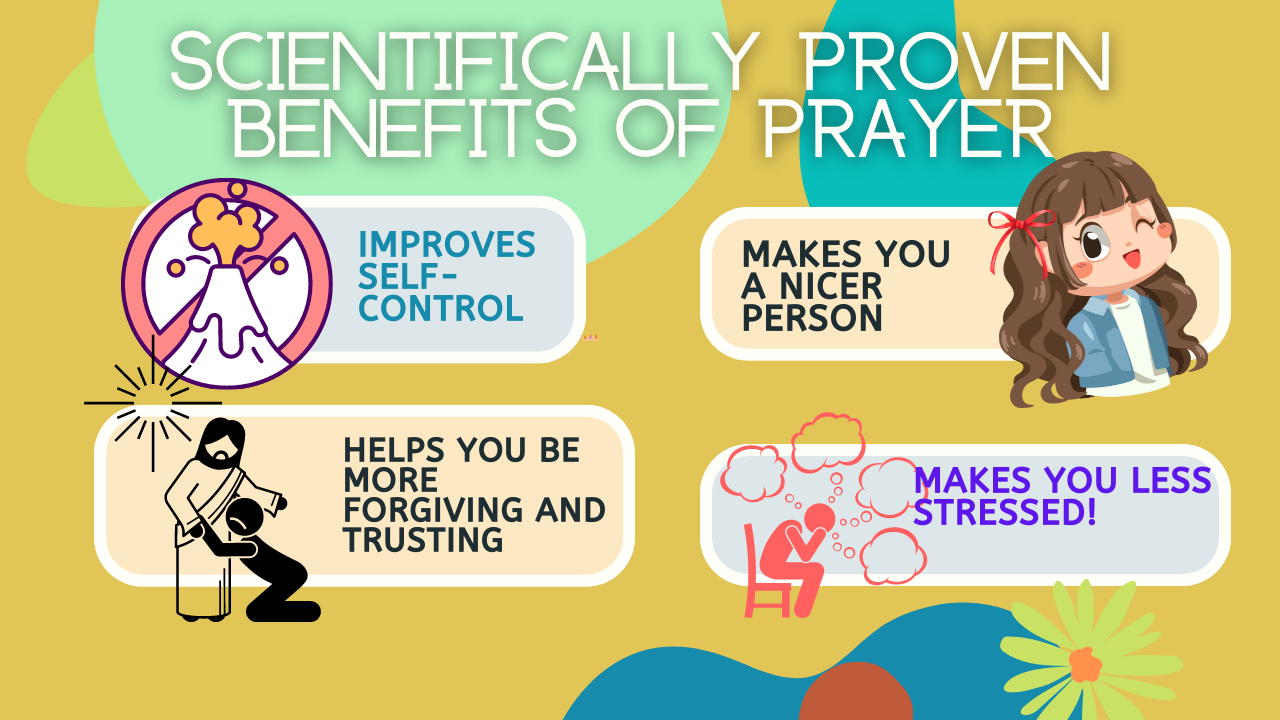
Science definitely proves there are benefits to prayer. Prayer has been shown to improve self-control, to make you nicer, to help you be more forgiving, to increase your trust, and offset the negative effects of stress.[4] Pretty awesome benefits. I would think that anything that give you more self-control, makes you nicer, more forgiving, trusting, and less stressed out definitely “works!” I want you to give prayer a chance. If you don’t already pray regularly, try doing so. Pray every day even if it’s just a little bit each day. Don’t worry about saying the “right” prayer. If you haven’t prayed much, believe me I think God will be happy with incremental steps. But just pray. And don’t go looking for monumental results right off the bat. If they happen, great! But if not, remember that doesn’t mean God isn’t listening. Maybe we just need better ears to hear. And if you do pray regularly, try spending at least as much time listening as asking. Sometimes God works in the silence far better than in the noise. But more prayer is something we could all benefit from. Does prayer bringing healing to a person every time, the way we want it to, when we want it to? No. Does prayer guarantee bad things won’t happen to you? No. But does prayer work? Most definitely, yes!
[1] http://www.nytimes.com/2006/03/31/health/31pray.html
[2] http://www.huffingtonpost.com/candy-gunther-brown-phd/testing-prayer-science-of-healing_b_1299915.html
[3] Ibid
[4] https://www.psychologytoday.com/blog/more-mortal/201406/5-scientifically-supported-benefits-prayer
Do Dogs Go To Heaven?

Do dogs go to Heaven when they die?
My oldest daughter, Eve asked me this question on our way to the bus stop one morning. She was about 7 or 8 years old at the time and this was when we were living in Georgia. I was carrying Emma in my arms as we were heading down the hill to the corner where the bus would come and take her to school when the question popped out. “Do dogs go to Heaven when they die?” I wasn’t completely surprised. Just the night before, we found out the cute little dog across the street got hit by a car and didn’t survive. I’m sure that’s how many kids first experience these thoughts about “what happens next.” But the number of questions only grow as we get older. I remember when I was eight years old and my grandmother died, my mom told me she had gone to Heaven and the first question I had in mind was, “How did she get there?” Did she catch a bus? How did she know where to go? Can I visit? Life can be pretty literal when you’re young, and I was looking for concrete answers about a topic that had none.

But every question we ask about death revolves around one central question:
What happens when we die? It’s a question that stays with us because so few people can tell us the answer. Jesus would know best, having done it himself, but he never shared much about it. Lazarus likewise never said a word. Elijah and Moses came back briefly, but didn’t say anything either. The closest we get to answers in the Bible is through John who had a vision of life in the spiritual world. He wrote it down in what we would call the Book of Revelation, but it was so intense and so beyond human understanding that it’s still the hardest book in the Bible to interpret – concepts and images that go beyond human understanding. Now, every once in a while we hear an amazing story like that of Colton Burpo, the young boy whose life inspired the movie and the book Heaven is for Real. And reading stories like that give us hope and allow us to point to something tangible to hold onto. But for every story like Colton’s, there are others who have come back and said there was nothing but darkness and cold and you wonder if we are any closer to an answer.

We’ve tried to prove or disprove the existence of an afterlife using logic and reason.
Which seems weird since logic and reason are based on our knowledge and experience and we simply don’t have enough of either when it comes to the hereafter. Most of these arguments revolve around the existence of God, because if we can prove God exists, it logically follows that all the rest of it is true, including the afterlife. On the other hand, some atheists like to use evolution as an argument against the existence of God which doesn’t make sense because evolution and God are not contradictory beliefs. So, it’s ironic that a popular argument in favor of God comes from an atheist. You probably don’t know the name Fred Hoyle, but you probably do know the theory he came up with – The Big Bang Theory (not to be confused with the TV show of the same name). Interestingly, Hoyle didn’t believe in the Big Bang Theory either. But he also didn’t believe in evolution as Darwin had originally posited.[1] Instead he believed in intelligent design, a concept that something greater than ourselves must have guided the development or even creation of humanity. He didn’t believe in God as we understand God, and might be offended to hear his argument being used in God’s defense. But what he said in defending intelligent design was, “The chance that higher life forms might have emerged in this way (through evolution) is comparable with the chance that a tornado sweeping through a junk-yard might assemble a Boeing 747 from the materials therein.”[2] That’s how infinitesimally small the odds are of human beings ever being created simply by chance. Now there are tons of people who would argue with Hoyle and argue that his analogy was too simple or came at it the wrong way, but Hoyle’s point was simply that it made more sense to believe in a creator than it did to think we happened by accident.

One doctor tried to prove the human body had a soul by weighing patients as they died.
You’ve probably heard this story before. Dr. Duncan MacDougall posited the theory that human beings have souls and that it could be proved at the point of death. He took six dying patients and weighed them right before death and immediately afterward, and he claimed that after the body had ceased functioning, the human body suddenly lost weight that could not be accounted for by normal means. He said that through his experiments, he calculated the human soul weighs ¾ of an ounce or as it is more popularly known today: 21 grams.[3] 21 grams, Dr. MacDougall said, was how much the soul weighed. But the truth is his results over this incredibly small sample varied widely and none of them had a consistency of weight loss. Just one person recorded an actual loss of 21 grams and the rest had completely different results.[4] But MacDougall’s efforts is testimony to our desire to learn about the afterlife.
Scholars have poured over the Bible to find clues to what we can expect when we die.
Jesus tells us God has a house for us in Heaven with many rooms and there is a room reserved there for each of us who believe in Him. John tells us when God creates the New Jerusalem at the end of the age it will have streets of gold and walls of jasper and foundations made of gemstones. But for me, my favorite image in the Bible comes from Revelation 7:9-12. The passage we’re reading is from John’s vision of the end of days before the creation of the New Heaven and New Jerusalem. Now this isn’t an image of the New Heaven, but an image of what John sees as we approach the day of final judgment when God will determine what happens to each of us. And even though this isn’t exactly an image of the New Heaven, to me this is a glimpse of what we can expect when we get there.
9 After this I looked, and there before me was a great multitude that no one could count, from every nation, tribe, people and language, standing before the throne and before the Lamb. They were wearing white robes and were holding palm branches in their hands. 10 And they cried out in a loud voice:
“Salvation belongs to our God, who sits on the throne, and to the Lamb.”
11 All the angels were standing around the throne and around the elders and the four living creatures. They fell down on their faces before the throne and worshiped God, 12 saying: “Amen! Praise and glory and wisdom and thanks and honor and power and strength be to our God for ever and ever. Amen!” – Revelation 7:9-12
This is often how I imagine Heaven to be.
Filled with people of every type from every nation. A multitude of every race, color, gender, age, and size. A crowd so large they cannot be counted. A place where all of God’s children live in unity with one another. And I think the reason we debate so much about what Heaven looks like and how you get there and what we can expect is because we are not sure if we are going to be there. Our beliefs about Heaven are often exclusive to our belief in God. Catholics believe that it is a combination of faith and good works that earn you a place in Heaven. Mormons believe Heaven consists of three levels and only believers of the Mormon faith get into the best level to be with God. And Jehovah’s Witnesses believe it all doesn’t matter. God has already picked out the 144,000 that will be joining him and too bad for the rest of humanity. Presbyterians and other Calvanist faiths believe we are predestined, kind of like the Jehovah’s Witnesses but with fewer limitations. And so the debate about who is right becomes more important than ever because it involves our eternal destiny. That’s why we worry so much about this stuff. But maybe instead of worrying about how to get into Heaven we should focus instead on living a life that honors Christ.

Sometimes we focus on the wrong things.
If we really want to get into Heaven the last thing we should be worrying about is getting into Heaven. Because worrying about it won’t get us there. There isn’t some magic formula where if you do “X” number of good things you get in. There isn’t some cosmic scale of justice that says if our total good guy points outweigh our bad guy points, we’re in. The only thing that truly matters is our heart for God. Just listen to the words of Jesus himself. He told his disciples, “Therefore I tell you, do not worry about your life, what you will eat or drink; or about your body, what you will wear. Is not life more than food, and the body more than clothes? 26 Look at the birds of the air; they do not sow or reap or store away in barns, and yet your heavenly Father feeds them. Are you not much more valuable than they? 27 Can any one of you by worrying add a single hour to your life?… 31 So do not worry, saying, ‘What shall we eat?’ or ‘What shall we drink?’ or ‘What shall we wear?’ 32 For the pagans run after all these things, and your heavenly Father knows that you need them. 33 But seek first his kingdom and his righteousness, and all these things will be given to you as well. 34 Therefore do not worry about tomorrow, for tomorrow will worry about itself. Each day has enough trouble of its own.” The solution is simple. Put God first. Trust in God and free yourself from worry. The rest will fall into place on its own.
Harvey West is one of the best pastors I know.
He was my senior pastor when I was attending Alpharetta First UMC back in Georgia and I was fortunate enough to take a Bible study class with him. During that class one of the people asked, “How do you know you are saved?” And Harvey said, “I don’t.” That stunned all of us right there. But then he continued. “But I have faith in God and in his Son Jesus Christ. And I believe that faith will save me. And so I don’t worry about it. Instead I focus on trying to live a life that best honors Christ’s sacrifice for me.” Those words have continued to guide me every day of my life and I hope they guide yours as well. And as for the question, “Do dogs go to Heaven?” I think they do. When we read the Scripture we hear from God through the prophet Isaiah that “the wolf and the lamb will feed together, and the lion will eat straw like the ox, and dust will be the serpent’s food. They will neither harm nor destroy on all my holy mountain.” If God will provide space for the wolf and the lamb, the lion and the ox, and even the serpent, surely my former neighbor’s dog is resting comfortably somewhere up there waiting for his human. But either way, I trust in God enough to believe God knows best and no matter what my vision of Heaven is or how we get there, God’s vision will always be better.
[1] http://www.uncommondescent.com/intelligent-design/fred-hoyle-an-atheist-for-id/
[2]http://en.wikiquote.org/wiki/Fred_Hoyle
[3] http://en.wikipedia.org/wiki/Duncan_MacDougall_%28doctor%29#In_popular_culture
Born This Way

“Beatrice Zinker always did her best thinking upside down.”
What a great way to start a book. Disney used to send me tons of books to review and one of them in particular caught my eye: Beatrice Zinker, Upside Down Thinker. Somehow, I knew it was going to be good. First-time author Shelley Johannes wrote this endearing story about a girl who was “different.” She dresses different, she acts different, she even EATS different – dessert first! Of course, her favorite is pineapple upside-down cake (one of mine, too)! But what makes Beatrice fun and unique is she EMBRACES her difference. She doesn’t have any angst about being herself. Despite peer pressure (and there’s plenty of it), she doesn’t try to be someone she isn’t. Even when she is criticized or misunderstood, she is always true to herself and instead turns these moments into ways to connect with others in new ways.
We could use all use a little of Beatrice inside of us.
I remember as a young kid in elementary school, standing in line for recess when some boy came up and taunted me with that horrible rhyme, “Chinese, Japanese, dirty knees, look at these!” Looking back now, it makes me livid with anger that this kid thought it was funny. But then… I don’t know why, but I cried. Even though I had no reason to be ashamed of my Japanese heritage, it still hurts to be singled out, to be told you don’t belong. It’s tough to stay true to yourself when people around you – whether at school or work or church – belittle, insult, or make fun of you simply for being who you are. I’ve been made fun of for being fat, for wearing glasses, for laughing funny (interestingly you should NEVER make fun of someone’s laugh – it’s not something they can help), and probably for more that I just can’t think of right now. I’m sure you’ve been made fun of, too, and didn’t it feel awful? What I love about Shelley’s book is not just that Beatrice remains true to herself, but Shelley recognizes it isn’t always easy to do. She doesn’t paint some Pollyanna picture of Beatrice’s life where everything works out perfectly. She shows the struggle Beatrice goes through in trying to find out how to do it. Which only makes Beatrice that much more of a hero!

It’s probably why the story of Gideon is one of my favorites in the Bible.
The Bible is full of stories about people, like Beatrice, who don’t fit the mold of what society would consider “normal.” Jesus himself didn’t live up to expectations. Everyone thought the savior of the Israeli people would be a mighty warrior like Captain America or Iron Man or Thor, a capable leader who would defeat all those who would stand up to God’s chosen people. But instead God sent a Jewish carpenter who gave up his own life rather than take the life of another. He rode in on a donkey instead of a horse. He talked about the value of women and children when no one else gave them a thought. But God was doing that all the time, breaking the mold of our expectations, taking people who are “different” and making them into shining examples of the very best of who we are capable of being. Gideon is one of those people. Let’s share together in his story, a different kind of guy who God believed in.
11 The angel of the Lord came and sat down under the oak in Ophrah that belonged to Joash the Abiezrite, where his son Gideon was threshing wheat in a winepress to keep it from the Midianites. 12 When the angel of the Lord appeared to Gideon, he said, “The Lord is with you, mighty warrior.”
13 “Pardon me, my lord,” Gideon replied, “but if the Lord is with us, why has all this happened to us? Where are all his wonders that our ancestors told us about when they said, ‘Did not the Lord bring us up out of Egypt?’ But now the Lord has abandoned us and given us into the hand of Midian.”
14 The Lord turned to him and said, “Go in the strength you have and save Israel out of Midian’s hand. Am I not sending you?”
15 “Pardon me, my lord,” Gideon replied, “but how can I save Israel? My clan is the weakest in Manasseh, and I am the least in my family.”
16 The Lord answered, “I will be with you, and you will strike down all the Midianites, leaving none alive.” – Judges 6:11-16
We worry a lot about “optics” these days.
We’re so worried about how things look, sometimes we fail to see what God has always known – it’s what’s inside that counts. It’s your heart. It’s your compassion, your thoughtfulness, your faith that matters the most. Not whether you look the part. Look at Gideon. Gideon was anything but the perfect leader. If God was looking for a commander to protect the people of Israel, even Gideon thought God was crazy. Verse 15 is my favorite. “Pardon me, my lord, but how can I save Israel? My clan is the weakest in Manasseh, and I am the least in my family.” But God tells him, “Go in the strength you have and save Israel out of Midian’s hand.” That line is so powerful and key. “Go in the strength you have…” God isn’t calling on Gideon to be someone he’s not. He’s calling on him to be the person he was created to be. And that is enough.

Sometimes it can be a challenge to embrace your differences.
But it’s those very differences that set you apart. “Go in the strength you have…” Such powerful words, but also encouraging. They tell us that we are enough in God’s eyes. We have gifts of our own to contribute. Shelley told me a quote from director and writer Joss Whedon inspired her to chase her dreams. Joss said, “Whatever makes you weird is probably your greatest asset.” She thought her “weirdness” was her creativity! Her love of writing and drawing is what might very well be her greatest asset. All her life she loved writing and drawing, but she wasn’t sure if those things had value. Her creativity felt like a flaw instead of something to be celebrated. Certainly nothing you could make into a career, but she realized perhaps it was not the flaw she had imagined, but instead her gift and her strength. She told me, “I had to come to grips with that. My brain was intuitive. I thought intuitively, not chronologically. I wasn’t ‘wrong.’ My brain was just different.” Shelley wanted to share that celebration of differences with every child to encourage them to embrace their differences, too. And that’s how Beatrice Zinker was born.
Shelley’s story reminds me of my own life.
When I was a kid, I talked a lot. If you asked my family today, I think they’d say things haven’t changed. My voice was always loud and booming. My parents could hear me from virtually anywhere in the house. I remember one time we went to the doctor and my mom even asked if there was anything they could do to curb my talking and I’ll never forget my pediatrician Dr. Thom told her that talking was a sign of intelligence. My mom probably thought if that was true then I must be a certified genius! All the time growing up, people would tell me my voice carried or that I was too loud and I became pretty self-conscious about it. But that was good because I learned how to control it and keep it “normal” when I needed to and allow it free reign when it was warranted. Still, I always wondered what someone could do with a loud voice and a penchant for talking. Then I started doing this. Instead of being “too loud” people told me from the beginning that they loved my voice. They liked that it carried, that I was easy to hear, and it felt like for the first time this thing that made me stand out did so in a way that was a real blessing.

We try so hard to be “normal.”
But what is “normal” anyway? We’re all “different” in some way and the trick is to turn those differences into something useful, to find out how being “weird” might be your greatest asset. God wants you to use your gifts in your own unique way. Not to shy away from them, but to find out how they can build us up together and give us the chance to be the best version of oursleves that God created us to be. If we truly believe God created us in his image (not literally in his image or we would all look like clones, but in his character), then we must believe we have gifts God meant for us to use to make this world a better, a more loving place. We are not mistakes. We have the chance to contribute to the world around us. Kids are not encouraged often enough to be the best version of themselves, but instead the best version of what the world expects. We celebrate when children do things the world labels as valuable instead of the gifts and personality they already have. That impacts our whole lives. If you have kids or grandkids, help celebrate not who you think they should be but who they are. Encourage them to seek out their own gifts and how that might make a lasting contribution to their lives and the world around them. And I want to encourage you to do the same for yourselves. At every age and every stage our gifts grow and change. Where and who we are when we are 20 is far different from where we are supposed to be when we are 40 or 60 or 100. So pray about it and seek out what makes you different NOW and see how God might want you to use that to be your best self. “Go in the strength you have,” and know it is enough for God.
Love Is A Verb

Have you ever heard of the seven stages of the married cold?
It’s one of those stories that’s been floating around for years, but it keeps coming back because it’s both funny and unfortunately true.[1]
In your 1st year of marriage, if your loving spouse gets sick, you say with all sincerity – “Oh, sweetie pie, I’m really worried about those nasty sniffles you have! There’s no telling what that could turn into with all the strep that’s been going around. I’m going to take you right down to the hospital and have you admitted for a couple days of rest. I know the food is lousy there, so I’m going to bring you takeout from your favorite restaurant. I’ve already arranged it with the head nurse.”
In your 2nd year of marriage, if your spouse gets sick, you still show much loving concern – “Listen, honey, I don’t like the sound of that cough. I called the doc and he’s going to stop by here and take a look at you. Why don’t you just go on to bed and get the rest you need?”

In the 3rd year, you say – “Maybe you better go lie down, darling. When you feel lousy you need the rest. I’ll bring you something. Do we have any canned soup around here?”
By the 4th year, you say with love – “No sense wearing yourself out when you’re under the weather. When you finish those dishes and the kids’ baths and get them to bed, you ought to go to bed yourself!”
5th year – “Why don’t you take a couple aspirin?”
6th year – “You oughta go gargle or something, instead of sitting around barking like a dog!”
And by the 7th year, you turn to the love of your life and say – “For Pete’s sake, stop sneezing. Are you trying to give me pneumonia? You’d better pick up some tissues while you’re at the store.”
If this isn’t you and your spouse, odds are you probably know someone like this. Most of us consider this to be the natural progression of a love relationship. As we spend more and more time together, we tend to lose not only the fire and passion of our early days, but also that “other-centered” focus that is typical at the beginning. But have you ever wished it wasn’t that way? Have you ever wondered if you could rekindle that intimacy? More time doesn’t have to equal less passion. How we treat each other is a choice we make everyday. It comes naturally at the beginning to be so “other-centered” because we are desperately trying to convince the other person we are worth putting in the time. We are more sensitive, more thoughtful, and more willing to compromise. It’s like those two gophers in the Warner Bros. cartoons who are so deferential to each other and so polite. That’s how we act in a new relationship. But once we have been together for a while all those things seem to fade. And when the relationship starts to get a little dull around the edges, when it isn’t so sparkly new and shining bright, we tend to dump it instead of work on it. In our disposable lifestyles, we tend to have disposable relationships.
Why do you think that is?
Why are we willing to dump something just because it isn’t working the way we expect it too?[2] Obviously, if you decide to get married, you don’t sit there with the intention it’s going to end. Most people think of marriage as a lifelong commitment otherwise why bother? Yet somehow, we chuck it all out the window pretty quickly. Don’t get me wrong, there are DEFINITELY relationships that NEED to end. There are times when staying together isn’t just unhealthy for us, but can be dangerous. I’m not advocating for staying together no matter what, but instead to give things a chance before chucking it out the window. Like anything worthwhile, a love that lasts a lifetime takes work and time and effort. It may not be that fiery, passionate love we had at the beginning, but can become a love that nourishes us and envelopes us with security and hope. And sometimes still with that fiery passion, too. Andy Stanley put it succinctly, “Falling in love requires a pulse, but staying in love requires a plan.” And guess what? God has a plan. In this letter to the church at Philippi, Paul is writing to them to give them encouragement to keep on growing in Christ. Apparently, Paul had spent a lot of time in Philippi and now that he’s been thrown in prison, he’s worried that they’ll forget the lessons of Christ as they think about what will happen to them so he’s writing this to bolster their confidence and to remind them of how Christ would have them behave toward one another. This model of behavior isn’t just for churches, but for our everyday lives and in our marriages as well and this is where we pick up in our Bible.

1 Therefore if you have any encouragement from being united with Christ, if any comfort from his love, if any common sharing in the Spirit, if any tenderness and compassion, 2 then make my joy complete by being like-minded, having the same love, being one in spirit and of one mind. 3 Do nothing out of selfish ambition or vain conceit. Rather, in humility value others above yourselves, 4 not looking to your own interests but each of you to the interests of the others.
5 In your relationships with one another, have the same mindset as Christ Jesus:
6 Who, being in very natureGod,
did not consider equality with God something to be used to his own advantage;
7 rather, he made himself nothing
by taking the very nature of a servant,
being made in human likeness.
8 And being found in appearance as a man,
he humbled himself
by becoming obedient to death—
even death on a cross! – Philippians 2:1-8
This is God’s recipe for a healthy relationship.
Take equal parts humility and equal parts concern for others and mix it together and you have the perfect recipe. Paul reminds us that even Jesus, Jesus who is by his nature God on Earth, even Jesus didn’t take advantage of who he was to make us bend to his will. Instead, Jesus, the creator and most powerful person in the universe, took on the attitude of a servant because he wanted to model for us the kind of life we could live if we just listened to God. God gives us these life lessons to make our lives better. But it takes faith to do it. Faith not only in God that what he says is true, but faith in one another. It takes conscious effort. It’s not something that comes naturally to us, so we have to actively do these things. We have to actively act in humility, to think of our partner more than ourselves, to react not in haste but in kindness, to take the attitude of a servant. To use another Andy quote, we have to learn to make love a verb. Love is a choice we make every day and if we ignore that choice we will see the seven stages of the married cold become a reality in our relationships. But if we DO actively choose to love one another, to think of them before ourselves, we can have the healthy, loving relationship we desire.

There is always a gap between our expectations and our reality.
It’s how we fill that gap that makes all the difference in the world. The most successful couples, the ones who report the most happiness, are the ones who fill that gap with the best of expectations.[3] They believe the best about their spouses, even when they are wrong. They CHOOSE to believe the best even though it’s likely not to be true. It’s that positive attitude that ends up inspiring their significant other to become the best partner they can be and in turn give them the relationship they always hoped for. There’s a book I’ve read that has some great ideas how you can put your spouse or significant other above yourself. It’s called The Love Dare. Some of you may have heard of it. It was a big deal about ten years ago, but the lessons and suggestions it has are still relevant today. But you don’t need a book to do this. All you need is the willingness to put others’ needs before your own. Think of how incredible of a world this would be if everyone thought of other people’s needs more than their own. Challenge yourself this week to do something unexpected for those that you love. Put their needs, their wants, and their desires above your own and see how that can brighten up their day. In the name of the Father and of the Son and of the Holy Spirit. Amen.
[1] Found in different sermon illustrations and on the Internet.
[2] https://www.psychologytoday.com/us/blog/living-single/201702/what-is-the-divorce-rate-really
[3] From Andy Stanley’s Staying In Love sermon series
Wired for Community
I am a self-made man.
Nobody has ever helped me. Why just this morning, I cooked two eggs and bacon for breakfast from chickens that I raised and a pig that I butchered myself. I cooked it in a pan that I made from steel that I forged in a blacksmith shop I created. I put on shoes that I sewed together from the skin of that same pig I got the bacon from, and then I laced them up from cotton I grew in my backyard that I harvested and spun into thread. I walked to the church on pavement that I put down myself and a sidewalk I formed by laying down concrete that I mixed on my own. I did this because I taught myself everything I know without anyone ever helping me. Yes, sir, I am a self-made man.
We all know that isn’t true.
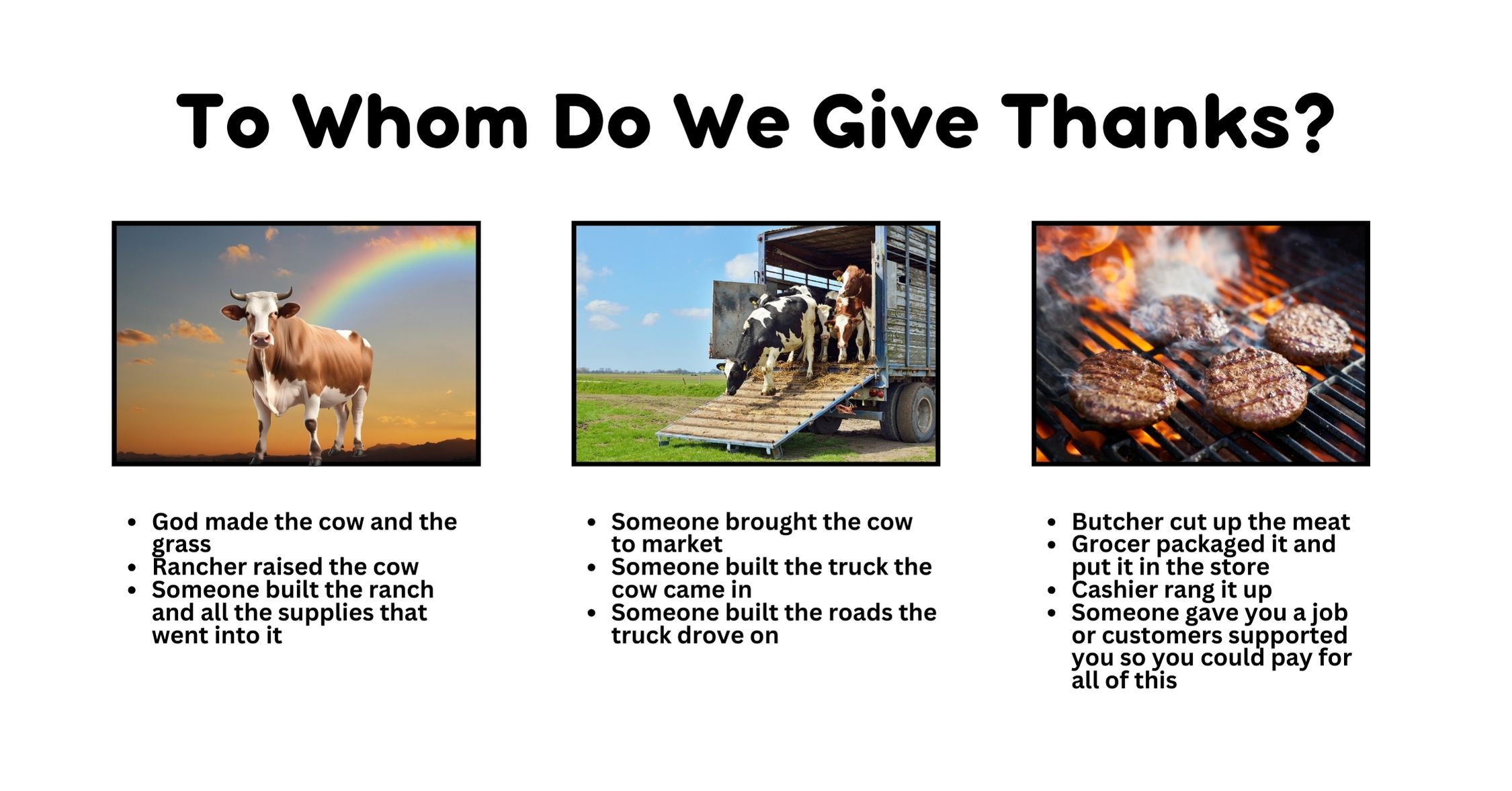
Nobody could do all those things without help from not just somebody but a whole bunch of somebodies. How would I have been able to cook my own meals as a baby, let alone as a full-grown man without somebody somewhere helping me? How often when we give thanks for our meal do we stop to think about the farmer who grew the vegetables on our plate or the rancher who raised the animals that provided the meat. How often do we think of the people who package our food and the truck drivers who take it to market so we can buy it? How often do we give thanks for the army of people who make it possible for our lives to keep moving forward every single day? Probably not often. Whenever we complain about life, we talk about “those people” who are ruining things for us. Whether “those people” are Democrats or Republicans, Christians or Muslims, Dodgers fans and Giants fans – there always seems to be a “those people.” But the truth is, there isn’t “those people.” There’s just us.
We live in community because we are wired for community. Literally.
Amy Banks, a doctor and an instructor in Psychiatry at Harvard Medical School said, “Neuroscience is confirming that our nervous systems want us to connect with other human beings.”[1] There was a study done on metastatic breast cancer patients back in 1989 where one group was placed in a supportive group environment and the other was given the standard care all patients received and what they found was that those placed in a supportive environment lived twice as long! Twice! There are truly tangible benefits of being part of a community. We talked last week about the children left in Romanian state care and how that sadly affected their lives, but there was also a study done with monkeys where they placed two “substitute mothers” in with them. One was a wire mother and one was a cloth mother. The wire mother had a bottle to feed the monkeys and the cloth mother did not. Yet the monkeys preferred spending time with the cloth mother despite the fact that the wire mother had food. Sadly, these monkeys – with no real mother to care for them – developed autistic tendencies just like the Romanian children did. There is more to life than just things like food, water, and air. As important as those are, living in community is just as important as these studies keep showing us.
That’s because God wired us for community.
Without community we cannot be the people God created us to be. But more than that, we need community because none of us are completely self-sufficient. We need others to help us. Not just with our physical needs, but our emotional and intellectual needs, too. We provide pieces of the puzzle to life that no one of us has by ourselves. And that’s how Paul described it in his letter to the church at Corinth. He talked about us being the body of Christ together and despite our protests otherwise, we cannot ignore that fact.
12 Just as a body, though one, has many parts, but all its many parts form one body, so it is with Christ. 13 For we were all baptized by one Spirit so as to form one body—whether Jews or Gentiles, slave or free—and we were all given the one Spirit to drink. 14 Even so the body is not made up of one part but of many.
15 Now if the foot should say, “Because I am not a hand, I do not belong to the body,” it would not for that reason stop being part of the body. 16 And if the ear should say, “Because I am not an eye, I do not belong to the body,” it would not for that reason stop being part of the body. 17 If the whole body were an eye, where would the sense of hearing be? If the whole body were an ear, where would the sense of smell be? 18 But in fact God has placed the parts in the body, every one of them, just as he wanted them to be. 19 If they were all one part, where would the body be? 20 As it is, there are many parts, but one body. – 1 Corinthians 12:12-20

The Body of Christ is like Voltron.
When I was growing up, there was an anime on TV about the pilots of five giant robot lions. These five lions had the ability to join together to form one giant robot named Voltron. In virtually every episode, there was a bad guy who threatened ALL of humanity, and at first they would try to beat him with just the lions. But ultimately, the only way to win was to form Voltron. The lions would connect to form the giant robot and they would defeat the bad guy! I always wondered why they didn’t just form Voltron right at the beginning of every battle except it would make for a very short show. But that’s the image that comes to mind for me when I read this passage. That we are like Voltron. Together we can do just about anything. Apart, we are only as good as a hand or an eye or a foot. Important, but only part of a whole. Sometimes I wonder if we are the cause of many of our own problems because we choose not to work together, to find the value in each person’s gifts.
It makes sense God created us for community.
After all we worship a God who is a community all by himself. God the Father. God the Son. God the Holy Spirit. Together but distinct. We refer to the Holy Trinity as the 3-in-1. And if we believe that we are formed in God’s image like it says in Genesis, it wouldn’t be a stretch to believe we are made to live in community like God. God seems to reward being in community. In our passage from Ecclesiastes, Solomon extols the virtues of supporting one another. Jesus told us anytime two or three are gathered in his name he is there (Matthew 18:19-20). And the writer of Hebrews encourages us to come together regularly to build one another up and support each other in our faith (Hebrews 10:24-25). But even if you didn’t believe a word of the Bible, the scientific evidence points the same way. Community is our natural state.

John Donne once penned a famous piece of writing called Meditation XVII.
You probably know the famous ending because it’s the title of a very famous Hemmingway book, For Whom the Bell Tolls. But Donne’s piece is much more than that one title. He wrote, “No man is an island, entire of itself; every man is a piece of the continent, a part of the main. If a clod be washed away by the sea, Europe is the less, as well as if a promontory were, as well as if a manor of thy friend’s or of thine own were: any man’s death diminishes me, because I am involved in mankind, and therefore never send to know for whom the bells tolls; it tolls for thee.”[2] Because we are all connected, when something happens to one of us, in a sense it happens to all of us. When any of us are diminished, whether it be by death or loss or persecution, it takes away from all we could be.[3] No man is an island. We are all part of the main. Or as we might say in the language of faith, we are all part of the body of Christ. God made us that way. All with different gifts, but united in the Spirit. Watching the news, listening to the radio, reading articles on the Internet or in print, it has become obvious we are less and less willing to live in community. In some bizarre way we are not willing to compromise. We are not willing to put ourselves in the other person’s shoes. Instead, we dig a trench. We jump in. And we refuse to budge. But that is not how we were created. We were not meant to be divided. We are meant to find a way to live together in community so that we can make each other better people. We are meant to find a way to live in community so we can learn and grow from each other. We were not meant to be as divisive and divided as we have become. And just as we would not be able to easily just cut off our hand or leg or any body part, we should also treat our brothers and sisters in Christ with honor and love and grace. Instead of continuing to fracture ourselves based on our own personal likes and dislikes, interpretations and understandings, we should find ways to keep coming back to the table that represents what Christ gave for us all.
God wired humanity a specific way.
All of those impulses, all of those deep desires, all of those longings of the heart – for relationships, for love, for meaning, even for God – are because that’s how God made you. One of the most profound questions in life we all ask is “Who am I?” And the answer is the person God made you to be. Like it says in Psalm 139, “I praise you because I am fearfully and wonderfully made; your works are wonderful, I know that full well.” But you are also shaped by your beliefs, your environment, and the people around you and that can change us both positively and negatively. Sometimes those things turn us away from seeing God or distracting us from a meaningful chance to know God. And when that happens we are less than what God intended for us to be. The world can be a harsh place. Not because of God but because of us. But these cravings of the human spirit were always meant to bring us back to him. That’s why we linger on them so much. That’s why we wonder about the meaning of life and if there is a purpose and if there is a God. Because God created us in such a way that no matter how far away you are from him in your spiritual life, there will always be a door open for you to come back, if you decide to pursue it. If you already have a deep faith in Christ, then I hope you think more about the incredible way God put us together and give thanks to Him for loving us so much that he would think about these things long before we ever did. And if you have doubts about God and where he is in your life, I hope you will decide to pursue it. I hope you will take the time to find out if it was God who really made you this way. I think you’ll be astonished by what you find.
[1] All of the examples in this section come from the article: http://www.theunlost.com/relationships/science-confirms-love-is-all-you-need-except-for-food-stuff/
[2] http://www.online-literature.com/donne/409/
[3] https://interestingliterature.com/2021/08/never-send-for-whom-the-bell-tolls-it-tolls-for-thee-meaning-analysis/# – Fun Fact: Donne wasn’t just a literary person but was Dean of St. Paul’s Cathedral! Faith was very important to him and this writing was done toward the end of his life as he reflected on the meaning of it all. Read the article for more info. It’s quite fascinating.
Wired for Love

7 Dear friends, let us love one another, for love comes from God. Everyone who loves has been born of God and knows God. 8 Whoever does not love does not know God, because God is love. 9 This is how God showed his love among us: He sent his one and only Son into the world that we might live through him. 10 This is love: not that we loved God, but that he loved us and sent his Son as an atoning sacrifice for our sins. 11 Dear friends, since God so loved us, we also ought to love one another. 12 No one has ever seen God; but if we love one another, God lives in us and his love is made complete in us. – 1 John 4:7-12

I was sure I finally found “the one.”
At the tender age of six years old, I thought I found her. Her name was Kari Covey. She had long blond hair that she wore in ponytails on either side of her head and I thought she was great. When I was pencil monitor, I would save the newest, sharpest pencil for her. When I was paper monitor, I would give her a piece of paper first and then go back and hand it out to everyone else. It was pretty obvious how much I liked her. The best thing was, I think she liked me too. I invited her and a bunch of my classmates to my birthday party when I turned six and at some point during the party, she started to chase me all around the house. I ended up trapped in my sister’s room and in front of all of my friends, Kari kissed me full on the lips. That was a great day! But alas it was not meant to be. That summer, Kari moved away. I didn’t even know until the beginning of the next school year when I couldn’t find her. One of her neighbors said her parents moved to Utah. I hope it wasn’t because of me. But it was okay, because I fell in love many, many more times after that. And each time I fell in love, I was sure she was the one.

When I was younger, I was worried about that. Worried about finding “the one.”
I remember making the comment to my friend Lance, “What if my one lives in China and we never meet? Or what if by the time we meet she’s already married because she couldn’t wait any longer?” The idea that there is only one person out there who is your soul mate is everywhere in our culture. It’s on TV, in movies, in books, in pretty much every storytelling medium there is. Even in video games! After all Mario had his Princess Peach, Pac Man had Ms. Pac Man. And Space Ace had Daphne. This idea of “the one” is everywhere. With just three words I think Tom Cruise ruined a generation of youth looking for love when he said to Renee Zellweger, “You complete me.” Now, I’m as much a romantic as anybody and I loved the movie Jerry Maguire, but this idea that there is only one human being out there we are searching for who can make us whole just isn’t true. The odds of anybody finding their “one” would be astronomical. That idea of love is too restrictive and doesn’t give credit to all the different ways God created for us to experience and give love – the love of friends, the love of family, parental love, and even love of humanity.
We are wired for love.
It is an essential part of who we are. We literally NEED love in our lives. That’s why we search so hard for it. Love is essential for life. Study after study has proven that. John Bowlby’s work on attachment theory[1], Rene Spitz’ work on maternal deprivation[2], and the awful condition of the children in Romanian orphanages gave ample evidence that love is an essential component of our lives.[3] It is one of the saddest stories of our time. Over 100,000 children were living in Romanian government institutions, the victims of a series of failed policies by the Romanian government who kept them in horrible conditions with poorly trained attendants. Even after the atrocious conditions were uncovered Romanian orphans still received only 5 to 6 minutes of attention per day.[4] Could you imagine a baby laying in his crib and only having human contact for 5 to 6 minutes a day? The New York Times reported, “Attendants still loll in the corridors, smoking and drinking coffee, leaving the children to rock in their cots.”[5] They estimated that 10% of all of these children will develop so poorly mentally and emotionally they will end their lives in a psychiatric institution.[6] They found that it wasn’t a lack of food or healthcare that was stunting their development, it was a lack of attention. A lack of love. Medically speaking the lack of contact, the lack of interaction, the lack of comfort and security made these children mentally deficient. Their brains were literally smaller than other children their age. We are wired for love.
Interestingly, we are not only wired to be loved, but we are also wired TO love.
An article by Psychology Today stated our need TO love is as strong as our desire to BE loved.[7] Dr. Raj Raghunathan wrote that being generous in our care and love for others does three things for us.[8] One, it encourages others to be generous to us. When we do nice things for people they often feel the desire and even the need to do something nice back. Two, something called homophily happens. Homophily is the propensity to attract like-minded people. So if you are a generous person, you tend to attract generous people in your life which is far better than being surrounded by selfish, self-centered people. And three, when we are generous, we are subconsciously saying to ourselves we are fulfilled. In fact, we have extra and our generosity stems from the overflow of our well-being. When we are stingy, we tell ourselves we don’t have enough and we need more – whether or not that’s true. We approach life from a “need” perspective and it not only colors our behavior but how we see ourselves. All of these reasons point to the idea that we are wired to love and be loved.
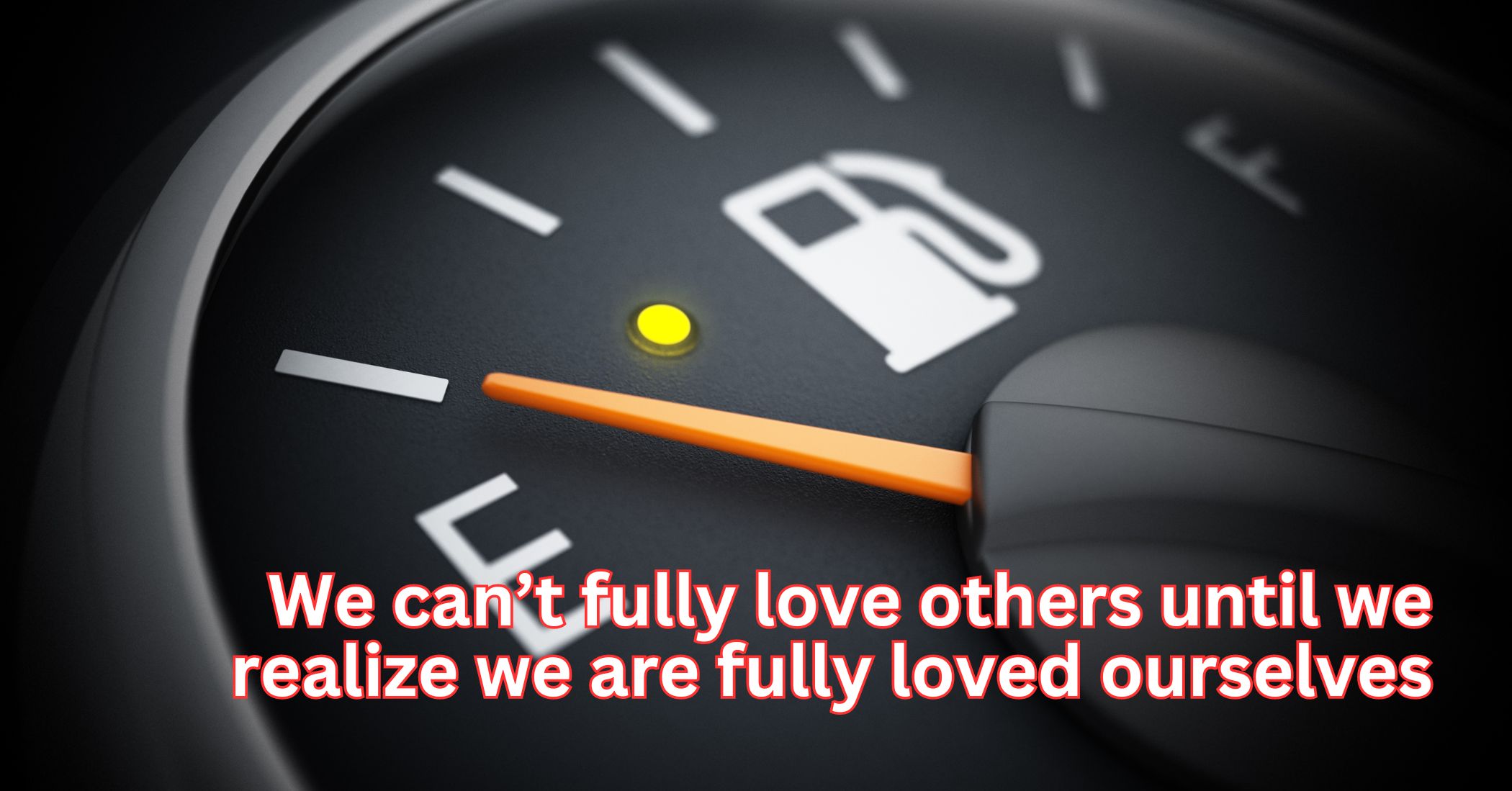
To fully love others, we need to know God’s love in our own lives.
It’s like those safety videos on an airplane where they tell you in case of an emergency to first put the oxygen mask on yourself before you put it on your child. As a parent, your first instinct is to protect your child, but the truth is the best way to help your child is to help yourself first. That way, you are clear-minded and in the best possible situation to make sure your child is okay. In the same way, we can’t fully love others until we realize we are fully loved ourselves. When we feel loved, when our love tank is full, it’s so much easier for us to love others in a way that fills them up too. So if we know in our hearts that there is a God who loves us, who has given so much for us, who loves us unconditionally and is constantly reaching out to us; when we internalize THAT and make that part of who we are, it frees us to be loving to others. Like it says in verse 10-11, “This is love: not that we loved God, but that he loved us… since God so loved us, we also ought to love one another.” God first loved us. Not that we loved God first, but he first loved us and because he loved us he taught us how to love one another. The key to a successful loving relationship is to first know and understand that you are loved and to know that God loves you abundantly. When you realize that, when you know that you are loved by the God of all love, you can enter into a loving relationship with confidence ready to give love out of the excess of what God has given you. But if you don’t feel that security of God’s love, if you enter into a relationship without the sureness of the love of God, you’re not able to fully give of yourself and you rob yourself of having the kind of love relationship God wants for you to have. Not just with your significant other, but with all of those around you.

That doesn’t mean that people who don’t believe in God don’t experience love.
Of course they do. Everyone has the capacity to experience love. It’s not only the way God made us, but the primary way he reaches out to us. God hopes that through love you will come to know him and believe in him. But you can experience love and never know where it comes from. It’s just that in that case, it’s going be like seeing a 3D movie and forgetting the glasses. You can still see the movie, but it’s a little out of focus most of the time. Not knowing or not believing that love comes from God robs you of the assurance that comes from his love. There is a strength in knowing that no matter what happens, you are loved by someone tremendously and unconditionally. Knowing that frees us from the pitfalls of the Jerry Maguire Syndrome – always searching for someone to complete us. Let’s face it, we can’t rely on other people to make us whole. We need to have that kind of self-assurance BEFORE we go out into the world so that we’re equipped to love someone else. So we can love from our overflow.
Don’t look to me as an expert.
I’ve made plenty of mistakes. And I haven’t always come from a place of self-assurance. Just ask Cassie. I’m far from perfect in this category. I struggle with doubts and when I’m hurting it’s not easy for me to remember I’m loved by God. But I do know God’s love has made me a stronger person. God’s love has helped to see me through some pretty difficult times. And knowing God loves me gives me the strength to love Cassie and Emma the way I hope they deserve to be loved. I still make mistakes. I still sometimes succumb to my own internal doubts and fears. But having God in my life has helped me to overcome those doubts and fears and to be a stronger person. I hope God will do that for you, too. I hope that in your own doubts and fears, in those times when you feel distant from God or you resort to your own inner weaknesses, that you’ll remember these words and gain strength from them. I hope you’ll realize that you don’t need someone to “complete” you because God loves you completely already. And that in your times of doubt, you’ll think about how you are made to love and be loved and that gift comes from God.
[1] http://www.simplypsychology.org/bowlby.html
[2] https://en.wikipedia.org/wiki/Ren%C3%A9_Spitz
[3] http://www.npr.org/sections/health-shots/2014/02/20/280237833/orphans-lonely-beginnings-reveal-how-parents-shape-a-childs-brain
[4] http://www.nytimes.com/1996/03/25/world/romanian-orphans-prisoners-of-their-cribs.html?_r=0
[5] ibid
[6] ibid
[7] https://www.psychologytoday.com/blog/sapient-nature/201401/the-need-love
[8] Each of these are found in the above article
Wired to Find the Meaning of Life

What is the meaning of life?
It’s a question most of us have asked at one time or another. In fact, 81% of Americans believe there is a higher purpose and meaning to their lives, and 73% believe finding that higher purpose is important.[1] This isn’t 81% of Christian Americans or religious Americans, this is 81% of ALL Americans. An even higher number, 85%, believe “there is more to life than the physical world and society.”[2] 85%! Which means even those who don’t see a higher purpose still ponder the meaning of life. In a Pew Gallop poll, nearly 20% of atheists said they believe in a higher power and although they don’t typically pray or feel religion is important, 35% said they often think about the purpose and meaning of their life at least weekly and almost the same number feel a deep sense of spiritual peace and well-being.[3] From a group of ATHEISTS! They don’t believe in God or an afterlife, but they do believe there is a higher purpose. There is something that compels us beyond just religious belief to seek the meaning of life.

As Christians, we believe that “something” is God.
God compels us to search for the meaning of life, to find some way to make our lives MATTER! We’re told our goal in life is to love God and love one another and to help others know God through our love, but how we do that is up to us. And as a kid, I thought I had it all figured out. I was sure it was to be a doctor. Even though at the tender age of 5 I had no idea who God was, I felt compelled to move in that direction. In fact, I was so sure, I never wavered all throughout school and declared pre-med when applying to college, even though I knew it would make it harder for me to get into some of the top universities. Because…you know…I had it all figured out. But college has a funny way of upending your carefully laid plans. It only took until the end of year one for me to realize being a doctor wasn’t going to be my path. Thirteen years of being sure, and it only took one to change my life completely. I floundered finding a new direction in life until I realized where God was leading me the whole time. And that’s how I ended up here. I knew God wanted me to find a way to help people, but it just did not happen in the way I had imagined.

Most of us flounder at some point in our lives to figure out what we are doing here on this great big planet.
Whether you believe in God or not, we ponder that overriding question. But we do believe we are meant for some purpose. When asked about it, even teenagers across the US overwhelmingly felt a deep sense of meaning to their lives. 87%! When asked what they thought that purpose was, again the answer was overwhelming – to help others. Nearly 50% thought they were meant to help others or to be a good person.[4] The next highest answer at 8% was to have a good job. Only 3% of teens thought their goal in life was to be successful or famous. A 17-year-old in Kentucky said, “I think that my purpose in life is to help people. I’ve gone through hard times myself, and I can’t even imagine the situations some kids are in — much worse even than the life that I’ve had growing up. I think that as long as I have the ability, and want to help people, that’s what I should do.” A 17-year-old from Utah said, “Everyone is here to fill in the holes in other people’s lives, whether little or big holes. Not everybody is the same, and we all need to share our talents and strengths to uplift other people.” And a 15-year-old girl from California impressed me so much when she said, “I am here to mourn with those that mourn, help those in need, comfort those who stand in need of comfort, and to stand as a witness to God at all times and in all things and in all places. I am here to stand for faith, divine nature, individual worth, knowledge, choice and accountability, good works, and integrity.”[5] At 15, she had a much more mature, well-thought-out answer than most adults.

But it just goes to show we really are wired for a higher purpose.
If you have a Bible or a Bible app on your phone, would you go to Matthew 5 beginning with verse 14. Matthew 5:14. We feel our lives are given meaning when we DO something meaningful and most of us believe that something is helping others. As Christians, we identify that through Jesus, but you don’t have to be religious to sense you have a higher purpose beyond just yourself. And that’s because God wired us that way. We are wired to find the meaning of life and that meaning lies in helping others. But you don’t have to take my word for it, or even God’s. From a purely scientific point of view, helping others gives meaning to our lives. Researchers have studied this and have found that helping others gives us a sense of free will, it helps us to feel like we are good people, and it strengthens our relationships to others both in a specific and a general sense.[6] But it also gives us a sense of purpose. Helping others makes us feel that life has meaning.[7] And if you’re a Christian that all makes sense. Most of what the prophets and the disciples record for us tells us to help others and to build one another up. There is testimony after testimony recorded in the Bible of different people who believe this to be true. New Testament. Old Testament. It doesn’t matter. The prophet Micah tells us that God asks of us “to do justice, and to love kindness, and to walk humbly with your God (Micah 6:8).” Paul wrote in his letter to the church in Galatia, “…do not use your freedom as an opportunity for the flesh, but through love serve one another. For the whole law is fulfilled in one word: ‘You shall love your neighbor as yourself (Galatians 5:13-14).’” Jesus tells us, “You shall love the Lord your God with all your heart and with all your soul and with all your strength and with all your mind, and your neighbor as yourself (Luke 10:27).” And God himself tells us in Leviticus, “The foreigner residing among you must be treated as your native-born. Love them as yourself, for you were foreigners in Egypt. I am the LORD your God.” Helping is a part of who we are and who were created to be. And here’s why.
14 “You are the light of the world. A town built on a hill cannot be hidden. 15 Neither do people light a lamp and put it under a bowl. Instead they put it on its stand, and it gives light to everyone in the house. 16 In the same way, let your light shine before others, that they may see your good deeds and glorify your Father in heaven. – Matthew 5:14-16

We are meant to be a city on a hill.
We are meant to point the way to God. As Christians we understand God has already done so much for us that we are compelled to do good things for others. We know Christ sacrificed everything so we might have eternal life and so we dedicate ourselves to helping others receive God into their lives too. We join together in God’s quest to bring as many as possible to him. So for us, doing good, helping others is not only what we feel compelled to do to love our neighbor, but is our way of honoring what God has done for us. Anybody can do good, but knowing why we do good and where this drive comes from gives us a sense of peace and wholeness that comes from nowhere else.
We often don’t spend enough time trying to figure out how to live out this deeper meaning.
We may believe there is one, but we don’t spend time thinking about it or how we can accomplish it. When asked how much time they spend on this question, almost 30% of people say they barely think about it if at all. When you add in the people who weren’t sure how often they think about it, that number jumps to 44%.[8] For something that’s so important, it’s amazing how many people don’t even consider the question. And if you’re a Christian, this is especially true. I hope it’s something you ponder more than once or twice a year. Because if our goal really is to love God and love one another, if our goal is to be a city on a hill so others know the love of God, we should be thinking about how to do that. I want to challenge you to go deeper in your faith this year. Whether that’s through a Bible or book study, a small group, volunteer efforts, or spending time in prayer (or all of them!), I hope you will be intentional in your efforts. Cassie is already leading a book study during the Lenten season as one way to kick start this Year of Growing Deeper and we will be adding more and more opportunities in the coming months. I hope you will find at least one to connect with and challenge yourself to grow closer to God. God loves you. God wants you. And God constantly is reaching out to you so you will find the peace and love through him that he hopes for you. So let’s do this together. In the name of the Father, and of the Son and of the Holy Spirit. Amen.
[1] https://research.lifeway.com/2021/04/06/americans-views-of-lifes-meaning-and-purpose-are-changing/ – by “important to them” they say it is a high priority in their life.
[2] Ibid
[3] https://www.pewresearch.org/short-reads/2019/12/06/10-facts-about-atheists/
[4] Data about teens comes from http://www.gallup.com/poll/11215/how-many-teens-see-purpose-life.aspx
[5] http://www.gallup.com/poll/11215/how-many-teens-see-purpose-life.aspx
[6] http://greatergood.berkeley.edu/article/item/can_helping_others_help_you_find_meaning_in_life
[7] Ibid.
[8] All data in this section comes from https://research.lifeway.com/2021/04/06/americans-views-of-lifes-meaning-and-purpose-are-changing/
Wired for God

Why are people sending us “good thoughts?”
I know it’s meant with the best of intentions, but what does that mean? I see this a lot on Facebook, mostly from non-religious friends but occasionally from religious ones, too. Usually, it’s in response to someone you care about going through a hard time. Whether it’s a health situation or the loss of someone close to them or getting fired from a job, if you scroll down the comments you’ll usually find someone who will say, “Sending you good thoughts” or “My thoughts are with you.” At first, I thought this was nice, a way for people to show they care, but it’s also an empty platitude. “Sending you good thoughts.” What does that mean? Are they facing the general direction of the person when they are sending these good thoughts? What is the person on the other end supposed to be doing with these good thoughts? It would be better to send money. After all thoughts are only worth a penny.

When people make these comments, I know it’s only meant in the best way.
But without God what does it really mean. When people are offering their prayers, they are offering something tangible. You might be thinking prayers are about as tangible as good thoughts, but when we offer a prayer for people, we are offering our commitment. We’re offering our time, we’re standing in solidarity with those we love by appealing to God on behalf of someone else, we’re offering our humility by bowing before God and asking him if not downright begging him for some kind of intervention. We are putting ourselves in front of the Creator of the Universe and saying, “Pay attention! This person is worthy of your help.” And people understand that idea. Whether they are religious or not, people appreciate your prayers. Because even if they don’t believe, there’s a part of them that understands the commitment you are making on their behalf. But here’s the thing. I think, deep down, most people believe in God. I don’t think there are as many atheists as we commonly believe. They might not believe in God the way we understand God, but people have this inclination to believe in something higher than themselves. And that’s why they say things like “sending good thoughts.” They may not believe in God, they may not believe in the power of prayer, but they believe there is something out there they can appeal to even if they don’t know what that something is.

That’s because we are wired for God.
We are wired for God. When God created humanity, he put within us this longing to search for him. We want to know God. We might refer to God in different ways, we might understand God in different ways, but we are all pointed in our lives toward God. Does that mean every religion is true? No. Does that mean we all believe in the same God? No. But it does mean that people encounter the Holy Spirit whether or not they believe in it or call it by that name. It means God is constantly revealing himself to us in and through the world around us. But our hearts have become hardened. Like the callous at the bottom of your big toe or on your writing hand. Remember that? When people used to write for a living and they would develop a callous on whatever hand they used for writing? That’s pretty much gone away because of computers, but like that callous that naturally forms over time by being constantly rubbed the wrong way, our hearts get hardened too as we get rubbed the wrong way, and it makes it more difficult for us to see God. That’s why Jesus told the disciples Isaiah’s prophecy has come true. We have eyes to see and ears to hear, and can’t seem to do either. But despite this callousness of life, despite our own hard-heartedness, despite all of that, we can’t help but seek God.
24 “The God who made the world and everything in it is the Lord of heaven and earth and does not live in temples built by human hands. 25 And he is not served by human hands, as if he needed anything. Rather, he himself gives everyone life and breath and everything else. 26 From one man he made all the nations, that they should inhabit the whole earth; and he marked out their appointed times in history and the boundaries of their lands. 27 God did this so that they would seek him and perhaps reach out for him and find him, though he is not far from any one of us. 28 ‘For in him we live and move and have our being.’[b] As some of your own poets have said, ‘We are his offspring.’[c]
29 “Therefore since we are God’s offspring, we should not think that the divine being is like gold or silver or stone—an image made by human design and skill. 30 In the past God overlooked such ignorance, but now he commands all people everywhere to repent. 31 For he has set a day when he will judge the world with justice by the man he has appointed. He has given proof of this to everyone by raising him from the dead.” – Acts 17:24-31
God created us and gave us life and in doing so hoped we would one day seek him and find him.
It’s simply part of who we are. It’s built into our DNA. If there was ever a way to dissect the spiritual part of our lives, we would find that God put us together in a certain way and that this desire to know him and to seek him is built into every strand within us. God isn’t something you leave behind at church. Instead God is always with us. That’s why Luke wrote in this book that God does not live in temples built by human hands. Because God lives within us! We are just very good at ignoring him. Instead we turn to other things to fill that part of our lives. We turn to other gods and other goals and other desires to fulfill this basic need to search for the divine. It’s so much a part of us that we don’t even realize how it bleeds into how we act and behave. That’s where phrases like “sending good thoughts” or “my thoughts are with you” enter into our vocabulary. There’s a part of us that wants to pray, to communicate with God, but we just don’t know it or understand it. Maybe we’re just flat out opposed to it. Maybe all your life you were told that if you prayed and believed, God would answer and he just flat out didn’t. And so, you gave up on prayer. But there’s a part of you that yearns to communicate again. There’s a part of you that wants to appeal to something greater than ourselves either individually or collectively to do something. But we just can’t bring ourselves to do it.
I have found most people are not truly atheists.
They may not believe in God the way we talk about God in church, but they are not truly atheists. To be sure there are some out there, but most people object to God not because the thought of God is stupid or childish or immature. But because they have found fault with him. God wasn’t there for them in their moment of crisis. God didn’t keep his promises. God allows evil to exist in the world. The God in the Old Testament and the God of the New Testament don’t add up to the same God. And if our understanding of God crashes head long into our experiences in life, God often is the victim. If God can’t uphold his end of the bargain, then he must not be real. But those objections are more about religion than the existence of God. Most people’s objections to faith are more about religion than God. They are more about our understanding of God rather than if he exists. I’ve heard horror stories about people who have a deep misunderstanding of God who are self-professed Christians and sometimes even pastors and church leaders, and if they were my experience with the God of Christianity, I wouldn’t believe in him either. My friend Jon from when we lived in Atlanta was so turned off by the church because of the hypocrisy and outright racism he found there. His friend and her fiancé went to her pastor to be married…and the pastor refused. She was white and was in love with an African-American man and the minister refused to do the ceremony because he said it was unbiblical. Sadly, he added it was an abomination before God. I don’t know where he got that from, but I know for a fact it doesn’t say that anywhere in the Bible, but he used the Bible as a defense to justify his own racism. If that was your experience with religion, maybe you wouldn’t believe either. I had a friend who used to be a pastor. He was consoling a grieving mother whose son had committed suicide. They were talking after the memorial service when one of his parishioners came up and told this bereaved woman that her son was going to hell for what he did. By the way, also not in the Bible. These are simply outdated untruths that a few ignorant people never bothered to question. And if that were typical of your experience with God, you probably wouldn’t believe in him either.

Instead people turn elsewhere to connect with God.
They turn to other religions or to other philosophies like Buddhism. They turn to material things like money. They put their faith instead in science. Because people are yearning to connect with SOMETHING even if they can’t put their finger on it. People everywhere are searching for answers. They are searching for meaning in life. They are hoping to find the answer to the eternal question, “Why am I here?” And if they really didn’t believe in something more, if they really didn’t believe in God, they would stop searching because without God there is no meaning. Without God, life simply is. There is no good and evil. Those are just constructs of the human mind. There is no love. That is just a chemical reaction within the body responding to external and internal stimuli. There is no soul or inner self. It’s all just an illusion. And most people just can’t go that far. They believe in love. They believe in the soul or something like a soul that defines who they are. They believe in good and evil. So their objection isn’t to the possibility of God but in how we’ve come to understand him. But this search. This search for answers. This search for meaning. These are things that God put within the DNA of our soul to make us curious so that even the most jaded people amongst us might be tempted to seek him out.
I was watching The Big Bang Theory the other day.
And there was this episode where the guys are trying to buy tickets to the new Star Wars movie. Leonard finds out tickets went on sale but when they try to buy them, they are all locked out. They try refreshing their screens, they try different websites, but nothing is working so Sheldon – a self-proclaimed atheist – announces that “desperate times call for desperate measures” and he drops to his knees to pray. “Lord, this is Sheldon Cooper. You’re good friends with my mom. I know I’ve spent my whole life denying that you exist.” Suddenly Wolowitz shouts out, “Got it!” And Sheldon concludes, “And I will continue to do so!” There is something in us that believes in something more, even if we are only willing to believe for the moment. There is something in us that hopes for something more. If you’ve never fully explored what that something is; if you’ve felt that pull in your life but haven’t really done much about it, I want you to consider that maybe, just maybe God wired you this way. That he has been tugging at your thoughts because he wants you to be connected to him. And I ask you to simply open up your heart to the possibility of God in your life. I’m going to ask you to take some time to really think about God and to actively search for him in everything you do. I’m hoping you will develop that desire to have eyes that see and ears that hear because I know God wants you to be a part of what he has in store for you. If you’ve already made that choice to open up to God, I challenge you to open your life to him even more. To allow him access to those areas you have always been resistant to, and only you and he know what those areas are. God made you to be naturally curious about life because he wants you to find him. And in addition to good thoughts, I’ll be saying a prayer for you in the name of the Father and of the Son and of the Holy Spirit. Amen.
The 12th Day of Christmas

Christmas is not what you think it is.
Everyone, whether they are religious or not, knows December 25th is when we celebrate the birth of Jesus…except it wasn’t. His birthday that is. Scholars believe if he was born in a manger, it was likely closer to spring or summer. It would have been way too cold otherwise. There are different theories why we celebrate on December 25th, but none of them are because he was born on that date.[1] Most nativity scenes show Jesus born in some kind of barn or stable, but it’s more likely he was born in a cave where many Israelites kept their animals.[2] And speaking of animals, we often picture sheep, cows, donkeys, maybe even some camels at the birth of Christ, but if you read it carefully, there is no mention of any animals present at Jesus’ birth. But perhaps what trips up people the most is the song “The 12 Days of Christmas.” It sounds like a countdown song to Jesus’ birthday, but December 25th is the FIRST of the 12 days of Christmas. It’s what the church calls Christmastime and it ended with the biggest Christian holiday of all – Epiphany! What’s that you say? You don’t know what the Epiphany is? Don’t worry, you’re not alone. Believe it or not, Epiphany used to be bigger than Christmas and was one of the most celebrated days of the year.
Somehow over time, it took a backseat to Christmas and Easter.
But really it should be one of the most important days in our calendar, because it was on the Epiphany when the magi arrived to honor Christ. We often think the magi arrived on Christmas Day, but if the star they saw in the sky was the Star of Bethlehem that rose at Jesus’ birth, they couldn’t have arrived until much later. Some scholars speculate it could have been as long as two years after.[3] In his book Christianity and World Religions, Adam Hamilton writes these magi were not “kings” but Zoroastrian priests – followers of a completely different faith who believed the stars revealed certain truths about the universe.[4] Zoroastrianism was originated in what is now modern-day Iraq[5] – about 800 to 900 miles away from where Jesus was born. That trip would have taken two to three months if they left the moment they saw the star, and it’s more likely they would’ve needed to prepare for the journey before undertaking it.[6] Rounding up supplies, the animals, the gifts, and their families and staff, would have taken a lot of time and the thought only three of them went on this massive journey would have been unlikely. So where did the number three come from and why did people assume they were kings? Let’s listen to the source itself. The story of the magi is only in Matthew’s version of the Gospel so we’ll read that passage today.

After Jesus was born in Bethlehem in Judea, during the time of King Herod, Magi from the east came to Jerusalem 2 and asked, “Where is the one who has been born king of the Jews? We saw his star when it rose and have come to worship him.” – Matthew 2
Herod upon hearing this, became frightened because he believed like most other Jews, that the savior would come and take control of Israel. That would mean Herod and his family would lose power if this child ever came to claim the throne. Fearful for his crown, Herod secretly met with the magi and sent them to Bethlehem to search for the Christ child, with every intent of killing this possible threat. The story continues.
9 After they had heard the king, they went on their way, and the star they had seen when it rose went ahead of them until it stopped over the place where the child was. 10 When they saw the star, they were overjoyed. 11 On coming to the house, they saw the child with his mother Mary, and they bowed down and worshiped him. Then they opened their treasures and presented him with gifts of gold, frankincense and myrrh. 12 And having been warned in a dream not to go back to Herod, they returned to their country by another route. – Matthew 2
The Epiphany is about the revelation of Christ to the world.
And the reason this is so significant is that it proves God’s intention to include ALL of humanity in his plan for salvation. It was the first-time people outside the Israelites saw Christ and believed He was the Messiah! It was the moment God’s covenant in Christ was extended to everyone. Paul understood this as he proclaimed the Word of God to the Romans. He says in chapter 3, verse 29, “Is God the God of Jews only? Is he not the God of Gentiles too? Yes, of Gentiles too…” And then in Romans 10:11-13, Paul continues, “As the Scripture says, “Anyone who trusts in him will never be put to shame.” For there is no difference between Jew and Gentile—the same Lord is Lord of all and richly blesses all who call on him, for, “Everyone who calls on the name of the Lord will be saved.” Most of the Jewish people believed God was their God only, that God would be revealed to the people of Israel and those who did not follow the faith according to Torah would never be accepted by the Lord. Even most of the Gentile converts believed they had to become Jewish for Christ to accept them. They believed this so firmly, men were having adult circumcisions to comply with Jewish tradition and Paul had to write to the churches in Rome, Corinth, Galatia, and Colossae to tell them to stop! Not only was it extremely painful, but it could result in infection or even death. Paul told them Christ accepted them as they were. In Galatians 5:6 he wrote, “For in Christ Jesus neither circumcision nor uncircumcision has any value. The only thing that counts is faith expressing itself through love.”

What it meant to be a “chosen people” radically changed with Jesus.
Instead of it being a “Hebrews only” club, the Israelites found out it was the polar opposite. They became God’s ambassadors to the world. It was going to be up to them to bring people into the fold. I’m sure it was a shock to many of the Jewish people. To so radically have your understanding of God flipped on its head must have been tough to process. But God knew these were the right people to share his message. And God didn’t stop there. God was reaching out to the rest of the world in ways that the rest of the world would understand – like these Zoroastrian priests. He didn’t bring this collection of Zoroastrian priests to Christ DESPITE their faith in another religion, but THROUGH their faith. It might seem like a contradiction if you read other parts of the Bible. After all, these Zoroastrian priests relied on astrology to figure out Jesus was the Christ child. And in the book of Deuteronomy, Moses clearly tells the people of Israel, “Let no one be found among you who sacrifices their son or daughter in the fire, who practices divination or sorcery, interprets omens, engages in witchcraft, 11 or casts spells, or who is a medium or spiritist or who consults the dead. 12 Anyone who does these things is detestable to the Lord… (Deuteronomy 18)” Yet, God used the priests’ belief in astrology to bring them to Jesus. Why were the Israelites forbidden from things like astrology and other sorts of divination when it worked for the magi? It’s because once you know Christ as Lord, to rely on these other forms of faith is to lose faith in Christ. But to those who do not know Christ as Lord, God reaches out to them in ways they can understand.
It’s continued evidence of God’s love for all of creation.
Epiphany is such an important part of our Christian calendar. It opened up our idea of salvation to be for everyone. And just as God has opened up his love for us, we too can open up our love for others, for not only do we gain hope from this day, but an example of the kind of love God wants us to express to all of those around us. Because when you understand how God loved us despite all our faults and failings and how God continues to reach out to the world despite so many who reject him, you begin to see how great God’s love is for us. And you also begin to understand how our own prejudices set us against one another when God wants us to instead reach out in love. We have to continually challenge ourselves to put aside our own biases and our own misconceptions about others and learn to love each other. That is the true meaning of the Epiphany. God’s acceptance of us all. Dennis Bratcher summarized these thoughts in a simple but beautiful prayer that I’d like to share with you.
“Father, we thank you for revealing yourself to us through Jesus. As ancient Israel confessed long ago, we realize it was not because of our own righteousness, or our wisdom, or strength, or power, or numbers. It was simply because you loved us and chose to show us that love in Christ.
As you have accepted us when we did not deserve your love, will you help us to accept those whom we find it hard to love? Forgive us, O Lord, for any attitude we hold onto that sees ourselves as better or more righteous than others. Will you help us to remove the barriers of prejudice and to tear down the walls of bigotry, religious, political, or social? Lord, help us realize the walls we erect for others only form our own prisons!
Will you fill us so full of your love there is no more room for intolerance. As you have forgiven us much, will you enable us with your strength to forgive others even more? Will you enable us through your abiding Presence among us, communally and individually, to live our lives in a manner worthy of the Name we bear?
May we, through your guidance and our faithful obedience, find new avenues in ways that we have not imagined of holding the Light of your love so that it may be a Light of revelation for all people. We thank you for your love, praise you for your Gift, ask for your continued Presence, and bring these petitions in the name of your Son, who has truly revealed your heart. Amen”[7]
[1] The first and most popular theory is that the church wanted to find an alternative to the merry-making around a celebration of Saturnalia and devised Christmas to focus people on something more holy. The second and less well-known theory involves the supposition that Christmas Day was about nine months after Passover and thus links the two dates together. Jesus’ death and Jesus’ Second Coming – although why they didn’t instead make Christmas nine months before Easter would be a mystery.
[2] A cave provided better shelter and didn’t require much construction other than a fence.
[3] Stephen M. Miller, The Jesus of the Bible, p.60.
[4] Adam Hamilton, Christianity and World Religions, p.27.
[5] https://en.wikipedia.org/wiki/Zoroastrianism
[6] OpCit., Miller, p.60.
[7] http://www.crivoice.org/cyepiph.html. – I did edit the prayer for grammar and for flow and time.
 Craig's Corner