
Wired to Find the Meaning of Life

What is the meaning of life?
It’s a question most of us have asked at one time or another. In fact, 81% of Americans believe there is a higher purpose and meaning to their lives, and 73% believe finding that higher purpose is important.[1] This isn’t 81% of Christian Americans or religious Americans, this is 81% of ALL Americans. An even higher number, 85%, believe “there is more to life than the physical world and society.”[2] 85%! Which means even those who don’t see a higher purpose still ponder the meaning of life. In a Pew Gallop poll, nearly 20% of atheists said they believe in a higher power and although they don’t typically pray or feel religion is important, 35% said they often think about the purpose and meaning of their life at least weekly and almost the same number feel a deep sense of spiritual peace and well-being.[3] From a group of ATHEISTS! They don’t believe in God or an afterlife, but they do believe there is a higher purpose. There is something that compels us beyond just religious belief to seek the meaning of life.

As Christians, we believe that “something” is God.
God compels us to search for the meaning of life, to find some way to make our lives MATTER! We’re told our goal in life is to love God and love one another and to help others know God through our love, but how we do that is up to us. And as a kid, I thought I had it all figured out. I was sure it was to be a doctor. Even though at the tender age of 5 I had no idea who God was, I felt compelled to move in that direction. In fact, I was so sure, I never wavered all throughout school and declared pre-med when applying to college, even though I knew it would make it harder for me to get into some of the top universities. Because…you know…I had it all figured out. But college has a funny way of upending your carefully laid plans. It only took until the end of year one for me to realize being a doctor wasn’t going to be my path. Thirteen years of being sure, and it only took one to change my life completely. I floundered finding a new direction in life until I realized where God was leading me the whole time. And that’s how I ended up here. I knew God wanted me to find a way to help people, but it just did not happen in the way I had imagined.

Most of us flounder at some point in our lives to figure out what we are doing here on this great big planet.
Whether you believe in God or not, we ponder that overriding question. But we do believe we are meant for some purpose. When asked about it, even teenagers across the US overwhelmingly felt a deep sense of meaning to their lives. 87%! When asked what they thought that purpose was, again the answer was overwhelming – to help others. Nearly 50% thought they were meant to help others or to be a good person.[4] The next highest answer at 8% was to have a good job. Only 3% of teens thought their goal in life was to be successful or famous. A 17-year-old in Kentucky said, “I think that my purpose in life is to help people. I’ve gone through hard times myself, and I can’t even imagine the situations some kids are in — much worse even than the life that I’ve had growing up. I think that as long as I have the ability, and want to help people, that’s what I should do.” A 17-year-old from Utah said, “Everyone is here to fill in the holes in other people’s lives, whether little or big holes. Not everybody is the same, and we all need to share our talents and strengths to uplift other people.” And a 15-year-old girl from California impressed me so much when she said, “I am here to mourn with those that mourn, help those in need, comfort those who stand in need of comfort, and to stand as a witness to God at all times and in all things and in all places. I am here to stand for faith, divine nature, individual worth, knowledge, choice and accountability, good works, and integrity.”[5] At 15, she had a much more mature, well-thought-out answer than most adults.

But it just goes to show we really are wired for a higher purpose.
If you have a Bible or a Bible app on your phone, would you go to Matthew 5 beginning with verse 14. Matthew 5:14. We feel our lives are given meaning when we DO something meaningful and most of us believe that something is helping others. As Christians, we identify that through Jesus, but you don’t have to be religious to sense you have a higher purpose beyond just yourself. And that’s because God wired us that way. We are wired to find the meaning of life and that meaning lies in helping others. But you don’t have to take my word for it, or even God’s. From a purely scientific point of view, helping others gives meaning to our lives. Researchers have studied this and have found that helping others gives us a sense of free will, it helps us to feel like we are good people, and it strengthens our relationships to others both in a specific and a general sense.[6] But it also gives us a sense of purpose. Helping others makes us feel that life has meaning.[7] And if you’re a Christian that all makes sense. Most of what the prophets and the disciples record for us tells us to help others and to build one another up. There is testimony after testimony recorded in the Bible of different people who believe this to be true. New Testament. Old Testament. It doesn’t matter. The prophet Micah tells us that God asks of us “to do justice, and to love kindness, and to walk humbly with your God (Micah 6:8).” Paul wrote in his letter to the church in Galatia, “…do not use your freedom as an opportunity for the flesh, but through love serve one another. For the whole law is fulfilled in one word: ‘You shall love your neighbor as yourself (Galatians 5:13-14).’” Jesus tells us, “You shall love the Lord your God with all your heart and with all your soul and with all your strength and with all your mind, and your neighbor as yourself (Luke 10:27).” And God himself tells us in Leviticus, “The foreigner residing among you must be treated as your native-born. Love them as yourself, for you were foreigners in Egypt. I am the LORD your God.” Helping is a part of who we are and who were created to be. And here’s why.
14 “You are the light of the world. A town built on a hill cannot be hidden. 15 Neither do people light a lamp and put it under a bowl. Instead they put it on its stand, and it gives light to everyone in the house. 16 In the same way, let your light shine before others, that they may see your good deeds and glorify your Father in heaven. – Matthew 5:14-16

We are meant to be a city on a hill.
We are meant to point the way to God. As Christians we understand God has already done so much for us that we are compelled to do good things for others. We know Christ sacrificed everything so we might have eternal life and so we dedicate ourselves to helping others receive God into their lives too. We join together in God’s quest to bring as many as possible to him. So for us, doing good, helping others is not only what we feel compelled to do to love our neighbor, but is our way of honoring what God has done for us. Anybody can do good, but knowing why we do good and where this drive comes from gives us a sense of peace and wholeness that comes from nowhere else.
We often don’t spend enough time trying to figure out how to live out this deeper meaning.
We may believe there is one, but we don’t spend time thinking about it or how we can accomplish it. When asked how much time they spend on this question, almost 30% of people say they barely think about it if at all. When you add in the people who weren’t sure how often they think about it, that number jumps to 44%.[8] For something that’s so important, it’s amazing how many people don’t even consider the question. And if you’re a Christian, this is especially true. I hope it’s something you ponder more than once or twice a year. Because if our goal really is to love God and love one another, if our goal is to be a city on a hill so others know the love of God, we should be thinking about how to do that. I want to challenge you to go deeper in your faith this year. Whether that’s through a Bible or book study, a small group, volunteer efforts, or spending time in prayer (or all of them!), I hope you will be intentional in your efforts. Cassie is already leading a book study during the Lenten season as one way to kick start this Year of Growing Deeper and we will be adding more and more opportunities in the coming months. I hope you will find at least one to connect with and challenge yourself to grow closer to God. God loves you. God wants you. And God constantly is reaching out to you so you will find the peace and love through him that he hopes for you. So let’s do this together. In the name of the Father, and of the Son and of the Holy Spirit. Amen.
[1] https://research.lifeway.com/2021/04/06/americans-views-of-lifes-meaning-and-purpose-are-changing/ – by “important to them” they say it is a high priority in their life.
[2] Ibid
[3] https://www.pewresearch.org/short-reads/2019/12/06/10-facts-about-atheists/
[4] Data about teens comes from http://www.gallup.com/poll/11215/how-many-teens-see-purpose-life.aspx
[5] http://www.gallup.com/poll/11215/how-many-teens-see-purpose-life.aspx
[6] http://greatergood.berkeley.edu/article/item/can_helping_others_help_you_find_meaning_in_life
[7] Ibid.
[8] All data in this section comes from https://research.lifeway.com/2021/04/06/americans-views-of-lifes-meaning-and-purpose-are-changing/
Wired for God

Why are people sending us “good thoughts?”
I know it’s meant with the best of intentions, but what does that mean? I see this a lot on Facebook, mostly from non-religious friends but occasionally from religious ones, too. Usually, it’s in response to someone you care about going through a hard time. Whether it’s a health situation or the loss of someone close to them or getting fired from a job, if you scroll down the comments you’ll usually find someone who will say, “Sending you good thoughts” or “My thoughts are with you.” At first, I thought this was nice, a way for people to show they care, but it’s also an empty platitude. “Sending you good thoughts.” What does that mean? Are they facing the general direction of the person when they are sending these good thoughts? What is the person on the other end supposed to be doing with these good thoughts? It would be better to send money. After all thoughts are only worth a penny.

When people make these comments, I know it’s only meant in the best way.
But without God what does it really mean. When people are offering their prayers, they are offering something tangible. You might be thinking prayers are about as tangible as good thoughts, but when we offer a prayer for people, we are offering our commitment. We’re offering our time, we’re standing in solidarity with those we love by appealing to God on behalf of someone else, we’re offering our humility by bowing before God and asking him if not downright begging him for some kind of intervention. We are putting ourselves in front of the Creator of the Universe and saying, “Pay attention! This person is worthy of your help.” And people understand that idea. Whether they are religious or not, people appreciate your prayers. Because even if they don’t believe, there’s a part of them that understands the commitment you are making on their behalf. But here’s the thing. I think, deep down, most people believe in God. I don’t think there are as many atheists as we commonly believe. They might not believe in God the way we understand God, but people have this inclination to believe in something higher than themselves. And that’s why they say things like “sending good thoughts.” They may not believe in God, they may not believe in the power of prayer, but they believe there is something out there they can appeal to even if they don’t know what that something is.

That’s because we are wired for God.
We are wired for God. When God created humanity, he put within us this longing to search for him. We want to know God. We might refer to God in different ways, we might understand God in different ways, but we are all pointed in our lives toward God. Does that mean every religion is true? No. Does that mean we all believe in the same God? No. But it does mean that people encounter the Holy Spirit whether or not they believe in it or call it by that name. It means God is constantly revealing himself to us in and through the world around us. But our hearts have become hardened. Like the callous at the bottom of your big toe or on your writing hand. Remember that? When people used to write for a living and they would develop a callous on whatever hand they used for writing? That’s pretty much gone away because of computers, but like that callous that naturally forms over time by being constantly rubbed the wrong way, our hearts get hardened too as we get rubbed the wrong way, and it makes it more difficult for us to see God. That’s why Jesus told the disciples Isaiah’s prophecy has come true. We have eyes to see and ears to hear, and can’t seem to do either. But despite this callousness of life, despite our own hard-heartedness, despite all of that, we can’t help but seek God.
24 “The God who made the world and everything in it is the Lord of heaven and earth and does not live in temples built by human hands. 25 And he is not served by human hands, as if he needed anything. Rather, he himself gives everyone life and breath and everything else. 26 From one man he made all the nations, that they should inhabit the whole earth; and he marked out their appointed times in history and the boundaries of their lands. 27 God did this so that they would seek him and perhaps reach out for him and find him, though he is not far from any one of us. 28 ‘For in him we live and move and have our being.’[b] As some of your own poets have said, ‘We are his offspring.’[c]
29 “Therefore since we are God’s offspring, we should not think that the divine being is like gold or silver or stone—an image made by human design and skill. 30 In the past God overlooked such ignorance, but now he commands all people everywhere to repent. 31 For he has set a day when he will judge the world with justice by the man he has appointed. He has given proof of this to everyone by raising him from the dead.” – Acts 17:24-31
God created us and gave us life and in doing so hoped we would one day seek him and find him.
It’s simply part of who we are. It’s built into our DNA. If there was ever a way to dissect the spiritual part of our lives, we would find that God put us together in a certain way and that this desire to know him and to seek him is built into every strand within us. God isn’t something you leave behind at church. Instead God is always with us. That’s why Luke wrote in this book that God does not live in temples built by human hands. Because God lives within us! We are just very good at ignoring him. Instead we turn to other things to fill that part of our lives. We turn to other gods and other goals and other desires to fulfill this basic need to search for the divine. It’s so much a part of us that we don’t even realize how it bleeds into how we act and behave. That’s where phrases like “sending good thoughts” or “my thoughts are with you” enter into our vocabulary. There’s a part of us that wants to pray, to communicate with God, but we just don’t know it or understand it. Maybe we’re just flat out opposed to it. Maybe all your life you were told that if you prayed and believed, God would answer and he just flat out didn’t. And so, you gave up on prayer. But there’s a part of you that yearns to communicate again. There’s a part of you that wants to appeal to something greater than ourselves either individually or collectively to do something. But we just can’t bring ourselves to do it.
I have found most people are not truly atheists.
They may not believe in God the way we talk about God in church, but they are not truly atheists. To be sure there are some out there, but most people object to God not because the thought of God is stupid or childish or immature. But because they have found fault with him. God wasn’t there for them in their moment of crisis. God didn’t keep his promises. God allows evil to exist in the world. The God in the Old Testament and the God of the New Testament don’t add up to the same God. And if our understanding of God crashes head long into our experiences in life, God often is the victim. If God can’t uphold his end of the bargain, then he must not be real. But those objections are more about religion than the existence of God. Most people’s objections to faith are more about religion than God. They are more about our understanding of God rather than if he exists. I’ve heard horror stories about people who have a deep misunderstanding of God who are self-professed Christians and sometimes even pastors and church leaders, and if they were my experience with the God of Christianity, I wouldn’t believe in him either. My friend Jon from when we lived in Atlanta was so turned off by the church because of the hypocrisy and outright racism he found there. His friend and her fiancé went to her pastor to be married…and the pastor refused. She was white and was in love with an African-American man and the minister refused to do the ceremony because he said it was unbiblical. Sadly, he added it was an abomination before God. I don’t know where he got that from, but I know for a fact it doesn’t say that anywhere in the Bible, but he used the Bible as a defense to justify his own racism. If that was your experience with religion, maybe you wouldn’t believe either. I had a friend who used to be a pastor. He was consoling a grieving mother whose son had committed suicide. They were talking after the memorial service when one of his parishioners came up and told this bereaved woman that her son was going to hell for what he did. By the way, also not in the Bible. These are simply outdated untruths that a few ignorant people never bothered to question. And if that were typical of your experience with God, you probably wouldn’t believe in him either.

Instead people turn elsewhere to connect with God.
They turn to other religions or to other philosophies like Buddhism. They turn to material things like money. They put their faith instead in science. Because people are yearning to connect with SOMETHING even if they can’t put their finger on it. People everywhere are searching for answers. They are searching for meaning in life. They are hoping to find the answer to the eternal question, “Why am I here?” And if they really didn’t believe in something more, if they really didn’t believe in God, they would stop searching because without God there is no meaning. Without God, life simply is. There is no good and evil. Those are just constructs of the human mind. There is no love. That is just a chemical reaction within the body responding to external and internal stimuli. There is no soul or inner self. It’s all just an illusion. And most people just can’t go that far. They believe in love. They believe in the soul or something like a soul that defines who they are. They believe in good and evil. So their objection isn’t to the possibility of God but in how we’ve come to understand him. But this search. This search for answers. This search for meaning. These are things that God put within the DNA of our soul to make us curious so that even the most jaded people amongst us might be tempted to seek him out.
I was watching The Big Bang Theory the other day.
And there was this episode where the guys are trying to buy tickets to the new Star Wars movie. Leonard finds out tickets went on sale but when they try to buy them, they are all locked out. They try refreshing their screens, they try different websites, but nothing is working so Sheldon – a self-proclaimed atheist – announces that “desperate times call for desperate measures” and he drops to his knees to pray. “Lord, this is Sheldon Cooper. You’re good friends with my mom. I know I’ve spent my whole life denying that you exist.” Suddenly Wolowitz shouts out, “Got it!” And Sheldon concludes, “And I will continue to do so!” There is something in us that believes in something more, even if we are only willing to believe for the moment. There is something in us that hopes for something more. If you’ve never fully explored what that something is; if you’ve felt that pull in your life but haven’t really done much about it, I want you to consider that maybe, just maybe God wired you this way. That he has been tugging at your thoughts because he wants you to be connected to him. And I ask you to simply open up your heart to the possibility of God in your life. I’m going to ask you to take some time to really think about God and to actively search for him in everything you do. I’m hoping you will develop that desire to have eyes that see and ears that hear because I know God wants you to be a part of what he has in store for you. If you’ve already made that choice to open up to God, I challenge you to open your life to him even more. To allow him access to those areas you have always been resistant to, and only you and he know what those areas are. God made you to be naturally curious about life because he wants you to find him. And in addition to good thoughts, I’ll be saying a prayer for you in the name of the Father and of the Son and of the Holy Spirit. Amen.
The 12th Day of Christmas

Christmas is not what you think it is.
Everyone, whether they are religious or not, knows December 25th is when we celebrate the birth of Jesus…except it wasn’t. His birthday that is. Scholars believe if he was born in a manger, it was likely closer to spring or summer. It would have been way too cold otherwise. There are different theories why we celebrate on December 25th, but none of them are because he was born on that date.[1] Most nativity scenes show Jesus born in some kind of barn or stable, but it’s more likely he was born in a cave where many Israelites kept their animals.[2] And speaking of animals, we often picture sheep, cows, donkeys, maybe even some camels at the birth of Christ, but if you read it carefully, there is no mention of any animals present at Jesus’ birth. But perhaps what trips up people the most is the song “The 12 Days of Christmas.” It sounds like a countdown song to Jesus’ birthday, but December 25th is the FIRST of the 12 days of Christmas. It’s what the church calls Christmastime and it ended with the biggest Christian holiday of all – Epiphany! What’s that you say? You don’t know what the Epiphany is? Don’t worry, you’re not alone. Believe it or not, Epiphany used to be bigger than Christmas and was one of the most celebrated days of the year.
Somehow over time, it took a backseat to Christmas and Easter.
But really it should be one of the most important days in our calendar, because it was on the Epiphany when the magi arrived to honor Christ. We often think the magi arrived on Christmas Day, but if the star they saw in the sky was the Star of Bethlehem that rose at Jesus’ birth, they couldn’t have arrived until much later. Some scholars speculate it could have been as long as two years after.[3] In his book Christianity and World Religions, Adam Hamilton writes these magi were not “kings” but Zoroastrian priests – followers of a completely different faith who believed the stars revealed certain truths about the universe.[4] Zoroastrianism was originated in what is now modern-day Iraq[5] – about 800 to 900 miles away from where Jesus was born. That trip would have taken two to three months if they left the moment they saw the star, and it’s more likely they would’ve needed to prepare for the journey before undertaking it.[6] Rounding up supplies, the animals, the gifts, and their families and staff, would have taken a lot of time and the thought only three of them went on this massive journey would have been unlikely. So where did the number three come from and why did people assume they were kings? Let’s listen to the source itself. The story of the magi is only in Matthew’s version of the Gospel so we’ll read that passage today.

After Jesus was born in Bethlehem in Judea, during the time of King Herod, Magi from the east came to Jerusalem 2 and asked, “Where is the one who has been born king of the Jews? We saw his star when it rose and have come to worship him.” – Matthew 2
Herod upon hearing this, became frightened because he believed like most other Jews, that the savior would come and take control of Israel. That would mean Herod and his family would lose power if this child ever came to claim the throne. Fearful for his crown, Herod secretly met with the magi and sent them to Bethlehem to search for the Christ child, with every intent of killing this possible threat. The story continues.
9 After they had heard the king, they went on their way, and the star they had seen when it rose went ahead of them until it stopped over the place where the child was. 10 When they saw the star, they were overjoyed. 11 On coming to the house, they saw the child with his mother Mary, and they bowed down and worshiped him. Then they opened their treasures and presented him with gifts of gold, frankincense and myrrh. 12 And having been warned in a dream not to go back to Herod, they returned to their country by another route. – Matthew 2
The Epiphany is about the revelation of Christ to the world.
And the reason this is so significant is that it proves God’s intention to include ALL of humanity in his plan for salvation. It was the first-time people outside the Israelites saw Christ and believed He was the Messiah! It was the moment God’s covenant in Christ was extended to everyone. Paul understood this as he proclaimed the Word of God to the Romans. He says in chapter 3, verse 29, “Is God the God of Jews only? Is he not the God of Gentiles too? Yes, of Gentiles too…” And then in Romans 10:11-13, Paul continues, “As the Scripture says, “Anyone who trusts in him will never be put to shame.” For there is no difference between Jew and Gentile—the same Lord is Lord of all and richly blesses all who call on him, for, “Everyone who calls on the name of the Lord will be saved.” Most of the Jewish people believed God was their God only, that God would be revealed to the people of Israel and those who did not follow the faith according to Torah would never be accepted by the Lord. Even most of the Gentile converts believed they had to become Jewish for Christ to accept them. They believed this so firmly, men were having adult circumcisions to comply with Jewish tradition and Paul had to write to the churches in Rome, Corinth, Galatia, and Colossae to tell them to stop! Not only was it extremely painful, but it could result in infection or even death. Paul told them Christ accepted them as they were. In Galatians 5:6 he wrote, “For in Christ Jesus neither circumcision nor uncircumcision has any value. The only thing that counts is faith expressing itself through love.”

What it meant to be a “chosen people” radically changed with Jesus.
Instead of it being a “Hebrews only” club, the Israelites found out it was the polar opposite. They became God’s ambassadors to the world. It was going to be up to them to bring people into the fold. I’m sure it was a shock to many of the Jewish people. To so radically have your understanding of God flipped on its head must have been tough to process. But God knew these were the right people to share his message. And God didn’t stop there. God was reaching out to the rest of the world in ways that the rest of the world would understand – like these Zoroastrian priests. He didn’t bring this collection of Zoroastrian priests to Christ DESPITE their faith in another religion, but THROUGH their faith. It might seem like a contradiction if you read other parts of the Bible. After all, these Zoroastrian priests relied on astrology to figure out Jesus was the Christ child. And in the book of Deuteronomy, Moses clearly tells the people of Israel, “Let no one be found among you who sacrifices their son or daughter in the fire, who practices divination or sorcery, interprets omens, engages in witchcraft, 11 or casts spells, or who is a medium or spiritist or who consults the dead. 12 Anyone who does these things is detestable to the Lord… (Deuteronomy 18)” Yet, God used the priests’ belief in astrology to bring them to Jesus. Why were the Israelites forbidden from things like astrology and other sorts of divination when it worked for the magi? It’s because once you know Christ as Lord, to rely on these other forms of faith is to lose faith in Christ. But to those who do not know Christ as Lord, God reaches out to them in ways they can understand.
It’s continued evidence of God’s love for all of creation.
Epiphany is such an important part of our Christian calendar. It opened up our idea of salvation to be for everyone. And just as God has opened up his love for us, we too can open up our love for others, for not only do we gain hope from this day, but an example of the kind of love God wants us to express to all of those around us. Because when you understand how God loved us despite all our faults and failings and how God continues to reach out to the world despite so many who reject him, you begin to see how great God’s love is for us. And you also begin to understand how our own prejudices set us against one another when God wants us to instead reach out in love. We have to continually challenge ourselves to put aside our own biases and our own misconceptions about others and learn to love each other. That is the true meaning of the Epiphany. God’s acceptance of us all. Dennis Bratcher summarized these thoughts in a simple but beautiful prayer that I’d like to share with you.
“Father, we thank you for revealing yourself to us through Jesus. As ancient Israel confessed long ago, we realize it was not because of our own righteousness, or our wisdom, or strength, or power, or numbers. It was simply because you loved us and chose to show us that love in Christ.
As you have accepted us when we did not deserve your love, will you help us to accept those whom we find it hard to love? Forgive us, O Lord, for any attitude we hold onto that sees ourselves as better or more righteous than others. Will you help us to remove the barriers of prejudice and to tear down the walls of bigotry, religious, political, or social? Lord, help us realize the walls we erect for others only form our own prisons!
Will you fill us so full of your love there is no more room for intolerance. As you have forgiven us much, will you enable us with your strength to forgive others even more? Will you enable us through your abiding Presence among us, communally and individually, to live our lives in a manner worthy of the Name we bear?
May we, through your guidance and our faithful obedience, find new avenues in ways that we have not imagined of holding the Light of your love so that it may be a Light of revelation for all people. We thank you for your love, praise you for your Gift, ask for your continued Presence, and bring these petitions in the name of your Son, who has truly revealed your heart. Amen”[7]
[1] The first and most popular theory is that the church wanted to find an alternative to the merry-making around a celebration of Saturnalia and devised Christmas to focus people on something more holy. The second and less well-known theory involves the supposition that Christmas Day was about nine months after Passover and thus links the two dates together. Jesus’ death and Jesus’ Second Coming – although why they didn’t instead make Christmas nine months before Easter would be a mystery.
[2] A cave provided better shelter and didn’t require much construction other than a fence.
[3] Stephen M. Miller, The Jesus of the Bible, p.60.
[4] Adam Hamilton, Christianity and World Religions, p.27.
[5] https://en.wikipedia.org/wiki/Zoroastrianism
[6] OpCit., Miller, p.60.
[7] http://www.crivoice.org/cyepiph.html. – I did edit the prayer for grammar and for flow and time.
明けましておめでとうございます
Akemashite Omedetou Gozaimasu
Happy New Year everyone! Now, I realize it’s not quite the New Year yet, but with January 1st coming up, I thought it would be a good idea to get just a little bit ahead of the game. After all, one of my New Year’s resolutions is to stop procrastinating. I was going to make that my resolution last year, but I decided to put it off. This is the time of year where we spend a lot of time looking back on what’s been going on in our lives. You can’t go on social media and not see posts about the “Top 9” something of 2023 or listen to the radio and hear the countdown of the year’s biggest hits. Wherever you turn people are reflecting on the past year – where it went right and where we could improve. As a person, as a nation, as a global community, how did last year go? And that’s a good thing. Reflecting on the past will help us do better in the future. One area I’m going to challenge ALL of us to do better in (myself included) is to grow deeper in faith. Let those roots of our faith dig down deep and take hold. Whether that’s coming to worship more often, joining a small group, volunteering, giving, or even praying, spend time next year doing something MORE than what you did this year and see how God will bless your life. And if there is someone in your life who could use some encouragement to come to church more often (or come at all), here are some facts you could share with them.

Coming to church regularly is associated with …[1]
- 55% lower risk for mortality among middle-aged people
- 68% lower risk of death among women due to drugs, alcohol, and suicide and 33% lower among men
- 22% decrease in the incidence of depression
- Better time and life management skills
- Decrease use of drugs, violence, and delinquency among at risk youth
- Higher math and reading scores, and greater educational aspirations
- Being more likely to finish homework and degree programs
- Better intimate relationships
- Young adults being 18% more likely to report higher happiness, 29% more likely to volunteer, and 33% less likely to use drugs

But even if there were not all of these statistical reasons to come to church, even if I didn’t have facts and figures to back up why coming to church is a smart and healthy thing to do, I’d say it’s still the right thing because faith is best in community. Faith is best in community. Our faith is something God meant for us to develop together as we are about to read in our passage today. If you’ll please go to Hebrews 10:19 in your Bibles or your Bible app we’ll begin there this morning. In this passage, the author has just finished writing about how people used to offer sacrifices to God in hope of cleansing themselves and starting life anew. But that obviously didn’t work because day after day, year after year, the priests continually offered sacrifices to God to cleanse themselves, but now…now that God has written his law on our hearts as we heard in Jeremiah, now that God has written a new covenant with us, we are cleansed in his sight. We are covered in forgiveness. And that is where we enter the Scripture.
Therefore, brothers, since we have confidence to enter the Most Holy Place by the blood of Jesus, by a new and living way opened for us through the curtain, that is, his body, and since we have a great priest over the house of God, let us draw near to God with a sincere heart in full assurance of faith, having our hearts sprinkled to cleanse us from a guilty conscience and having our bodies washed with pure water. Let us hold unswervingly to the hope we profess, for he who promised is faithful. And let us consider how we may spur one another on toward love and good deeds. Let us not give up meeting together, as some are in the habit of doing, but let us encourage one another—and all the more as you see the Day approaching. – Hebrews 10:19-25
Seems that even as early as 70 AD, the church had a problem with worship attendance.
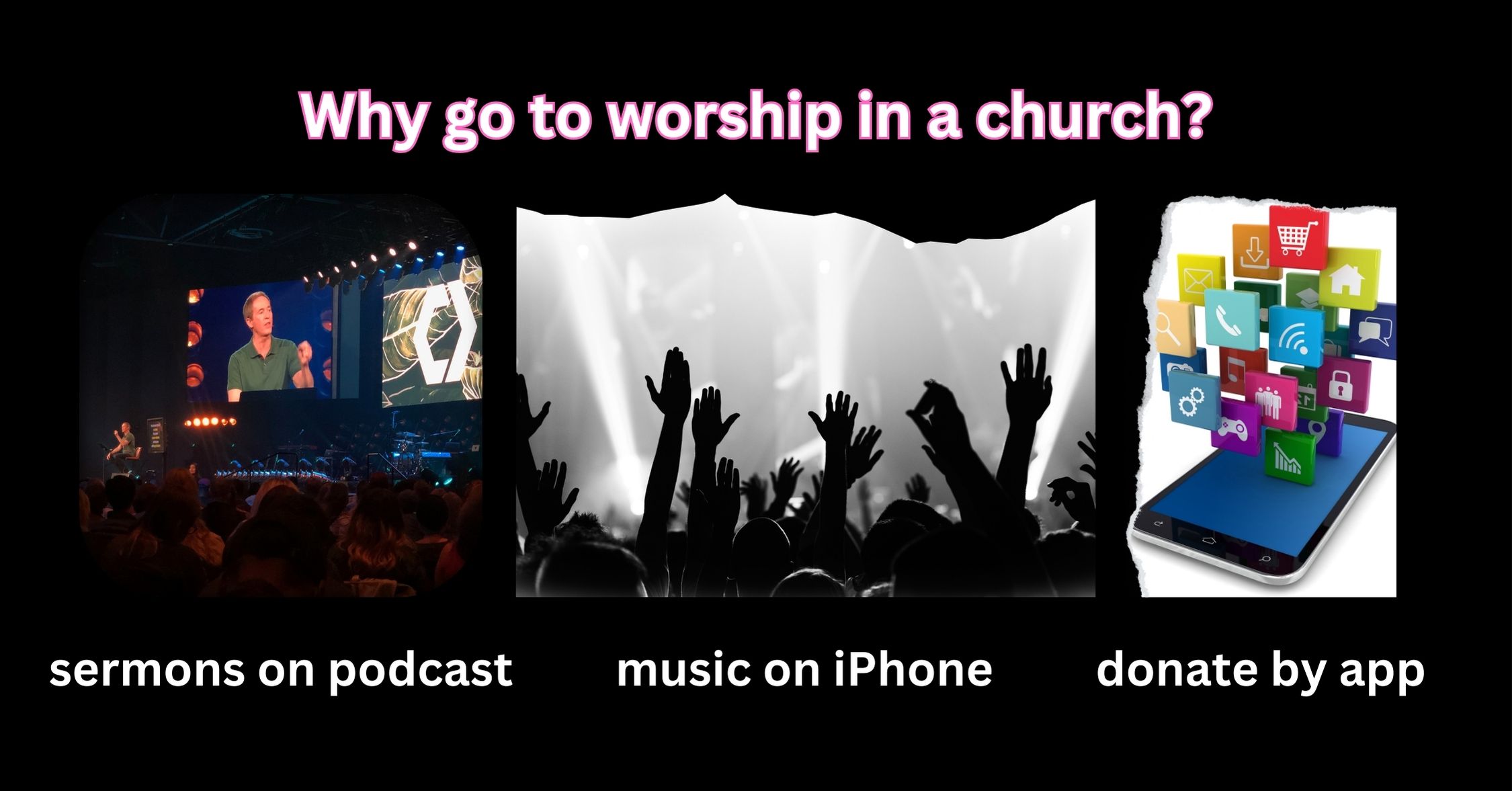
And they didn’t even have Sunday morning football to worry about. This letter was written only about 40 years after the death of Christ and Paul already feels the need to tell people to keep going to church. People were deciding they didn’t need to bother, the same sentiment many have today. Even if you considered yourself a follower of Christ, even if you wanted your daily or weekly dose of spiritual fulfillment, why bother coming to Sunday worship? You can listen to sermons via podcast. You can sing worship songs on your iPhone. You can even donate to your church or other organization through a mobile app. Who needs to step foot in a building? According to the research, only 23% of Americans both profess faith in Christ and attend church as an active participant.[2] Only 23%. The sad part is “active participant” is defined as someone who comes only once a month. On any given weekend, 17.5% of Americans can be found in a Christian church. You might think, “Well, maybe they’re going to other churches,” but that’s not it either. When you add in all the other religious groups, the number only goes up by 2%.[3] We, as Americans, have decided to devote our time elsewhere.
But we are NEEDED in the church as much as we need to be there.
When we took our membership vows, we promised to give our prayers, our presence, our gifts, our service, and our witness to God and to this church. And when we say presence, it means presence in the body of Christ. Presence means participating in this community of faith. Because even though we could sing praises to God in our showers; even though we could listen to sermons in our car; and even though we can give our offerings by mail or even on our phones, worship is more than that. Worship is more than the sum of its parts. It means fully and whole-heartedly giving of yourself to this time together. Of being fully present in worship, of being aware of those around you and what is happening. Presence means more than simply attendance. It means more than sitting in a chair or giving your offering to God. It means really being present for one another. It means sharing in fellowship and community because our Lord Jesus Christ told us that where two or more gather in his name he will be there. It means engagement in the community. Because worship is many things, and it is not just about us. Worship is many things, it is not just about us. It never has been. It’s about the body of Christ. And at different times and in different ways we contribute to the faith development of those around us, whether we are conscious of it or not.
We often dub the success or failure of a worship experience by what we get out of it.
But not every sermon was written for you. Not every song was played for you. Not every prayer was said just for you. Some weeks you’ll get more out of the message than other weeks. Some Sundays you’ll be profoundly moved by the Word of God or by a song we’ve sung. But even in those weeks when you didn’t connect to the sermon or the music, YOU may still have an important role to play. Maybe you’ll notice that person in the pew who needs a loving hand. Maybe you’ll notice that first time visitor who is feeling awkward and alone. Maybe you’ll be sitting next to someone who is having doubts about God. Maybe you’ll be the person they need.
That’s what happened to me when I was serving at Roswell UMC.
It was a rare occasion when I wasn’t either involved in worship or teaching a Sunday School class or something, but on this one particular Sunday, I wasn’t doing any of those things. I planned to simply show up, experience, and be a part of worship. Now, on those rare occasions, I usually sit up front or near the front, but because I had been talking to someone outside, I was a bit late and decided to sit in the next to last row. There was only me and one other woman in the pew and she was sitting pretty far away from me. I noticed she had a diaper bag, so I guessed that her little one was in the nursery and sure enough, she was. When it was time for the greeting, I made it a point to walk over to her and say “hello.” She turned to me and said, “Hi, I’m so glad you were sitting here. I’ve been meaning to talk to you.” I couldn’t help but wonder if she meant me specifically or just one of us since we had five full-time elders on staff. But she literally meant me. She had seen me and my family when coming to worship and noticed we were a mixed-race family and she was too. She wanted to ask me privately if this would be a welcome place for her child who was a blend of Asian and Caucasian heritage and she knew I could relate. I was able to set her concerns at ease and not long after she became a member of the church and we had the chance to baptize her child. It always felt to me as if this was one of those moments when God placed me in that place at that time for someone else. To be honest, I couldn’t remember a bit about the sermon or any of the songs we sung, but I have always remembered that woman and her family. Maybe you’re here for the same reason. Maybe you’re here to help someone else. Or maybe someone is here to help you.
We come to church for the promise of a better life.
But that better life starts here and now. It starts with each one of us, here today, offering ourselves to God as a living sacrifice for his will. To allow God to use our presence to serve his Kingdom. And while there are lots of benefits for us to be in worship, perhaps the biggest benefit is the community of Christ that surrounds us and that we are a part of. We made a promise when we joined this church to give of our prayers, presence, gifts, service and witness. Fulfill that promise today and everyday for the Lord and Savior who gave his life for you.
[1] Please note that while these benefits are AWESOME, your mileage may vary! You can read the details for yourself at the following websites: Vanderbilt University, JAMA Psychiatry, Peter Haas,
[2] David T. Olson, The American Church in Crisis, (Grand Rapids: Zondervan, 2008), 29-30.
[3] The American Church Research Project.
“Hello, My Name is Jesus”
The first time I put on my nametag at Disneyland was when I believed I actually had a job at the Happiest Place on Earth. Up until then, it didn’t seem quite real. To be sure, I went through the hiring process, got assigned my first area, went through Disney University, and attended Traditions like every single cast member to walk through the doors of a Disney theme park. But it was when I was given my nametag and put it on in the upper left corner of my shirt that it all clicked into place. I was a cast member of the Walt Disney Company. In life there are moments when something becomes real for us, like putting on a nametag. But other times life unfolds over a series of small moments, each one leading to the next until we come to realize we are living in a new reality. That’s how it was for me when I started to attend UCLA. I remember waiting to hear back from all the schools I applied to and was ecstatic when my acceptance letter came in the mail, but it wasn’t quite real yet that I was about to attend UCLA. When I went to orientation on campus and had the chance to buy my first UCLA sweatshirt, it still wasn’t quite real. I think it all crystallized in my mind when my parents left me at the dorm for the first time and I was completely on my own. Then it became REAL! But it wasn’t like the nametag. Instead, it was this slow-growing realization that crystalized in that moment. I was a UCLA Bruin.
No matter how it happens, when that realization hits, our life changes perspectives.
A new reality sets in, a new way of looking at things. Becoming a cast member was incredibly meaningful to me. That nametag meant something when I put it on. It meant I was part of something bigger than myself. It meant I belonged to a community that stood for something, that believed in something. “We create happiness.” I was part of that now. Becoming a Bruin was the same way. I was there for an education, but at the same time I now belonged to a community and shared something in common with everyone around me. Together we were part of something bigger. For all the brochures I read about the school, for all the information I gathered from books and magazines, it was a different feeling than actually becoming a student at UCLA. I was a Bruin! Becoming a follower of Christ is like that too. When you GET IT, when Jesus becomes real to you, you realize you are part of something bigger than yourself. That you are part of a much larger community. That being Christian means something. It stands for something. It shapes you and changes you in ways it’s hard to describe, more than a job, more than a school. And I’d have to say in even more profound and deep ways than you can probably imagine. But like those other moments, it has to become REAL for you. It has to become more than just words on a page or an hour of your life every Sunday. Because if the words on the page don’t make it into your heart, the Bible is nothing more than a book of interesting stories. And to be honest, not all that well written. Not a lot of character development, no climatic build-up, no dramatic tension, GREAT overarching theme and some pretty amazing events happen, but Matthew, Mark, Luke and John weren’t exactly J.R.R. Tolkein.

But the Bible is one of the most amazing books ever written.
What makes it so brilliant is as much what is NOT said as what IS said. Exploring the Bible is like an archaeological dig right in the comfort of my chair. The more I dig, the more I find. And that’s because the Bible is more than just words on a page. When I read it, I get something new from it almost every time. I feel like in some ways, God is talking to me through the words on the page, giving me new insight into my life and the world I live in. But I don’t think any of that would have happened if my own faith in Christ didn’t become real for me. And I can be slow on the uptake at times so this was a long process. It started probably from birth, but my first recollection of someone helping to make Christ real in my life was my mom back when I was 8 years old. From there it wouldn’t be until college when I met Lisa who really made an impact on me and got me thinking again about God. Then it was Mark and Steve and Andrea, friends of mine I met while working at Disneyland who kept inviting me to church. It was then I started to become more serious in my faith. And of course my wife, Cassie who supported me in this journey so I could stand before you here today. And that’s just some of the people who helped me get to know Jesus. There wasn’t one “aha” moment like Paul on the Road to Damascus. Instead, it was a series of events that changed the course of my entire life – one after another after another that changed me and then inspired me to want to do this – to share how life-changing, peace-giving, and satisfying it could be to have Christ in your life. I figure that’s what it must have been like for those shepherds nearly 2000 years ago when they first heard the news.
And there were shepherds living out in the fields nearby, keeping watch over their flocks at night. 9 An angel of the Lord appeared to them, and the glory of the Lord shone around them, and they were terrified. 10 But the angel said to them, “Do not be afraid. I bring you good news that will cause great joy for all the people. 11 Today in the town of David a Savior has been born to you; he is the Messiah, the Lord. 12 This will be a sign to you: You will find a baby wrapped in cloths and lying in a manger.”
13 Suddenly a great company of the heavenly host appeared with the angel, praising God and saying,
14 “Glory to God in the highest heaven,
and on earth peace to those on whom his favor rests.”
15 When the angels had left them and gone into heaven, the shepherds said to one another, “Let’s go to Bethlehem and see this thing that has happened, which the Lord has told us about.”
16 So they hurried off and found Mary and Joseph, and the baby, who was lying in the manger. 17 When they had seen him, they spread the word concerning what had been told them about this child, 18 and all who heard it were amazed at what the shepherds said to them. 19 But Mary treasured up all these things and pondered them in her heart. 20 The shepherds returned, glorifying and praising God for all the things they had heard and seen, which were just as they had been told. – Luke 2:8-20
I don’t know about you, but I think I would have collapsed on the spot.
We tend to think of angels as these chubby little dudes with harps who float around playing sweet music, but that isn’t at all the image the Bible gives us. We read about seraphim and their six wings; two covered their face, two covered their feet, and two helped them to fly (Isaiah 6:2). Not what I’m used to imagining. The Bible tells us about cherubim too, and they aren’t nice and cuddly. They had four heads, four eyes, and four wheels and all of it was covered with eyes (Ezekiel 10:11-12). They were the guardians of the Tree of Life in Eden and carried flaming swords. So imagine you’re one of the shepherds and suddenly this vision of an angel pops up out of nowhere. Immediately, terror probably sinks into your heart. But the angel says to them, “Do not be afraid. I bring you good news that will cause great joy for all the people. Today in the town of David a Savior has been born to you; he is the Messiah, the Lord.” And then after giving them this pronouncement an entire army of these scary, powerful beings appear right around them. But as impressive as that was, that moment didn’t make Jesus real for them. It was when they saw him in person lying in the manger. When they encountered Christ for themselves was when they believed and they went out and told everyone they knew. Only then did it go from being just words to becoming a reality. When they encountered Christ for themselves was when all of the stories went from being just words to becoming a reality.

We call that the incarnation of Christ.
The incarnation of Christ. It’s a fancy word meaning that Christ becomes real for us in this life. For the shepherds, for Mary and Joseph, for the early disciples, Jesus literally became real. But today, Christ becomes real for us through the love of other people. Jesus knew this would happen. He knew that people would have a difficult time believing and he knew he wasn’t always going to be here for us in person. But that’s why he spent time with the disciples training them to spread the Gospel. That’s why he sent the Holy Spirit, to embolden and empower those early followers. That’s why he said to Thomas, “Because you have seen me, you have believed; blessed are those who have not seen and yet have believed (John 20:29).” Jesus was talking about us. But in a way, we have seen him. We may not have seen him directly, but for each of you who experiences the reality of Christ in your heart, for those of you where Jesus isn’t just some guy in a book, but a living, breathing being, this stuff is REAL. Christianity isn’t a religion based on blind faith, but a faith based on our experience with Jesus through the world around us. The love of a friend, the kind words of a stranger, the tough love of those closest to us; those are the things that make Christ a reality for us today. We may not have burning bushes or witness the resurrection of a friend, but we can’t say God isn’t active in the world because he is. Christ is alive in us. Christ is alive in us.
Many of us don’t yet experience that reality.
We know that the world is only about 1/3rd Christian as it is, which means the vast majority of people don’t live with this view of life. And of that part of the world that is Christian, not all of them live with that feeling of assuredness either. I don’t. There are times when I worry or question where God is in the world. There is too much cruelty and evil and greed and selfishness in the world not to experience moments of doubt. But for the most part, the love of God is just too evident in my life to turn away. That’s not the case for everyone. There are many people who turn away. There are many people who never experience God’s love in the first place. There are many who are overwhelmed by doubt or anger or pain and who cannot reconcile that with a loving God. Then there are those who feel they don’t need God. They don’t necessarily believe or not believe, but Christ isn’t a reality for them in a way that makes it evident why they need to do anything about it in their lives. It’s up to those of us who believe to make Christ real for them, too. It’s up to us to make the reality of the love of God so evident that they can’t help but believe. It will take humility. It will take perseverance. It will take patience. And most of all it will take love. I want to challenge you to think of someone in your life who could really use a good dose of God’s love and spend time thinking how you could make Christ a reality for them. Think about what they need, who they are, what’s gone on in their life that might have distanced them from Christ and pray about what you could do for them. And if you ARE that person, if you are the one for whom Christ is not a reality, please simply open up your heart to the possibility of God’s great love. Ask questions. Explore your doubts. Challenge yourself that maybe you need God in your life more than you are willing to admit. And see where it leads you. As we go out into the world and celebrate the love of Jesus made real for us in the world, let us also be a beacon of light and life to those around us. Let the incarnation of Christ work through us that we might touch the life of another and help them to know that Jesus loves them, too.
The Unreliable Bible

Don’t tell anyone, but I had a little crush on my Den Mother.
I loved being in Cub Scouts, and not just because of her. It was fun to earn the badges and hang out with my friends. It was cool to go to school in our uniforms and see all the other kids who belonged to your troop. At the time I didn’t realize it, but it was great to feel part of something bigger than yourself. I loved all the doodads you could get for your uniform, too. I had this one cravat for my kerchief that I particularly thought was cool. It was blue and gold and just looked awesome. Everyone in scouts had a handbook and we used that as a guide to help us earn each badge. You’d have to fulfill certain requirements to progress to the next level. We started at Bobcat and then moved to Wolf and then Bear and finally Webelos. Earning my Arrow of Light badge was bittersweet. It was the highest honor you could achieve as a Cub Scout so I was happy and proud to have achieved it, but it also meant it was time to graduate to the Boy Scouts. It was the end of an era. But what made me a scout wasn’t the uniform or the awards or even the scouting handbook. It was an adherence to the ideals of scouting. Going through the book and earning the awards was evidence of my character, but it wasn’t those things that made me a scout. It was about upholding the Cub Scout motto to do my best.

In the same way, our faith doesn’t come from the Bible.
Like the Cub Scout handbook, it’s meant to help us and guide us and in the case of the Bible get to know God better and draw closer to him. But if the Bible were the end-all-be-all of existence, we’d be in a lot of trouble because there are so many things the Bible never addressed. The internet, genetically modified fruit, modern medicine to name just a few. And within the Bible are contradictory narratives. Right from the very beginning. The first chapter tells us that God created the Heavens and the Earth. Then he created the seas and the land. Then he created the plants and after that the animals. And only after everything else was created did he make people. The Bible is very clear on this. Until chapter two. Because in that chapter it says God made man and breathed life into him before any other living thing. When Adam was created, there were no plants or animals. There weren’t even any women. Just him. So, if your faith rests only on the inerrancy of the Bible, you’ll eventually find you have no faith at all. But thankfully, it doesn’t. Our faith does not rest on the Bible. Our faith rests on the life, death, and resurrection of Jesus Christ. As Paul wrote to the church in Corinth, “If there is no resurrection of the dead, then not even Christ has been raised. 14 And if Christ has not been raised, our preaching is useless and so is your faith. If only for this life we have hope in Christ, we are of all people most to be pitied (1 Corinthians 15:13-14, 19).”

Christianity does not exist because of the Bible. The Bible exists because of Christianity.
Christianity does not exist because of the Bible. The Bible exists because of Christianity. We do not believe in Jesus because it’s in a book. We believe in Jesus because he was born to a virgin, lived amongst us, performed miracles only God could perform, died for our sins, and rose from the dead. And while the Bible chronicles the life and teachings of Jesus, the Bible is not why we are Christian. Andy Stanley used this example in a sermon. He said you don’t exist because of your birth certificate. If something happened to your birth certificate, you wouldn’t cease to exist. Your birth certificate documents something that happened.[1] In the same way, the Bible documents something that happened. And this is exactly why Christianity spread, because the early disciples believed that Jesus rose from the dead and died for their sins. We see this in our reading.
13 When they saw the courage of Peter and John and realized that they were unschooled, ordinary men, they were astonished and they took note that these men had been with Jesus. 14 But since they could see the man who had been healed standing there with them, there was nothing they could say. 15 So they ordered them to withdraw from the Sanhedrin and then conferred together. 16 “What are we going to do with these men?” they asked. “Everyone living in Jerusalem knows they have performed a notable sign, and we cannot deny it. 17 But to stop this thing from spreading any further among the people, we must warn them to speak no longer to anyone in this name.”
18 Then they called them in again and commanded them not to speak or teach at all in the name of Jesus. 19 But Peter and John replied, “Which is right in God’s eyes: to listen to you, or to him? You be the judges! 20 As for us, we cannot help speaking about what we have seen and heard.”
21 After further threats they let them go. They could not decide how to punish them, because all the people were praising God for what had happened. 22 For the man who was miraculously healed was over forty years old. – Acts 14:13-22
Peter and John weren’t putting their lives on the line because of the Bible.
The Bible didn’t exist and would not exist until hundreds of years after their death. In fact, some of the most important letters and teachings of the Bible were written or said to be written by them. But Peter and John put their lives on the line because they believed Christ was the risen Savior, and they believed because they witnessed him after his death. They said to the Jewish elders who were putting them on trial, “As for us, we cannot help speaking about what we have seen and heard.” It didn’t matter their lives were being threatened, they could not deny their own experience and so eventually the Sanhedrin had to let them go. They believed because of what they knew. Not because of something they read or some theory they heard. They believed because of what they knew and eventually they wrote it down and it became part of what we know to be the Bible today.

But no one in the first century came to believe in Christ because of the Bible.
They didn’t believe because of the Bible in the second century either. Or the third. It wasn’t until Easter in the year 367 that Athanasius, the Bishop of Alexandria, first issued the 27-book list that we call the New Testament.[2] It didn’t become officially canon until the Synod of Hippo in 393.[3] And during that time, Christianity grew BEFORE there was a Bible. Despite persecution, their numbers went from a dozen men to thousands of people to literally millions, until by the year 300 they accounted for 10% of the population of the Roman Empire.[4] In the year 313, Emperor Constantine made Christianity legitimate and by 380, Emperor Theodosius made it the official state religion of the Empire.[5] So for the first 360 years of its existence, Christianity grew from a small group of followers to a Jewish sect to the official state religion of the biggest empire in the known world, and that whole time they didn’t have a Bible. How in the world did they come to believe?
People believed in Jesus Christ because of the transformative power of faith.
People believed in Jesus because of the transformative power of faith. It wasn’t because of a book. It was because they saw for themselves how faith in Christ changed those around them. I’m sure the same is true for you. Although you may have read the Bible as a kid or sung that song we all know and love (“Jesus loves me this I know, for the Bible tells me so…”), that’s not why you believed in Jesus. It’s because you trusted whoever it was that took you to Sunday School. It’s because you thought your pastor knew what he was talking about. It’s because your grandmother had such overpowering faith that you felt compelled to learn more about God. No matter how it happened, you came to have faith in Christ because of the people around you who in either overt or subtle ways convinced you this was something worth believing in. But you didn’t come to faith because of a book. You came to faith in Christ because it was made real to you through the love of those around you, just as it did for Peter and John and Matthew and Luke and Mark and Paul who were so overwhelmed by the love of Christ they had to write about it and tell it to everyone they knew. Love became real for them and through that love they had faith.

The Bible is important.
Please don’t misunderstand that point. I do believe the writers of the Bible were inspired by God. I believe that the words within it are useful to teach, rebuke, and correct as Paul wrote to Timothy. But I also believe human beings are fallible and we have often misinterpreted the words contained within it. I believe human beings even with the best of intentions interpret the Bible in ways that do NOT reflect God’s will. And I know the Bible contains contradictions we cannot resolve. And if the Bible has been used in your life to make you afraid; if the Bible has been used against you as a weapon; if the Bible has been the justification for causing you pain and anguish, I am so sorry. Because that was not why the Bible was written. To quote Jesus’ disciple, John, “Jesus performed many other signs in the presence of his disciples, which are not recorded in this book. 31 But these are written that you may believethat Jesus is the Messiah, the Son of God, and that by believing you may have life in his name.” The Bible was meant to tell the story of God’s great love. A love so great that Jesus gave himself up on the cross for us as a sacrifice for our sins. A love that moved dozens and then thousands and then millions of people to love one another so radically that it convinced others to do the same, and hopefully it has or will do the same for you. The next time you read the Bible, keep that in mind. If you have given up your faith in Christ because of the Bible, please come back. If you have stayed away from believing in Jesus because of the Bible, please give it a chance. And if you have doubts because of the Bible, please feel free to share and ask about it. But know that we believe in Jesus not because of a book, but a book was written because we believe so strongly and want to share that love with the world.
[1] Andy Stanley in his sermon, “Who Needs God?: The Bible Told Me So,” August 27, 2016. Also attributed to that sermon is a variation of the quote “Christianity doesn’t exist because of the Bible…”
[2] https://en.wikipedia.org/wiki/Development_of_the_New_Testament_canon#Muratorian_fragment
[3] https://gotquestions.org/canon-Bible.html
[4] https://en.wikipedia.org/wiki/State_church_of_the_Roman_Empire
[5] https://en.wikipedia.org/wiki/Christianity_in_the_4th_century
Where Do Babies Come From?

Depending on when you asked you probably got a different answer. Parents have been answering that question in different ways since time began. There’s the stork story, the cabbage patch story, the story of the birds and the bees, you get the picture. Different kids at different ages can handle different stories. A lot of it has to do with where your child is and how ready YOU are to share. I still remember the day I found out – February 16, 1977, the day they aired the ABC Afternoon School Special, “My Mom’s Having A Baby.” We plopped down in the family room and watched it with my mom. The cartoon parts were hilarious and at nine years old, that was enough for me. When I got into eighth grade we had “sex ed” with Mr. Reller and Mr. Reller took the more direct approach to learning. He let us ask any questions we wanted and there were some doozies. I found out more in that one day of class than in the whole rest of eighth grade! But if nine-year-old me was in that room, it would have been too much. I wasn’t ready for it. It took time for me to gain the maturity, knowledge, and level of understanding to process the things we were talking about. I think I’m STILL processing some of what we talked about that day.

The same is true for our faith.
We need time to mature in our faith as we ask more and more complex questions. That’s a fundamental truth for anything we want to learn about. We start with the basics, build a good foundation, and then go on from there. Nobody starts with the LEGO Expert set. We don’t talk about God the same way to a 5-year old as we would a teenager or an adult. They have different levels of understanding. But what happens when you grow older and your faith doesn’t grow with you? When we leave our faith in childhood, our God stays there, too. Lots of people leave the church in their teens and don’t come back until something draws them back. Whether that’s getting married, raising children, or noticing a hole in their life they are hoping to fill, they come back to church with only the tools they left with. So whatever God we believed in back when we left the church is often the God we still believe in when we come back. The problem is our adult ideas don’t match up with our Sunday School God. Sometimes people never come back because they can’t reconcile the God they believe in with the life they know. But it’s not God that doesn’t make sense, it’s that our ideas about God haven’t changed as we have. And this isn’t a new problem either. You’ll find that most of the problems and issues we come up with today are the same problems and issues we’ve had all along. Even the 1st century church had these problems. You’d think being so close to the time when Jesus actually lived, they might have an advantage, but they struggled with faith just as much as we do today. Maybe even more so because everything was so new.

1 We have much to say about this, but it is hard to make it clear to you because you no longer try to understand. 12 In fact, though by this time you ought to be teachers, you need someone to teach you the elementary truths of God’s word all over again. You need milk, not solid food! 13 Anyone who lives on milk, being still an infant, is not acquainted with the teaching about righteousness. 14 But solid food is for the mature, who by constant use have trained themselves to distinguish good from evil. – Hebrews 5:11-14
Is your faith still in its infancy?
Just because you’re going to church doesn’t mean your faith is growing. It needs to be nurtured and tended to and fed like any other living thing. For a garden to bloom, you can’t just plant seeds in the ground. You have to water it, position it to get the right amount of sun, give it good soil to take root in, and tend to it. If you don’t, you might get lucky but usually, you just have a bunch of seeds buried in the ground. In the same way, faith needs to be nurtured. Without care, it just withers away and that’s what has Paul frustrated. He’s writing to this group of believers who he feels have grown lax in their spiritual growth. He’s so frustrated he insults them, “You need milk, not solid food!” He tells them they should be teaching this stuff, but they still haven’t mastered the basics. And he says, “But solid food is for the mature, who by CONSTANT USE have trained themselves to distinguish good from evil.” Constant use. If we don’t practice our faith it becomes stagnant. We grow up, our ideas of the world become more complex, but our vision of God remains rooted in our childhood.
As you get older, you don’t believe the stork brought you to your family.
But a lot of us hold on to childhood beliefs about God unless our faith grows with our understanding of the world. In one of his sermons, Andy Stanley mentions some of these versions of God from our childhood.[1] One of them he calls Bodyguard God. Bodyguard God is the God that always protects us from harm. This is the God who never lets bad things happen to good people. We tell children if they listen and obey then God will keep them safe, but to a child this means nothing bad will ever happen to me as long as I believe. But that is just not true and it leads people to abandon their belief in God the moment things go bad because they have based their understanding of God on something that isn’t true. God never promises us a life free from harm. He even says it out loud. Jesus told them flat out, “In this world you will have trouble.” I don’t know how much more plain he could be. “In this world you will have trouble (John 16:33).” Then he goes on, “BUT (my emphasis) take heart! I have overcome the world.” Jesus doesn’t promise us a life free from trouble. In fact, he guarantees it! It’s just we don’t have to lose hope when trouble comes our way because we know God is with us. But Bodyguard God? That God doesn’t exist.

Then there’s Blanket God.[2]
Blanket God is the God of comfort, the God who is always present. He reminds me of Linus from the Peanuts gang because his blanket is always with him. But there are times in our lives where we are distant from God. There are times in our lives where we not only don’t feel his presence but instead feel his absence. And this poses a big problem for Blanket God believers because they feel abandoned and sometimes it leads them to abandon their faith. What they don’t understand is God is still there. Even in those moments where we can’t feel his presence, God is constantly reaching out to us. There’s just something that is blocking our vision of him. Sometimes that means we have to weather the storm until the fog clears from our eyes. This is when we need a deeper faith to hold on even when we can’t see God for ourselves. A friend of mine from Georgia gave me the best advice one time when I was going through my own period of doubt and it’s stuck with me ever since. He told me when he looks back on his life he can see all the ways where God helped him through the valleys. He couldn’t see it at the time because he was stuck in his own grief or anger or depression or whatever he was feeling at the time. But afterward, he would look back and see how God was present for him and when he was going through another valley, that’s how he could keep his faith in God, knowing that even if he seems absent God is still at work in his life.
There’s also Gap God.
Gap God is the God who fills in the gaps of our faith. This God is the God who explains the unexplainable. Whenever something happens when we don’t understand or can’t explain, we say, “It’s a God thing.” And while that might seem to be giving God his props, it’s really undermining our faith. Because God becomes a crutch for the unexplainable when we start to use God in that way. Remember when the AIDS epidemic first began and there were people like Pat Robertson who said it was caused by God to rid the world of homosexuality? Then they had to backtrack when heterosexual people started getting it too. Or when Hurricane Katrina hit in 2005 and those same God pundits declared it was God’s wrath upon a sexually promiscuous society? As if that one area of the world was the only den of ill repute. Using God to fill in the gaps of our knowledge is not only small-minded but denies the real power of God. We don’t believe in God because of the mystery of God. We believe in God because of his revelation in Jesus Christ. We don’t believe in God because of the things we can’t explain, but because of the things we have experienced ourselves.

Before Emma was born, I went through my own period of doubt.
I’ve shared this before and it was a really tough time for me. Cassie was pregnant and I went to my pastor, Jane to talk about it and I’ll never forget what she said. First, she told me it was okay to doubt, that doubt was sometimes healthy for our faith. But she also said, to hang in there and when Emma is born, I’ll know God is real. And she was right. The first time my baby girl held my finger in her tiny hand, I couldn’t help but feel like I was witnessing a miracle. I know it happens every day to hundreds of thousands of people, but this time it was happening to me. I know the biology of it all, I know how babies are born, but to be part of the creation process was mind blowing. And I saw God’s great plan up close for once. It wasn’t my LACK of knowledge that made God real for me, it was my understanding that did.
If you have lost faith because of one of these versions of God, I implore you to come back.
These are simplistic views of God that were meant for a time when we didn’t have the life experiences we have now. I want to challenge you to open your heart up to the possibility that it isn’t God that’s the problem, but instead our outdated views of him. Get to know God again. And if you are solid in your faith, I challenge you to keep studying, praying, and looking for God in your life because God doesn’t disappear overnight, but in the slow erosion of our faith. God vanishes because we allow life to chip away at our vision of God until there isn’t enough for God to rest upon and it all collapses beneath us. Question God. Question your faith. Don’t be afraid to put God to the test but be open and willing to listen to the response he returns. Don’t outgrow your faith, but instead nurture it, feed it, protect it and let it grow with you.
[1] From Andy’s sermon to North Point Community Church, “Who Needs God? Gods of the No-Testament.”
[2] Andy called him Boyfriend or Girlfriend God, but I think this description fits God better.
The Truth Is Out There
Before we found out chocolate was good for you…we ate it anyway because it was so good. But, when studies came out saying it provided real health benefits, it gave us every excuse to indulge in this tasty treat. But consider this. How many of you read the fine print? Most chocolate you buy in the store ISN’T good for you. It’s highly processed, contains way more milk and sugar that you don’t need, and doesn’t contain the nutrients that make it good for you in the first place.[1] If you’re going to have chocolate at all it should be at least 70% cocoa, taken in moderate amounts, and still contain flavonoids which often get stripped away in the process of making your favorite chocolates. It’s the flavonoid epicatechin that is the active ingredient doing all the hard work to help your body.[2] Without it, it’s just sugar your body doesn’t need. Remember when wine was good for you? First it was bad, then it was good, and now it’s bad again. You know why? Because they found out that in all of these studies that said drinking in moderation was good for you, they never studied the people. Turns out there was a reason moderate drinkers showed positive health results – reasons that had nothing to do with having a glass of wine each day. The new results are in, and it says that the safest amount of alcohol is zero drinks per day.[3] Most of you probably hadn’t heard about this news. It doesn’t grab your attention like the one that says having a glass of wine a day is good for you. Now that’s a headline! The truth is often buried behind a stack of half-truths and untruths and we don’t take the time to find out if what we like to hear is based on fact or not. Because what we are really after is validity rather than verity. We are looking for validity instead of verity. The truth may be out there, but we aren’t all that interested in finding it.

The same is true with our faith.
We are interested in finding out whatever it is that supports our view of faith, but aren’t all that interested in finding out information that may challenge it. If you believe in predestination, you aren’t all that concerned you might ignore that God tells us we have the freedom to choose (Joshua 24:15). If you believe women should never be pastors, you aren’t interested to hear Paul supporting women who taught Scripture to men (Acts 18:26). And if you believe every word in the Bible is the literal word of God, you don’t want to hear about the two different creation stories or two different accounts of the Great Flood even though they are right there in the first book of the Bible.[4] Because these things challenge your system of beliefs. That’s even true for people who don’t believe in God. If you’ve made up your mind God doesn’t exist, no amount of evidence is going to convince you otherwise. You might say you have a bunch of reasons why you don’t believe, but I have to challenge you to ask, “Is my objection to God really about God’s existence or my resistance?”[5]
How open are you to the truth?
Are you more interested in being right or finding out what’s real? Because if you only care about being right, all you’ll see in front of you are the things that confirm your own beliefs. You’ll forever live in a world of your own making which can be disastrous. One of my friends told me she would never get her kids vaccinated because it might harm them. And I’m not talking about COVID vaccines (although there is plenty of denial about that too). I’m talking measles, mumps, and rubella; the famous and quite standard MMR. Vaccines, by the way, that her parents readily gave to her and her siblings and my parents gave to me and my sisters and I’m sure one most of you received, too. There was a study published in the journal The Lancet which claimed a link between autism and MMR and anti-vaccine advocates picked up on this like white on rice. But it wasn’t true. Studies have been done to refute it. The design of the original study was found to be grossly flawed. And it turns out the lead author had a financial incentive to lie – he was being paid by companies involved in a lawsuit against the makers of those vaccines.[6] But despite the massive amount of evidence against the lie, people continue to believe it – except my friend who once she had kids did get them vaccinated. When we give up on the search for truth, the world is worse off for it. Doctors would still be doing lobotomies to free us from evil spirits and bloodletting to balance out our humours.[7] We would still believe people are inferior based on race or gender alone (sadly many still hold onto these falsehoods also). And we would still believe eggs are bad for you![8]

What is it in us that leads us to deny the truth?
How is it we remain willfully ignorant of the facts no matter how obvious they are? And this is a question for all of us. You are not as immune as you’d like to think. It would be hypocritical to look around and think, “Well, I hope (insert name here) is reading this,” because I am sure there is something in your life you are denying right now. Whether it’s the way you are living, the way you are caring for your body, the way you are practicing your faith, there is probably something you are living in denial about, and if you say, “That’s not true” there’s perfect evidence right there. Now, whether you believe in the Bible or God or any of it, you’ll find that this problem of truth denial can be found all throughout history. Even Jesus had to deal with it.
31 To the Jews who had believed him, Jesus said, “If you hold to my teaching, you are really my disciples. 32 Then you will know the truth, and the truth will set you free.”
33 They answered him, “We are Abraham’s descendants and have never been slaves of anyone. How can you say that we shall be set free?”
34 Jesus replied, “Very truly I tell you, everyone who sins is a slave to sin. 35 Now a slave has no permanent place in the family, but a son belongs to it forever. 36 So if the Son sets you free, you will be free indeed. 37 I know that you are Abraham’s descendants. Yet you are looking for a way to kill me, because you have no room for my word. 38 I am telling you what I have seen in the Father’s presence, and you are doing what you have heard from your father.” – John 8:31-38
Pride. That’s what gets in the way of the truth.
Pride. It is the poison that gets in the way of healing, of good relationships, of reconciliation, and the truth. Pride. We’ve read from this passage before, but this time I want you to hear it from the perspective of pride. Did you hear how the other Jews answered Jesus? He said, “If you hold to my teaching, you really are my disciples. Then you will know the truth, and the truth will set you free.” But instead of absorbing those words, instead of thinking about what Jesus had to say, they responded. “We’ve never been slaves of anyone. How can you say that we shall be set free?” Pride made them blind to the fact they were slaves to their own sin. You’ve probably heard kids say, “You’re not the boss of me!” Well, this is the adult version of that very same sentiment. “We’ve never been slaves of anyone! You’re not the boss of me! You can’t tell me that I need to be set free.” Andy Stanley brought this up in one of his podcasts. How many times have you been in the middle of an argument and it dawns on you the other person is right. And even though you know they are right, you keep on fighting anyway. Because it’s no longer about two people or two sides trying to get to the truth, now it’s all about winning. It’s all about being able to say you’re right. That’s pride. We think pride makes us strong. We think pride is an admirable trait. But we would be wrong. Strength lies in humility.

There’s a reason people use the expression “puffed up with pride.”
Pride inflates our ego to the point where we devalue others. Pride swallows up the room and pushes out space for new ideas and new learning. Pride forces us to continue down a path even when it’s clear it’s the wrong path. Humility on the other hand keeps us grounded. Humility opens us up to new ideas and new ways of thinking. And it takes a great deal more strength of character to be humble than to be filled with pride. Pride is for the weak, not the other way around. C.S. Lewis wrote in Mere Christianity that pride was the great sin, the one from which all others stem. He describes pride as “spiritual cancer: it eats up the very possibility of love, or contentment, or even common sense.”[9] There was a study done on the quality of humility as a competitive advantage in the workplace and the researchers came to the conclusion, “Humility is frequently associated with shyness, lack of ambition, passivity, or lack of confidence. We argue quite the opposite—that humility offers strategic value for firms by furnishing organizational members with a realistic perspective of themselves, the firm, and the environment. In fact, we propose that humility is a critical strength for leaders and organizations possessing it, and a dangerous weakness for those lacking it.”[10] Another study showed humble people make the best leaders.[11] And even the FBI believes humility is essential for success. In an article on leadership they wrote, “Humility often can be overlooked or, even, viewed as weakness. It is not. It is vital. Allowing yourself to be humble and to express your humility openly allows for others to grow. There is nothing more powerful than that.”[12]

Commit yourselves to the pursuit of truth instead of your own righteousness.
For it was Jesus himself who told us the truth would set us free. This week, challenge yourself to keep an open mind. Try a new food. Try a different detergent when washing your clothes or a different shampoo for your hair. We often get into routines without ever challenging if there might be better ways of doing things. Don’t blindly pick something, but actually think about it, ask for opinions, look something up. Open up your horizons to a world of possibilities (please keep in mind I am NOT telling you to do something dangerous or illegal – certainly you don’t have to go that far to do something different). If you’re on the fence about faith, I want to dare you to open your mind to the possibility there is a God. That he actually loves you. That he really did send his Son to Earth to die for you. And that he wants a relationship with you even if you don’t want one with him. If you have honest objections to faith, that’s totally reasonable and also healthy for any strong journey towards the truth. But be open to a world where God exists and has been searching for you for your entire life. Open that door a crack and watch the love that will pour in.
[1] http://www.cnn.com/2016/02/10/health/chocolate-health-benefits/
[2] https://www.webmd.com/diet/news/20040601/dark-chocolate-day-keeps-doctor-away#1 The study done by Engler through the UCSF School of Nursing used 1.6 oz. per day of Dove Dark Chocolate.
[3] https://www.popsci.com/moderate-drinking-benefits-risks/
[4] http://faculty.gvsu.edu/websterm/cflood.htm
[5] From Andy Stanley’s sermon “Who Needs God? I do” https://whoneedsgod.com/message-gallery/2016/10/4/who-needs-god-part-6
[6] https://www.ncbi.nlm.nih.gov/pmc/articles/PMC3136032/
[7] https://theconversation.com/five-bloodcurdling-medical-procedures-that-are-no-longer-performed-thankfully-75818
[8] https://www.healthline.com/nutrition/why-are-eggs-good-for-you#TOC_TITLE_HDR_6
[9] C.S. Lewis, Mere Christianity, p. 125.
[10] http://www.sciencedirect.com/science?_ob=PdfExcerptURL&_imagekey=1-s2.0-S0090261604000506-main.pdf&_piikey=S0090261604000506&_cdi=272151&_orig=article&_zone=centerpane&_fmt=abst&_eid=1-s2.0-S0090261604000506&_user=12975512&md5=65d0f6fc48d7e81535608d991b99f331&ie=/excerpt.pdf
[11] https://www.entrepreneur.com/article/238328
[12] https://leb.fbi.gov/2014/march/leadership-spotlight-humility-a-leadership-trait-that-gets-results
Alone In A Crowd

I love hosting parties. I hate going to them.
You would think as a pastor it would be easy for me to mingle with people I don’t know, and in the context of church you’d be right. I love making people feel welcome. I love meeting first time visitors. I try to go the extra mile to make people feel at home. But that’s the key. This is our space. We are the host. We have home field advantage. When I was young, it was so easy! I guess I had the innocence of youth. You know how I met one of my best friends, Lance? It was my first day of Kindergarten and I just went up to him and said, “You want to be my friend?” It’s been over 50 years now and we’re still friends. It’s harder for me now. Maybe because I’m more aware of social norms. Maybe because I’m not as innocent as I used to be, but it’s tough for me to walk into someone else’s territory and feel comfortable. I’m not sure how to behave, how open I can be, where the restroom is, what are the rules of the house. Do I need to take my shoes off? Which is always tough for me because I have very flat feet and it hurts to walk around without shoes. But I want to respect our host. After all, they opened their doors to me. So, it feels weird to walk into a place that is completely foreign, that has its own customs and traditions, that has a history and expectations all its own. How do you live up to all of that? You feel like a fish out of water. At least I do.

I imagine Jacob felt the same way.
Let me set the scene for you. Jacob and Esau were brothers. But early on, Jacob blackmailed his brother to give up his birthright to him[1] and then later tricked his father to steal the family blessing away from Esau. Which was a very big deal back then. Stealing the birthright was like stealing the family inheritance and stealing the blessing meant that Esau would always be inferior to Jacob in the family. After twenty years, Jacob was forced to flee from where he had been living (again because he had deceived someone even if rightfully so) and decided it was time to reconcile with his brother. He was understandably nervous. And a little bit fearful for his life. After all, his brother had no reason to forgive him. No reason to accept him onto his land. And no reason to be kind to him. So, you can imagine the level of anxiety Jacob had when he finally approached his brother for the first time in two decades.
Jacob looked up and there was Esau, coming with his four hundred men; so he divided the children among Leah, Rachel and the two female servants. 2 He put the female servants and their children in front, Leah and her children next, and Rachel and Joseph in the rear. 3 He himself went on ahead and bowed down to the ground seven times as he approached his brother.
4 But Esau ran to meet Jacob and embraced him; he threw his arms around his neck and kissed him. And they wept. 5 Then Esau looked up and saw the women and children. “Who are these with you?” he asked. Jacob answered, “They are the children God has graciously given your servant.” 6 Then the female servants and their children approached and bowed down. 7 Next, Leah and her children came and bowed down. Last of all came Joseph and Rachel, and they too bowed down.
8 Esau asked, “What’s the meaning of all these flocks and herds I met?” “To find favor in your eyes, my lord,” he said. 9 But Esau said, “I already have plenty, my brother. Keep what you have for yourself.”
10 “No, please!” said Jacob. “If I have found favor in your eyes, accept this gift from me. For to see your face is like seeing the face of God, now that you have received me favorably. 11 Please accept the present that was brought to you, for God has been gracious to me and I have all I need.” And because Jacob insisted, Esau accepted it. 12 Then Esau said, “Let us be on our way; I’ll accompany you.” – Genesis 33:1-12
What a relief it must have been!
To have been accepted with literal open arms like that. To be made welcome immediately and to be accepted. This was worse than just walking into a party at someone’s house or going to a new school or your first day on the job. Jacob was fearful for his life! And not just his, but his whole family as well. But Esau doesn’t treat Jacob like an enemy, and he doesn’t approach Jacob as if something fishy was going on. Instead, he approaches him with what we consider the love of Christ. No strings attached. No reservations. He even initially refuses Jacob’s gift and tells him to keep it for himself.[2] But when Jacob insists, he graciously accepts it – not for his own gain, but to help ease Jacob’s anxiety. Then he does exactly what a good host should do – he accompanies him to his new home.

This is the kind of hospitality that God wants us to offer to everyone.
An open, no strings attached, no reservation, unrequited love for our neighbor. When you are the host, whether it’s a party at your home or welcoming a new teammate at work or even here at church, keep this in mind. When you have home team advantage, the onus is on YOU to take the initiative. It’s up to YOU to reach out, to offer hospitality, and to accompany the new person in our midst. Sit with them. Talk with them. Take your cues from them. Don’t impose your own needs and wants upon them but try to be in tune with what they need and want from you. Romans 12:9-13 sums up God’s expectations pretty well. Be sincere in your love of neighbor. Honor others above yourself. Join them mentally and emotionally wherever they are. As it says in the passage, “Be joyful in hope, patient in affliction, (and) faithful in prayer.” Practice hospitality. It’s kind of God’s recipe for being a successful host no matter what situation you find yourself in.

What happens before a person enters our doors is more than we’ll ever know.
Whether that’s at home, at work, or at church, whatever brought them to us is deeper than what we see on the surface. While at a seminar for intercultural communication, they said people are like icebergs. What we see, what we hear, what we observe is only about 10% of what is actually going on. The other 90% is down below, hidden from our view and we’re not going to get to it on a first visit or even maybe a fiftieth. We just need to be patient, be observant, and be in tune with those who come to us. From a church context, this is especially critical. Nelson Searcy once wrote, “Seven minutes is all you get to make a positive first impression. In the first seven minutes of contact with your church, your first-time guests will know whether or not they are coming back.”[3] If you haven’t done the math yet, the first seven minutes is before they ever hear a song or listen to a sermon. It’s the time they spend from the parking lot to the door to the chair. That’s the most critical time for a guest. So how we go about offering hospitality and being a welcoming church is so very vital.[4]

But there is a right way and a wrong way of doing this.[5]
People want to be welcome, but they don’t want to stand out. From my own observation as the new membership pastor at Roswell UMC, it takes on average 18 months for someone to feel comfortable enough to actually join the church. Like jumping in a pool, everyone has their own way of doing it, but most people like to mosey in the shallow end and progress deeper and deeper as they feel comfortable. Often, they have joined a small group, started singing in the choir, or volunteered to help out before they consider actually joining. And they don’t like to give their personal information for at least the first four or five times they attend worship. They want to sit and observe and see if it’s a good fit. Highlighting them during announcements or prayer is often just too much for most people and they absolutely hate “passing the peace.” For some of you, you’re thinking, “What?!” But it’s true. There have been many, many, many studies on this. People want to be welcome, they don’t want to stand out.
It’s always hard being a new pastor at a new church.
I’m coming into YOUR house to serve you which feels a bit awkward because I don’t know much about you yet. It takes time to get to know you, get to know what is important to you, and how best I can use my gifts and graces to help be a blessing here. But as hard as it is for me, it’s especially hard for my family. Time and time again, they get thrust into a new church, one that they didn’t pick and are expected to make it their church family right from the start. And on our first day here, people were friendly and welcoming, but no one came up to Cassie to sit with her. No one came up and introduced her to different people in our congregation. No one showed her around. Thankfully, Cassie is the type to do it on her own, and she really liked you all right away. But sometimes it’s the little things that go into that first seven minutes that make the biggest difference. No one did anything wrong, but sometimes we need to take that extra step to be a truly exceptional host. Be bold and be willing to be that angel of hospitality. And if you’re not that kind of person, tap someone on the shoulder who has that gift and point out someone who could use that extra touch. This is true no matter the context. Whether it’s at work, at school, or at church, when you have home court advantage, be the gracious host. Don’t assume someone else will do it, because you know what they say about assumptions! Imagine, if it’s hard for you to step up into that role, how hard it must be for that new person walking in the door. Everybody can use a friend.
[1] https://www.gotquestions.org/birthright-Bible.html
[2] This totally reminds me of a Japanese custom to always refuse a gift at first offering. A Western equivalent would be “Oh, you shouldn’t have!” But a friend once told me that in Japanese custom you must refuse three times and if after the third time the person still insists, then you must take it or risk shaming them. But refusing is important because it shows your own humility and hospitality.
[3] https://www.ministrymagazine.org/archive/2017/12/Five-keys-to-opening-the-front-door
[4] Which is not to say that music and good sermons are not important because they are! A good sermon is often cited as the number one reason why people come and stay. Music is up there along with children’s programming, outreach, and fellowship. But it’s those initial seven minutes where an impression is made.
[5] If you’re interested, here are a couple of good articles on the subject:
Outreach Magazine’s “10 Things Not to Do to First-Time Guests”
Melody Maxwell’s “7 Do’s and Don’ts of Welcoming Guests to Your Congregati
Humble Pie

In a few days, I’ll be eating a tremendous meal at my sister’s house.
I don’t know how she does it, but on Thanksgiving, she has this FULL spread of food. Turkey, dressing, potatoes, warm rolls, soft butter, and my brother-in-law’s famous cranberry sauce which I love. He says it’s from the back of a box, but I can’t make it like he does. It’s going to be a seriously gut-busting day. One thing I really love about Thanksgiving is PIE! And I’m not alone. Thanksgiving is the number one pie holiday with Christmas being number two.[1] Pie is part of my Holy Trinity of desserts – homemade cookies, ice cream, and pie; so pie a la mode is like heaven on a plate. However, there’s one kind of pie which probably won’t be on the menu, but one we should all probably have a slice of once in a while. Humble pie. We could all use a good slice of humble pie.

I was thinking about this while watching one of my favorite episodes of Sports Night.[2]
The show opens with Dan and Casey getting ready for an evening broadcast and it becomes really clear Casey doesn’t know the staff very well. He’s kind of oblivious to the people who make the show happen. And so a few days later, when he’s being interviewed on another talk show and gets complimented about his wardrobe, he doesn’t think to compliment the woman on his staff who picks out all his clothes. Instead he makes a joke and everyone laughs. But later on, the wardrobe assistant, Monica, comes to his office, carrying his clothes for that night’s show and says to him, “I think you hurt the feelings of the woman I work for. Maureen? She’s been working here since the day you started?” Monica holds up a tie and asks him, “Do you know what color this is?” And Casey looks at it and says, “It’s gray.” And Monica says, “It’s called gunmetal. Gray has more ivory, gunmetal has more blue. Do you know what shirt you should wear with it?… Mr. McCall, you get so much attention and so much praise for what you actually do and all of it’s deserved. When you go on a talk show and get complimented on something you didn’t, how hard would it be to say, ‘That’s not me. That’s a woman named Maureen who’s been working for us since the first day. It’s Maureen who dresses me every night. And without Maureen I wouldn’t know gunmetal from a hole in the ground. Do you have any idea what that would have meant to her? Do you have any idea how many times she would have played that tape for her husband and her kids?” Casey doesn’t know what to say. He just got served a big helping of humble pie. But it really makes him think on what she said, and at the end of the episode, he publically gives thanks to the people behind the scenes who make the show a reality. And when he does, we know it comes from a place of gratitude because we know Casey has a humble heart.
When we give thanks, do we do it from a humble heart?
Do we realize how fortunate we are for the blessings we have or for the people in our lives who helped to make it happen? Because none of us live in a vacuum. No matter how talented or successful or powerful we are, we only got there on the backs of other people. As independent and self-sustaining as we like to believe we are, it really does take a community of people to make it happen. None of us can do it on our own. None of us is truly a self-made person. But it takes a humble heart to realize that. Someone once wrote, “If you want to live in a state of perpetual thanksgiving, you must abide in humility. Humility is the state of mind wherein pride, ego and haughty self-sufficiency have been crucified with Christ.”[3] The culture we live in encourages a pull-yourself-up-by-your-bootstraps mentality, but that mentality denies the state of the world we live in. We owe our success and our blessings to those around us, to our community, and ultimately to God. That’s the lesson King David tried to teach the people of Israel in the passage we are going to read. Prior to this passage, David had addressed all of Israel about his desire to build a temple to the Lord. He told them of how the Lord had chosen Solomon to succeed him as King and that it would be Solomon who would build the temple, but David wanted to make it as easy as possible for Solomon to accomplish this task so before he died, David wanted to amass everything that would be necessary for building it. He not only acquired all the necessary material, but he donated his personal fortune into building the temple and he asked all the leaders of the nation of Israel to do the same. By the time he was done, the people of Israel had donated more than 8 billion dollars worth of gold and more than 243 million dollars in silver not to mention the precious stones, bronze and iron that was also given. And that’s on top of what David gave. And so after all the wealth had been collected, David lifted up this prayer of thanksgiving to God.
10 David praised the Lord in the presence of the whole assembly, saying, “Praise be to you, Lord, the God of our father Israel, from everlasting to everlasting. 11 Yours, Lord, is the greatness and the power and the glory and the majesty and the splendor, for everything in heaven and earth is yours. Yours, Lord, is the kingdom; you are exalted as head over all. 12 Wealth and honor come from you; you are the ruler of all things. In your hands are strength and power to exalt and give strength to all. 13 Now, our God, we give you thanks, and praise your glorious name.
14 “But who am I, and who are my people, that we should be able to give as generously as this? Everything comes from you, and we have given you only what comes from your hand. 15 We are foreigners and strangers in your sight, as were all our ancestors. Our days on earth are like a shadow, without hope. 16 Lord our God, all this abundance that we have provided for building you a temple for your Holy Name comes from your hand, and all of it belongs to you. 17 I know, my God, that you test the heart and are pleased with integrity. All these things I have given willingly and with honest intent. And now I have seen with joy how willingly your people who are here have given to you. 18 Lord, the God of our fathers Abraham, Isaac and Israel, keep these desires and thoughts in the hearts of your people forever, and keep their hearts loyal to you. 19 And give my son Solomon the wholehearted devotion to keep your commands, statutes and decrees and to do everything to build the palatial structure for which I have provided.”
20 Then David said to the whole assembly, “Praise the Lord your God.” So they all praised the Lord, the God of their fathers; they bowed down, prostrating themselves before the Lord and the king. – 1 Chronicles 29:10-20
David’s model of thanksgiving is one that comes from humility.
He praises God as Creator and Father of all. He attributes all good things to God. And then he adds this line, “But who am I, and who are my people, that we should be able to give as generously as this? EVERYTHING comes from you, and we have given you only what comes from your hand.” David wants to make sure everyone understands that all the wealth and power and blessings they have been given are only because of God’s grace. It would have been easy for them to take pride in what they accomplished. Think about how much they were able to give! When you include David’s personal contribution it was over $12-13 BILLION DOLLARS worth of gold alone. It would have been easy for them to say, “See what we’ve done? Look at we were able to accomplish! All for God of course, but look at what WE were able to accomplish!” And David reminds them in his prayer that this is nothing. This is nothing because they were only returning to God what he allowed them to use. As huge of a sacrifice as this seemed to be, it was really no sacrifice at all because it didn’t belong to them in the first place.

This was an important lesson to Israel and to us.
To remember that all we have accomplished comes on the backs of the many people around us. That as talented as we are, it is only because we are utilizing the gifts that God has given. And that our worth cannot ever be measured in dollars and cents but in the love we show to others. Because the richer we are, the more we seem to forget these lessons. We don’t even have to go back to ancient Israel to see that’s true. Patricia Greenfield from UCLA studied the linguistic frequency of key words in our writings over a period from 1800 to 2000 and as the country became wealthier “the frequency of the word ‘get’ went up, and the frequency of the word ‘give’ went down.”[4] Americans also became more individualistic and less community-oriented. Words like “individual,” “self,” and “unique” were more common while words like “give,” “obliged,” and “belong” were seen less. This might seem to be a small thing, but when you couple that with giving statistics that show that poorer people give about 50% more of their income to charity than the wealthy, it’s not that big of a leap to say that as we become more affluent, we tend to forget our humility and instead become more sure of our own ability to succeed. The wealthier we are the more we cut ourselves off from our communities and from those around us. We cut them off and assume people are only in it to take from us what is “rightfully ours” forgetting again that it doesn’t really belong to us in the first place and won’t go with us when we die. We forget these wise words from Ecclesiastes which says in chapter 9, verse 11, “The race is not to the swift or the battle to the strong, nor does food come to the wise or wealth to the brilliant or favor to the learned; but time and chance happen to them all.” We forget our good fortune is as unlikely to happen to us as it is to anyone else, but when we stay grounded in humility, we become rooted in reality and realize how truly grateful we need to be. Because thankfulness without humility is like pie without the filling. Thankfulness without humility is like pie without the filling – it’s empty. It has no real meaning.

When I was at UJCC, our associate pastor, Akiko, used to say these great prayers for blessing the food.
She would always give thanks for the land, for the animals, for the people who cultivated the land…I mean she would do more than ask for a blessing upon the food. She would give thanks for the chain of life that made it possible to have this food on our table and it made me think how much more interconnected we are than we often think about. Too often we take things for granted that we shouldn’t. Things like water and the sun and the plants, let alone the people and the resources that it takes to make the world go round. This week as we celebrate thanksgiving let us remember that no matter how great our accomplishments we never do it in a vacuum. Let us find within ourselves the humility to admit that we need others more than we think we do. In that vein, let us challenge ourselves through this Christmas season to give thanks to at least one person every day for what they do in our lives. Give thanks to them for helping you in ways big and small that maybe you’ve never noticed before or given voice to. And give thanks for the invisible ways in which your life is made better because of the efforts of those who labor around you. Pray daily to God for no other reason than to give thanks. Not just for the food we eat or the clothes we wear, but for being the one who gives life. For being the one who loves us enough to send his son into the world for us. And for being the very model of humility we should strive to emulate. Let’s face it. We can all stand to eat some humble pie once in a while. Make it your thanksgiving treat this year.
[1] https://premise.com/blog/totw-favorite-holiday-pie-in-the-us/#:~:text=Thanksgiving%20and%20Christmas%20dominate%20the,%25)%20and%20Christmas%20(41%25).
[2] “Six Southern Gentlemen of Tennessee,” Sports Night 12/15/1998
[3] http://www.christianblog.com/blog/blessings2you/humility-is-the-foundation-for-thanksgiving/
[4] http://www.npr.org/2013/09/03/218627288/why-being-wealthy-doesnt-lead-to-more-giving

