
iCloud

What is “the Cloud?”
Most of us have things being stored in “the Cloud.” We have pictures and emails and documents that are being kept there. We’re able to watch Netflix and Hulu and Disney+ because of it. And today “the Cloud” touches almost every aspect of our lives in some way. But what is it? If you’re not a very technical person, hearing that your things are being stored in “the Cloud” might seem almost like magic. But “the Cloud” is just a cute term for the storage of materials remotely instead of locally. “The Cloud” is just a term for storing data remotely instead of locally. Back in the old days, like in the 1980’s and 90’s, if you didn’t have your data downloaded to your computer or stored on a floppy disc, it didn’t exist. Computer games, photos, and documents all had to be stored somewhere in your home. And you could almost forget about video. The amount of data it took to transmit video was enormous by today’s standards. But with advances made in communications and technology, we can now store and transmit all of that material to different places and from different places. We call that accumulation of material, “the Cloud.” “The Cloud” is sort of like The Force. As Obi-Wan Kenobi said, “It surrounds us, penetrates us, and binds the galaxy together.”
The Bible talks about us being surrounded by a cloud, too.
And it too is all around us. This passage is part of the famous “faith” narrative in the letter to the Hebrew people living in Jerusalem. The writer of the letter gives many examples of what it means to live by faith sharing names the Hebrews would be familiar with. People like Abel and Noah and Abraham. People like Isaac, Jacob, Joseph, and Moses. He talks about all the trials and tribulations they personally dealt with and the Israeli people dealt with – the crossing of the Red Sea, the walls of Jericho falling. And then the writer adds this…
39 These were all commended for their faith, yet none of them received what had been promised, 40 since God had planned something better for us so that only together with us would they be made perfect. Therefore, since we are surrounded by such a great cloud of witnesses, let us throw off everything that hinders and the sin that so easily entangles. And let us run with perseverance the race marked out for us, 2 fixing our eyes on Jesus, the pioneer and perfecter of faith. For the joy set before him he endured the cross, scorning its shame, and sat down at the right hand of the throne of God. 3 Consider him who endured such opposition from sinners, so that you will not grow weary and lose heart. (Hebrews 11:39-12:3)
We are surrounded by a great cloud of witnesses.
Kind of intimidating actually. There are some places I don’t want a “great cloud of witnesses” to be watching. But that’s not what is meant here. It isn’t a bunch of ghosts watching our every move. It is the accumulated knowledge and experience of everyone who has gone before and paved the way ahead of us. Our faith in God is not some empty promise but built upon our forebearers in faith – both those we know and those we’ve never met or maybe even heard of. People like Deborah, Joseph, Gideon, and Ruth help us to understand God in a better way and to know who he is. Because of disciples like Peter, John, and Mary, we know the person of Christ and have come to trust in his promises. Our “cloud of witnesses” are all those people who have come before and whose stories form the foundation of our faith. As it says in John 20, “30 Jesus performed many other signs in the presence of his disciples, which are not recorded in this book. 31 But these are written that you may believe[b] that Jesus is the Messiah, the Son of God, and that by believing you may have life in his name.” We tell the stories of those who have passed to give us strength and inspiration in tough times and to help us have confidence in what we believe.

But what really gives us hope is that first line.
“None of them received what had been promised.” Doesn’t SOUND hopeful so why does it bring hope? Sometimes we get stuck in an Old Testament “eye for an eye” mentality and it’s hard for us to look beyond that. Most of the world, whether they are religious or not often thinks this way, too. We expect tit for tat. When we do good, we expect good to come back to us. If we give money or time or energy into something, we expect others will do the same or return the favor in some way. But that doesn’t always happen, and when it doesn’t, because of our quid pro quo thinking, our faith and trust in the system weakens. The same is true with our faith and trust in Christ. When things don’t work out as expected, we become disappointed in God. We think somehow God has reneged on his end of the deal. But this passage reminds us that is not the case. “None of them received what had been promised” and yet…God had in mind something better. Even if they didn’t get the reward they expected, it’s only because God had something better planned. That “something better” may not always seem obvious to us because we see through a much different lens than God does. God can see the whole picture while we can only see our piece of it. But the writer of Hebrews here is trying to encourage us to keep our trust in God and shares this “cloud of witnesses” as testimony to God’s faithfulness so that we can remain strong, even in difficult times. So the writer of Hebrews encourages us to throw off our fears and trust in God. To continue to live a life of faith, to act and behave in a way that is consistent with a person who believes in the living Christ.

On All Saints’ Sunday we pay tribute to our own “cloud of witnesses.”
We honor and remember those who have since passed on who helped us to grow in our faith. We remember those who molded us and shaped us into the people we are. We honor loved ones we miss. Our definition of “saints” is probably different than what you traditionally imagine. It might even feel a bit uncomfortable to talk about our loved ones as saints. We often think of St. Patrick or St. Valentine or even St. Nicholas – specific people who have been honored by the Catholic Church for extraordinary service to God. People who are beyond reproach and most of us are far from that. But that type of “saint” is more like the Queen bestowing a knighthood upon one of her people. It’s a human title instead of a Heavenly one. For us, we believe that all Christians are saints. The word comes from the Greek hagios which means “consecrated to God, holy, sacred, pious.” So, to say we are saints doesn’t mean we are without flaws, or we deserve to be revered. That honor is reserved for God and God alone. It means we are set apart in service to God. When we talk about All Saints’ Day, it’s a way of honoring ALL those who have participated in the life of God’s Kingdom. Take a moment today to reflect and pray for those who have made an impact in YOUR faith journey and may we live up to that legacy.
What If?

What if?
It’s natural to wonder how things might have turned out if we had done something different in our lives. What if you went to a different college? What if you had moved to a different city? What if you turned left instead of right? Our life is filled with choices and each one makes a difference. Growing up, one of my favorite comic books was titled “What If?” and every month they would explore this idea about how the choices we make can affect our lives. Sometimes the differences were huge. Sometimes the differences were small but meaningful. Sometimes the differences were just…different. It was always interesting to read but was also a reminder that every day is important. What we do and say MATTERS! God has given us this chance at life, but we only get to do it once so how can we make the most it?
God wants us to be BOLD!
Nowhere in the Bible is there a story about a guy who played it safe and was told by Christ, “Good job! Who needs to take risks? Play it safe.” Instead, it’s quite the opposite. In the story of the Parable of the Talents, God rewards those who have taken a chance with the gifts they are given and instead punishes the guy who plays it safe. In the book of Acts, we read about Ananias and Sapphira who withhold a portion of their profits for themselves instead of giving it to God and they die on the spot! Not that God would literally kill us for playing it safe, but maybe it’s a metaphor for how our trust and our faith die a little bit when we hold back. We were put on Earth to serve God in BOLD ways, to dare to make this world a better place. And that takes BOLD people. There was a scene in the movie Dead Poets Society that reminds me of God’s call to boldness. In it, Mr. Keating is teaching his students about poetry, and the kids are used to studying about rhyme and meter and iambic pentameter – all the forms and functions of poetry. But Mr. Keating wants to inspire them, to go beyond just studying about it and understanding it and he says to his students, “We don’t read and write poetry because it’s cute. We read and write poetry because we are members of the human race. And the human race is filled with passion. Medicine, law, business, engineering, these are all noble pursuits, and necessary to sustain life. But poetry, beauty, romance, love, these are what we stay alive for. To quote from Whitman: ‘O me, o life of the questions of these recurring, of the endless trains of the faithless, of cities filled with the foolish. What good amid these, o me, o life?’ Answer: that you are here. That life exists, and identity. That the powerful play goes on, and you may contribute a verse. That the powerful play goes on and you may contribute a verse. What will your verse be?” What will YOUR verse be?
God is never short of inspiration either.
There’s a great passage in Malachi I want to share with you today. Malachi is the last book of the Old Testament. It was written to the Jews who had returned from Babylon after the temple had been rebuilt. The people had become spiritually apathetic. They didn’t turn to false gods or other deities, but were “disillusioned about their future and skeptical of God’s promises.”[1] They had the form and function of a church, but really had turned into nothing more than a country club for Jewish people. They stopped being a church. And in the beginning of this chapter, Malachi foretells the coming of Christ and asks the important question, “…who can endure the day of his coming? (Malachi 3:2)” Who can endure the day of his coming? And he follows it up with the section we are about to read this morning.
8 “Will a mere mortal rob God? Yet you rob me.
“But you ask, ‘How are we robbing you?’
“In tithes and offerings. 9 You are under a curse—your whole nation—because you are robbing me. 10 Bring the whole tithe into the storehouse, that there may be food in my house. Test me in this,” says the LORD Almighty, “and see if I will not throw open the floodgates of heaven and pour out so much blessing that there will not be room enough to store it. 11 I will prevent pests from devouring your crops, and the vines in your fields will not drop their fruit before it is ripe,” says the LORD Almighty. 12 “Then all the nations will call you blessed, for yours will be a delightful land,” says the LORD Almighty. – Malachi 3:8-12
Test me in this!
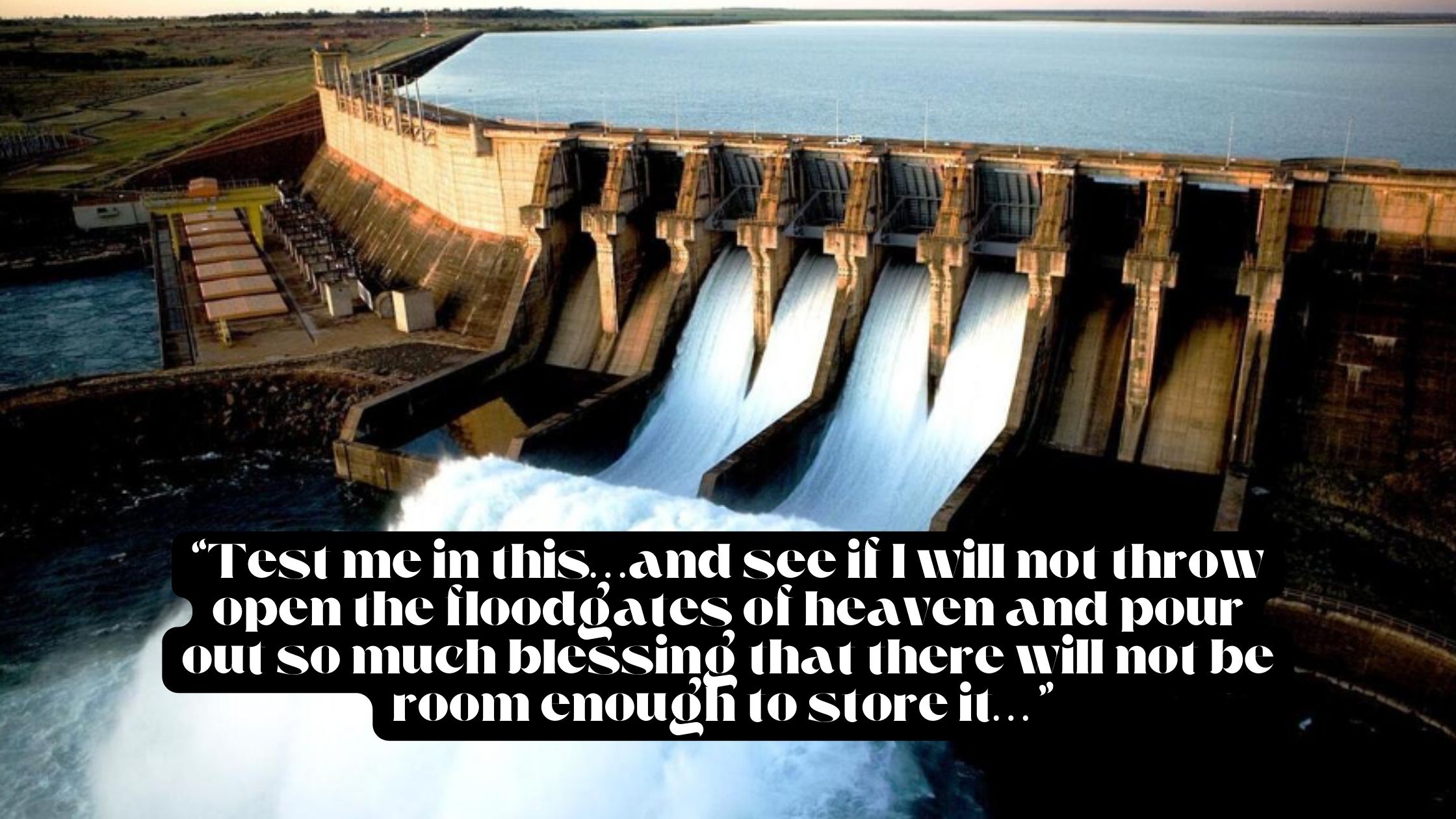
“Test me in this…and see if I will not throw open the floodgates of heaven and pour out so much blessing that there will not be room enough to store it…” That is such a striking image and I imagine as God is saying this, he isn’t angry or upset. He’s excited! He’s challenging. He’s ripe with anticipation. Are you willing to take God up on that offer? All we need is two things – faith and trust. When we have faith in God’s promise and trust him to be faithful to us, he promises a flood of blessings. Instead, we often choose to rob God of what is already rightfully his. God doesn’t ask you to give everything you have. He only asks for your trust enough in him so he can show you the amazing blessings he has in store for you. God challenges us to tithe, not because he needs it, but because we do. When we fail to give in service to God, we are not only robbing God, but robbing ourselves of this opportunity to experience God’s blessing in our lives. Now, you might be tempted to get this image of a mighty God holding back this wonderful blessing as a punishment for our failure to be more faithful or trusting. But the curse we are under is one we’ve made ourselves, not one that God wants for us. When we hold back from giving all we can, we are also holding back the chance for God to work in our lives in the most powerful of ways. God WANTS to do this for us. He invites us to “test him,” but that requires us to have faith in God’s promise.

For me, this is a reality.
And I can’t promise that it will happen for you in the same way. But before I ever even thought about becoming a pastor, I went through a real crisis of faith. It was not long after 9/11 and we just found out Cassie was pregnant with Emma. With so many horrible things going on in the world, it made me wonder what kind of world we were bringing our newborn child into. I started to wonder what kind of God would let so much evil go unchecked. Where was God in all of this mess? Maybe…there wasn’t a God. My whole world seemed to turn upside down, and it was horrible. I lost sleep. I woke up in the middle of the night sweating through my shirt. I felt hopeless and helpless. But during this time, I kept hearing this challenge – to test God. I heard it from my pastor, from the radio, on the Internet, and so I did it. And I can’t help but feel that it was God reaching out to me through these various people. Test me in this. Not with money but with prayer. I prayed for God to give me a sign, to show me some direction, to show me some kind of proof that he was there. And through people I loved and people I never heard of; through books and radio and Scripture and everything in-between, I kept feeling more and more connected again to God. God helped me to develop eyes to see and ears to hear until I felt what John Wesley felt – that blessed assurance God was there. And at the end of it all, I felt a new calling on my life. I needed to serve God in a new way so others who may be distant from God could see him and know they are loved. It was this crisis of faith that led me to be here today.
Where do you need to be bold?
What areas do you find yourself hesitating in? What things do you not fully trust God with handling? For you it might be prayer, too. But it might be giving financially to growing God’s kingdom whether that is through our church or in some other way. Or it might be in giving of your time to help others grow in their faith. Maybe you’re being called to serve as a Sunday School teacher or in the tech booth or on one of our committees. Challenge yourself in this thanksgiving season on how you can be bolder in your love of God and neighbor and see if he doesn’t rain down blessings upon blessings on your life. In whatever way I can, I would love to help so please reach out. But it’s really up to you. How is God calling on you to be bolder, more giving, more open to where he is leading. May we all pray to have eyes to see and ears to hear.
[1] Some of this section is taken from The Archeological Study Bible, “Introduction to Malachi,” p. 1545.
One More Day

If you only had one more day, how would you spend it?
Probably not at work. Or paying bills. Or worrying about buying the newest video game. Instead, we’d probably spend it doing the things we love with the people we love. That might be going to Disneyland or spending the day at the beach or maybe just spending the day at home eating our favorite meal. We’d talk to one another, share our thoughts and feelings, give lots of hugs, hold hands, and pray about what happens next. Because when it comes right down to it, we know in our heart what is truly important. Jesus tells us, “Where your treasure is, there your heart will be also.” And he uses the word “treasure” to broaden the scope of things we store up for ourselves. It’s more than just money. It’s how we spend our time, how we share our talent, and where we give our effort. And when we find ourselves with just one more day or even one more week, one more month, or one more year, it forces us to open our eyes to what’s truly important. But for the most part, we don’t think about life that way. We live life as if we had forever instead of one more day. We trifle away our lives worrying about the unimportant, investing in things that ultimately don’t matter, and then later regretting our decisions. Let’s change that.

Because you don’t have forever.
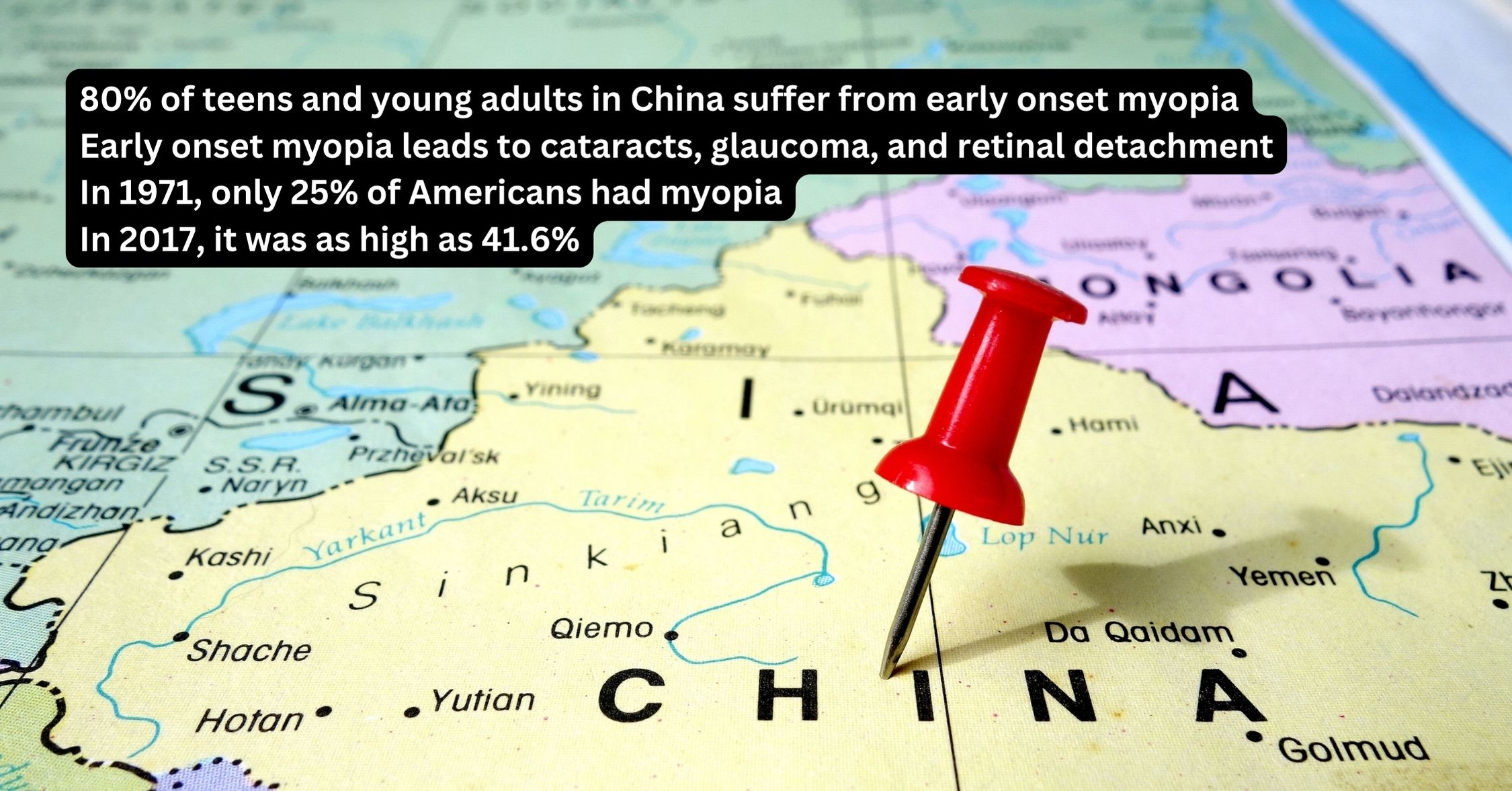
None of us do. Not even Jesus. So where is your treasure? Where does it lie? Most of us would say it’s with our family and friends. Some might even say it’s with God. But if you look closely at your life, where is it really? That’s the question we need to ask because it’s so easy to fool ourselves into thinking we’ve got our priorities straight. But maybe it’s more out of whack than we like to believe. I’m guessing, whoever is in charge of the iPhone must be a Christian because every week I get this little guilt trip early Sunday morning. About 9am, right when I’m getting to church, I open up my computer and at the top right corner, a little box pops up with my screen time for the week. And I think, did I really spend that much time on the computer? Now to be fair, about 90% of what I do weekly for the church takes place on my computer. Whether that’s working on the sermon, doing the weekly email, creating slides for worship, or doing ZOOM meetings, most of it takes place on this 13” screen on my desk. But if I’m honest, I spend a decent amount of “me” time on my computer, too. I love playing Magic the Gathering Arena online. I play Marvel SNAP. I hunt for bargains on eBay and Amazon. And I’m not alone. They did a study in China where they track early onset myopia and about 80% of teens and young adults are near-sighted. [1] All linked to too much screen time and not enough getting outdoors. Those kinds of problems lead to things like glaucoma, cataracts, and retinal detachment! And it’s not just in China but the entire world. In America, we went from 25% of the population being myopic in 1971 to 41.6% in 2017.[2] It’s estimated that worldwide, 40% of the world will be myopic by 2030.[3] What does that say about where our treasure lies? And more importantly, where it does not.
Obviously, that doesn’t mean you have to throw away your phones.
Or give all your money to charity. Or quit your job to spend time with your family. Our phones can be incredibly helpful, not only for work or personal time but for keeping in touch with those family and friends who are important to us. And you need money to care for those same family and friends – whether it’s to feed them or clothe them or pay for medicine to care for them. And without your job, could you save enough money to ever get to spend quality time with them? It’s about priorities. About setting them and keeping them. Because we are challenged all the time to keep them straight. We get pulled in a million different directions and it can be hard and frustrating trying to keep up with all of it. We probably feel a little bit like that Aesop fable about “The Miller, The Son, and The Donkey.” We can please some of the people all of the time or all of the people some of the time, but we can’t please all of the people all of the time. So, it’s important to set and keep our priorities and not let them get lost in the shuffle of life. The passage we are about to hear today is from a group of letters in the Bible called the “Pastoral Letters” because each one is written by Paul to help Timothy and Titus lead their churches. And in this first letter to Timothy, Paul gives advice on a wide number of topics. But we are going to focus on one. Paul is offering advice to Timothy on how to preach about “true wealth” and how we confuse material wealth and spiritual wealth. As you read this passage, listen for how that challenge speaks to you. Hear now the Word of God.

17 Command those who are rich in this present world not to be arrogant nor to put their hope in wealth, which is so uncertain, but to put their hope in God, who richly provides us with everything for our enjoyment. 18 Command them to do good, to be rich in good deeds, and to be generous and willing to share. 19 In this way they will lay up treasure for themselves as a firm foundation for the coming age, so that they may take hold of the life that is truly life. – 1 Timothy 6:17-19
When Paul writes about “those who are rich in this present world” he’s talking about you.
About all of us. We don’t have to be rich financially for this to apply to us. We could be rich in other ways like time. And by that I don’t mean we have more time in our day than others. But when we are young, we approach life like we’re going to live forever. We don’t often think if we should be spending our time somewhere else because there’s so much of it left. The days in front of us outnumbers the days behind us. We are rich in time! But does that mean we should waste it? Paul is talking to everyone who has an abundance. Of anything. Of money. Of time. Of energy. Of useful limbs. Of wisdom. Of experience. And in that way, he’s talking to everyone, because no matter how old we are, we are rich in something. And Paul is telling us that in whatever ways we have an abundance, to use them not for building up more for ourselves, but to help others. To be rich instead in “good deeds” rather than anything else. And in that way, we are not only making the world a better place, but we are laying a foundation for the next one. I like how Paul puts it, “so that (we) may take hold of the life that is truly life!”

Take the time now to plan ahead for the future.
Don’t wait until it’s too late to do what needs to be done. Because when those opportunities pass us by, we can’t always get them back. One regret I often hear is not spending enough time with family. Skipping those games your kids wish you had attended. Missing those meals because something just couldn’t wait. Ditching your friends to be with some girl you just met even though you’d been planning this for months. You think, “They’ll understand.” And they might. But at what cost? Now of course there are times when you really can’t get away, when it might mean your livelihood or an opportunity that won’t come around again. But a lot of times, we sacrifice the very things that are the most important to us just because we can. But you never get those moments back. It’s not like you can gather your family up on a Sunday morning and say, “Okay, I know I promised to have dinner with you all week and I didn’t, so here’s what we’re going to do. We’ll stop by IHOP on the way to church and have a huge stack of pancakes! Then after church we’ll go over to Olive Garden and have as many breadsticks as you want. Then we’ll go out to dinner at Red Lobster for those yummy cheddar biscuits and that will make up for all the dinners I missed, and we’ll bond and everything will be okay.” It just doesn’t work like that. One extravagant moment doesn’t make up for all the missed opportunities, all the disappointment. True devotion comes in the choices we make day by day.
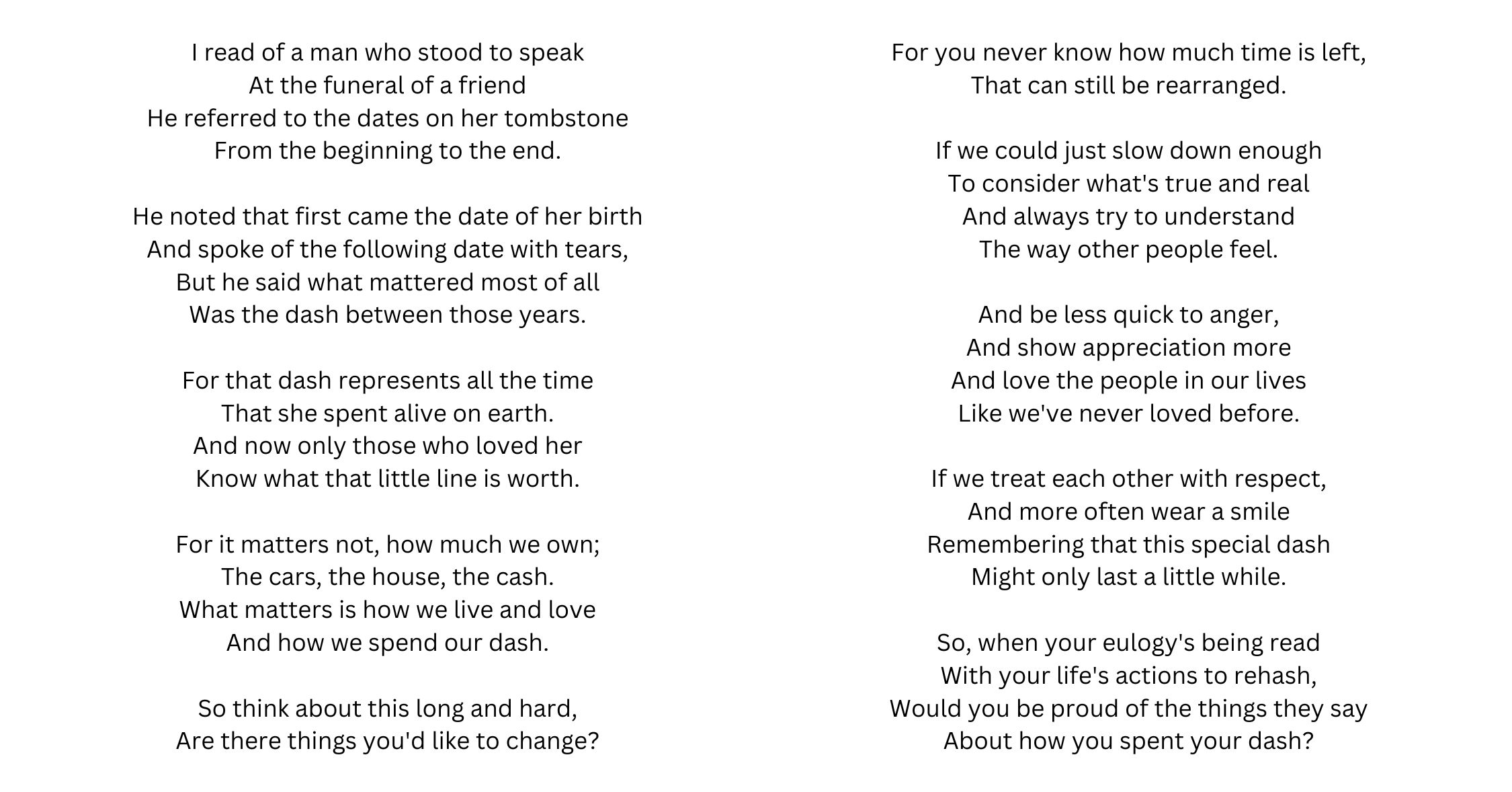
Linda Ellis wrote a wonderful poem called “The Dash” that captures all of this.
In the name of the Father, and of the Son, and of the Holy Spirit. Amen.
[1] https://www.npr.org/2023/10/18/1206701199/how-our-tech-habits-are-causing-our-eyes-to-elongate-which-causes-myopia
[2] https://www.nei.nih.gov/about/news-and-events/news/myopia-close-look-efforts-turn-back-growing-problem
[3] Ibid NPR “How Tech Habits…”
Line Item Giving

If you love God, raise your hand.
Now, raise it a bit higher. REALLY show the world you love God! Ask yourself why didn’t you do that in the first place? Why not thrust your hand in the air as high as it could go the first time? Maybe we’re just a bit unsure. Maybe we’re a little bit afraid. Afraid of being made a fool. Afraid of being the only one out there. Afraid of what others will think of us. We are often fueled by fear. And that’s why we have a hard time to being as bold as God wants us to be. It’s hard to overcome that fear, but that fear affects every part of our lives. From our relationships to our work lives to our faith and we can see that fear become manifest when it comes to giving. We might feel like we SHOULD be giving more or that we COULD be giving more, but fear holds us back from actually doing it. Fear about how the money will be used. Fear about if the people in charge will spend it wisely. Fear of not having enough for what we want to do. But what if giving wasn’t really about money. What if giving was in fact really about your trust and faith in God?
God doesn’t need your money.
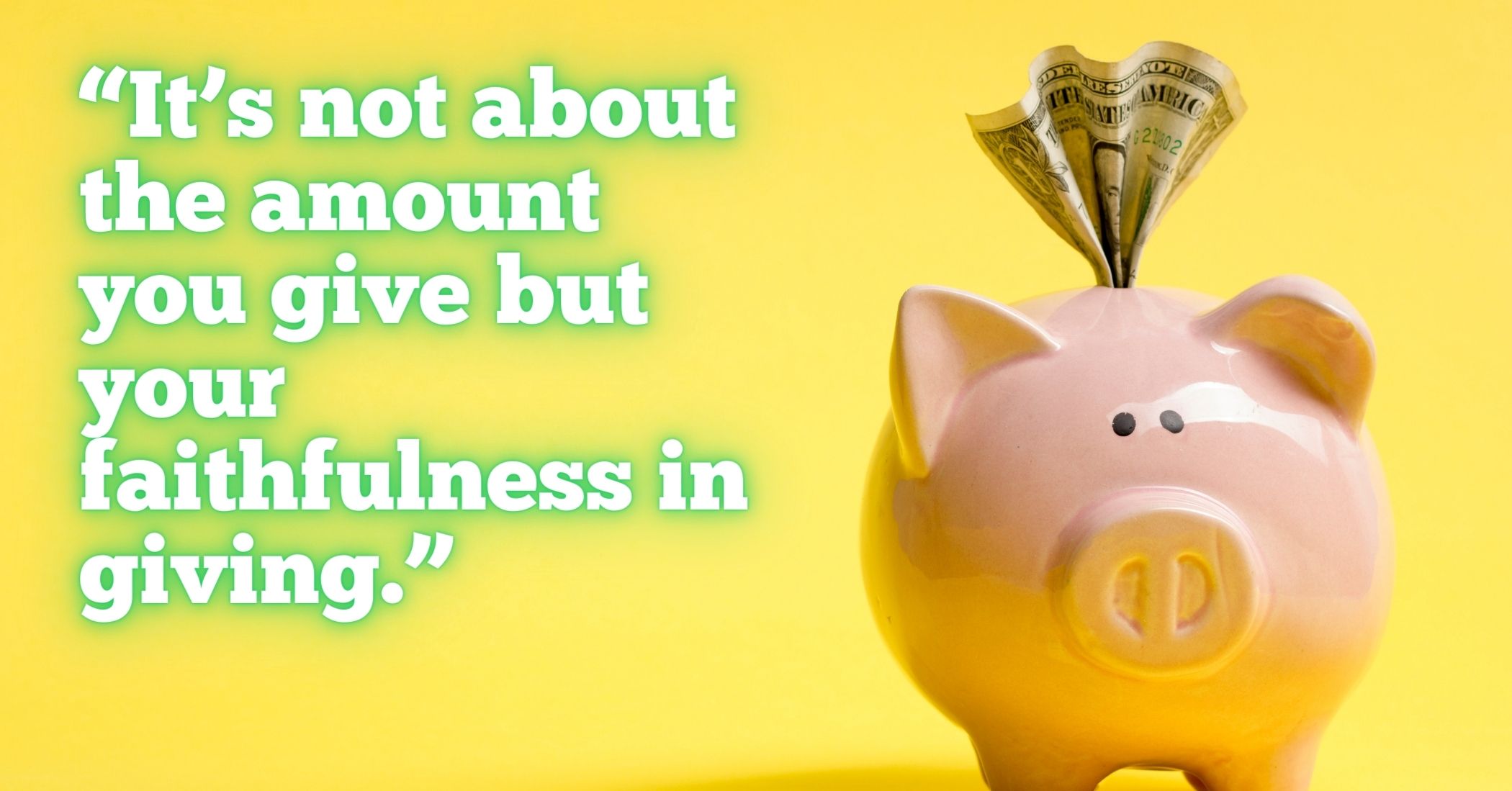
It’s all his anyway. Psalm 24:1-2 – “The earth is the LORD’s, and everything in it, the world, and all who live in it; for he founded it on the seas and established it on the waters.” It ALL belongs to God. Giving is about our faith and trust. If you have your Bibles or a Bible app on your phones, would you please go to 2 Corinthians 9:6. In this letter to the church at Corinth, one of the things Paul hoped to accomplish was to get a donation from the church so more churches could be built. I don’t know if this was the first sermon on giving outside of Jesus, but there is no doubt that was Paul’s goal. He wanted to convince the Corinthians to challenge themselves in giving. Earlier he wrote, “But since you excel in everything — in faith, in speech, in knowledge, in complete earnestness and in the love we have kindled in you— see that you also excel in this grace of giving. I am not commanding you, but I want to test the sincerity of your love by comparing it with the earnestness of others. For you know the grace of our Lord Jesus Christ, that though he was rich, yet for your sake he became poor, so that you through his poverty might become rich (2 Corinthians 8:7-9).” Sounds like a guilt trip, right? Maybe it was a little bit. But Paul was earnest in his desire to challenge the congregation to grow their faith through giving. See what he says right there in verse 8? “I am not commanding you, but I want to test the sincerity of your love by comparing it with the earnestness of others.” Later, he makes it clear he’s not challenging the AMOUNT they give, but their faithfulness in giving. The amount matters very little. It’s our faith and trust in giving that is the most important thing. Which leads us to our passage today.
6 Remember this: Whoever sows sparingly will also reap sparingly, and whoever sows generously will also reap generously. 7 Each of you should give what you have decided in your heart to give, not reluctantly or under compulsion, for God loves a cheerful giver. 8 And God is able to bless you abundantly, so that in all things at all times, having all that you need, you will abound in every good work. 9 As it is written:
“They have freely scattered their gifts to the poor;
their righteousness endures forever.”[a]
10 Now he who supplies seed to the sower and bread for food will also supply and increase your store of seed and will enlarge the harvest of your righteousness. 11 You will be enriched in every way so that you can be generous on every occasion, and through us your generosity will result in thanksgiving to God.
12 This service that you perform is not only supplying the needs of the Lord’s people but is also overflowing in many expressions of thanks to God. 13 Because of the service by which you have proved yourselves, others will praise God for the obedience that accompanies your confession of the gospel of Christ, and for your generosity in sharing with them and with everyone else. 14 And in their prayers for you their hearts will go out to you, because of the surpassing grace God has given you. 15 Thanks be to God for his indescribable gift! – 2 Corinthians 9:6-15

I think we are all challenged to be “cheerful givers.”
I don’t know of many people who give the way Paul challenges us to give. He says in verse 7, “Each of you should give what you have decided in your heart to give, not reluctantly or under compulsion, for God loves a cheerful giver.” But there IS a part of us that is reluctant to give. Part of that is because plain and simple, we’re a little bit selfish. And we feel like we have a right to be. After all, we earned this money! We worked hard to get it and we want to spend it the way we want to spend it. The other part is even when we want to give, we don’t always trust the people we’re giving it to. We’ve heard about the seemingly ridiculous cost spent by the government like the $7,622 coffee brewer that the Air Force bought.[1] But it doesn’t even have to be on that scale. You’ve probably watched friends and family spend money on things you would consider a complete waste. Maybe it’s your kids, your parents, or even your spouse. “How much did that coffee maker cost?” “Why did you buy Tylenol when the store brand would have been fine?” “How many times a year do you need to go to Disneyland?” That one might have been from personal experience (actually Cassie is very understanding about my need for Disney). It’s hard to just be a cheerful giver because once we give it, we don’t have a lot of say in how it’s spent and that bothers us a lot because what if they waste it?

And that’s the challenge for us – to have faith and trust in our giving.
But we confuse faith and trust in GOD with faith and trust in how our money is being spent. It’s the difference between giving to give and giving to get. Are we giving cheerfully or conditionally? When we give for the sake of giving, it becomes more about developing our faith and trust in God. It’s about developing a heart of generosity. But we when we give to get, we care an awful lot about the outcome of our giving. We want to know how THEY are spending OUR money, and while that might on the surface seem rewarding, we are missing out on the greater transformation of becoming generous people. Being a cheerful giver is part of our developing relationship with God, the building of our faith and trust. Look at the rest of the passage from Paul’s letter, verses 12-15. “This service that you perform is not only supplying the needs of the Lord’s people but is also overflowing in many expressions of thanks to God. 13 Because of the service by which you have proved yourselves, others will praise God for the obedience that accompanies your confession of the gospel of Christ, and for your generosity in sharing with them and with everyone else. 14 And in their prayers for you their hearts will go out to you, because of the surpassing grace God has given you. 15 Thanks be to God for his indescribable gift!” Paul tells us here giving isn’t just about helping others’ physical needs, but it is a way of saying thanks to God for the gifts you have been blessed with. It’s a way of witnessing to others your love for Jesus. And in your spirit of giving, you will be blessed in return. It may not be in the tangible ways we expect when we give to get, but it can instead be in growing our faith or growing closer to God or learning to value the things money can’t buy. Giving is about the building up of faith and trust in God. And when we withhold our gifts and graces, we are not just cheating God but cheating ourselves of an opportunity to become who God wants us to be.

When we focus only on the outcome of our giving, we become line item givers.
We want to pick and choose the outcome of our giving like the Line Item Veto Act of 1996. Congress passed a law giving the President the authority to veto portions of the federal budget without having to veto the whole thing. That way they could pass a budget without worrying about a federal shutdown and we all know how real THAT threat is. But the Supreme Court ruled it unconstitutional because it cheated the system. It might be faster and more efficient, but at the price of the faith and trust of the people the government was created to serve. The same is true about our personal giving. We love the idea of line item giving – of giving only to those things we believe in. But that assumes we know better where our money needs to go than other people. And while we certainly know what we want and what we like better than anyone else, that doesn’t mean we know where it might be used the best or where it might be needed the most. That’s where our trust and faith come in. At a certain point we need to let go of our need for control. Will there be times people waste the gifts we share? Sure. But what God cares about isn’t your money, but your heart and when we worry so much about the outcome of our giving, our hearts grow cold and cynical. But when we give cheerfully and let go of our fears, we gain something for ourselves – a heart of faith and trust. By the way, this isn’t just about money but about everything we have to give – our time, our talents, and our service, too. When you give freely, you gain something greater – a heart for living that will bring you peace and freedom from anxiety. When you withhold, you come to a poverty of spirit and a poverty of friendship, trust, love, and other things God wants to bless you with. In whatever ways you give, reflect today on your heart for giving. Let go of your fear and doubt. Let go of your need for control and instead turn it over to God. Be the cheerful giver God hopes for you to be.
[1] Why coffee pots cost so much on planes – more to it than you think. Not so ridiculous when you realize what goes into it, but on the surface we make snap judgements about waste.
Unity in Diversity

The Dodgers had no business winning the World Series in 1988.
By every estimate, they were the underdogs – by a long shot. The A’s had the Bash Brothers – Mark McGwire and Jose Canseco. Two of the greatest hitters of their time. Canseco had just become the first 40-40 player in baseball history – 40 home runs and 40 stolen bases, and together with Dave Henderson they had 3 guys with over 90 RBIs. The A’s also had the American League rookie of the year in Walt Weiss who manager Tony LaRussa said was better than either of the other two. And the A’s had the best closer in the game with Dennis Eckersley. Eckersley had 45 saves that season with a total ERA in those saves of 0.02.[1] If there was ever a sure thing in sports, Eckersley was it. The Oakland team just got done running over the American League West with 104 wins and crushed the Boston Red Sox in four straight games to get to the World Series. On paper, even the Los Angeles Times said the Dodgers were in over their heads. But as the old saying goes, they don’t play the games on paper. And after Kirk Gibson’s miraculous home run to win Game 1, the Dodgers behind Orel Hersheiser’s amazing season went on to beat the A’s in 5.
You just never know what makes a winning combination.
It’s the right mix of a bunch of different elements all coming together at the right time to make something beautiful. Unity in diversity. The blending together of different elements to make something better. The Dodgers won despite the odds being stacked against them because they were able to come together and through this bizarre mix of chemistry and talent and timing outperform arguably the best team of the decade. The diversity of talent and what each person brought to the table was exactly what they needed to win. And that’s true about life in general. It’s our great diversity that makes us amazing. When I hear people disparaging the value of diversity or why it might be important, what I really hear is fear. Fear of the unknown. Fear of the different. Fear of their own inadequacy. What they fail to realize is that it’s in our diversity the best ideas germinate. It’s our diversity that brings a new perspective to a situation or solves a problem otherwise unsolvable. In 1956, the Methodist church granted full clergy rights to women for the first time.[2] Before that, we were of the closed-minded thinking that only men could deliver the Word of God. But since then we have been blessed with a plethora of female clergy who have made a difference in our lives. If it weren’t for my pastor Rev. Jane Nugent, I wouldn’t be a pastor today. It was her counseling and her prayerful thoughts that encouraged me to head down this path. But what if we had never had female clergy? What if we had been so closed-minded that we couldn’t see what God was doing in the lives of these wonderful women? Think of how many lost opportunities there would be.

The Supreme Court overturned decades of precedent when they denied diversity inclusion.
In Students for Fair Admission v. Harvard and University of North Carolina the Supreme Court ruled that race couldn’t be considered as one of many factors in admitting students to the schools.[3] While some have hailed it as the end of an unfair practice, that conclusion is short-sighted because in the long run we’ve denied the value that people of different perspectives and heritage add to the mix. It’s not a blow for just the underprivileged and people of color, but even for those who fought against it, because they are missing out on the value of being in a diverse community. Here are some startling statistics for you from the business world to illustrate this point:[4]
- Organizations in the top quartile for gender diversity have a +25% likelihood of outperforming their peers
- Organizations in the top quartile for ethnic diversity have a +36% likelihood of outperforming their peers
- Diverse companies earn 2.5x higher cash flow per employee
- Inclusive teams are over 35% more productive
- Diverse teams make better decisions 87% of the time
It’s not just an idea, it’s a statistically proven benefit. And better yet. It’s God’s idea. Whether you are Christian or not, you’re probably familiar with this passage. And whether your believe it or not, it has value for what it teaches us.

And God said, “Let the water teem with living creatures, and let birds fly above the earth across the vault of the sky.” 21 So God created the great creatures of the sea and every living thing with which the water teems and that moves about in it, according to their kinds, and every winged bird according to its kind. And God saw that it was good. 22 God blessed them and said, “Be fruitful and increase in number and fill the water in the seas, and let the birds increase on the earth.” 23 And there was evening, and there was morning—the fifth day.
24 And God said, “Let the land produce living creatures according to their kinds: the livestock, the creatures that move along the ground, and the wild animals, each according to its kind.” And it was so. 25 God made the wild animals according to their kinds, the livestock according to their kinds, and all the creatures that move along the ground according to their kinds. And God saw that it was good.
26 Then God said, “Let us make mankind in our image, in our likeness, so that they may rule over the fish in the sea and the birds in the sky, over the livestock and all the wild animals, and over all the creatures that move along the ground.”
27 So God created mankind in his own image,
in the image of God he created them;
male and female he created them.
28 God blessed them and said to them, “Be fruitful and increase in number; fill the earth and subdue it. Rule over the fish in the sea and the birds in the sky and over every living creature that moves on the ground.”
29 Then God said, “I give you every seed-bearing plant on the face of the whole earth and every tree that has fruit with seed in it. They will be yours for food. 30 And to all the beasts of the earth and all the birds in the sky and all the creatures that move along the ground—everything that has the breath of life in it—I give every green plant for food.” And it was so.
31 God saw all that he had made, and it was very good. And there was evening, and there was morning—the sixth day. – Genesis 1:20-31
God created the Earth with an abundance of diversity!
From the birds in the sky to the fish in the sea and everything in between, God created it to be in harmony with one another. He saw “all that he had made, and it was very good.” God finds value in all of creation and if God does, so should we. But increasingly we strip away the great diversity God has created. We try to streamline creation into a world designed just for us. A good example is the tomato. Tomatoes out in the wild look and taste nothing like the ones we buy in the store. The ones in the store are genetically modified to withstand days and sometimes weeks of travel, to sit in a supermarket for more days after that, and to retain a nice, red, round look that people find appealing. But they taste bland compared to their wild and heirloom cousins. That’s because to create the “LOOK” we expect, they had to breed out what makes a tomato TASTE great. And who thought that was a great idea? Today, scientists are working hard to reintroduce flavor by again genetically modifying the tomato to appeal to the most people, but maybe…just maybe we should let God do the work and simply enjoy the variety that pops up in creation. Enjoy diversity. It just makes everything better.

As we celebrate World Communion Sunday we are brought together to be one body.
If even for just this one day, we are reminded that even though different groups of Christians have varying beliefs and traditions, we are better when we are one in Christ. It’s a reminder that we are not in competition with the Catholics or the Presbyterians or the Anglicans, but instead we share one common belief in Jesus who is Lord of us all. It’s a reminder that we can do more together than we can apart. The world is becoming more diverse. Our nation is becoming more diverse. Over the years our community has become more diverse. Our churches need to become more diverse with the rest of the world. Embracing diversity is not only a good thing, but exactly what God planned all along. In the name of the Father and of the Son and of the Holy Spirit. Amen.
[1] https://www.latimes.com/archives/la-xpm-1988-10-14-sp-3967-story.html
[2] https://www.umc.org/en/content/ask-the-umc-when-did-the-church-first-ordain-women
[3] In case you want to know more: https://www.npr.org/2023/06/29/1181138066/affirmative-action-supreme-court-decision
[4] https://learning.linkedin.com/resources/learning-culture/diversity-workplace-statistics-dei-importance
Still Small Voice

My mom once said I had the best hearing in the world.
What she actually said was I had the best “selective” hearing in the world, but that’s not what I heard. If my parents were talking about something that interested me –movies, going out to dinner, Disneyland – I could hear them from behind the closed door of my room while they were on the other side of the house. Their voices came through as clear as day and I’d come bounding out of my room all ready to go. But when my mom asked me to come and help clean the table or take out the trash or vacuum the living room, amazingly, even though the discussion was much louder, I couldn’t hear that AT ALL. She might even say it two or three times and I would be totally oblivious to it. Has that ever happened to you? Or maybe with your kids? It’s pretty astounding what we can and can’t pick up with our ears. I was reading an article by Seth Horowitz from the New York Times about the difference between hearing and listening and it was pretty fascinating.[1] Did you know that we can “hear” at least 10 times faster than we can “see?” Our ears pick up and respond to things much faster than even our eyes. And it’s because our hearing is one of the alarm systems for the body. It’s designed to pick up a vast volume of surrounding sounds and over the years, our brains become trained which sounds are important to pick up on and which ones are not. So we can actually “hear” much more than we realize. Horowitz pointed out though there is a vast difference between “hearing” and “listening.” We “hear” a LOT, but we pay attention to comparatively very little. Again, we train ourselves to hear what we think is important and what is not. He said, “listening, really listening, is hard when potential distractions are leaping into your ears every fifty-thousandth of a second.”[2] It’s up to us to train our ears to listen to the things that are important.

Too often we “hear” what we want and tune out what we don’t.
Think about our political climate today. It’s astounding how people can completely ignore little things like facts and instead focus on fiction. And how both sides of an argument would agree with that statement. We truly do live in an era of “alternative facts.” If you have a Bible or a Bible app on your phone please go to Matthew 13 beginning with verse 10. Matthew 13:10. It might seem worse today given our hyperaware social media cycle, but this kind of closed-minded thinking is not new. Jesus had the same thing happen to him. Now right before this passage we are about to read, Jesus shares with the crowd some parables. Matthew writes that such a large crowd gathered while Jesus was by the lake he actually had to go out in a boat so people could hear him. Jesus tells the parable of the sower where he talks about how sharing the Gospel is like spreading seeds on the ground and how those seeds can fall into different types of soil. At the end of this parable he closes with the phrase, “Whoever has ears, let them hear.” Of course, Jesus means something much deeper than the literal meaning of this phrase.
The disciples came to him and asked, “Why do you speak to the people in parables?”
11 He replied, “Because the knowledge of the secrets of the kingdom of heaven has been given to you, but not to them. 12 Whoever has will be given more, and they will have an abundance. Whoever does not have, even what they have will be taken from them. 13 This is why I speak to them in parables:
“Though seeing, they do not see;
though hearing, they do not hear or understand.
14 In them is fulfilled the prophecy of Isaiah:
“‘You will be ever hearing but never understanding;
you will be ever seeing but never perceiving.
15 For this people’s heart has become calloused;
they hardly hear with their ears,
and they have closed their eyes.
Otherwise they might see with their eyes,
hear with their ears,
understand with their hearts
and turn, and I would heal them.’
16 But blessed are your eyes because they see, and your ears because they hear. 17 For truly I tell you, many prophets and righteous people longed to see what you see but did not see it, and to hear what you hear but did not hear it. – Matthew 13:10-17
Do you have ears to hear?
Jesus points to the crowds, to the thousands of people who followed him just to listen to his teaching, and said even these people did not have “ears to hear.” He told the disciples even prophets and righteous people, people we would normally associate with people who “get it,” even THESE people could not understand what Jesus was saying. It wasn’t simply a matter of following Jesus that opens up our mind to God’s Word or all of these thousands of people would have understood. It had to be more than that. We not only had to hear, but to truly listen. We had to be fully present and to be willing to listen to what Jesus was saying to understand God’s work in our lives.
Perhaps a better interpretation of Jesus’ words would be “Whoever has ears to listen, let them listen.” Because there is a big difference between hearing and listening. Hearing is simply an auditory ability. Listening is active engagement. You can hear without ever listening. Isn’t that true? Most of us can probably remember at least one moment where we felt “unheard.” Sometimes we do it to the people we even love the most. Just ask Cassie. I have to admit there are times I’m “hearing” her, but my mind is drifting somewhere else and I’m not really listening like I should. I don’t mean to, but my mind is distracted with something else and I’m not focusing on what she has to say. If Cassie asked me to take out the trash…that might not register. If Cassie asked me if I’d like to go to Disneyland, I’d remember that forever. We listen to what is important to us, but not always what is important. And that’s what Jesus is referring to in this passage. Even among all the people gathered, many of them heard Jesus’ words but lacked understanding. Not that Jesus was trying to trick them, but he was trying to convey deep truths that only those with an open heart for God could understand. Often what Jesus was teaching was radically different than what the priests and the church leaders were teaching and on some gut level this appealed to the crowds. But to fully understand what Christ was sharing meant we had to be actively listening, to process what Jesus was saying, and to take a step back to understand it. When Christ says, “Whoever has will be given more…” he isn’t referring to material possessions but instead to understanding, truth, and peace. It might be better to read it as “Whoever has ears to hear” or “Whoever has an open heart for God will be given more wisdom, peace, and understanding. Whoever does not have an open heart, even what peace and knowledge they do have will be taken from them.”

The art of listening is truly a gift from God.
And it’s a gift that is available to us all. What it takes is a still mind, an active presence, and a willingness to hold back from responding immediately. Stephen Covey, the famous author, once wrote, “Most people do not listen with the intent to understand; they listen with the intent to reply.” This is true not just with one another but with God. How often is it that our prayers are filled with requests or pleas to God about what WE want and what WE need? And how much of our prayer time is filled with us listening instead? We spend so much time talking AT God and so little time actually listening TO God. You might think, “Yeah, but God never talks back to me anyway.” But I wonder if that’s really true or if we haven’t developed ears to hear or maybe we haven’t given God a chance to speak. Now, I’m not saying God will respond the way you and I respond to each other, but haven’t you at times heard that still small voice in your head? Haven’t you ever felt nudged to do something or say something and wonder where that came from? When that still small voice gives us instruction that is aligned with God’s will how can we say that isn’t God? And God can speak to us through his Word. Have you ever been reading the Bible and found that even though you read the same passage three times already, you suddenly came away with a different understanding? Couldn’t that be God? And when you needed a word of encouragement or comfort and suddenly a friend calls up out of nowhere couldn’t that be God? Perhaps it’s just that we haven’t developed ears to hear.

This week, practice the art of listening.
Spend time in quiet prayer. Start your prayers by simply being open to God’s presence instead of going down your laundry list of wants and needs. Pray for God’s leading in your life. And then take those listening skills out into the world and really listen to one another. Imagine what might happen if we had the intent to really understand one another, even and maybe especially people who don’t think like we do. Maybe we could better understand how to talk WITH one another instead of AT one another. And maybe the world would be a place where we work together despite our differences to make things better. Don’t listen with the intent to reply, listen with the intent to understand. Someone once said, “God gave us two ears and one mouth for a reason.” Perhaps we should listen twice as hard as we like to speak. In the name of the Father and of the Son and of the Holy Spirit.
[1] http://www.nytimes.com/2012/11/11/opinion/sunday/why-listening-is-so-much-more-than-hearing.html?_r=0 Seth S Horowitz, “The Science and Art of Listening,” Nov 9, 2012, The New York Times.
[2] Ibid.
No Room

Scotty didn’t get enough credit.
There would be no Captain Kirk or Mister Spock or Bones if not for the man we know as “the miracle worker” – Chief Engineer, Montgomery Scott. One of the few “red shirts” who never died. If you were ever a fan of the original Star Trek, you know Scotty saved the ship over and over again despite the seemingly near impossible tasks he seemed to be given. “I cannot change the laws of physics,” he is known for saying. But then he did. Even though he would protest or say why he couldn’t do it, he always found a way. It remained a mystery how he was able to do the impossible…until he revealed his secret in the movie The Search for Spock. Kirk asks for a repair estimate on the Enterprise and Scotty tells him, “It’ll take at least eight weeks sir…” Kirk is about to respond when Scotty finishes, “but you don’t have eight weeks so I’ll do it for you in two.” Kirk replies, “Mr. Scott, do you always multiply your repair estimates by a factor of four?” And Scotty says, “Of course, sir. How else can I keep my reputation as a miracle worker?”
Scotty gives himself a “buffer.”
He creates space to allocate for the unknown. And that way, he’s prepared for the unexpected. Because life can throw you curve balls, he found that this strategy worked for him. It gave him a chance to expect the unexpected. Disney does that in their theme parks. No matter how short the line is on a ride, the sign outside will always say “5-minute wait.” Even if you can walk right on! That way, if you get through the line early, you’ll be happy and if you don’t, you’ll still think you got through the line early and be happy. They give themselves a buffer zone to be prepared for the unexpected.

Do you give yourself a buffer in life?
Not necessarily a time buffer, but space in your life for the unknown. Our lives are often full of rigidity. We become rigid in our schedules, rigid in our viewpoints, rigid in our expectations, and we can’t handle when things come up that upset the balance we’ve created. We get mad or angry or disappointed in the unexpected. BUT! BUT!!! It’s in the unexpected that the most amazing opportunities can occur. And if we aren’t open to it, we can miss those opportunities. Jesus alludes to this in the story we are going to share together this morning. In our reading, Jesus has been speaking to the crowds after his encounter with the woman who committed adultery. The crowd wanted to stone this woman for breaking the commandments, and instead of telling them “no” or speaking against them, Jesus simply said, “Let any one of you who is without sin be the first to throw a stone at her.” And…they walked away. Not long after this, Jesus is again talking to a group of Jewish people. He is able to convince some of them he truly is the Son of God and he shares with them some wisdom they may not have been ready to hear.
31 To the Jews who had believed him, Jesus said, “If you hold to my teaching, you are really my disciples. 32 Then you will know the truth, and the truth will set you free.”
33 They answered him, “We are Abraham’s descendants and have never been slaves of anyone. How can you say that we shall be set free?”
34 Jesus replied, “Very truly I tell you, everyone who sins is a slave to sin. 35 Now a slave has no permanent place in the family, but a son belongs to it forever. 36 So if the Son sets you free, you will be free indeed. 37 I know that you are Abraham’s descendants. Yet you are looking for a way to kill me, because you have no room for my word. – John 8:31-37
The truth will set you free.
“If you hold to my teaching, you are really my disciples. Then you will know the truth, and the truth will set you free.” We often equate freedom with independence, but that’s not what Jesus is saying here. Knowing the truth won’t make you more independent. In fact, in some ways it’ll make you more DEPENDENT as we realize how much we need Christ in our lives. But it will also give you a sense of inner peace and that’s the freedom Jesus is referring to – freedom from worry, freedom from anxiety because you have faith and trust in Christ. It is in Jesus we gain a spiritual freedom as we focus on what’s important. Having that freedom is what allows us to move forward in life – to grow and learn and fulfill our purpose. But like the group Jesus is talking to, many of us don’t even know we need this “freedom.” We walk around with all of this potential but are so rigid in our thinking and our perceptions we can’t see we are not as free as we think we are. We don’t leave room in our hearts and minds for new possibilities or new ways of looking at the world and so we become slaves to our own selves.

It’s interesting how this group of Jewish people talk to Jesus.
Jesus isn’t speaking to Gentiles. He’s speaking to his own people. And even more surprising, John tells us, is this group of people actually thinks he is the Messiah. John tells us in his Gospel, he’s speaking to believers. And yet, they argue with him. They cast doubt on him. They challenge him and this is why Jesus says they don’t have room in their hearts for his message. They say to him, “We are Abraham’s descendants and have never been slaves of anyone. How can you say that we shall be set free?” First of all, they HAVE been slaves of nearly EVERYONE! The Egyptians, the Assyrians, the Babylonians, even the Persians. How quickly they are to forget but in their indignation they make this broad statement challenging Jesus when they are completely wrong. On top of that, they are missing the point. Christ wants them to know there is a greater freedom he offers than physical freedom. When you live a life in Christ, you can be free in a different way. But their own pride and rigid view of the world gets in the way of seeing the truth. Jesus tries to steer them back when he says, “Very truly I tell you, EVERYONE who sins is a slave to sin.” And everyone sins. So none of us are truly free without Christ. You might not be in shackles or caged like an animal, but you are NOT free. Because sin separates us from Christ, and you become a slave to whatever that sin is. Anger. Hate. Jealousy. Greed. Rage. Pride. WHATEVER it is, it has a hold on you. But when you free room in your heart for the Holy Spirit, when you have that freedom Christ is talking about, you create space for God to do the unexpected and to be open to receive it. That is the remarkable power of God.
Are you like that at times?
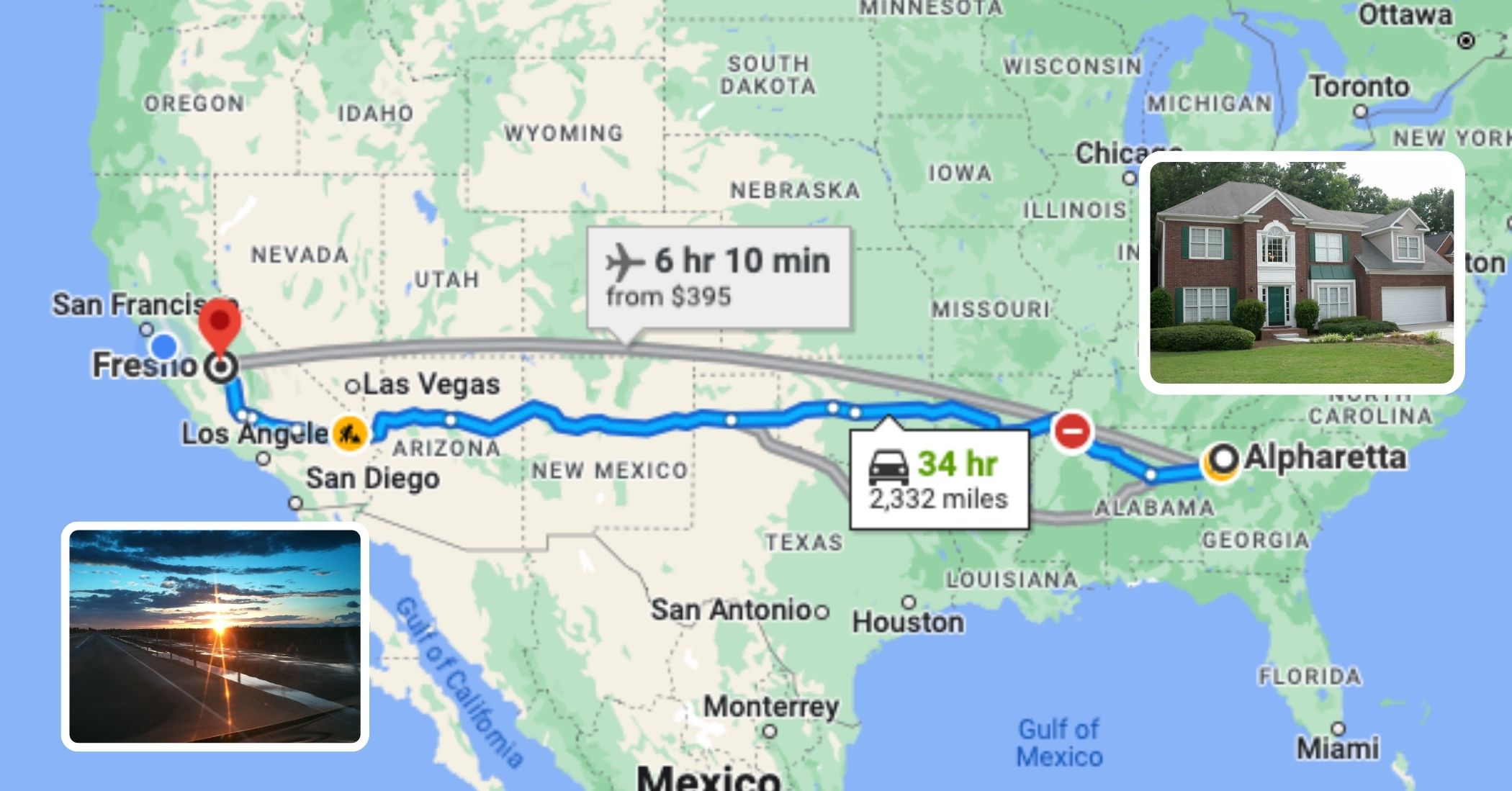
Are there times you feel yourself resistant to new ideas and new ways of thinking, even if your old ways are not producing the results you were hoping for? Christ is asking us to be open to the possibilities, to give room in our hearts to where God might be leading you, to allow for the movement of the Spirit in your life. God wants you to leave a buffer for the Spirit to work within you and around you. Because it’s in those gaps that amazing things can happen. It’s a lesson it’s taken me a while to learn, but that has become easier over time. It wasn’t always easy for me to listen to where God was leading me. I often thought that my plans were his plans and that made me unwilling to open up to where else God might want me to go. That was the case when I found out I wasn’t going to be coming back to Roswell UMC. My District Superintendent, my boss in the Methodist system, told me it was likely I was going to a small rural town outside of Atlanta. It was a town that was racially divided. It was a town that didn’t have a good school system. It was a town where Cassie would have to commute three hours every day for work on a good day and it was rarely a good day for traffic in Atlanta. And it was a place that didn’t fit any of my gifts and graces. How in the world could this be where God was sending me? We tried everything to forge our own path, to go the route WE wanted to go, but every time we tried, we kept hitting roadblocks. Finally, I gave up. Normally, I’d say that was horrible, but in this case it was the best thing I could have done. I literally went into my closet, laid down on the floor and in the pitch blackness of the room, I prayed. And I just said to God, “I can’t believe this is the path you want me to follow, but if it is, I’ll do it. But if it isn’t, if this is not where I’m supposed to be, would you please open a door for me? No matter what door is opened, I’ll walk through it.” That honest prayer, where I finally created room in my life for God to work, helped me to let go and trust in God like I should have all along. It only took an hour to get a response. After that prayer, I went back to my desk and started going through my emails and found one from a friend of mine out in California who just became a DS herself. She asked how things were going and I opened up to her about our situation. About an hour later, I got a phone call that changed the course of my life. I ended up coming back home to California to serve in our conference. And it has just been one God-led moment after another. It hasn’t always been smooth and rarely the way I expected it to turn out, but I have felt so blessed. All because I was finally willing to open myself up to where God was leading me.
Are you open to where God is leading you?
Do you pray regularly? Not for what you want or what you need, but do you ever pray for what God needs from you? Are you open to new ideas and new ways of doing things? Or have you become so rigid in your life that there isn’t room for where God might be leading you next? In any situation where you find difficulty, do what Scotty did and give yourself a buffer. Allow room for the unexpected and the unknown. Give different ideas a chance and you might be wildly surprised at where God is taking you.
Some Assembly Required

Three of the most dreaded words I know in the English language – Some Assembly Required.
They make it seem so innocent, but we all know what it really means: “Advanced degree in engineering.” That’s what they should put on the side of the box. It would be more accurate. One time, we bought our oldest daughter, Eve a new bicycle. I was in the store and saw one I thought would be great for her, so I found a salesperson and asked them to get one for me from the back. He asked if I wanted them to put it together for an extra $10 bucks. I smiled politely and said, “No thanks,” but inside I was laughing. I mean, seriously. Pay an extra $10 to have someone put together a bicycle? Come on! So, I took the new bike home and started to put it together. Cassie came in and asked why I didn’t just have the guy put it together for us, and I laughed and said, “Honey. I’m not going to waste $10 bucks to have someone do something I can do for free. I used to do this all the time when I was in high school.” You know, high school at the time was 25 years in the past. Bicycles have changed slightly. But I was confident! After about 5 hours, I wheeled the bicycle out and let Eve try it. But darn it if there weren’t a couple of extra pieces. Cassie asked me, “How come there’s extra pieces?” And I told her as a good husband ought to, “Oh, they always do that. They put extra pieces in.” Cassie just looked at me as if to say, “You know, this isn’t a LEGO set.” I’ll tell you; I should’ve paid the $10 bucks. Not just to save me 5 hours of work, but I never did put it together right. Wouldn’t it be great if Pay someone $10 bucks and have your problems solved. But life isn’t like that. We make choices every day on how to live our lives. Sometimes we build the bike correctly. Sometimes…we put the brake assembly on wrong. The key is to choose the right set of directions for your life. Because no matter how hard you try to build that bicycle, if you have directions for an Easy Bake Oven, you’re going to have an awfully hard time.

But God gives us the instructions to a better life.
Through his Word, through the life of Jesus, by the guidance of the Holy Spirit – it’s all there if we simply follow him. Because when we listen to God, we make the kind of choices that will help us to have the life he wants for us. BUT if we ignore his instructions or put OTHER things ABOVE God (money, status, famous people), or think we can do it on our own, that’s when we get into trouble. Because we remove God from the process. You can’t make mashed potatoes without potatoes. You can’t make omelettes without eggs. You can’t have the life God wants for you, if you don’t include God in that life. That’s why God warns us against living our lives according to things like horoscopes, witchcraft, and mediums. Not because these things are evil, but because when we put our faith in things other than God, we start living a life separated from God and we become something other than what God wants us to be. And everyday, everyday when you wake up, you make that choice on how you are going to live your life just as surely as you choose what clothes to wear and food you’re going to eat, except the consequences can be much bigger.

Our reading this morning comes from the book of Joshua, Chapter 24.
In this chapter, God is speaking through Joshua. Joshua’s lived a long and fruitful life and has seen his people finally at peace. There are no enemies to fight, and they live in the land that God had promised them so long ago. So, Joshua is getting ready to die. He knows it’s his time and has one last message from God. Joshua gathers all the people together at Shechem and begins to tell them what God has said.
2 Joshua said to all the people, “This is what the LORD, the God of Israel, says: ‘Long ago your forefathers, including Terah the father of Abraham and Nahor, lived beyond the River and worshiped other gods. 3 But I took your father Abraham from the land beyond the River and led him throughout Canaan and gave him many descendants. I gave him Isaac, 4 and to Isaac I gave Jacob and Esau. I assigned the hill country of Seir to Esau, but Jacob and his sons went down to Egypt.
And from there, he gives the people a mini biography of God. He tells them of all the times God has been there for them. When they cried out in Egypt, when they were conquered by the Amorites, when he saved them from Balak, and on and on. And each time, God was there. God has always been there. It was the people who turned on God. And once again, God has saved them and given them this land. And so now, Joshua makes this one last proclamation.
14 “Now fear the LORD and serve him with all faithfulness. Throw away the gods your forefathers worshiped beyond the River and in Egypt, and serve the LORD. 15 But if serving the LORD seems undesirable to you, then choose for yourselves this day whom you will serve, whether the gods your forefathers served beyond the River, or the gods of the Amorites, in whose land you are living. But as for me and my household, we will serve the LORD.”
Who do you serve?
Because it IS a choice. And it is a choice we make everyday. You might be thinking you already follow God, but how many times do we SAY we follow God, but act as if we don’t. I’m sure almost all of us have been there at one time or another. I know I have. I want to follow God each and every day, but I know I’ve made my share of mistakes. I know I haven’t always done what he wanted and I’ve been selfish in my actions. But thankfully, we follow a God who loves us and forgives us for our mistakes. That’s not what gets us in trouble. Making mistakes is part of being human. The trouble begins when they stop being mistakes. When we make the conscious choice to put the things of this world before God, that’s when we dishonor all that God has done for us. Then we become as God said through Isaiah, “These people come near to me with their mouth and honor me with their lips, but their hearts are far from me.” (Isaiah 29:13) Are you following the instructions God has for your life?

It’s funny sometimes how so little has changed.
From the time of the early writers of the Old Testament to today, we still have many of the same problems. Moses uses the examples of horoscopes and witchcraft and mediums as things that might steer us away from God, and we still have those today. Now we also have the internet and YouTubers and TikTok superstars to go along with that. People on the app formerly known as Twitter who spout lies and half-truths, and millions follow them! Sometimes followers of Christ go too far and condemn all of those things as if they are the cause of evil, but they are not. When I was growing up, it was Dungeons and Dragons that got a bad rap. People were saying it was the “work of the devil.” As a Dungeon Master myself, I was offended by that and those attitudes turn people away from faith. As I got older it became things like Magic the Gathering (something I also enjoy) and then it became Harry Potter. None of those things are evil or bad and there are plenty of good people (and good Christians) who enjoy those things. It’s when those things dominate your life to the point where they push out what’s important – like God and family and friends – that’s when it becomes dangerous. Again, it’s not about the things in our life, but about the choices we make. And if you follow God’s call on your life, you don’t have to worry about it because it’s all there in the instructions.

When I was growing up, my family and I often went up to the Mammoth Mountain area to vacation.
We’d stay up at June Lake and go fishing every day. We’d get up early, go out to the lake and rent a motorboat for the day and go out onto the water. Those were awesome times. I loved fishing with my dad. It would be so much fun. We’d take what we caught and bring it back to the cabin for dinner that night, or we’d freeze it and bring it back with us. We always had a good time. Except once. The mosquitoes were biting pretty bad and I’m somewhat allergic to mosquito bites. Not horribly allergic, but they would swell up on me when I got bitten and I’d have these huge red welts on my skin. The next day, my dad brought some mosquito repellant out with us. Well, on the way to where my dad wanted to fish, I was reading the back of the can and it said, “WARNING!” in BIG capital letters, “WARNING! Do not use this product on your face or mouth.” When we got to our fishing spot, my dad pulled out the can, and told me to stand up in the boat and he began spraying my clothes all over. Then he said, “Close your eyes” and he held up the can toward my face! I looked at him with alarm and said, “Dad, it says on the can not to use it on your face.” And my mom said, “Kensuke, maybe you shouldn’t spray it on his face.” And there I am nodding my head. And my dad said, “I know what I’m doing. Just close your eyes. They don’t really mean it when they say that.” So, I closed my eyes, and no sooner did that spray hit my face, I started shouting out loud, “My eyes! My eyes!” I dropped to the floor of the boat, reached my hands over the side while my dad is holding on to my jacket to keep me from going over, and I’m throwing water into my face, trying like mad to get rid of the stuff. Needless to say, we didn’t catch any fish from THAT spot, and I spent most of that morning looking at my mom and saying, “Am I going blind? Hold up your fingers.” All because my dad didn’t follow directions. He had the can. The directions were clear. But he chose to ignore them. We do that to God sometimes, too. We have the directions, but we don’t follow them. If you’ve never made the choice to really follow a Christ-like life, I want to challenge you to give it a try. To test God in this and see how your life could be better. If you already follow God, challenge yourself this week to take a look and see where you might not be doing as God would want you to do, and work on that. Because the truth is, God wants you to have a better life. You just have to choose to do so.
Thirty Good Years
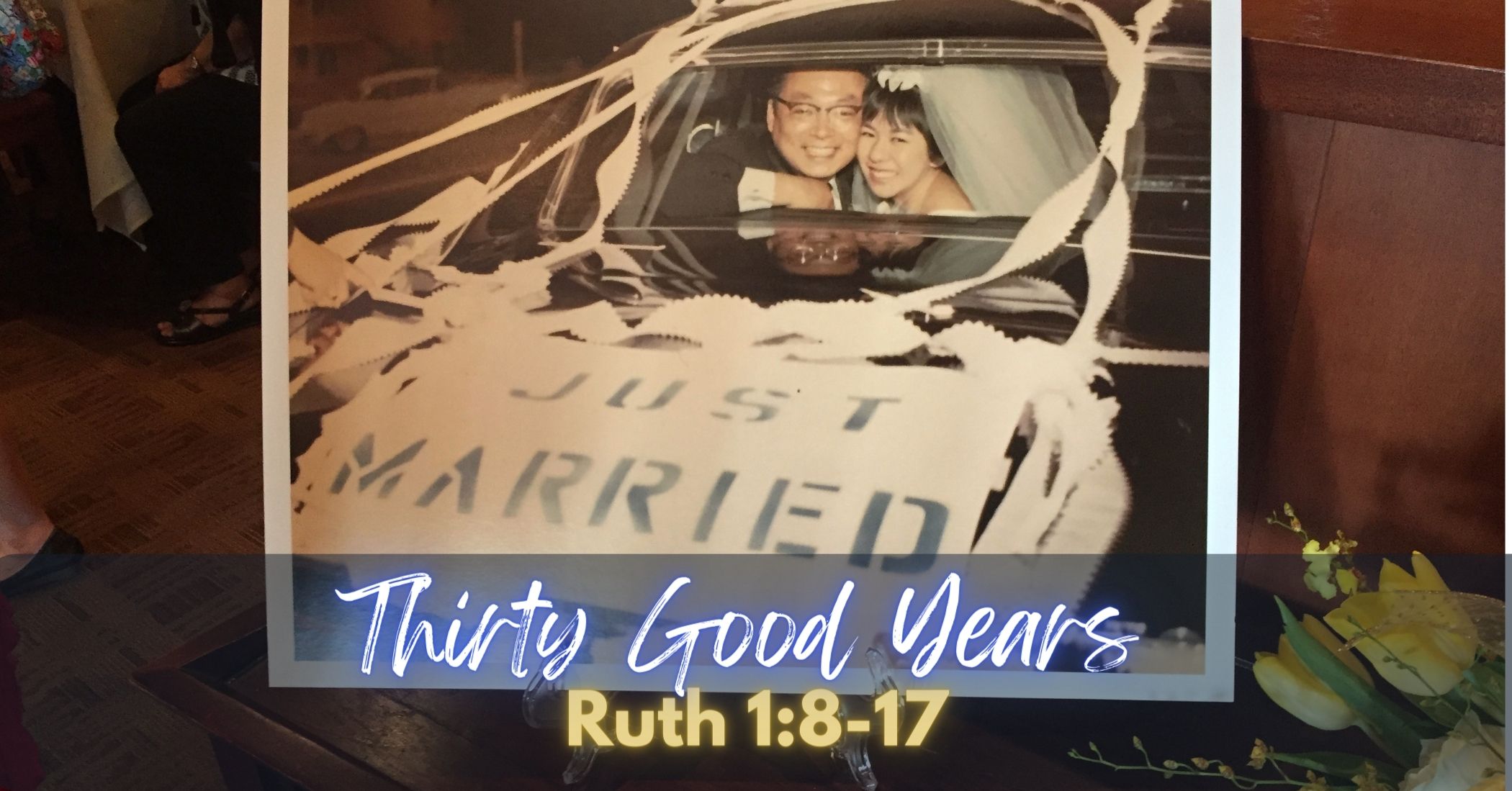
Being successful in the world takes one key ingredient.
And it might not be what you think. You might guess talent, and yes, talent helps, but talent alone will get you only so far. We all know of talented people who couldn’t make a career out of what they love to do or haven’t achieved the level of success their talent merited. So, is it status, money, luck, opportunity? All those things contribute to being successful, but even with them, there is still one thing missing. Commitment. Commitment is the key ingredient to success. Take the Beatles for instance. The Beatles are one of the most successful rock bands in the history of music, but did you know before they ever hit the shores of America, John Lennon and Paul McCartney had been playing together for about seven years? In 1960 they played a gig in Hamburg, Germany and unlike other places they played at, they would play five to eight hours straight. John once said in an interview about that time together, “We got better and got more confidence. We couldn’t help it with all the experience playing all night long…. In Liverpool, we’d only ever done one-hour sessions, and we just used to do our best numbers, the same ones, at every one. In Hamburg, we had to play for eight hours, so we really had to find a new way of playing.”[1] It was because of this large amount of time playing together, constantly finding new ways to challenge themselves and become better, that pushed them to a new level of talent and it was the difference for them between long-term success and short-lived fame. It’s what made the Beatles into the Beatles instead of Dexy’s Midnight Runners. Who is that you might be wondering? Exactly.
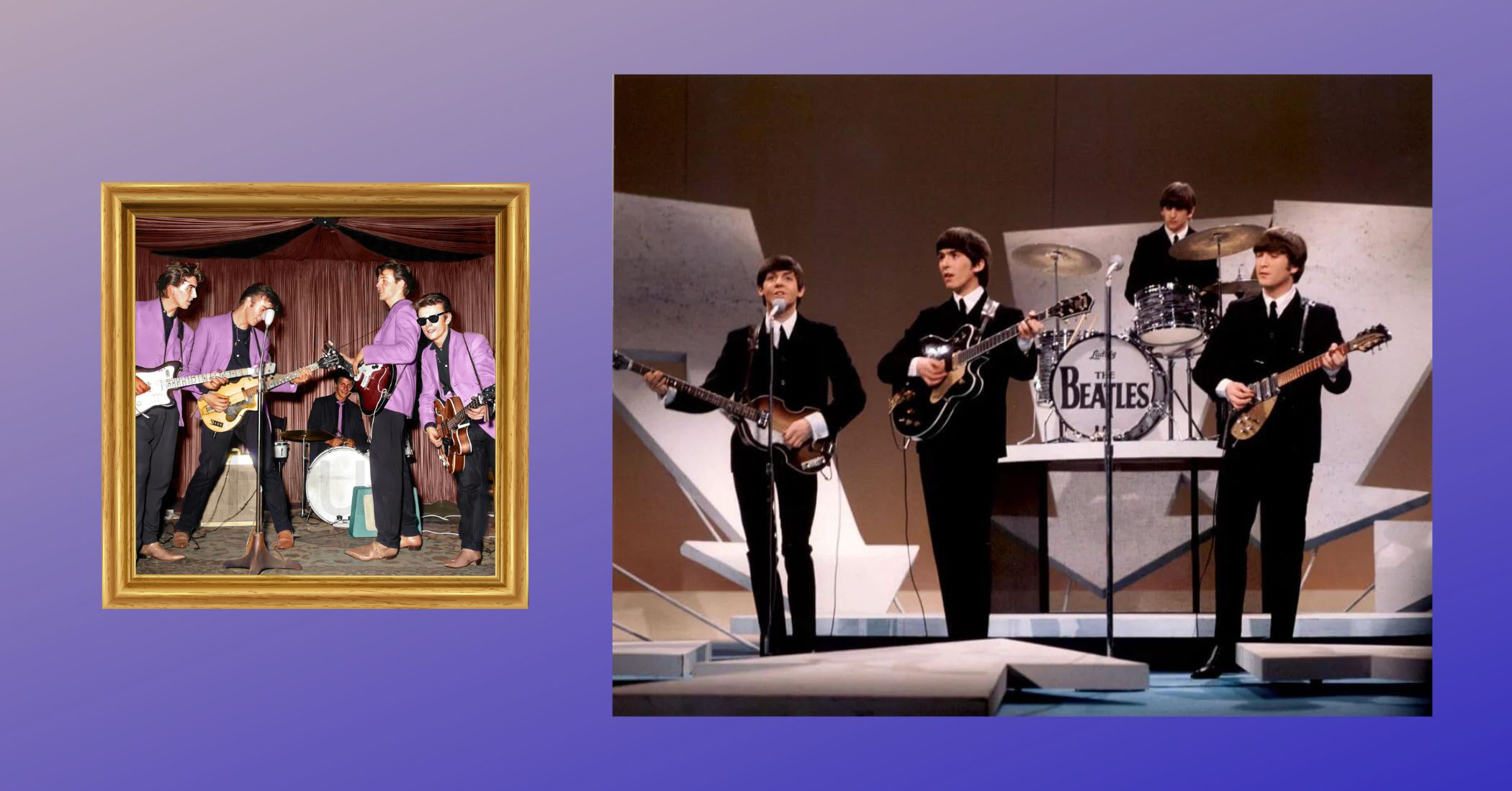
Malcolm Gladwell called this level of commitment the 10,000 Hour Rule.
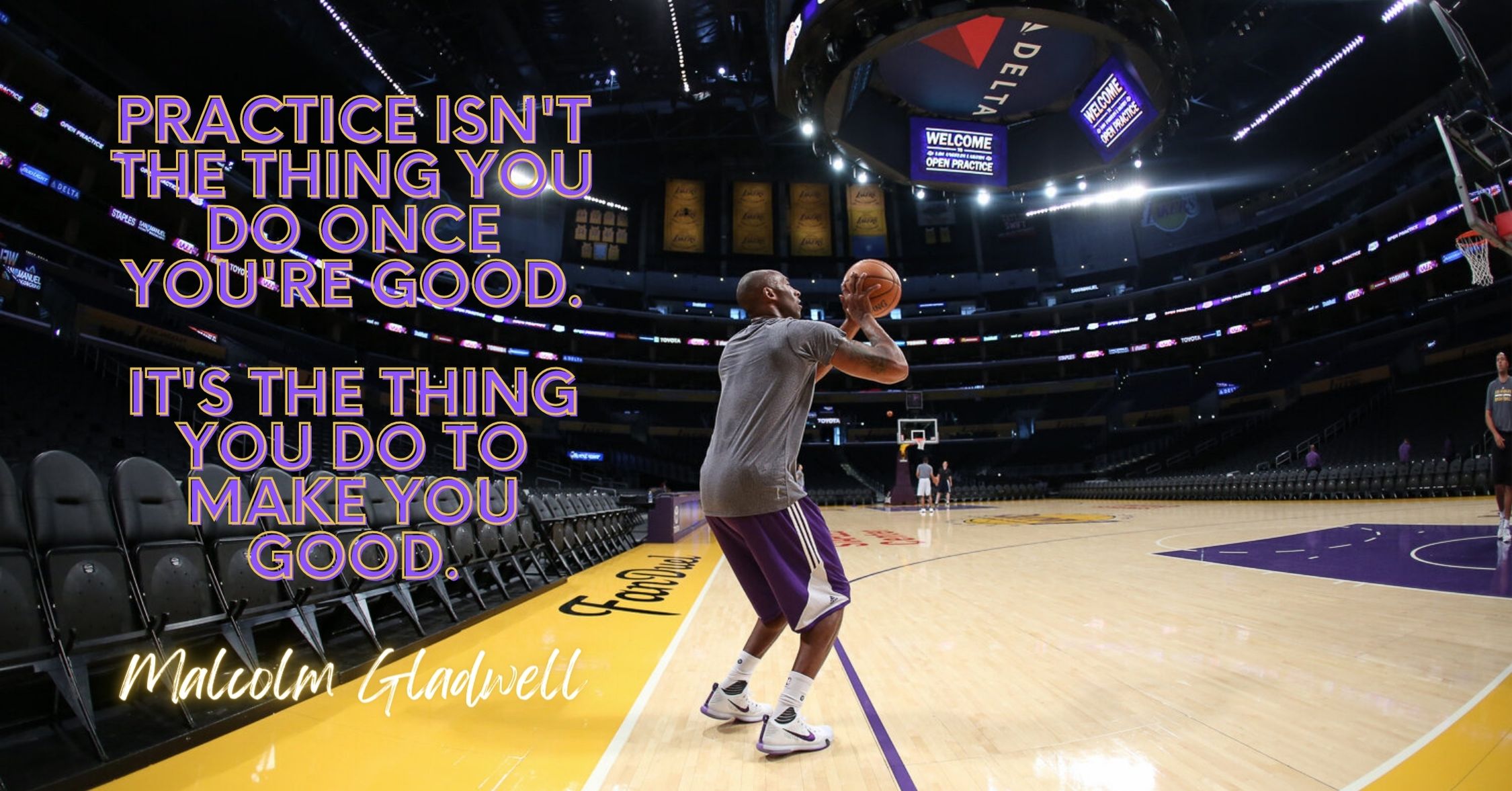
His theory is that it takes 10,000 hours honing your craft to be exceptional at whatever it is you’re doing. Whether in sports, entertainment, or even in business, it’s that dedication to putting the hours in that makes the difference. We often hear stories about our favorite ball players who are the first ones to practice and the last ones to leave. We hear about superstar athletes who, even at the height of their game, will ask the coach to shag a few more fly balls, to stay late and keep working on their free throws, or to spend just a little more time studying film. And Gladwell said it was the 10,000 Hour Rule that separates the average from the exceptional. He put it this way, practice isn’t the thing you do ONCE you’re good. It’s the thing you do to MAKE you good. And that’s true in every aspect of our lives – work, school, relationships, even our faith. It takes commitment to become successful.
Commitment is something the Bible talks about as well.
The story of Ruth opens with a famine in the land of the Israelites and so Elimelek, his wife Naomi, and their two sons Mahlon and Kilion all move to the country of Moab to start a new life. Eventually, and the Bible doesn’t tell us how long, but eventually Elimelek dies and Naomi is now a widower. Her two sons marry Moabite women named Orpah and Ruth, but after about 10 years of marriage, both of Naomi’s sons die, too and now Naomi is all alone, which is a HUGE deal in early Israelite society. Back in those days, a woman without a husband or sons to provide for the family likely suffered an impoverished life. Naomi decides to return to Judah where she heard God had answered the prayers of the people and provided food. But before she goes, she decides to release her daughters-in-law from their duty to her. And that is where we pick up the story.
8 Then Naomi said to her two daughters-in-law, “Go back, each of you, to your mother’s home. May the LORD show you kindness, as you have shown kindness to your dead husbands and to me. 9 May the LORD grant that each of you will find rest in the home of another husband.”
Then she kissed them goodbye and they wept aloud 10 and said to her, “We will go back with you to your people.”
11 But Naomi said, “Return home, my daughters. Why would you come with me? Am I going to have any more sons, who could become your husbands? 12 Return home, my daughters; I am too old to have another husband. Even if I thought there was still hope for me—even if I had a husband tonight and then gave birth to sons— 13 would you wait until they grew up? Would you remain unmarried for them? No, my daughters. It is more bitter for me than for you, because the LORD’s hand has turned against me!”
14 At this they wept aloud again. Then Orpah kissed her mother-in-law goodbye, but Ruth clung to her.
15 “Look,” said Naomi, “your sister-in-law is going back to her people and her gods. Go back with her.”
16 But Ruth replied, “Don’t urge me to leave you or to turn back from you. Where you go I will go, and where you stay I will stay. Your people will be my people and your God my God. 17 Where you die I will die, and there I will be buried. May the LORD deal with me, be it ever so severely, if even death separates you and me.” – Ruth 1:8-17
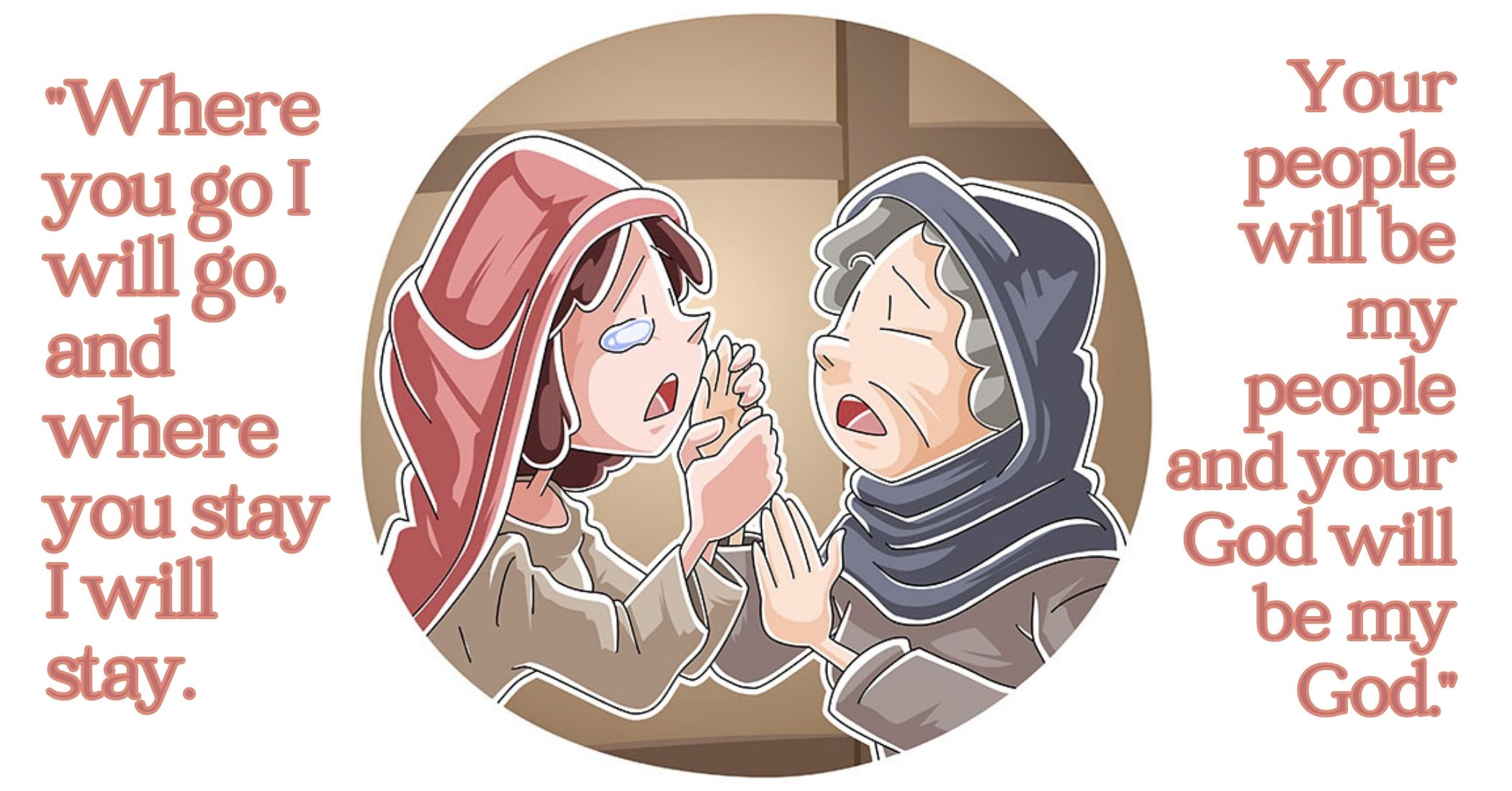
Ruth personifies the very essence of commitment.
She has every reason to leave. Her prospects of staying with Naomi are not good. Ruth, being relatively young or at least young enough to find another husband, could have made a good life for herself had she gone back. Without a husband and without other resources, Naomi was looking at possible starvation or at the very least a poor, tenuous life. But instead, Ruth chooses to stay, even though Naomi, without a husband or sons, was without land and without property. Naomi was essentially a nomad. Ruth says to her though, “Where you go I will go, and where you stay I will stay. Your people will be my people and your God my God. Where you die I will die, and there I will be buried.” This is the kind of commitment God seeks from us. The kind that is faithful in both the good times and the bad, that sees things through and doesn’t give up. It’s the kind of commitment we’re supposed to have toward God when the Bible tells us that we are to “love the Lord with all our heart and all our soul and all our mind (Matthew 22:37).”
But often we think of commitment as something negative.
Like a burden or an unwelcome task. When we talk about commitment, we’re as likely to conjure up images of marriage as we are to being locked up in a mental institution. It’s this kind of perception of “commitment” that makes us think of it as “lacking freedom.” But the truth is commitment is the ultimate freedom because commitment is a choice. It’s a choice we make every day. Like Ruth, we choose to stay in our relationships. We choose to follow Christ. We choose to follow our passions. The problem is that in our disposable society we often choose NOT to commit to one another. We choose instead to leave an escape hatch. But when we always have one foot out the door, we are never really in it. We’re never fully committed and thus we can never enjoy the fruits that come from commitment.
In the book, have a little faith by Mitch Albom, Mitch and the rabbi talk about these fruits.
Mitch sees them in the relationship the Rabbi has with his wife, Sarah and talks to him about how they are truly a team. They stick together through thick and thin. Sarah would often joke with congregants and tell them, “I’ve had thirty wonderful years with my husband, and I’ll never forget the day we were married, November 3, 1944.” “Wait…,” someone would say doing the math, “that’s way more than thirty years ago.” “Right,” she would say. “On Monday, you get twenty great minutes, on Tuesday you get a great hour. You put it all together, you get thirty great years.” The Rabbi knew there was wisdom in his wife’s light-hearted joke. He told Mitch. “I think people expect too much from marriage today…They expect perfection. Every moment should be bliss. That’s TV or movies. But that is not the human experience. Like Sarah says, twenty good minutes here, forty good minutes there, it adds up to something beautiful. The trick is when things aren’t so great, you don’t junk the whole thing. It’s okay to have an argument. It’s okay that the other one nudges you a little, bothers you a little. It’s part of being close to someone. But the joy you get from that same closeness – when you watch your children, when you wake up and smile at each other – that, as our tradition teaches us, is a blessing. People forget that.” Why do they forget it? “Because the word ‘commitment’ has lost its meaning. I’m old enough to remember when it used to be a positive. A committed person was someone to be admired. He was loyal and steady. Now a commitment is something you avoid. You don’t want to tie yourself down. It’s the same with faith, by the way. We don’t want to get stuck having to go to services all the time, or having to follow all the rules. We don’t want to commit to God. We’ll take Him when we need Him, or when things are going good. But real commitment? That requires staying power – in faith and in marriage.” And if you don’t commit? I asked. “Your choice. But you miss what’s on the other side.” What’s on the other side? “Ah.” He smiled. “A happiness you cannot find alone.”

And that’s what commitment is all about.
Commitment is a happiness you cannot find alone. Commitment is a happiness you cannot find alone. That statement is true for marriages, for families, for friends, for faith, and for communities. There is something about commitment to one another, a commitment to an idea or an ideal, that builds character, that helps us grow, that deepens our faith that we cannot find without it. If you never committed your life to Christ or made a commitment to join a faith community, I want you to consider doing so. If you would like to give your life to Christ, let me know so we can journey down that road together. Commitment is a journey. It sees us through difficulties and drives us to even greater success. And when we commit to one another, whether that commitment is to a spouse, a friend, our families, our church or our God, we build a wealth of experiences that leads us to a happiness we cannot find alone.
[1] Malcolm Gladwell, Outliers, p.49.
The Key to Happiness

If I said, I have a surefire way of making you 10-25% happier with your life would you do it?
It isn’t illegal. It isn’t harmful. And it doesn’t cost you anything. Would you do it? Sounds to good to be true, right? But if all that is true (and it is) wouldn’t you at least try it? The funny thing is the key to happiness is much more simple than you probably imagined. So simple in fact, you will think, “Now why didn’t I do that before?” Some of you, even after I tell you what it is, may not do it, and that’s all right. But if you DO it, you will be happier. Numerous studies have shown this to be true. In fact, you’ll be happier than if you won a million dollars in the lottery.[1] Want to know what it is? You’re going to have to wait. We’ll get to that in a few minutes.
In our last post, we began exploring life through the context of the book have a little faith.
In the book the author, Mitch Albom, follows the lives of two men who have had a powerful impact on his life – a rabbi and a Christian minister. And through their lives he discovers answers to some of life’s hardest questions. This week we are going to focus on the elusive quest for happiness. How can we live a happier life? When Mitch asked the rabbi this question, this was his answer:
“The things society tells us we must have to be happy – a new this or that, a bigger house, a better job. I know the falsity of it. I have counseled many people who have all these things, and I can tell you they are not happy because of them. The number of marriages that have disintegrated when they had all the stuff in the world. The families who fought and argued all the time, when they had money and health. Having more does not keep you from wanting more. And if you always want more – to be richer, more beautiful, more well known – you are missing the bigger picture, and I can tell you from experience, happiness will never come.” So, have we solved the secret of happiness? “I believe so,” he said. Are you going to tell me? “Yes. Ready?” Ready. “Be satisfied.” That’s it? “Be grateful.” That’s it? “For what you have. For the love you receive. And for what God has given you.” That’s it? He looked me in the eye. Then he sighed deeply. “That’s it.”

That’s the key to happiness. Be grateful.
Be grateful. Studies show that being grateful increases your happiness anywhere from 10%-25% over a period of time. 10% to 25%![2] Not just for the day or for the moment, but sustained happiness over a period of time. Dr. Robert Emmons did an experiment where he asked people to write down once a week five things they were grateful for. He compared their results and their levels of reported happiness and found that this simple exercise of recording your blessings increased their happiness by 25%. Not only that, but they were more optimistic about their future, felt better about their lives, and exercised 1.5 hours more per week than those in either of the other two groups. They did a similar study with a group of patients suffering from neuromuscular disorders, often a result of a delayed reaction to the polio virus. They wanted to find out if their hypothesis held up even among people who had deeper challenges. They found this group also expressed more happiness and optimism than those who didn’t write down their blessings and they even slept better than the other group.[3] What most astounded me was the results of a study done that showed over a six-month period you would be happier recording your blessings for five minutes a day than winning more than a million dollars in the lottery. In that moment, winning the lottery seems pretty awesome, but in just six months your happiness increase is barely up 4% to what it was before, compared to 10% by people who simply journal their gratitude – 2.5 times happier than winning the lottery. Want to know other ways gratitude makes your life better? People like you more. You are generally healthier. It can boost your career. It reduces materialism and increases your spirituality. It improves our sleep. We live longer lives. It makes us feel good. It helps us to relax. We have better marriages. We have more and better friends. And at work it can improve our productivity and decision making. And those are just SOME of the benefits of being grateful.[4]

But gratitude seems to be going the way of the dinosaur.
More and more we seem to have an attitude of entitlement or expectation rather than thankfulness. How many times have you opened the door for someone and they just walk through without saying anything? How many times have you let someone in front of you while driving and they don’t acknowledge you with even a “thank you” wave? Whatever happened to the “thank you” wave? How absent is our attitude of gratitude? Well don’t worry. This isn’t something new. In fact, Jesus had to deal with this problem. Interestingly, this encounter with Christ happens right after Luke’s version of the mustard seed story, which is a little bit different than the one we heard last week. But this is what happened.
11 Now on his way to Jerusalem, Jesus traveled along the border between Samaria and Galilee. 12 As he was going into a village, ten men who had leprosy met him. They stood at a distance 13 and called out in a loud voice, “Jesus, Master, have pity on us!” 14 When he saw them, he said, “Go, show yourselves to the priests.” And as they went, they were cleansed.
15 One of them, when he saw he was healed, came back, praising God in a loud voice. 16 He threw himself at Jesus’ feet and thanked him—and he was a Samaritan. 17 Jesus asked, “Were not all ten cleansed? Where are the other nine? 18 Has no one returned to give praise to God except this foreigner?” 19 Then he said to him, “Rise and go; your faith has made you well.” – Luke 17:11-19 [5]

Ten men all had the same affliction – leprosy. Ten men were healed. But only one came back.
Only one came back to give thanks. They might have wondered why Jesus was sending them to the priest, but as they walked, the answer became obvious – to be welcomed back into society. Only the priest could declare someone as having been cured of leprosy. And being cured was a big deal because having leprosy meant you were ostracized from society. You were banished not only for fear your disease might spread, but because people thought you were being punished by God for some sin you had committed. The disease was a mark of God’s wrath upon you. So to be suddenly cured of something that had kept them away from family, friends, and the rest of society would have been a miracle to say the least. But only one of them returned to give thanks to the one who made it possible. Maybe the others were in a hurry to get the approval of the priest. Maybe the others never put two and two together that through Jesus, God had cured them. Maybe they never even thought about it and were just glad their whole ordeal was over. But one did. One of them realized that this gift came from Christ and came back in gratitude. The irony here is that it was one of the least likely people to have done so – the Samaritan. The Samaritan people were looked down upon by the Jews. They were considered unclean because most of them had intermarried with others in the area so the Jews looked down upon them as unworthy. The Samaritan, more than any other, would have reason not to come back – out of spite, out of anger, out of loneliness. But instead, he realizes who the source is of his many blessings, and comes back to give thanks. Now, the Bible doesn’t tell us how many foreigners were in this group, but likely there were at least as many Jewish people as there were others. But none of them came back except the one. How much is that like us today? We take for granted God provides. We take for granted Jesus offers salvation. And we do little to appreciate it. Instead we get angry at God when things don’t go our way instead of being grateful for what we do have.

We live today in an age of entitlement.
People EXPECT to have things given to them. People EXPECT to have things go right. We live with the philosophy that I’m a good person so good things should happen to me and we equate “good things” with “things we want to have happen.” We equate “good things” with “things we want to have happen.” Even if we don’t do anything to deserve them. And we get mad when they don’t. On one of our trips to Los Angeles, my daughter Emma and I went to this little food place called Milk where they serve the best red velvet cupcakes I’ve ever tasted and these really yummy morsels called Ooey Gooey Chocolate Chip Cookies. Don’t get me started or we’ll never get out of here. But as we left the car and walked to the place, there was a homeless woman asking for money from anyone who passed by. And seeing her really bothered Emma. She felt bad this woman was without a home and without a place to call her own, so as we walked back she asked me, “Daddy if that woman is still there, can I give her my money?” She reached into her pocket and pulled out what little change she had, and I smiled at her and said, “Of course, honey. That would be nice.” And sure enough, the woman was still there, so Emma went up to her and gave her every last cent in her pocket. I know it made Emma feel good to do what she could to help her. Emma will often give her own money to Sunday School or the homeless or whatever else she feels compelled to give towards. So the woman took her money, looked up at her, looked up at me, and said, “That’s it?!” I was shocked. “That’s it?!” she said again in a loud voice, looking at the coins. “Can’t you do better than that? Come on I want to go buy some stuff.” It crushed Emma. It made me mad. Now, I know it wasn’t a huge amount, but this was coming from a woman who had nothing and was begging on the streets for a handout. Yet when a little child gave her all she had, she spat on it like it was nothing. I offered to take back the money, but the homeless woman held on to it anyway. I guess she didn’t feel that badly about it. Emma, however, felt horrible about it all the way home and would mention it again and again. “Daddy, if I had more I would have given it to her.” We talked all the way home about how we can only be faithful to God and where God leads us, but it’s up to others how they react. Still, how ungrateful can we be? And it made me think, are we sometimes that ungrateful toward God?
In Jesus, we have received the greatest gift of all – forgiveness.
He died bearing the sins of the world, and WE PUT HIM THERE. He suffered because of our sinful nature. And still asked for forgiveness on our behalf. And because of that, we have been given a chance at eternal life with our Father in Heaven. Isn’t that worth our gratitude? Take five minutes out of your day over the next month either in prayer or writing down in a journal the things you are grateful for. They could be minor, they could be life-changing, but spend just five minutes each day and see if that affects your life. When we take time out to be grateful, it changes our perspective. It helps us to appreciate the people around us more and to appreciate the blessings we have. We begin to look at life not as a series of things we don’t have, but instead for the many things we do. And it changes us as well. It changes us to be more like the one than the other nine. It changes us to look at a child’s gift with grace and gratitude instead of spite. And it offers to the world a better place to live. On top of all that? It will make you a happier person. As a wise man once said, “It is not happiness that makes us grateful, but gratefulness that makes us happy.”[6] In the name of the Father and of the Son and of the Holy Spirit. Amen.
[1] http://happierhuman.com/benefits-of-gratitude/
[2] http://www.spring.org.uk/2007/09/practicing-gratitude-can-increase.php and http://happierhuman.com/benefits-of-gratitude/
[3] http://www.spring.org.uk/2007/09/practicing-gratitude-can-increase.php
[4] http://happierhuman.com/benefits-of-gratitude/
[5] I was inspired to use this passage because of a devotional I read at Christianity Today. Thank you to people with a heart of gratitude. http://www.christianitytoday.com/iyf/faithandlife/devotionals/9c3010.html
[6] http://blog.ted.com/2013/06/14/want-to-be-happy-be-grateful-brother-david-steindl-rast-at-tedglobal-2013/

