
Faith and Family Trip to Disneyland 2024 – Hospitality

What is hospitality?
9 Let love be genuine. Abhor what is evil; hold fast to what is good. 10 Love one another with brotherly affection. Outdo one another in showing honor… 13 Contribute to the needs of the saints and seek to show hospitality. – Romans 12:9-10, 13
Jesus modeled it. Paul wrote about it. But are we doing a good job of it in our churches and personal life? What lessons can we learn from the absolute master of hospitality – Disneyland! Join us as we find out what it means from Disney to offer hospitality and how we can apply those lessons into our own context. It’s going to be a lot of fun.
Next February, we are headed to Disneyland for our seventh Faith and Family Trip! I am excited to share this adventure with all of you and hope this is a great chance for us all to get to know each other better and inspire us to do more as people of faith. Here are the details:
- Date and Time: Sunday 2/18/24 (optional dinner on Saturday)
- Cost: $50 NOT including admission
- Will include lunch on Sunday, hefty snack, and souvenir!
- Everyone gets a t-shirt!
- What to Expect: Attractions in the morning, lunch and a tour in the afternoon, and a fun group activity for prizes! Everyone gets a little souvenir as well.
Our plans are to meet up early on Sunday to take advantage of being there at opening, have some devotional time together, and head into the park. We’ll go on some rides in the morning, have a mid-morning snack and lunch together, and take a tour emphasizing our theme of hospitality by a former cast member – me! And then we’ll have a cool scavenger hunt for prizes as well as other fun stuff! And more rides. After that it’s free time! We will have an optional dinner the night before for those arriving early and you can join me for dinner at the park if you’d like as well or just go off and have fun.




And it will be FUN! Hopefully you’ll also walk away with a different perspective on church. Our goal is to integrate best practices from the outside world and apply them to how we can be more effective for Christ. This trip will be focused on hospitality and how we can use our own radical hospitality to reshape how others see us and grow our church together. Can’t wait to see you !!!
Chocolate Chip Cookies… And God!

Chocolate chip cookies are my favorite!
For anyone that knows me, that’s probably not a big surprise. Homemade are the best! There’s something about the love and care that goes into a cookie from home that you just can’t get from a machine. Probably my favorite chocolate chip cookie is the Nestle Tollhouse Chocolate Chip Pan Cookie. It’s sort of like a blondie and a chocolate chip cookie combined into one. Yum. These were the chocolate chip cookies of my youth. My mom would make them on very rare occasions, and they tasted so good out of the oven, they would melt in your mouth! I love the taste of brown sugar and butter with the hot melting chocolate chips as it just oozes across your taste buds. The best. But have you ever thought about what goes INTO a chocolate chip cookie? I never really did. Sugar, brown sugar, flour, salt, baking powder, vanilla extract, eggs, and of course chocolate chips. Pretty much what you’d expect, right? A lot of the same basic ingredients you find in most baking recipes. But did you know crystallized sugar originally came from India? It was discovered about the 5th century. Today Brazil is the biggest exporter of sugar. The story is similar for the vanilla bean which is used for the vanilla extract. Originally found only in Mexico, the Totonac people of the Mazatlan valley were the first to cultivate it. But after a 12-year-old slave by the name of Edmond Albius discovered how to hand-pollinate the plant, the vanilla industry thrived and today most vanilla is produced in Madagascar. The chocolate chip cookie itself is a 20th century invention of Ruth Graves Wakefield of the Toll House Inn in Whitman, Massachusetts. She was the one who blended in chunks of chocolate into a cookie back in 1937 to make one of my (and the world’s) favorite desserts today. The chocolate chip itself wasn’t created until 1941 when chocolate companies decided to package chocolate into baking morsels. Before that people would have to break apart the chocolate into chunks on their own. And the famous Nestle Toll House Cookies were named after the place of their birth in Massachusetts. So each time I bite into one of my favorite homemade chocolate chip cookies, I have to thank the people of India, Brazil, Mexico, Madagascar, and Ruth Graves Wakefield of the Toll House Inn in Whitman, Massachusetts.[1]

All of that to say that life is far more complex than the narrow window we view it through.
To describe a chocolate chip cookie I only expanded upon three of the ingredients and already had to credit five completely different civilizations across history. Who knows who else we would include if we traced the history of flour or baking powder or brown sugar? I can generally give credit to God and the chicken for eggs, but who first thought to combine it with flour to make dough? In our attempt to simplify the world into manageable nuggets of information that we can remember, we often forget the complexity that makes up God’s brilliant design. We forget about the diverse nature of the world and how each part was created by God and contributes in its own way to a far more complex world than we can understand.
Our reading today comes from the Book of Genesis, Chapter 1.
As you probably know, this chapter is about the beginning of all creation and the writer gives us a glimpse into the work God has done. Prior to our reading, God has already been creating tons of different stuff. He’s created the heavens and the earth, light and darkness, and the water and the sky. The basics. Then God gets into even more complex stuff – land, vegetation, and time. Think about that. God CREATED time. Next, he created the stars and the sun and the moon, but so far, no other life on the Earth other than plants. And then this is where we come in.
20 And God said, “Let the water teem with living creatures, and let birds fly above the earth across the vault of the sky.” 21 So God created the great creatures of the sea and every living thing with which the water teems and that moves about in it, according to their kinds, and every winged bird according to its kind. And God saw that it was good. 22 God blessed them and said, “Be fruitful and increase in number and fill the water in the seas, and let the birds increase on the earth.” 23 And there was evening, and there was morning—the fifth day.
24 And God said, “Let the land produce living creatures according to their kinds: the livestock, the creatures that move along the ground, and the wild animals, each according to its kind.” And it was so. 25 God made the wild animals according to their kinds, the livestock according to their kinds, and all the creatures that move along the ground according to their kinds. And God saw that it was good. – Genesis 1:20-25
We sort of take creation for granted don’t we?
I mean we have birds and fish and whales and if you believe in evolution dinosaurs which are very cool and lions and cows and all of these other kinds of animals. Just tons of different animals populating the Earth, and this is BEFORE human beings even come into the picture. But have you ever asked yourself why? Not why did God create these things before humans although that’s a great question, but why did God create them at all? Why did God create waters teeming with living creatures? For me, I would have been happy with just the fish. And maybe whales. But why bother creating the rest? What purpose do they serve? But “God blessed them and said, ‘Be fruitful and increase in number and fill the water in the seas, and let the birds increase on the earth.’ …God made the wild animals according to their kinds, the livestock according to their kinds, and all the creatures that move along the ground according to their kinds. And God saw that it was good.” Just because the answer isn’t obvious to us doesn’t mean there isn’t a purpose there.

Take for example the jellyfish.[2]
You might wonder why God would create jellyfish? They seem more troublesome than they are worth. They have a sting that at its most severe can cause death. They can be problematic in other ways, too. Did you know back in 1999, they were responsible for a cascading blackout in the Philippines? And back in 2008 they caused the Diablo Canyon Nuclear Power Plant in San Luis Obispo to shut down for two days! But jellyfish have their upside as well. They are considered a culinary delicacy in many Asian countries. And they are also harvested for their collagen, which is used to help treat rheumatoid arthritis. On the surface, we might dismiss the jellyfish as pretty useless or even deadly, but they serve serve other purposes as well. Some of which we know and probably some of which we don’t. Which is to say God creates this huge diversity for a reason and just because we can’t always see it doesn’t mean it isn’t there.

But diversity is useful in many ways. Even in church.
A recent study on church congregations revealed how important diversity is to God’s purpose. Baylor University released its findings after doing research on churches over a twenty-year period and came to the conclusion that racially diverse churches had higher attendance on average than their largely all-white counterparts. These findings contradict some long-held beliefs in what has been referred to as “the homogenous unit principle” – “the idea that churches flourish if they stick to people of the same race and class.”[3] Believe it or not, this isn’t just a theory held onto by scholars and scientists but by many folks sitting in the pews. The number of times I’ve heard people saying the same exact thing – that our best outreach strategy is to reach out to “people like us” – would probably surprise you. Most of these people would never think of this as being racist, but being practical. But as this study showed, diversity leads to better results. Consider this: claiming to “hire the best person regardless of gender” was often an excuse for not including women in leadership, but as studies have shown, companies with more women on their board of directors tend to be more successful and profitable than their counterparts.[4] We have to overcome our fears and our prejudices to embrace the rich diversity of God’s creation. It’s not only the right thing to do (which should be enough) but is also the route that will lead us to helping others come to faith in Christ.

Diversity is something God is great at.
Look at our earlier reading today. I love the image Paul uses in this passage from 1 Corinthians that we are all parts of one body and no matter how we behave or what we think about one another, it doesn’t take away from the fact we really are connected in God’s great creation. He writes in verse 15, “Now if the foot should say, ‘Because I am not a hand, I do not belong to the body,’ it would not for that reason stop being part of the body….But in fact (verse 18) God has placed the parts in the body, every one of them, just as he wanted them to be.” We are all different. We all come from different backgrounds with different life experiences, and those allow us to bring our unique gifts to the table. It’s in diversity that we come up with new and different ideas, things any one of us may never have thought up on our own. And it’s those new ideas and new ways of doing things that continue to help us grow in our faith, in our soul, and in our understanding of one another. Let us learn from the chocolate chip cookie and embrace our differences so that together we might be greater than the sum of our parts.
[1] Research for this section was done by referencing Wikipedia for “sugar,” “vanilla,” and “chocolate chip.”
[2] http://en.wikipedia.org/wiki/Jellyfish
[3] https://www.umnews.org/en/news/racial-diversity-linked-to-church-growth?mkt_tok=MDc4LUpYUS02NDMAAAF8V8jHdEHFMt6nzBMNx5VfAmLVmNqiPxhxTkkKUI9G8TpZvVNLaMqnlYen_2D1W2GbxxYd9wn5XD3Jr4dKNHzZ-UAtoSPeV5ktRBKmiUeprpz23g
[4] https://www.hsph.harvard.edu/ecpe/why-diversity-matters-women-on-boards-of-directors/#:~:text=The%20business%20benefits%20of%20having%20women%20on%20a,runs%2C%20makes%20decisions%2C%20and%20ultimately%2C%20on%20its%20success.
The Flaw In Our Gospel

Jyn Erso died so the Rebellion might live.
Jyn’s tale of sacrifice and redemption is powerful. The plans she gave her life for were transferred to the ship, Tantive IV moments before she was killed. The envoy on board used her diplomatic ties to travel into a restricted system and take those plans to the gathering Rebel forces where an attack was being put into action. The leader of that diplomatic envoy? Princess Leia Organa. And as Paul Harvey used to say on his famous radio show, “Now you know…the rest of the story.”[1] If you like Star Wars, you know Luke, Leia and Han would find a way to deliver the plans to the Death Star in time so Luke could blow up the Empire’s massive battle station. And although Jyn’s story ends on the planet Scarif it is not the end of the story. Her tale is just one in a much larger tapestry, and even though it is great all by itself, it’s made more meaningful because of the larger story of which it is a part. Where does your story end?

Faith in Christ is essential to Christianity, but it is not the end of the story.
I was reading an article from Outreach magazine, and Ken Wytsma wrote something that stuck with me. He said, “If all we have is Good Friday, then we are missing Easter.”[2] He argues the flaw in our Gospel story today is focused so much on getting people to believe we fail to see the larger picture. That we are only telling half the story. He wrote in part, “Personal salvation for the individual took the spotlight (in how we convey the Gospel) rather than Christ’s redeeming work for the many. There was an overemphasis on salvation for me…” Jesus didn’t turn to his followers and say, “Oh, good. Now that you believe in me, my work is done.” He told them “…you will be my witnesses in Jerusalem, and in all Judea and Samaria, and to the ends of the Earth (Acts 1:8).”
The cross is the beginning of our journey. Not the end.
If you have a Bible or a Bible app on your phone, would you please go to Matthew 5:14. One of the things I love about Methodism is our emphasis on striving toward “Christian perfection.” John Wesley, the founder of Methodism, believed this was something each of us could actually achieve. But whether we attained this lofty goal or not, it was an ideal we should constantly strive for. And it wasn’t an ideal for the super-pious or for the winner of Bible Trivial Pursuit. It was an ideal Wesley honestly believed was within reach of anyone. And again, you didn’t need to go to seminary or become a priest to be equipped to do this work. He felt ordinary people doing ordinary things could do it. Things like prayer, worship, communion, reading your Bible, and attending a small group were ways you could achieve this goal. Will most of us get there? Probably not. But it’s the journey that makes it worthwhile. It’s the journey that honors God. Getting to the cross IS important, but where you go from there is equally important. There is a reason Jesus emphasizes discipleship and not conversion. Conversion is a moment in time, but discipleship is a lifelong process. It becomes part of our character. It defines who we are.

True discipleship takes place in community.
Faith is not a solo journey. We are meant to travel this road together. Jesus sent his disciples out into the world two-by-two. He told us that where two or more are gathered, there he would be. Even in the Old Testament, we read in the book of Ecclesiastes, “Two are better than one, because they have a good return for their labor: 10 If either of them falls down, one can help the other up. But pity anyone who falls and has no one to help them up.” Our faith is meant to be developed in relationship with one another. Not only do we gather strength in numbers, we also are able to test our belief, help each other, and be a stronger witness for Jesus in the world. And at the same time we are growing in our faith, we are supposed to share it with the world as it says in this brief passage from Matthew.
14 “You are the light of the world. A town built on a hill cannot be hidden. 15 Neither do people light a lamp and put it under a bowl. Instead they put it on its stand, and it gives light to everyone in the house. 16 In the same way, let your light shine before others, that they may see your good deeds and glorify your Father in heaven. – Matthew 5:14-16

Our love of Christ was meant to be shared with the world!
It isn’t supposed to be hidden away, yet so many of us have a hard time sharing our faith or inviting people to church. We say we’re worried about what people will think of us. We say we’re worried we don’t know enough. But are those just excuses for not wanting to put ourselves out there? Because we are more than willing to talk about our favorite places to eat or our favorite movies or our favorite sports teams. We have no problem sharing those things that are important to us so why should our faith be any different? When I was serving at Roswell UMC in Atlanta, GA, there was a monthly street fair during the summer near our church, and if you’ve ever been to Georgia in the summer you know how hot it gets. So we would take part in the fair by handing out free cold bottled water to people passing by and we’d give out little cards inviting people to come to our church. One of our members quit the church because of it. I remember calling her on the phone when she transferred her membership to find out what happened. Maybe we had done something wrong without realizing it. Maybe someone said or did something to make her feel unwelcome or unappreciated. But when we talked, she told me it wasn’t anything we did to her. She just didn’t want to belong to a church that evangelized in public. Keep in mind this wasn’t a requirement for the church and about 99% of our members did not participate. It was just a handful of people who wanted to do something tangible to show the love of Christ to our neighborhood. The woman who left our church said she didn’t think it was right. I was really confused what wasn’t “right” about it so I asked her and she responded, “I just think faith is a personal thing.” And she’s right. I agree 100%. Faith is personal, not private. It is meant to be shared. It is a personal choice like raising your children, but how many self-help books on raising kids were you given when you had your first child? How many people felt free to share their own personal parenting philosophy? Just because something is personal doesn’t mean we can’t share our thoughts, opinions, and preferences with those we love. We trust they will understand it’s out of love we share those things and in turn listen to them when they share with us. Our faith, like a fine wine, a good meal, or wonderful music, is made all the better when others experience it with us, so why not tell people about it? How will people know the difference Christ can make in their life if we aren’t willing to share it with others?
The challenge is not whether we should share our faith but finding our unique voice to do so.
How Jesus has touched your life is almost surely different from how Jesus has touched mine. We may have many similarities, but our stories are unique to us. And so is how we will share it. For those who are bold, let them proclaim it boldly! But for the rest of us, we need to find our voice either literally or figuratively. So this week, I’m asking you to think about one person or persons who you wish would come to church with you. Think of one person or persons whose life would be made better, who would feel more at peace, who would feel less alone in the world if Christ was a part of it. And pray about how you might share the love of Christ with them. The life, death, and resurrection of Jesus is the most phenomenal event the world has ever seen. But it is so far removed from our everyday life experience, that it takes a personal connection to often make it real. Among those who don’t come to church, a personal invitation from a friend was still almost twice as likely to be effective as anything else.[3] And among those seeking to explore faith, more than half of them were looking for casual one-on-one conversations with friends and family.[4] Even as our experience with traditional church is changing, people still crave personal connection.

Jyn’s story is only a part of the Star Wars saga.
It isn’t the whole story by itself. It’s a vital part that helps us understand all that comes after it, but it isn’t complete without the hope and redemption that follows as a result. The Gospel story isn’t meant to be a shelter from the storm. It isn’t a safe haven from the world we live in. And it isn’t a safety net in case there is an afterlife. The Gospel story is the armor and shield God gives us to have the strength to go out into the world and share his message of hope and redemption to a world that needs it now more than ever. As Ken wrote in his article, “The gospel isn’t simply good news we hear – it’s good news we become. We aren’t simply recipients of grace, but agents of grace as well.”[5] If all there was to the story of Jesus is the cross, there would be no Christianity. It’s what happened after that changed the world. Be a part of the story. Help to change the world.
[1] Paul Harvey was a radio host for a show he created called “The Rest of the Story” which ran for decades. He was known for offering an unknown glimpse into the past of someone famous that revealed something or just enlightened the audience about someone. Many of his stories are archived on Archive.org a non-profit organization seeking to preserve internet knowledge – a library for the Internet. https://archive.org/details/PaulHarveyTROTS/
[2] “Why Race Belongs In Our Gospel Conversations,” Ken Wytsma, Outlook Magazine, Vol. 17, No. 1 (Outreach, Inc. Colorado), p. 60
[3] The Barna Group, Churchless, 2014 p.28 (Kindle edition)
[4] https://www.barna.com/research/opportunities-for-faith-sharing/
[5] Ibid, p.64
Five People You Won’t Meet in Heaven

What in the world is a gigachurch?
Churches are growing so big today they had to add a new type of church – the gigachurch. A gigachurch is a church that has more than 10,000 in worship during a given week. 10,000! Can you imagine that? At one time churches were just churches, but eventually some grew so big we called them megachurches and those worshipped over 2,000 a week. But now we have gigachurches. Could you imagine our building holding 10,000 people? We would definitely need that new sanctuary. And probably more parking. How would you feel if EVUMC became a gigachurch? Some of you would be in awe! Some of you…would feel uneasy. There are people who love coming to a church where it feels like family, where you know almost everyone’s name. They worry about losing the intimacy of a small church. They worry a church that’s too big will mean we can’t truly build community or grow deeper in our faith. But are those real concerns or are they masking something else? Maybe a fear of change?
The truth is, people who go to big churches feel as connected as all of us.
To God and to each other. It would be a mistake to think otherwise. Some people prefer small churches. Some prefer big churches. But we can find connections to God and our faith in every setting. Size does not determine the depth of our faith. There isn’t some inverse correlation between numbers of people and how much you’re able to grow in your relationship with God. For every church, no matter how big or small, you get out of it what you put into it. No matter the size, you can always find a community of people to belong to, to help you grow deeper in faith. No matter the size you can find ways to serve the community and the world. Big doesn’t necessarily mean better, but it also doesn’t mean it’s worse either. Just because it’s different doesn’t make it less meaningful.

Talking about church growth makes some people feel uncomfortable.
Like that’s not what church is supposed to be about. That somehow if we try and grow the church we’re losing sight of helping people grow deeper in their faith. Or that we’re forgetting what it means to be a church. But church growth is helping us to not only grow deeper in our own faith but to help others develop theirs. Numbers are simply one way to measure how effective we are in accomplishing the mission that Christ himself gave to us. And that mission is the same now as it was 2000 years ago when Jesus walked the Earth, to make disciples in his name and baptize the nations in the name of the Father and of the Son and of the Holy Spirit. It’s what is known as the Great Commission, and until that mission is accomplished, we should be devoting our time, energy, and effort into making it a reality. Imagine a world filled with people who were actually followers of Jesus Christ. People who acted like he did, loved like he did, and gave of themselves like he did for one another. What an amazing world that would be!
God cares about the numbers.
God cares about the numbers because behind every number is a real person. When I was doing research for our sermon today, I read that line and it stuck with me.[1] Behind every number is a real person. If the Bible is any indicator, God cares very much about the numbers. In fact, there’s a whole book in the Bible called Numbers, and in chapter 26 of that book, it lists how many men were in each clan. By the end of that chapter, we know the total number of men in Israel was 601,730. That’s a very specific number. In Acts 1, the Bible tells us there were about 120 Christ followers, men and women both, and this was right after Christ went back up to Heaven. In Acts 2, we find out 3,000 people came to Christ in that one day. By Acts 4, we find out that the number of men, just men, who believed had grown to about 5,000. That doesn’t include the women and children which would have made that number even bigger. By the end of the book of Acts, there are so many people coming to Christ, they simply say over and over again how their numbers kept increasing. And even though their numbers kept increasing, they didn’t say to themselves, “Well, that’s pretty good.” Instead, they went out into the world, sending disciples to the ends of the known earth to teach about the love of Christ. They felt this way because they took seriously what Jesus told them.

Then Jesus went through the towns and villages, teaching as he made his way to Jerusalem. Someone asked him, “Lord, are only a few people going to be saved?” He said to them, “Make every effort to enter through the narrow door, because many, I tell you, will try to enter and will not be able to. Once the owner of the house gets up and closes the door, you will stand outside knocking and pleading, ‘Sir, open the door for us.’
“But he will answer, ‘I don’t know you or where you come from.’
“Then you will say, ‘We ate and drank with you, and you taught in our streets.’
“But he will reply, ‘I don’t know you or where you come from. Away from me, all you evildoers!’
“There will be weeping there, and gnashing of teeth, when you see Abraham, Isaac and Jacob and all the prophets in the kingdom of God, but you yourselves thrown out. People will come from east and west and north and south, and will take their places at the feast in the kingdom of God. Indeed there are those who are last who will be first, and first who will be last.” – Luke 13:22-30.
There are so many people out there who do not know the love of Christ.
There are so many who don’t know what it means to have Christ at the center of their life, or how that helps you, or how that can help make this world a better place. What are we doing about that? Because Jesus makes it very clear not everyone gets to Heaven. And that thought disturbs me as I’m sure it disturbs most of you. We don’t like to think about that. We don’t like to think about people NOT making it into Heaven. I mean, we’re fine if Hitler doesn’t make it. But it’s hard for us to imagine Aunt Sue or Uncle Bob not being there. They’re good people after all. But what if that’s not enough? I know that’s a disturbing thought, and some of you probably don’t believe it to be true. But should we take that chance? What if you’re wrong? Should we gamble on the lives of others just because we THINK it may not be true? Jesus’ words are not ambiguous. “…Many, I tell you, will try to enter and will not be able to.” What if those who are not able to are people we could have reached out to? Now, I don’t know who is going to make it and who won’t. I leave that to the grace of God. But it is imperative we help others come to faith in Christ. Like I said, not just because we care about their eternal future, but because we care about their lives in the here and now. Living a life with Christ at its center is the greatest gift we can share. Church growth is a byproduct of our passion for sharing the love of Christ.

Thinking about our church growing might scare some of you.
Not because you don’t want people to know the love of Christ, but because it means things will change. And we worry about change. We worry about what the future might have in store for us when we leave it up to God. We worry that it won’t feel like the same church anymore and it causes fear and anxiety to swell within us. I had someone come up to me one time after I gave a sermon about church growth who asked me how big I’d like for us to grow. I told him I didn’t know, but that I would like for it to grow as big as God wants it to be, and he replied, “Well I hope we don’t grow too big.” Which is a strange response, because if you asked this person if he wanted to see the world come to faith in Jesus Christ, he would have said “yes” without a doubt. But I also understand why he replied that way. He was worried he would no longer recognize the church he had grown to love. He worried that if we grew too big, it wouldn’t feel the same anymore. But that is a fear borne out of the unknown. It isn’t based on fact, but out of this idea that the church would change in ways we MIGHT not like. But is that a reason to stop growing? Is our discomfort a reason to stop growing? Or do you think Christ wants us to trust in him that we will always be able to find our space within the church? Too often we allow our fear get in the way of how Christ wants for us to live and it hampers us as we strive to bring his vision for the world into reality. At Roswell UMC, we were definitely a megachurch. Our average worship attendance was around 1,500. Our membership was about 7,000. You might think people would get lost in a church that size, but just the opposite. They had Sunday Schools for adults bigger than our church here. They would have their own speakers, their own music, their own announcements, their own prayer time. It was, for all intents and purposes, church. So they broke bread with one another and shared time together and they found their own intimacy, even in a church that big. They found a place to call their own while still being part of something much bigger. We are afraid of the unknown but God will take care of us.
You’ve probably heard of the novel The Five People You Meet In Heaven.
Or maybe you’ve seen it on TV. In any case, it’s about a man who dies in a tragic accident while saving a little girl, and on his way to Heaven he bumps into five people who have made a difference in his life. It’s a really sweet tale about the impact we have on the lives of others and how our choices are significant whether we realize it or not. But when we think about facing our fears about church growth, about pushing back on change, I wonder if it might have been better to have a book called The Five People You Won’t Meet In Heaven. It would be the tale of five people who will never know the love of Christ in their life because we were afraid to reach out to them. The five people who didn’t make it because we were unwilling to change. The five people who don’t know God or Jesus because we thought we had done enough.

There’s this Kevin Costner movie called The Guardian that I like mostly for this one scene.
Throughout the whole movie, we hear that Kevin Costner is this legendary Coast Guard person who’s saved tons of lives. But he won’t say how many. He keeps evading the question. At one point in the movie, he decides to go into retirement and this young guy he’s been helping to train asks him, “Hey, there’s something I’ve got to know. What’s your real number?” And Costner says, “22.” And to this young guy, that’s far less than he expected from someone everyone considers a legend, so he says, “22? That’s not bad. It’s not 200 but…” and Costner says, “22 is the number of people I lost, Jake. The only number I kept track of.” As much as we celebrate the impact we make on the world around us, I hope we are equally driven by those we have yet to reach.
Change is scary.
But the consequences of not changing are even scarier. When people are critical of growing churches by saying it’s not about the numbers, the truth is it’s all about the numbers. Just maybe not the numbers you’re thinking of. It’s not about dollars and cents. It’s not about filling the pews. It’s about people knowing the love of Jesus Christ. And if we can be a part of the solution to that problem all of our efforts are worth it. Have faith in God that as we grow, you will grow too. Have faith that as our church changes there will always be a place for you and it will continue to be meaningful. Have faith that we don’t have to lose who we are, but instead we can become something even greater when we do it together. And remember this, behind every number is a person waiting to know God.
[1] I wish I could remember where I read it so I could give credit to the author!
Let It Go!: Giving UP Forgiveness

Who would have thought 24 bunny rabbits could cause so much damage?
But that’s exactly what happened in Australia. In 1859, an Englishman brought 24 wild rabbits to Australia to hunt them. Apparently the rabbits outsmarted the Englishman and have bred continuously since that time. Today there are estimated more than 200 million rabbits across the Australian countryside costing the populace more than $500 million in damages annually.[1] Maybe he was just “sharing the wealth” with this once British colony, as rabbits have become the most invasive non-native species to inhabit the United Kingdom.[2] Today, damages caused by these Easter celebrants is over £260 million every year! The United States has many of its own problems with invasive species. The kudzu plant is among the most well known, especially in the South. The object of many jokes, the plant itself is hardly a laughing matter. This fast-growing vine is virtually impervious to pesticides and herbicides, can grow up to a foot per day, and costs an estimated $500 million in lost crops and control costs annually.[3] Native to Japan, the plant grew rapidly in the South where conditions were ideal for it, and without its natural predators, the plant thrived covering more than seven million acres.[4] Richard Benyon, the minister for the natural environment in England, said, “It becomes increasingly difficult and costly to control invasive non-native species as they become more established. Taking early action may seem expensive, but this report shows that it is the most effective approach, saving money in the long run and helping our native wildlife to thrive.”[5]

Human beings have their own invasive species.
Bitterness, anger, hatred, and resentment. These emotions are the kudzu and bunny rabbits of the human soul. They take root, spread and twist it as well as any known biological disease does to our bodies. In fact, recent studies have shown that bitter, angry people have higher blood pressure and are more likely to die of heart disease and other illnesses than people who are not.[6] Being bitter and angry can literally kill you. And like Mr. Benyon said about other invasive species, early action is the most effective approach to rooting it out. Before it digs deep into your soul, before it has a chance to twist you like a pretzel, you have to get rid of it. Because as long as you hold onto it, you’ll never be able to truly follow Christ. You’ll never be able to give yourself to God in the way we need to experience all that God has in store for us. You have to unburden your heart.
Jesus talks about this in our Bible passage this morning.
This occurs right after Jesus is having dinner at a Pharisee’s house. In this section of the Bible, Jesus is spending much of his time teaching and sharing parables about God and the world. At the Pharisee’s house he told the parable of the Great Banquet where the invited guests all came up with excuses why they couldn’t be there, much like we give excuses for why we don’t commit our lives to Christ. One guy says he has to tend to his field, one guy says he has to care for his animals, one used his marriage as an excuse, but they all had an excuse for not coming to the banquet. God’s warning for us is that we can’t afford to let these other things get in the way of our relationship with God or we might just be sacrificing our own salvation. In the passage we’re about to read, Jesus emphasizes this point in another way.
25 Large crowds were traveling with Jesus, and turning to them he said: 26 “If anyone comes to me and does not hate father and mother, wife and children, brothers and sisters—yes, even their own life—such a person cannot be my disciple. 27 And whoever does not carry their cross and follow me cannot be my disciple.
28 “Suppose one of you wants to build a tower. Won’t you first sit down and estimate the cost to see if you have enough money to complete it? 29 For if you lay the foundation and are not able to finish it, everyone who sees it will ridicule you, 30 saying, ‘This person began to build and wasn’t able to finish.’
31 “Or suppose a king is about to go to war against another king. Won’t he first sit down and consider whether he is able with ten thousand men to oppose the one coming against him with twenty thousand? 32 If he is not able, he will send a delegation while the other is still a long way off and will ask for terms of peace. 33 In the same way, those of you who do not give up everything you have cannot be my disciples.
34 “Salt is good, but if it loses its saltiness, how can it be made salty again? 35 It is fit neither for the soil nor for the manure pile; it is thrown out.
“Whoever has ears to hear, let them hear.” – Luke 14:25-35
This is a tough passage to hear.
When we first read these words they seem harsh. It’s pretty much against everything Jesus taught. Hate your father and mother? Hate your wife and children? Hate even yourself? This doesn’t sound like the Jesus who commanded us to love God and love our neighbor. It doesn’t sound at all like the Jesus who told us to love one another so that everyone will know we are his disciples. In fact, it sounds like just the opposite. But what Jesus is doing here is a technique he often uses – hyperbole. He’s trying to shock the crowd to get his point across. The fact that it IS so incongruous makes the listener focus on what Jesus is about to say. The meat of his argument comes in the verses following those statements where Jesus starts talking about tower building and going to war and emphasizes that in either instance we wouldn’t even begin the project unless we knew what we were getting into. We wouldn’t commit before being prepared. Unless you knew the costs and benefits. Unless you knew the risks you were about to take. Discipleship is the same way. Because Jesus knew that becoming a disciple wasn’t an easy path. Especially in those days. There would be a lot of pressure from family and friends not to follow Jesus. There were those who thought he was a heretic or crazy or both and to follow Christ meant to go against what society considered acceptable. And that’s something we all struggle with – doing what’s right vs doing what is acceptable. Becoming a disciple of Christ meant risking being an outcast. So Jesus warned them they needed to understand what was necessary to become a disciple.
The same is true for us.
Do we really understand what it means to be a disciple of Christ? Are we willing to leave our old life behind and embrace Jesus’ version of it? You’ve heard some of Christ’s radical teachings on forgiveness. Turn the other cheek. Give a thief the clothes off your back. Forgive not seven times but seven times seventy times. These are not simple commands, but necessary if we are to embrace his teachings. Jesus doesn’t tell us these things arbitrarily. He tells us these things because they are true. The more we lead a life like Christ, the more people will embrace Christ for themselves. When they experience the love of Christ in the world, only then will they really know a loving God. But that can’t happen if his followers are filled with the same prejudices, hatreds, and bitterness that the rest of the world embraces. If we don’t let go of those emotions, there is nothing to distinguish us from everyone else except a fish symbol on our car.

That reminds me of a story I heard in seminary.
I don’t know if it’s true or not, but it’s about a guy driving along the highway when suddenly this other car comes out of nowhere and cuts him off. The guy has to slam on his brakes to avoid hitting the car in front, and this makes him mad beyond belief. He starts tailgating the other guy, honking at him, making obscene gestures. Suddenly in his rear view mirror, he sees a police officer with his lights flashing and so he pulls over to the side and surprisingly the officer pulls over with him. The officer gets out and asks to see the man’s driver’s license and identification. The man pulls them out and hands them to the officer. The officer hands them back and tells the man he can go on his way and the man asks why he pulled him over in the first place. The officer says, “I noticed one of those fish on the back of the car, but with the way you were behaving, I thought the car might be stolen.”
Being a Christian has to mean more than simply saying we are.
It means being a Christian even in the tough times. Even in the times when people have done wrong to us. It means forgiving someone when they don’t deserve it. It means letting go of our hurt and opening ourselves up not only to the possibility of more hurt but of greater love as well. It means putting aside the comfortable for the potential of the future. That’s what it means. When Christ tells us we must hate the ones we love, he only means we must be willing to let go of the past in order to embrace the future. To truly be disciples we must be willing to unlearn the lessons we have been taught. We must be willing to operate by a new set of rules, ones that are more encompassing and more loving than any we have embraced before. And even if the world tells us that there is some sense of justice in holding on to our hate, our bitterness, and our anger, we know better. To embrace the lessons of Christ, we have to let go and open ourselves up to the possibilities God can bring our way. Letting go of the past is the only way we can be free. Free to live. Free to love. Free to reach the potential life God has carved out for us. God isn’t punishing us for holding on to these feelings. God is telling us that when we don’t let go, we are anchored to this world and we can’t be free to live as God wants us to live.
Our challenge for this week is to let go of the past.
Forgive those who are clouding our future. Forgive them so YOU can move forward. Whether it’s someone who wronged you or someone who hurt you or someone who made your life hard to endure. Forgive them. It might not even be someone who did something to you recently. It could be someone from your past, someone who isn’t even a part of your life anymore but whose presence haunts you as if they were still there. Forgive them. Let go of the hurt. Because like the kudzu, the pain, bitterness, resentment, and hatred we carry with us are roots that bind us to the world. It can grow and fester within us at extraordinary rates unless we root it out, which isn’t easy and isn’t comfortable, but once we are free, the burdens we carry are lifted from us and we can live the life God had always promised us. Pray this week for God to reveal to you those burdens you haven’t let go of. Pray for God to give you the strength to let them go, to cut them loose from your life, and to offer forgiveness for those past wrongs. And pray that God will not allow the mistakes of the past to haunt you from your promised future. Take a moment to picture someone in your mind who you need to forgive, who stirs up those emotions within you, and then pray these words.
Gracious and forgiving God, mold us into beings who can be as forgiving as you. Do not allow the pettiness, bitterness, anger, and resentment of life to weigh us down. Lift these burdens from us and give us the strength to let them go. Let us give these things up to you so that we can live the life you have created for us and not the life we have created for ourselves. In the name of the Father and of the Son and of the Holy Spirit. Amen.
[1] http://www.csiro.au/en/Outcomes/Safeguarding-Australia/European-Rabbits.aspx
[2] http://www.theguardian.com/environment/2010/dec/15/rabbits-invasive-species-cost
[3] http://www.sciencedaily.com/articles/k/kudzu.htm
[4] http://maxshores.com/the-amazing-story-of-kudzu/
[5] http://www.theguardian.com/environment/2010/dec/15/rabbits-invasive-species-cost
[6] http://www.cnn.com/2011/HEALTH/08/17/bitter.resentful.ep/
Don’t Tell! – Giving UP Anonymity

Two people: One you know and one you probably don’t.
Frank Lloyd Wright is a world-famous architect whose works have been touted as being genius. Even non-architects like myself have heard of the famous Frank Lloyd Wright who designed the Guggenheim Museum along with hundreds of other buildings. He was named as the “greatest American architect of all time” by the American Institute of Architects.[1] But Wright, as famous as he was, was equally famous for refusing to share the limelight. Even when other architects made brilliant design contributions and in some cases took the lead on a project, he refused to allow them any credit. He even threatened to bring them to court on charges of forgery unless they put his name first and submitted all documents for his approval.[2] Wright was so consumed with his own fame and recognition that he refused to spread it to others. At one point he decided to go it on his own without the help and collaborative effort of others in his field. He immediately went on a nine-year slump where he only completed two projects. It wasn’t until he invited people back into his creative process that he again flourished, but still didn’t credit anyone with his work. Ed de St. Aubin, a psychologist who studied Wright’s work, said, “It is amazing that few of the hundreds” of Wright’s “apprentices went on to achieve significant, independent careers as practicing architects.”

George Meyer on the other hand is definitely NOT a household name.
But much of what he has done with his life is known by many. He is a writer who has worked on shows like Late Night with David Letterman, Saturday Night Live, and most famously for George, The Simpsons.[3] Many of the most famous lines from that show are credited to him, and even the ones that are not, most writers on the staff say have been influenced by him. George is a giver. He likes to give credit where credit is due. Sometimes even when it’s not. There have been times, George could easily have pushed for more prominence (and deservedly so) on many episodes of The Simpsons but instead would let others have the credit and help develop their careers. He often did the unglamorous work of rewrites because that was where he felt the show needed him the most, although many believe he often had many great ideas. He would put some of his strongest effort into helping out scripts focused not on the prominent guests like Madonna, but on lesser known ones that didn’t get as much attention. He had what they call in the world of mountaineering, expedition behavior.

Expedition behavior is a term for those who are selfless, generous, and put the team ahead of themselves.[4] It’s the kind of quality that defined George. The way George gave of his time and talent helped to cultivate the talent of others. We simply don’t have the time to share all the praise those around him have given toward this man. Unlike Frank Lloyd Wright who took all the credit for himself and didn’t make an effort to cultivate the architects around him, George’s collaborative style has led to the success of many others who have gone on to very successful careers of their own. Some have won Emmy Awards, some have become authors and actors, some have become cartoonists and columnists, one man wrote the famous “Soup Nazi” episode for Seinfeld (who also was an Emmy-nominated writer and producer for the show), and one went on to create the show The Fresh Prince of Bel-Air that launched Will Smith’s career.[5] Adam Grant in his book Give and Take calls George a genius-maker. But what if we took these same ideas of selflessness and giving and turned them toward being better disciple-makers instead?
We’re going to delve into that.
This is the story of the man with leprosy. It’s very short but we’re going to look at it in a different way. As we read it, I want you to think about the way in which Jesus approaches his mission on Earth. If he’s come to save the least and the lost, he’s doing it in a weird way – at least by our standards today.
12 While Jesus was in one of the towns, a man came along who was covered with leprosy.[b] When he saw Jesus, he fell with his face to the ground and begged him, “Lord, if you are willing, you can make me clean.”
13 Jesus reached out his hand and touched the man. “I am willing,” he said. “Be clean!” And immediately the leprosy left him.
14 Then Jesus ordered him, “Don’t tell anyone, but go, show yourself to the priest and offer the sacrifices that Moses commanded for your cleansing, as a testimony to them.”
15 Yet the news about him spread all the more, so that crowds of people came to hear him and to be healed of their sicknesses. 16 But Jesus often withdrew to lonely places and prayed.– Luke 5:12-16
Jesus says many times to different people, “Don’t tell.”
He told the man he healed of leprosy, “Don’t tell,” but people knew what happened. We don’t know if the man said something or people just saw what happened, but the news spread and crowds gathered to be healed. In Matthew 9, Jesus healed two blind men and told them, “See that no one knows about this,” but they told anyway. Then he raised a girl from the dead and again Jesus told the parents not to say a word. And when the disciples see Jesus with Moses and Elijah, Jesus says not to tell anyone until after he has gone. Haven’t you ever wondered why he did this? Wouldn’t it make more sense to tell EVERYBODY? I mean, if you knew Jesus could heal the sick and raise the dead and had eyewitness testimony about it, wouldn’t YOU believe? But Jesus was not trying to make a name for himself. He was trying to give the glory to God. He wanted us to have a heavenly perspective instead of an earthly one. If people started fixating only on him, they would start to glorify Jesus, the MAN, create an earthly idol, and fail to see what truly mattered – the grace and love of God.
Christ’s entire life was like this.
He lived a life in service to others, not to elevate himself but to bring people closer to God. At any time, he could have proven his divinity, but instead he embraced his humanity. He came not to conquer but to build community. He came to bring glory to God and not to himself. Had he wanted, he could have ruled the world by force. Instead, he chose to sacrifice himself for the world. Had Jesus become the leader the Israelites were looking for, Jesus would have been lord over a temporary kingdom, but the kingdom he built and is continuing to build is one that will last an eternity. And that is the difference between givers and takers. Givers are looking at the long haul. They are looking to make the world a better place. And even if that means sacrificing personal glory, they know the contribution they make will long outlast anything else they could achieve.
One of my favorite stories is about a man named Cliff Gardner.
Like George Meyers, you probably don’t know him unless you watched the television show Sports Night back in the 90’s. There was a scene where Sam, the Sports Night consultant, is explaining exactly who Cliff Gardner is to the studio execs. He starts out by asking, “Do you know who Philo Farnsworth was? He invented the television. I don’t mean he invented television like Uncle Milty, I mean he invented the television in a little house in Provo, Utah. But the one I really admire is his brother-in-law, Cliff Gardner. He said to Philo, ‘I know everyone thinks you’re crazy, but I want to be a part of this. I don’t have your head for science…but it sounds like in order to do your testing, you’re gonna need glass tubes.’ See Philo was inventing the cathode receptor, and even though Cliff didn’t know what that meant or how that worked, he’d seen Philo’s drawings and he knew they were gonna need glass tubes and since television hadn’t been invented yet, it wasn’t like they could get them at the local TV repair shop. ‘I want to be a part of this,’ Cliff said, ‘and I don’t have your head for science. How would it be if I taught myself to be a glassblower? And I could set up a little shop in the backyard. And I could make all the tubes you’ll need for testing.’ There oughta be Congressional medals for people like that.” The world needs more Cliff Gardners. The world needs more George Meyers. We don’t need more Frank Lloyd Wright’s. If we want to get the job done that Christ has given us, we need to be in the business of building people up, not taking people down. Life is not a zero-sum game. We don’t have to sacrifice the well-being of other people to get ahead ourselves. Instead, we need to be focused on being disciple builders. We need to focus on the needs and well-being of others and not worry about the credit we receive. Because there is only one person whose approval we should be seeking, and his home is our ultimate destination.
[1] Details of Frank Lloyd Wright’s career are from: http://en.wikipedia.org/wiki/Frank_Lloyd_Wright
[2] Adam Grant, Give and Take, p. 78. Details about Wright’s self-centered actions and Meyer’s selfless ones are all taken from Adam Grant’s book in the chapter The Ripple Effect.
[3] http://en.wikipedia.org/wiki/George_Meyer
[4] Grant, p. 74.
[5] Grant, p. 93.
The Wall of STUFF – Giving UP Things

How much STUFF can a person have?
I teased my parents about being “hoarders” when I was in college because they used to have lots of stuff around the house. At one point, my dad had a whole box of Dennison’s chili in his bedroom closet because there wasn’t room for it in the pantry, or the kitchen, or even the dining room. But after watching the show Hoarders and other shows like it, my parents seem to be the model of cleanliness. Hoarding, otherwise known as disposophobia, is real and some have even postulated it is a result of our obsession with STUFF. I don’t generally watch CSI but there was an episode about hoarding and at the end of the episode, two of the characters, Ray and Nick, are talking. Ray tells Nick that the philosopher Erich Fromm forecasted a society obsessed with possessions. “Fromm said people had two basic orientations, ‘having’ and ‘being.’ A ‘having’ orientation seeks to acquire or possess things, property, even people. But a person with a ‘being’ orientation derives meaning from the experiences in life. Unfortunately, Fromm concluded that a culture driven by commercialism like the one we live in today is doomed to the ‘having’ orientation, which leads to dissatisfaction and emptiness.” Ray continued, “When you consider in 1960 there was no such thing as public storage in America. Today there are over 2 billion square feet dedicated to it. Makes you think he had a point.” Can you imagine that? 2 billion square feet for more of our STUFF. Did you know the word “stuff” literally means “to fill up.” The real question is, “What we are filling up our lives with and why?”
I can’t help but think of the story of Jesus and the Samaritan woman.
He meets this woman at the well near where she lives and after getting into a discussion with her, Jesus says, “Everyone who drinks this water (meaning the water from the well) will be thirsty again, 14 but whoever drinks the water I give them will never thirst. Indeed, the water I give them will become in them a spring of water welling up to eternal life.” So the question is, are you filling up on well water or living water? We like to think we are filling up on living water, but most of us are probably filling up on well water. We get stuck in the grind of daily living and we become convinced that our problems will be solved with STUFF. Whether that STUFF is money or power or likes on Instagram, we crave the accumulation of things, hoping that it will solve all our problems, but in the end, we are always thirsty for more. Because what Jesus said is true. Only when we drink of the living water, only when we live a life in Christ, and realize the impermanence of this place will our thirst be quenched. What we need to do is change what we drink, not drink more of what we have. We need living water.

We have always struggled with the balance between God and STUFF.
Our reading this morning in one of Paul’s letter to Timothy he talks about this exact issue. Although there are many instances where people write similar stories or letters about the challenge of giving, Paul offers a reason beyond simply telling us “because you should.” He offers a concrete difference between people who make giving a priority and those who don’t. And he explains why it’s better to give. I believe that whenever God tells us to do something it’s always for our benefit and not necessarily for God’s. God doesn’t need anything from us, he wants something FOR us. And when we listen to God, our lives become better, even if we can’t see it at the time. That’s why God wants for us to become detached from STUFF and develop a heart for giving. Sometimes it seems counterintuitive that giving up our abundance will somehow make us more wealthy, but we find out how in Paul’s letter to Timothy.
3 If anyone teaches otherwise and does not agree to the sound instruction of our Lord Jesus Christ and to godly teaching, 4 they are conceited and understand nothing. They have an unhealthy interest in controversies and quarrels about words that result in envy, strife, malicious talk, evil suspicions 5 and constant friction between people of corrupt mind, who have been robbed of the truth and who think that godliness is a means to financial gain.
6 But godliness with contentment is great gain. 7 For we brought nothing into the world, and we can take nothing out of it. 8 But if we have food and clothing, we will be content with that. 9 Those who want to get rich fall into temptation and a trap and into many foolish and harmful desires that plunge people into ruin and destruction. – 1 Timothy 6:3-9
Paul basically invented the saying, “You can’t take it with you.”[1]
He writes to Timothy, “For we brought nothing into the world, and we can take nothing out of it.” No matter how much STUFF we have at the end of the day, it doesn’t matter. We can’t take it with us. The guy who wrote the saying, “He who dies with the most toys wins” didn’t know what he was talking about. Paul tells us our goal should be “godliness with contentment”; to live a Christ-like life which brings a peace that only God can give. It’s why he writes, “…godliness with contentment is great gain,” because that peace is not something you can buy, but a gift from God for living the kind of life that honors him. But Paul also warns against people with corrupt minds, the kind that uses “godliness (as) a means to financial gain.”[2] He warns that the person who “acts Christian” to get more money, more possessions, more STUFF is disconnected from the life God wants for us all. We get so focused on these unimportant things we don’t even consider whether or not it will really bring us the joy and peace we all crave.

Let me give you a non-monetary example.
When I was in 4th grade, I had a crush on a girl named Karleen Boyle. I don’t know how it started, but everyday after school I would chase her out the door. Kind of a foolish way to tell a girl you like her. Go and chase her down. Pretty soon it became almost a daily competition. Sometimes her friends would join in. She had this Jabberjaw lunch pail that I got to know real well, because she would swing it at me if I got too close. There was some sort of unwritten rule that if she made it to the parking lot she won. And even though I lost every day, I was undeterred. I would chase her and every day she escaped. Until one day, she swung that Jabberjaw lunch pail and missed. I reached out as it passed by me and grabbed her by the arm. She just looked at me as a triumphant grin spread across my face and she asked, “So what are you going to do now?” Honestly, I didn’t know. So I let her go. I had become so focused on getting her, I never really thought what I would do once I did. Sometimes we’re like that about the material things in our life. We become so focused on it, on more money, more things, more recognition – we become so focused on filling our lives with STUFF, that we don’t often think about what happens after we get it. We’re sure that once we get whatever it is we are after, life will be so great! But there’s always more money to grab, more things to own, and more fame to have. When will it be enough? When we realize the STUFF of this world will never give us the peace we crave.
What holds us back from giving more of our time, talent, and gifts is this obsession with STUFF.
Hoarding is just an extreme example of it, but each of us struggles with letting go. When we do give, we often become focused on what we get out of it. But we forget ultimately giving is about living. We give to live. Because giving is an attitude. Giving is a spiritual discipline. When we remember that it isn’t ours to begin with and that it all belongs to God, we become more grateful for what we have and we become less worried about what happens to our gift. When we have an attitude of giving we draw closer to God. And giving has some lifelong benefits, too. Like the fact that 80% of people who tithe have no credit card debt compared to the national average of 61%.[3] 74% have no car payments compared to the $750 billion in loans out there today.[4] 48% have no mortgage.[5] But as one analyst said, the tither looks at these statistics and says his life got better for giving. The doubter looks at the same stats and says to himself the tither is able to tithe because his life started off better. For all of the evidence I can share with you, it still comes down to a personal decision to do it – to give more. God wants us to give, not because he needs anything, but because when we let go of all the STUFF in our lives, our lives become better. One of my favorite pieces of Scripture is from Malachi. I like to think of it as the God Challenge where God tells the people of Israel, “’Bring the whole tithe into the storehouse, that there may be food in my house. Test me in this,’ says the Lord Almighty, ‘and see if I will not throw open the floodgates of heaven and pour out so much blessing that there will not be room enough to store it.’” That image of God telling us, his people, to test him and see the abundance of blessing that will come from your giving. “See if I will not throw open the floodgates of heaven and pour out so much blessing that there will not be room enough to store it!” That’s the kind of life God wants for you. A life of abundance. Abundance in peace. Abundance in life. Abundance of love. The things that are most important. But again, as in all things, this is a choice. You have to eventually trust that God’s system works and try it for yourself. Don’t get me wrong. I like STUFF too. I’m not saying having stuff is a sin. I’m not advocating for living like John the Baptist on honey and locusts. But I am advocating that what Ray told Nick in that CSI episode is true. The trick is to not let the STUFF get in the way. I want to challenge you during this time of Lent to give more. More of your time, more of your talents, more of your gifts. Take the God challenge and see if making this a regular part of your life doesn’t make your entire life better. You would be surprised at the difference it can make. Take a drink of the living water and see how refreshing it can be.
[1] http://www.joe-ks.com/phrases/phrasesY.htm
[2] http://www.biblegateway.com/resources/commentaries/IVP-NT/1Tim/Christian-View-Money
[3] http://www.creditcards.com/credit-card-news/credit-card-industry-facts-personal-debt-statistics-1276.php
[4] http://www.cbsnews.com/news/us-consumer-debt-rises-on-student-auto-loans/
[5] http://www.christianpost.com/news/study-christians-who-tithe-have-healthier-finances-than-those-who-dont-95959/
The Long Game – Giving UP Giving

Let me share with you the true story of a guy named Sampson.
Sampson wanted to be the “Clinton of Illinois” and set his sights on winning a Senate seat. No one thought him a likely candidate. But he had a lot of determination. Sampson ran for a seat in the state legislature at only 23 years of age…and lost with a resounding 8th place finish where only the top four won a place. After operating a completely failed business, he tried a second time and took second, this time earning that seat. Serving eight years, he decided to go national and try for that Senate seat he had his eye on. He was up against two very strong opponents – Shields and Trumbull. Both had been State Supreme Court justices and Shields was the incumbent. But in the first poll, Sampson was ahead with 44% support, Shields had 41% and Trumbull only at 5%. But then a fourth candidate entered, Gov. Joel Matteson who quickly took the lead. Shields withdrew and Matteson was on top 44% to Sampson’s 38% with Trumbull holding on at only 9%. It didn’t look good for Sampson, so he did what no other politician would have done – he withdrew from the race and threw his support behind Trumbull. Despite having clearly the larger percentage of the vote, Sampson fell on his sword and gave the race to Trumbull who won 51% to Matteson’s 47%.[1]

But why would Sampson do such a thing?
Why would he sacrifice his own position to another opponent? The thing is that Sampson’s goal once Matteson entered the race was not to win, but to stop Matteson from getting that seat. He had suspicions that Matteson was crooked. Reports about Matteson attempting to bribe influential voters was enough to convince Sampson that Matteson was not going to be good for the country and he and Trumbull, while political opponents shared common ideology about the development of the state. So for the good of Illinois and the good of the country, Sampson withdrew. Good thing, too. A year later, Matteson was indicted for fraud after cashing outdated checks to the tune of hundreds of thousands of dollars. And as for Sampson? After a second failed attempt at the Senate, he finally got a seat with the support of many of those who had originally opposed him. His generosity, his willingness to sacrifice for others, had earned him a great deal of respect. And in 1999, C-SPAN conducted a poll of thousands of people about Sampson and about three dozen other politicians who vied for similar political office and he came out at the very top as having the highest evaluation of any of them. Sampson, or rather Sampson’s Ghost, was a pen name this politician used in letters. His real name was Abraham Lincoln.[2]

Adam Grant, the youngest tenured professor at the Wharton School of Business, used this example.
He wrote about it in his groundbreaking book, Give and Take, and in it, he writes that the best way to succeed in business is to have a giving mentality. He found that there are basically three types of people who inhabit our professional lives – givers, takers, and matchers. As you can probably guess, givers are those whose primary focus is not on themselves but on helping others. Whether it’s co-workers, clients, or random people asking for help, givers love to help other people, not expecting anything in return but because they believe in the philosophy that life is about giving to others. Takers believe in that old maxim by Mark Twain who said, “The principle of give and take… – give one and take ten.”[3] Takers can sometimes act like givers, but generally only in the short run. They are likely to give to people they feel are their superiors while often forgetting about those who helped them make their way to the top. Matchers are status quo type of people. They give but generally to curry favor, bank a future favor, or to repay a favor. They are happy to give, but don’t like being indebted to people or have people too indebted to them. As Walsh noted, there’s a little bit of all three of these in all of us and they come out in different ways at different times, but those whose primary mode of operation is as a giver often end up being very successful. On top of that people who are givers generally have people rooting for them to succeed and will often sacrifice for them to see them move ahead as opposed to takers who are always having people gunning for them.
As you can imagine, giving takes time, energy, and effort.
Often times givers are at the bottom of the workplace success ladder. They often score lower and do not perform as well as takers and matchers. In a study of 600 medical students in Belgium, the students with the lowest grades had unusually high scores on giver statements like “I love to help others” and “I anticipate the needs of others.” They went out of their way to help their peers study, sharing with them what they knew and often filling the gaps in other people’s knowledge. They sacrifice their own time, energy, and effort, sometimes at the cost of their own performance so you’ll often find givers at the bottom of the success ladder. Do you know who you’d find at the top? GIVERS! Givers are generally at the top of the success ladder as well. How can that be? It turns out that over time, givers who are successful learn how to manage their time most effectively to be both true to their core (as a giver) and to succeed. Often times it is BECAUSE of their giving that they achieve the success that they have. People have long thought that raw talent and chance opportunities determined our success, but as more and more studies have been conducted, other factors like hard work and giving have been found to be more influential than chance, luck, or talent.
But this is nothing new to God.
God wrote the playbook on success far earlier than Adam Grant. He even gave us that knowledge in the Bible. This passage takes place right after he chooses the twelve to be his apostles. He begins to teach them immediately and a gathering of his disciples crowd around him while Jesus shares these life lessons with us. He talks about giving right after he talks with them about loving their enemies and this is what he says.
37 “Do not judge, and you will not be judged. Do not condemn, and you will not be condemned. Forgive, and you will be forgiven. 38 Give, and it will be given to you. A good measure, pressed down, shaken together and running over, will be poured into your lap. For with the measure you use, it will be measured to you.” – Luke 6:37-38

This is just one of many verses God uses to talk to us about the power of giving.
At first, the verse doesn’t seem to go that way. In fact, the little chapter subtitle is “Judging Others.” At least it is in my Bible. But looking closer at it, both of these verses are really about giving. “Do not judge, and you will not be judged” is just another way of saying that you should give the gift of grace to others because you will need that grace yourself from God. “Do not condemn, and you will not be condemned” is another way of saying that we should give the gift of mercy because we need God’s mercy to get into Heaven. And “Forgive, and you will be forgiven” is along the same lines. There isn’t a one of us that doesn’t need God’s forgiveness. Then Jesus sums it up with verse 38. “Give, and it will be given to you. A good measure, pressed down, shaken together and running over, will be poured into your lap. For with the measure you use, it will be measured to you.” Jesus re-emphasizes here the importance of giving and offers an example people of his day would be familiar with. A person going to market would often bring a cup or bowl to measure the grain he was purchasing. Grain wasn’t sold by weight but by volume so after agreeing on a price, the seller would then fill the bowl to the top.[4] A “good” measure was one where the seller would make sure you got your money’s worth. After filling the bowl, they would press it down, then shake it to settle any loose grain, and then pour more grain until it was running over and then literally pour that into your lap. You would usually come to market with a loose-fitting tunic for just that purpose, to carry things like grain back to your home. Since the seller would fill the bowl to overflowing, it would be too hard to carry without spilling in the bowl. This is the kind of abundance we should be giving to others. “For with the measure you use, it will be measured to you.”
What Adam Grant discovered was something God’s been trying to tell us for centuries.
Give and it will be given back to you in abundance. Don’t you find that this is true? When you get exceptional service at a restaurant, don’t you tend to give a larger tip? Maybe even one that is MORE generous than usual? Sometimes when people give freely without strings attached, we give more in return, not because we feel obligated, but because we feel so loved by their generosity and willingness. There is one caveat. Giving must come from the heart. As Grant describes in the book and I’m sure you’ve experienced in your own life, there are plenty of fakers – people who pretend to give or maybe even convince themselves they are giving out of concern for others, but are really only giving for what they get out of it. When we give in order to receive, if that is our purpose, we will be found out. People can smell authenticity. You may be able to fool them for a while, but eventually people are able to tell. The abundance that comes from genuine giving is because of the goodwill and love that genuine giving generates. Not because of the giving alone, but because we are naturally drawn to people who are so willing to help us and others for no other reason than they want to. And this ties in to the character of God who is the most generous giver, and God is pleased when we behave in ways that mirror him. More than a generous giver, God loves a genuine giver. Because it’s not about the amount you give, but the heart in which you give it. Challenge yourself this week to be more giving in every way, to give more of your time, effort, energy, and gifts. Live a life not of reciprocity but generosity. Don’t worry about being repaid for your generosity or feeling obligated when others are kind to you. Be grateful, be thankful, be generous.
[1] From the book Give and Take by Adam Grant pp. 11-17.
[2] Ibid.
[3] Op.Cit., p.1
[4] http://www.keepbelieving.com/sermon/1996-11-24-The-First-Law-of-Christian-Giving/
Plus It! – Giving UP Lent

Lou Green isn’t a household name, but his creation is.
Back in 1962, Lou was the owner of a little fast food place in Cincinnati, Ohio and he was struggling with sales every Friday. Business got to be so bad that he was making only about $75 on that day of the week. See, Lou worked in a neighborhood that was 87% Catholic and back then, Catholics didn’t abstain from meat just on the Fridays during Lent, but on every Friday and Lou only sold hamburgers. A competing restaurant in town, Frisch’s, had been making a good fish sandwich and all Lou’s customers were going over there. Knowing he could come up with something on his own, he created a special batter, made his own tartar sauce, and presented his creation to the head of the company, Ray Kroc. And the Filet-O-Fish sandwich was born.[1] But even then it wasn’t easy. Ray wasn’t convinced it would sell and he had created his own sandwich to combat “meat-free Fridays” – the Hula burger, a cold bun served with a slice of pineapple in the middle. Ray challenged Lou and put the burgers together against each other and said whichever sold better the company would adopt. Needless to say, Ray lost. Today, McDonald’s sells over 300 million Filet-O-Fish sandwiches a year. Lou doesn’t see a penny of it, but don’t worry. When Lou sold his franchise he owned 43 McDonald’s locations across Greater Cincinnati.

What surprised me was to find out at one time Catholics were meat-free EVERY Friday.
Today it’s just during Lent, but before Pope Paul VI loosened the restriction in 1966, it was meat-free every Friday.[2] If you don’t know, Lent is the period Christians observe from Ash Wednesday to Easter Sunday and represents the forty days Christ spent in the desert. In fact, the Latin word for Lent is “Quadragesima” which means “forty days.” [3] But why go meat-free in the first place? And why Fridays? Some people jokingly or not speculated the Church mandated the restriction to help the fishing industry. But for us today, we see it as a way to honor Christ and to remember his sacrifice on the cross.[4] Since Christ died on a Friday, Catholics not only skipped red meat but the flesh of any warm-blooded animal. Dr. Michael Foley explained that it seemed theologically fitting to abstain from eating the “meat of an animal whose blood has been shed” on the day in which Christ’s blood was shed.[5] Today, you often hear of Christians, both Catholic and Protestant alike, giving something up for Lent, if not meat them something else. Soda. Sweets. Swearing. But something that’s meant to be challenging in some way to honor and reflect on Christ’s sacrifice for us.
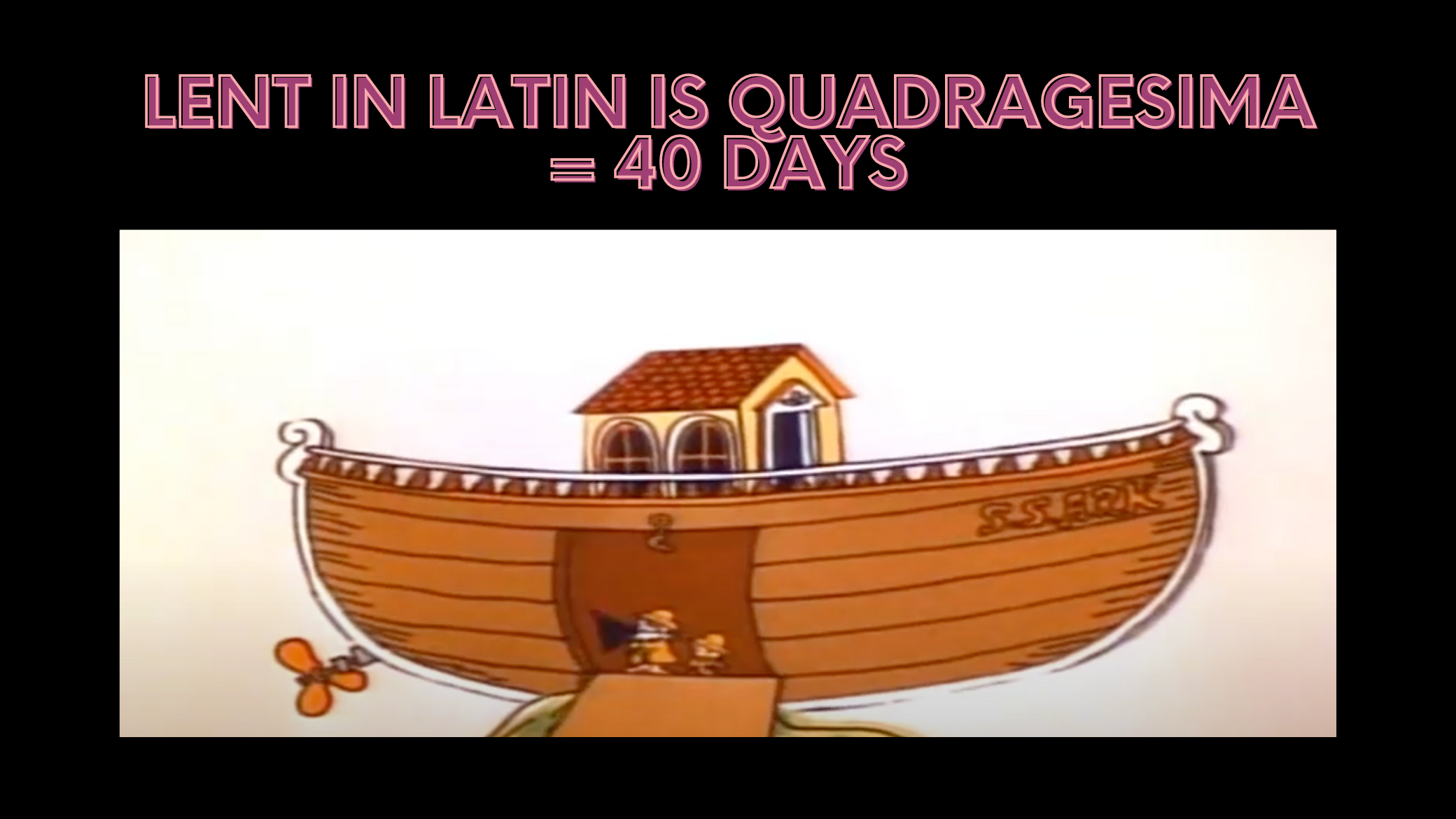
Are you giving something up for Lent?
If you’ve never done it before, I want to encourage you to try it. It’s not a requirement. Nothing bad happens to you if you don’t do it, but this could be something to challenge you to grow in your faith. And if you have done it before, I want to challenge you to do something new. I want to challenge you to “plus it.” We’re going to read from this passage today. “Plus it” is a term Walt Disney used when talking about making something even better. Never one to settle for something that worked, he always challenged himself to find a way to do something better and he called that “plussing it.” One day, early in Disneyland’s history Walt was talking to a group of his accountants who were trying to convince him not to hold this Christmas parade he wanted to do. They ran the numbers and to do everything Walt wanted was going to cost about $350,000, and this was back in the 50’s and early 60’s when the park was still young. They told him not to spend the money, that nobody would complain because they were already going to be there and they wouldn’t be expecting it and he said to them, “That’s just the point…We should do the parade precisely because no one’s expecting it. Our goal at Disneyland is to always give the people more than they expect. As long as we keep surprising them, they’ll keep coming back. But if they ever stop coming, it’ll cost us ten times that much to get them to come back.”[6] That concept of always challenging ourselves to “plus it” is true for our faith also. If we grow complacent in our faith, it will take so much more effort to energize us once again. Instead, we should keep finding new ways to examine our faith, to practice our faith, and to grow our faith. We only have to look to Jesus for an example.

27 “But to you who are listening I say: Love your enemies, do good to those who hate you, 28 bless those who curse you, pray for those who mistreat you. 29 If someone slaps you on one cheek, turn to them the other also. If someone takes your coat, do not withhold your shirt from them. 30 Give to everyone who asks you, and if anyone takes what belongs to you, do not demand it back. 31 Do to others as you would have them do to you.
32 “If you love those who love you, what credit is that to you? Even sinners love those who love them. 33 And if you do good to those who are good to you, what credit is that to you? Even sinners do that. 34 And if you lend to those from whom you expect repayment, what credit is that to you? Even sinners lend to sinners, expecting to be repaid in full. 35 But love your enemies, do good to them, and lend to them without expecting to get anything back. Then your reward will be great, and you will be children of the Most High, because he is kind to the ungrateful and wicked. 36 Be merciful, just as your Father is merciful. – Luke 6:27-36
Christ calls his people to do something radical.
He wants them to “plus” their spiritual life. He challenges his followers to love their enemies and to do good to those who hate them. We take it for granted now that this is the way we are supposed to act, but back then, this was completely against what they had been taught. Instead of “eye for an eye, tooth for a tooth,” Jesus was saying to turn the other cheek. Give your shirt to the guy who just stole your coat. But listen carefully to what Jesus says, “If you love those who love you, what credit is that to you? Even sinners love those who love them.” Jesus is challenging his followers to do more than the status quo. He’s saying to them that it really isn’t much of a stretch to love those who love you. He’s pushing them to do something MORE! And not because it makes us look better in God’s eyes. We aren’t trying to score Brownie points with God. Jesus is challenging us to grow deeper in our faith by taking love of neighbor to a whole new level. What if we did the same? During Lent we traditionally give something up as a way of honoring Christ’s sacrifice and to remind ourselves how much we need God’s forgiveness. But what if we did the unexpected? What if instead of just giving something up, we gave something more? What if we gave more of ourselves to God and to one another? What if we gave more time, more money, more prayer, more of everything to God? What would that look like?

During this Lenten season, I want us to challenge ourselves to do more than just give something up.
But to really give something UP! To INCREASE what we do for God. To really “plus” your Lenten experience this year and make it one to remember. Let’s look at Lent not just a six week period where we give something up, but maybe increase and deepen our faith by doing something meaningful. And if you’ve never given something up? Then try this year to experience what that is like and use the extra time, money, and effort to invest in God. Lent is a time for us to reflect on all that Christ has done for us. Let us use this time to do the unexpected and be the people Christ calls us to be. Prayerfully ask God what he is leading you to give up during this Lenten season. And then ask how God wants you to give more so that you will grow deeper in your faith. Let us pray.
Heavenly Father. As we enter into this Lenten season, help us to grow spiritually in our faith in you as we remember the sacrifices Christ made so that we can enter into a relationship with you. Help us also to be the type of people who do the unexpected that we may shine a light on you with our lives. The Lenten season is only about to begin, but help us look forward to the end when we celebrate the Risen Christ who represents all the hope we have in the world. In the name of the Father and of the Son and of the Holy Spirit. Amen.
[1] http://usatoday30.usatoday.com/money/industries/food/2007-02-20-fish2-usat_x.htm
[2] http://www.catholiconnection.com/2013/02/fasting-and-abstinence-old-rules-compared-to-new-rules.html
[3] http://www.newadvent.org/cathen/09152a.htm
[4] http://www.npr.org/blogs/thesalt/2012/04/05/150061991/lust-lies-and-empire-the-fishy-tale-behind-eating-fish-on-friday
[5] https://heavy.com/social/2019/03/no-meat-fridays-lent-catholics/
People of the Light

Food can trigger fond memories.
Growing up, my dad’s cooking was fun to eat. My mom was the master chef of the house, so eating my dad’s food was special because it didn’t happen often – usually on weekends when he was home from work. He would cook different stuff from my mom, so each meal of his was an adventure. One of his staples was shoyu weenies. He would fry up a package of sliced wieners in a skillet with some soy sauce and it would taste delicious! My dad made a little fried rice to go with it using leftovers from the day before. He would sprinkle a little of this and a little of that (I never knew that this and that was) to make it a perfect side dish and I wondered where in the world my dad would come up with such an idea like this! Literally decades later, I was listening to NPR and heard a story about food in the internment camps during WWII and they mentioned shoyu weenies! With fish and fresh meat not available in the camps, my dad’s family and other’s like his often had to make do with whatever they were given – often hot dogs, spam, and other processed food. Somehow, they used these products in ways that resembled the foods they loved. Shoyu weenies, Weenie Royale, and spam musubi all came from the foods they had available, and now he’s passed them on to me.

The phrase “making lemons into lemonade” comes to mind.
These people who were imprisoned and had everything stripped away from them still found ways to not just endure but thrive. They found ways to make sake, to create art, and build beautiful dressers out of discarded fruit boxes. When my grandfather passed away, we found the side of an old orange crate in his bedroom and wondered why in the world he would have this. But when we turned it over, there was a beautiful carving of a fish flying out of the water. I remember when we found it and wondering how none of us knew about this side of him. It was inspiring. It would have been easy for them to embrace what the Japanese call shigata-ga-nai, a sense of acceptance with resignation; but instead they turned their circumstance into an opportunity to show the worldthat despite the indignation and humiliation they endured, they could rise above it and wouldn’t let this define them. Many Japanese Christian pastors encouraged their congregations to do more than simply suffer in silence, but to show the true heart of Christianity. Rev. Hideo Hashimoto of the Fresno Japanese Methodist Church told his congregation in a sermon he gave on May 10, 1942 – “In the camps, cooperation will not only be highly desirable, it will be the absolute minimal requirement, even to eat and sleep. This is a great opportunity to prove that Christianity works and the Christian spirit alone works. If it doesn’t work in the Centers, it will not work anywhere. For that very reason, Christians are on trial. This is the testing of our faith.” Rev. John Yamazaki of the Japanese Episcopal Church in Los Angeles shared in his Easter message that year, “In a sense, this is our Calvary, and we must be willing to say: “Father, forgive them, they know not what they do.” We must also try, with Him, to say: “Into Thy hands I commit my spirit.” But that is not all. As Jesus the Christ had His resurrection from the dark tomb, so may it be with us. We shall have our Easter and be triumphant.”

It is in that Christian spirit of love and inspiration we share our reading this morning.
In the Bible, light is symbolic of Christ and appears over and over throughout Scripture. We are called to be the “people of the light” (Luke 16:8) and Jesus himself said, “I am the light of the world. Whoever follows me will never walk in darkness, but will have the light of life” (John 8:12). And it is this light that we are to share.
14“You are the light of the world. A city on a hill cannot be hidden. 15Neither do people light a lamp and put it under a bowl. Instead they put it on its stand, and it gives light to everyone in the house. 16In the same way, let your light shine before men, that they may see your good deeds and praise your Father in heaven…” – Mattthew 5:14-16
We are called to be the people of the light.
In EVERY circumstance. No matter how difficult or how daunting, no matter how strenuous or tough, we are the light of the world. But it can be hard to be the light, to be one of those who can turn the other cheek, to forgive not seven times but seventy-seven times. But THIS is the kind of people God wants us to be. When we are wronged, when we are hurt, when we are threatened, we are tempted to react in kind, to give an eye for an eye and a tooth for a tooth, but Jesus tells us we need to rise above that. That we need to “let your light shine before men, that they may see your good deeds and praise your Father in heaven.” We see examples of this all throughout the Bible. Joseph, the guy with the Technicolor dreamcoat, was sold into slavery by his own brothers and yet his faithfulness to God, his ability to be a light in the darkness, convinced Pharaoh to make him his right-hand man and in turn save his family and the people of God. Daniel and his friends were taken forcibly by King Nebuchadnezzar to serve in the royal courts and were told they must eat the food and wine they were given. But this would violate God’s call on their lives, so Daniel chose instead to follow God. Daniel’s example to be the light in a time of darkness eventually convinced the King that the God Daniel followed was indeed the “God of gods and the Lord of kings” (Daniel 2:47). So many of these stories reflect the Japanese-American experience during the war that we are taught even in captivity, even under the rule of strangers, even when persecuted in our own land, Christians are called upon to be the people of light – to stand out amongst the crowd, not as a way of bringing glory to themselves, but by bringing glory to God by our actions.

We must be the people of the light.
And it doesn’t matter which side of the fence we stand on, this is the call God pours into us. Some of the most amazing and heart-warming stories I have heard over the years have been ABOUT the people on the other side of the barbed wire fences, who stood alongside their Japanese-American brothers and sisters and did whatever they could to help them. People who saw there was a grave injustice being done and decided to do something about it. One of those people was Dr. Frank Herron Smith. He was the superintendent of the Pacific Japanese Provisional Conference of the Methodist church at the time of the war. When I interviewed Rev. Lloyd Wake for my master’s thesis he shared with me Dr. Smith was a great influence on him. That he, “not only preached about justice and love, but he lived it.” Dr. Smith was said to have shishi no koe – the voice of a lion – and he used that voice to speak on behalf of the Japanese people at every turn; writing letters, standing up at conferences, and giving a voice to a people who had no voice. During the war, he tirelessly went from church to church, coordinating the efforts of volunteer missionaries who helped turn many of the churches into storage facilities so that families wouldn’t have to get rid of all of their belongings. He would manage the various properties, maintain the parsonages, and when insurance companies decided to drop their coverage of the churches, Dr. Smith mortgaged his own home to help cover the costs. He was unkindly called “the white Jap” because of his passion and love for the Japanese-Americans under his care, but to those who knew him, they called him “Smith-san,” an honorific for one who gave so much. Bishop Sano, the first Japanese-American bishop in the Methodist Church, shared this story about Dr. Smith. He said, “…Dr. Smith made the rounds visiting us in the camps. He wore himself out. One of the hallowed places in the spread of this nation is a hotel and a bus station…I have visited in Cheyenne, WY. He slept in the lounge of the hotel on a chair because “there was no room for him in the inn.” Next morning, he walked across the street to board a Greyhound bus… When the janitor came early the next morning to clean up the bus station, he found Dr. Smith on the floor. He had suffered a stroke… No matter how much hysteria and hate I experience, it was memories like this that saved my soul.” These are the kind of stories that bring the light of Christ to us and serve as an example of what it means to be a Christian.

My dad was very young when he, my grandparents, my uncle and aunt went to the camps.
But he was old enough to remember what life was like there and I know those experiences have added to the person he is today. I know he grew up having his ethnicity thrown in his face as if it were something he should be ashamed of. And despite the fact that my dad owned nothing but American cars until I was in high school – I mean we drove a huge Buick century that was built like a tank and got about three miles to the gallon. Despite the fact that he served in the United States Navy, despite the fact that his best friends were of all different ethnicities including a bald white man that we knew of as Uncle Dan, he was still called “jap” and “nip” by people who didn’t know him. You know how I found out that those were racist words? We were in the store when I was little and instead of getting the Cheez-Its that we normally buy, I picked up a box of Cheese Nips because I was curious if they tasted any different. They looked the same. So I brought the box over to my dad, and he told me to put them back. He said we would never buy those because of what that word meant. So I put them back. Instead we bought Cheez-Its and Tid Bits and Nacho Cheese Doritos, but never Cheese Nips. And then one day, Cassie, the girls, and I went to visit my parents, and sitting on the kitchen counter was a big ol’ tub of Cheese Nips. The kind you get at Costco. I looked at my mom and said, “What is going on here? I thought Dad said never to buy these things.” And she just shrugged her shoulders and said, “Well, I guess he’s over it.” And it gives me hope that all wounds can be healed no matter how deep. That God is working in all of us to make us one people. But it still takes people like you and me who remember what has happened in the past and prevent it from happening tomorrow. It takes people like you and me to be a light unto the darkness that we may point toward the God that created us and show the world what it means to be a Christian. I pray we have the strength of those who lived through life in the camps. I pray that we have the gaman, the fortitude, to endure as they have. And I pray that we never forget the lessons of those days, that we can become beacons in the community for love and justice and that in the spirit of those who are our inspirations, that we do all we can to honor their past by living a life of honor in the present.
 Craig's Corner