
More Than Chicken Soup

Being sick is miserable.
But I have to tell you, some of the moments I’ve felt the most loved are when I’ve been laid up in bed with a fever. When you’re sick, people are just nicer to you overall. They help you out in ways they never think of doing when you’re feeling normal. For instance, in our house, I’m the cook. Cooking is fun for me. Cleaning not so much, but cooking? I’m all over it. So generally, when there’s cooking to be done, I’m the one to do it. But when I’m sick, Cassie ALWAYS cooks for me and often brings me a nice big bowl of hot soup. Now granted it’s usually the kind you heat up out of a can, but I don’t care. She takes care of me, and I feel loved. She gets me water. She gets me warm Sprite. She makes sure I get some rest. And a hundred other little things to maximize my recovery. I have to tell you, except for the downside, being sick isn’t so bad…in normal times. In COVID times, I think we would all hope for everyone to be safe and healthy.
Caring for others is an amazing opportunity to show love.
And it doesn’t have to be with people who are physically sick. We can be drained mentally, emotionally, even spiritually. Just having someone there to help you through it is not something you are likely to forget. Can you think of a time when you were feeling awful or anxious or depressed and someone helped you? Maybe you were physically ill or maybe you were going through addiction problems and someone was there to help. Maybe you were diagnosed with depression, and you only found out because someone noticed and took the time to bring you to a counselor. Maybe you were suffering from a broken heart and needed someone to lean on. We are more than just these physical bodies. And when any of that is thrown out of kilter, life becomes that much harder.

As Christians, though, we have a moral imperative to heal the sick.
We’re going to be reading today from Matthew 10:1-8. Now, when this passage takes place, it is still in the early stages of Jesus’ ministry, but already he was doing the miraculous and everywhere he went he did two things – share the Gospel, heal the sick. Share the Gospel and heal the sick. In Matthew 4, soon after he gathers the first of his disciples, the Bible tells us in verse 23, “23 Jesus went throughout Galilee, teaching in their synagogues, proclaiming the good news of the kingdom, and healing every disease and sickness among the people.” In Matthew, we see a real focus on Jesus as healer. From that point in his ministry to the part we’re going to be reading about this morning, Jesus goes on a healing spree. He heals a man with leprosy, a centurion’s servant, a paralyzed man, a dead girl and her mother, two blind men, and a man made mute by demon-possession. He even healed Peter’s mother-in-law! Funny thing, I never pictured Peter being married. But there it is. Anyway, that’s where we pick up in our reading for this morning. Jesus is gathering the twelve disciples together for the first time and sending them out into the world. From Matthew 10:1-8, hear now the Word of God.
1 Jesus called his twelve disciples to him and gave them authority to drive out impure spirits and to heal every disease and sickness. 2 These are the names of the twelve apostles: first, Simon (who is called Peter) and his brother Andrew; James son of Zebedee, and his brother John; 3 Philip and Bartholomew; Thomas and Matthew the tax collector; James son of Alphaeus, and Thaddaeus; 4 Simon the Zealot and Judas Iscariot, who betrayed him.
5 These twelve Jesus sent out with the following instructions: “Do not go among the Gentiles or enter any town of the Samaritans. 6 Go rather to the lost sheep of Israel. 7 As you go, proclaim this message: ‘The kingdom of heaven has come near.’ 8 Heal the sick, raise the dead, cleanse those who have leprosy, drive out demons. Freely you have received; freely give.

What amazes me about Jesus’ call to heal is that it’s more than just physical healing.
It’s also a way to provide spiritual healing at the same time. Listen again to verses 6-8, “Go rather to the lost sheep of Israel. As you go, PROCLAIM THE MESSAGE: ‘The kingdom of heaven has come near (meaning Jesus).’ Heal the sick, raise the dead, cleanse those who have leprosy, drive out demons….” Proclaim the message and heal the sick. We heard that same theme in Matthew 4 earlier when Matthew tells us that Jesus proclaimed the good news and healed every disease and sickness among the people. And again in chapter 9 where it says in verse 35, “35 Jesus went through all the towns and villages, teaching in their synagogues, proclaiming the good news of the kingdom and healing every disease and sickness.” Healing of both body and spirit went hand-in-hand. Healing alone can be a powerful witness to God’s power, but when Jesus healed, he did more than just cure them of their physical ailments. He also shared with them the good news about who he was and why he was sent. He did that because the REASON for healing is more important than the healing itself. It’s like that old proverb. You know the one. “Give a man a fish and you feed him for a day, teach a man to fish and you feed him for a lifetime.” Healing people (giving them a fish) would cure their ills for the moment, but the next time they were sick how would they handle it if Jesus wasn’t around? Sharing with them the message of hope that is in Christ (in essence TEACHING them to fish) is something that will help them now and in the future. It’s a kind of healing that goes beyond the surface and reaches our soul. Because now there’s a place for them to go to in their pain, a hope they can lean on no matter what the circumstance. Healing is more than just taking away our aches and pains, sometimes it’s not even that. Sometimes healing is offering hope when there is little hope left. Sometimes it’s a healing of our souls that is most in need.

We have a duty to help those in need.
Whether that is physical, spiritual, emotional, or mental, if we take seriously the lessons of Christ, it is our calling to help others. We can argue all day whether or not healthcare is a “right,” but in the end it doesn’t matter because we have a duty that’s higher than that. A “right” is something we are owed, but a duty is something we are obliged to give. And as Christians, Jesus makes it very clear it is our duty to help others. Yet, there are many people who claim to be Christian who would deny access to even basic medical needs, who want to repeal the Affordable Care Act without offering a viable plan in its place. If our goal as a nation was to help people who couldn’t afford basic healthcare, this law did exactly that. From the time it went into force in 2014 up until the election of the current administration and its rollbacks, the ACA helped to decrease the percentage of uninsured people by nearly 50%![1] Literally, tens of millions of people who didn’t have healthcare suddenly did. But after the Trump Administration started rolling back the ACA, more and more people are again losing their health insurance. Since he took office, the percentage of uninsured people has continued to rise year after year. The worst part is not those who voluntarily opt out of the ACA, but children who are seeing the effects of these rollbacks also. The US Census Bureau’s most recent report shows that in just one year, there was an increase in 320,000 more uninsured children than the year before.[2] Today more children are uninsured than they were just a few years ago and of course, it affects the poor much more than the wealthy.
That was the case with a little boy named Deamonte Driver who was only 12 years old.[3]
Deamonte died in 2007, but his story is a reminder of how important this issue is for us as Christians and simply as human beings. Deamonte was a seventh-grader in Prince George’s County, Maryland just outside of Washington, D.C. He complained to his mother about a toothache. His mother, Alyce, had a difficult time finding a dentist who would accept Medicaid because of the low pay out to physicians, a problem that still exists today. As Deamonte’s pain got worse, Alyce had no choice but to finally take him to the emergency room where doctors gave him medication for headache, sinusitis, and dental abscess and sent him home. But the bacteria in Deamonte’s abscess spread to his brain and he was rushed back to the hospital. The doctors did everything they could but the infection had turned into meningitis and ultimately Deamonte died…from a toothache. He died never having finished the seventh-grade. The cost of the two operations he needed and the eight weeks of care and therapy totaled about $250,000. All of which could have been avoided for an $80 tooth extraction that Alyce simply couldn’t afford. While we think this kind of thing could never happen to us, it does. And it’s getting worse. In December of 2019 (before COVID), Gallup reported a record 25% of Americans say they or a family member put off treatment for a serious medical condition because of cost. Another 8% put off treatment for less serious conditions which put the total up at 33%, tying the high right as the ACA was enacted.[4]
If we truly believe in the sanctity of life, we have to care for ALL life.
And as we consider this question leading up to the election, and think about who we want to lead us forward, also consider how we might do more. We shouldn’t have any more Deamonte’s, and we can do something about that in making wise choices about who we elect. But maybe we need healing of a different sort at the same time. Former VP Joe Biden called this election a “Battle for the Soul of the Nation” and maybe it is. Maybe we need a healing of the soul as much as anything else. We may not be able to heal the nation with a law or a mandate, but if we work on a personal level to heal the soul of the nation one person at a time, maybe we can make a difference. Maybe we can bring hope through healing – both body and soul. The next time a loved one is sick make them a bowl of chicken soup. Care for them and help them to feel loved. And ask if you can say a prayer for them as well. Sometimes our need for prayer is just as great as our need for repair.
[1] https://www.census.gov/content/dam/Census/library/publications/2020/demo/p60-271.pdf and https://en.wikipedia.org/wiki/Affordable_Care_Act (The numbers they use to calculate this were by age under 65 since most over 65 qualified for government sponsored healthcare)
[2] https://www.census.gov/content/dam/Census/library/publications/2020/demo/p60-271.pdf (These number are for children 0-18 from the year 2019 compared to 2018 – the most current data available)
[3] https://www.theguardian.com/inequality/2017/jun/13/healthcare-gap-how-can-a-child-die-of-toothache-in-the-us and https://oneill.law.georgetown.edu/death-from-a-toothache-the-story-of-deamonte-driver-and-where-we-stand-today-in-ensuring-access-to-dental-health-care-for-children-in-the-district/ and https://www.childrensdefense.org/child-watch-columns/health/2011/deamonte-drivers-continuing-legacy/
[4] https://news.gallup.com/poll/269138/americans-delaying-medical-treatment-due-cost.aspx
Cradle to Grave
Who isn’t “pro-life?”
Really. Let’s take a look at that. I don’t know many people who are not pro-life. We like life. Some of us even love it. The closer we get to the end of it, the more we seem to treasure it. Isn’t everybody “pro-life?” I don’t understand why so many Christians consider being “pro-life” a justification for how they choose who represents them in government. They seem willing to forgive any number of other sins like adultery, lying, and cheating if someone promises to select a “pro-life” judge. They are willing to ignore racist and sexist comments, put up with cyber bullying, and endorse crime and corruption on the highest levels, if they get a little something in return. God tells us all sins are equally horrible, “for all have sinned and fall short of the glory of God,” yet a portion of humanity has decided that isn’t so. Because, after all, life trumps everything else.


If only that were so.
I wish being “pro-life” was exactly what it sounded like – someone who cares about LIFE! In all its glory. Because that sounds pretty Christian to me. Pro-life. What a wonderful way to live. But even in this, certain Christians are showing their hypocrisy. I’m going to quote now from an article I read about four years ago, but it seems even more appropriate now.
“You see, it’s not that you’re really pro-life… I can tell by how often your heavy burden for the sanctity of life evaporates upon delivery. In so many cases this compassion really has a nine-month expiration date, as if life begins at conception but ends upon leaving the birth canal. The completion of that third trimester is actually the shelf life of your passionate regard for much of the living.
Because if that life you say you so treasure, one day converts to Islam, you label it dangerous, you see it as a threat, you applaud suggestions of its expulsion, you deny it open worship.
If that life eventually comes out as LGBTQ, you condemn its soul, harass it in your workplace and church, try to prevent its marriage, tell it where and when it can use a public bathroom. You bully it and drive it to suicide.
If that life has brown skin and wears baggy pants and gets gunned down during a traffic stop, you not only have little grief over its loss, but readily blame it for its own execution.
If that life is strapped to a prison gurney and pumped full of drugs that will cease its lungs from expanding while its terrified mind comprehends it all, you celebrate the occasion as justice being served — after a last meal you resent having to pay for.
If that life has to endure its formative years in overcrowded, grossly underfunded public schools, you tell it to “pull itself up by its own bootstraps,” while nestled in the cloistered, privileged gated community of a Suburbia where bootstraps come with a birth certificate.
If that life has working parents who can’t make a living wage, you label it a lazy, unproductive drain on society always looking for handouts and trying to work the system to its advantage.”[1]
Life needs to have more meaning than that.
We should be doing more to care for one another from the cradle to the grave, not just for the nine months a baby is in the womb, but for its whole life. How is it that our country has one of the highest mortality rates among like nations for pregnant mothers?[2] Out of 10 similar countries, we are ranked 10th and overall ranked 55th. If “life” is so important to us why aren’t we better at it? Why is it that we have by far the highest number of gun deaths than any other economically advanced country? We are second overall in total number of gun deaths at 37,200 behind only Brazil.[3] In the show, The West Wing, Toby Ziegler says, “I do know that if you combine the populations of Great Britain, France, Germany, Japan, Switzerland, Sweden, Denmark, and Australia, you’ve got a population roughly the size of the United States. We had 32,000 gun deaths last year and they had 112. Do you think it’s because Americans are more homicidal by nature? Or do you think it’s because those guys have gun control laws?” I find it ironic those who label themselves as pro-life are often the staunchest opponents to universal healthcare and gun control. Why? Wouldn’t it make sense for someone who proclaims to be pro-life to want those things? The list of hypocrisy is much longer than that. What about refusing to wear face masks? How can you claim to be pro-life and refuse to wear a face mask? Certainly, you wouldn’t tell the world not to worry about the coronavirus. And we wonder why people are leaving the church. It’s hard to reconcile this kind of hypocrisy with the moral high-ground so many Christians like to believe they have. Worst of all, it goes against what Jesus taught.
31 “When the Son of Man comes in his glory, and all the angels with him, he will sit on his glorious throne. 32 All the nations will be gathered before him, and he will separate the people one from another as a shepherd separates the sheep from the goats. 33 He will put the sheep on his right and the goats on his left.
34 “Then the King will say to those on his right, ‘Come, you who are blessed by my Father; take your inheritance, the kingdom prepared for you since the creation of the world. 35 For I was hungry and you gave me something to eat, I was thirsty and you gave me something to drink, I was a stranger and you invited me in, 36 I needed clothes and you clothed me, I was sick and you looked after me, I was in prison and you came to visit me.’
37 “Then the righteous will answer him, ‘Lord, when did we see you hungry and feed you, or thirsty and give you something to drink? 38 When did we see you a stranger and invite you in, or needing clothes and clothe you? 39 When did we see you sick or in prison and go to visit you?’
40 “The King will reply, ‘Truly I tell you, whatever you did for one of the least of these brothers and sisters of mine, you did for me.’
41 “Then he will say to those on his left, ‘Depart from me, you who are cursed, into the eternal fire prepared for the devil and his angels. 42 For I was hungry and you gave me nothing to eat, I was thirsty and you gave me nothing to drink, 43 I was a stranger and you did not invite me in, I needed clothes and you did not clothe me, I was sick and in prison and you did not look after me.’
44 “They also will answer, ‘Lord, when did we see you hungry or thirsty or a stranger or needing clothes or sick or in prison, and did not help you?’
45 “He will reply, ‘Truly I tell you, whatever you did not do for one of the least of these, you did not do for me.’
46 “Then they will go away to eternal punishment, but the righteous to eternal life.”
Whatever you did for the least of these.
Makes you think maybe Jesus cared about EVERYBODY. Not just the ones who could “pull themselves up by their bootstraps.” He cared about people who were homeless; people who were impoverished; people who were in prison; Jesus cared about the sick and those who were food insecure. And Jesus was critical of those who looked down on others, who treated others without regard for human dignity. He overturned the tables in the temple because of the money lenders and merchants trying to make a profit off of God in a Holy space. He often criticized the elders and religious leaders for their lack of compassion and rigid ways of thinking. And he warns us, right there in this passage, that if we behave in the same way, we can expect no different. “…[W]hatever you did not do for one of the least of these, you did not do for me.” We need to treat people as God created them. As Children of God.

The topic of abortion is complex to say the least.
Those who argue that keeping abortion legal leads to more abortions are ignorant of the truth. Today the abortion rate is lower now than it was since BEFORE Roe vs. Wade was argued in the Supreme Court.[4] There isn’t this widespread use of abortion as birth control as people feared. Instead, today we have more education. We have more options. We have more resources available to more people. And that’s really the key to success in any endeavor. Educate not discriminate. Convince not coerce. If we want lasting change, we have to win the hearts and minds of people, not take away their freedom to choose. There’s so much more to this debate than can go into a 20-minute message, so you’ll have to trust me when I say that issues of race and class and healthcare all play major factors in how this plays out.[5] The bottom line is if you want to advocate on behalf of life, the “pro-life” movement is the wrong way to go about it. Instead focus on making life better for everyone. Focus on treating life as sacred – ALL life, not just the ones you pick and choose. Ultimately, the choice is yours as it should be, but I hope as we reflect on what it means to be Christian during this election season, we take time to pause and pray. Give God a chance to guide your vote and to guide your life. In the name of the Father and of the Son and of the Holy Spirit. Amen.
[1] https://www.huffpost.com/entry/white-conservative-christian-friends–i-wish-you-really-were-pro-life_b_12475464
[2] https://www.vox.com/2020/1/30/21113782/pregnancy-deaths-us-maternal-mortality-rate
[3] https://worldpopulationreview.com/country-rankings/gun-deaths-by-country ; https://www.pbs.org/newshour/health/theres-a-new-global-ranking-of-gun-deaths-heres-where-the-u-s-stands
[4] In 1973 when Roe was decided the rate was 13/1000 women aged 15-44 and the ratio was 196/1000 live births. In 2016 the rate was 11.6 and the ratio was 186. Both lower than before Roe. https://en.wikipedia.org/wiki/Abortion_statistics_in_the_United_States
[5] For a really good Christian doctor’s perspective, you might want to read this article: https://billmoyers.com/story/christian-doctor-fighting-for-reproductive-rights/
Until that Day

Sometimes it takes someone outside of our group to speak truth to us.
If you haven’t heard of E. Stanley Jones, he was a very influential Methodist preacher and missionary, best known for his work in India. Of his many friends was a man you might know by the name of Mahatma Gandhi. Yes, that Gandhi. Together they had many conversations about Christianity, and in one of those conversations, Jones turned to his friend and said, “Mr. Gandhi, though you quote the words of Christ often, why is it that you appear to so adamantly reject becoming his follower?” To which Gandhi replied, “Oh, I don’t reject Christ. I love Christ. It’s just that so many of you Christians are so unlike Christ.”[1] It’s hard to refute Gandhi of all people. Plus, it’s true. There are so many ways we fall short of the Christ-like way we should treat one another. It’s particularly noticeable in how often we disagree. Instead of working things out, we just break off and start a new group who think just like us. Did you know that there are approximately 41,000 different Christian denominations?[2] 41,000! I didn’t know we could disagree so fundamentally on 41,000 different things.
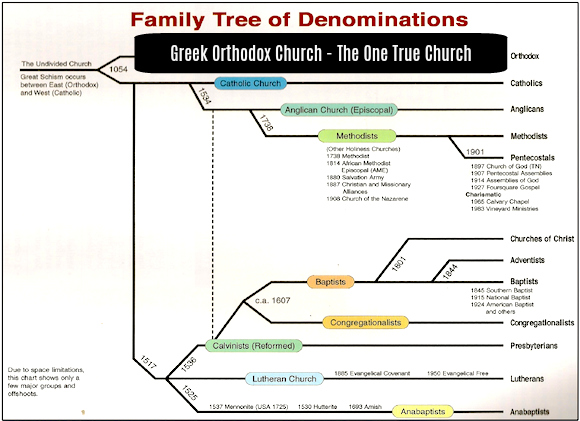
Of course, we all think we’re right.
That fact hit me square in the face one day when I was on the search for some mighty gyros. When I was attending seminary, there was a Greek Orthodox church I would drive by every morning to get to school. And once a year, they had a festival where you could get the best baklava, spanakopita, and gyros this side of the world. Like any church festival, they also had lots of crafts, trinkets to buy, and exhibits and in one of those exhibits was a big poster board showing a timeline of all the major different Christian denominations. There was a line for Roman Catholics, Baptists, even Methodists. But running throughout all of these was a huge, big, fat one labeled “Greek Orthodox Church – the One True Church.” Maybe they thought it was a selling point, but instead it came across as arrogant as if all other Christian beliefs had no validity. But that’s part of the problem. Our pride gets in the way of our efforts to unite. We focus far too much on the things that divide us instead of the things that unite us. If we would only focus on what we hold in common we could accomplish so much together. That was and always has been the hope of Christ, that the Children of God would be united as one. We can hear that hope in Jesus’ prayer to the Father after the Last Supper. The other Gospels (Matthew, Mark, and Luke), skip this prayer entirely and instead go right to the Garden of Gethsemane, but this one is specifically for a prayer for the Body of Christ, both then AND now. Jesus is thinking of us, of you and me, when he says this prayer. Hear now the Word of the Lord from John 17.
20 “My prayer is not for them alone. I pray also for those who will believe in me through their message, 21 that all of them may be one, Father, just as you are in me and I am in you. May they also be in us so that the world may believe that you have sent me. 22 I have given them the glory that you gave me, that they may be one as we are one— 23 I in them and you in me—so that they may be brought to complete unity. Then the world will know that you sent me and have loved them even as you have loved me.
If we could unify as one church, we would be so much stronger.
But our divisiveness keeps us from being as strong as we could be. Imagine what it might be like if we were able to put aside our differences and instead unite in a common cause. Imagine all the different projects we could do if we were together instead of apart. Doing a quick Google search for churches in the area, there were over 20 in about a one-mile radius of our church. And that doesn’t include any of the Methodist churches which never even showed up in the search! What if we did what most businesses would do and consolidate our churches and turned the property left behind into affordable housing? Or homeless shelters? Or feeding centers? If we sold even a fourth of those properties, we could probably feed everyone in Berkeley for a year. Or start our own cooperative business venture and help employ local residents while using the profits to fund a variety of ministries to fight racial injustice, homelessness, and poverty. There is no end to what we could do together. Imagine the energy, vitality, and excitement we could generate by being united. What a powerful statement we would be making on behalf of Christ. “…that they may be brought to complete unity. Then the world will know that you sent me and have loved them even as you have loved me.” Isn’t that what it is all about, sharing the love of Christ with the world?
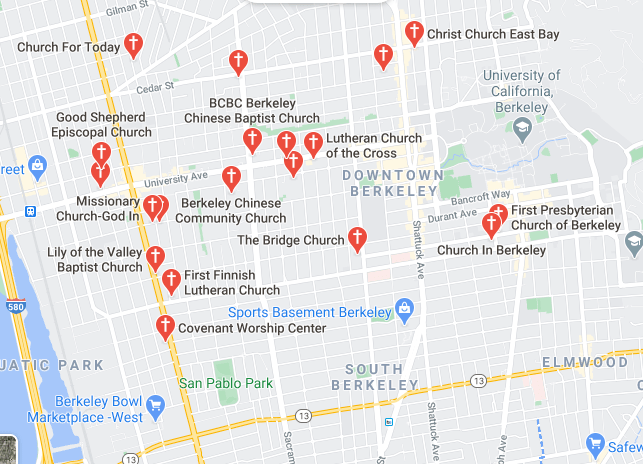
Most people aren’t even aware of other churches in their area.
If I asked you to name three of the other churches in a one-mile radius of ours, most couldn’t do it (unless you were looking at the graphic I just posted). It’s not that we don’t care or we don’t like them, we’re just blissfully ignorant of the church landscape. Once we find a place where we fit in, that’s what we stick with. There might be other churches that are closer, but we like what we like and we stick with what we like. But it also blinds us to the possibilities. When I was serving in Dinuba, I was caring for two churches, both were filled with God-loving, wonderful people, but both were struggling financially. They were literally about half a mile from each other. It didn’t make a lot of sense why these two Methodist churches weren’t together. When they were formed, it did. One was an historically Japanese church like ours, whose original mission field were Japanese immigrants to the area. And there were a lot of them. They had services in different languages and had different cultural needs. But over the years, while there were some differences in culture, they were no longer separated by language and it had been that way for decades. Visitors would often ask me, “Why haven’t these two churches merged?” And there wasn’t really a good answer. Both were struggling. Both could use the energy and vitality that comes from having more people in worship. Both could use the cost savings from insurance and utilities to operate and maintain only one facility. Yet, neither had even considered that option before. Today, they are one church and doing well. They were able to fix up their church building, doing some much needed repairs and making the place look even more appealing to guests. They found a way to incorporate both of their traditions and honor their past while looking to the future. And they are still wonderful people doing God’s work. Now there are more of them to do the work together.
There’s nothing wrong with small churches.
In fact, most churches are small community churches that serve the needs of their local area. And it allows for more intimacy, more nuance, and we hope deeper relationships. But we should do more to work in cooperation with one another. To utilize the strength of being united even while maintaining our individuality. One of the reasons I love the Methodist church is because of our connectional system. It allows us to do more together than any one church could do apart. We give a certain amount of what we receive to the greater United Methodist Church and with that, they are able to fund churches all over the globe, give scholarships to seminary students, provide relief work when natural disasters occur, fight against racial injustice, and encourage people to come and know Christ. For literally pennies on the dollar, we are able to do all of this and more together.
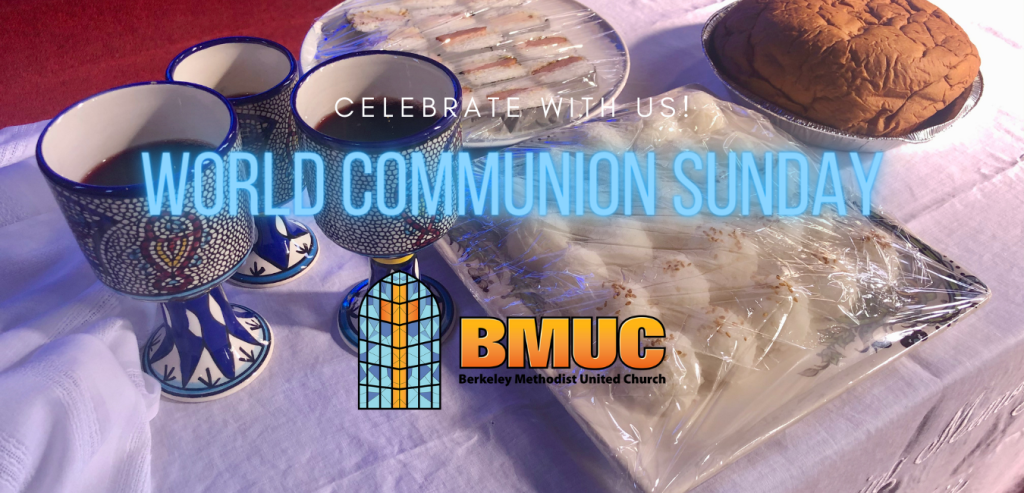
Today is World Communion Sunday.
It is a time for us to reflect on who we are as Christians and what that really means to us. It is a time for us to reflect on all that we have in common with our fellow brothers and sisters in Christ around the globe and to pray for them and with them for the furtherance of God’s kingdom. It is a time to lay aside our differences and remember who we are as God’s children. John Wesley once said, “…to all opinions that do not strike at the heart of Christianity, we think and let think.” It is time for us to do that today. We must remember at all times that we are to love one another. As Christ told us, “By this all men will know that you are my disciples, if you love one another.” We have a long way to go my brothers and sisters. We have a long way to go.
There is so much work to be done in the world.
But if we work on it together, who knows what we can accomplish?
Until every child has a home, a meal, and a loving family, our work as Christians is not yet done.
Until every woman gets paid for her work and not by her gender, our work as Christians is not yet done.
Until we stop polluting our airways, our waterways, and our byways, our work as Christians is not yet done.
Until racism, ageism, and every other “ism” is eradicated, our work as Christians is not yet done.
Until we first take the plank out of our own eyes, our work as Christians is not yet done.
Until there is no Jew nor Greek, slave nor free, male nor female, our work as Christians is not yet done.
Until we are all one in Christ Jesus, united as one people, our work as Christians is not yet done.
My brothers and sisters in Christ, our work is not yet done.
We leave this morning as we opened, with the words of a non-Christian, Mahatma Gandhi, speaking to us about us. “To live the gospel is the most effective way – most effective in the beginning, in the middle and in the end. Not just preach, but live the life according to the light… If, therefore, you go on serving people and ask them also to serve, they would understand. But you quote instead John 3:16 and ask them to believe it and that has no appeal to me, and I am sure people will not understand it…the gospel will be more powerful when practiced and preached.”[3] God uses messengers of all types to communicate to us, if we only listen. In the name of the Father and of the Son and of the Holy Spirit. Amen.
[1] From an article in Christian Today 2006 – http://in.christiantoday.com/articledir/print.htm?id=2837
[2] Accessed 9/28/2020 – https://www.learnreligions.com/christianity-statistics-700533#:~:text=Number%20of%20Christian%20Denominations.%20According%20to%20the%20Center,Christian%20denominations%20and%20organizations%20in%20the%20world%20today.
[3] http://in.christiantoday.com/articledir/print.htm?id=2837
Red State / Blue State

Since when did Christianity become synonymous with the Republican Party?
In my lifetime, the most devout president was Jimmy Carter and he was a Democrat. From Georgia no less. He was at one time the state’s governor and got elected on a platform of civil rights, affirmative action, and anti-segregation. This progressive-thinking president was also the same man who “prayed several times a day, and professed that Jesus was the driving force of his life.”[1] He still teaches Sunday School at his home church in Plains, GA and serves as a deacon. A devout Baptist, he split from the Southern Baptist Convention because their doctrines did not match with his Christian beliefs and he worked to form a coalition of other Baptists and Baptist leaders who felt the same way including President Clinton. Did I mention he was a Democrat? Yet over the years, the Republican Party has become equated with Christian beliefs. When people hear the word Christian, they picture in their mind someone who is an anti-immigrant, climate-denying, conspiracy theorist who is at best willfully ignorant of the racial injustice in our society. What is worse is we have allowed that to happen. It doesn’t matter if you are a Democrat or a Republican, we cannot afford to allow any political party to claim us as their own. If our faith means something to us, it has to be above partisan politics. The choices we make in life should adhere to a higher calling. One that represents love, justice, mercy, forgiveness, and diversity.

But like Hester Prynne, wearing a cross around your neck is like wearing a scarlet letter.
In the Bay Area, being called a Christian is like being called an adulterer. I spent a Sunday last year with our youth and in talking to them one of them mentioned how hard it is to admit to being Christian. People make fun of you, jeer or sneer at you, and look down at you as some kind of misguided miscreant. Being Christian is something we should be able to share without first having to explain you’re not one of “those” Christians. Whoever, “those” Christians are. I know people both Republicans and Democrats who are wonderful examples of what it means to be Christian. I also know members of both political parties who claim to be Christian but act and believe in ideas that are far from Christ’s teachings. The ones who are models of Christianity, are also the type of people who put people above party and God above all. When you already believe you are not the one in charge and whatever power you possess trifles in comparison with the one who created the universe, it gives you the freedom to choose according to your conscience rather than out of fear or human greed or pride or self-righteousness.
The term “evangelical Christian” has been corrupted.
The Atlantic ran an article back in 2015 that said depending on how you define “evangelical Christian” anywhere from 7% to 47% of Americans would qualify. A definition that widespread doesn’t seem to be a good definition at all, but the media tends to use it to describe any politically conservative Christian as “evangelical” and discards moderate-leaning conservatives or anyone who would be considered politically progressive. But why? Do people believe you can’t be a person of faith and still have progressive ideas? Because if that’s the case, Jesus would not be an “evangelical Christian.” Jesus told his followers to let go of the idea of an eye for an eye and embrace love and forgiveness instead. Jesus told his followers not to discriminate against others just because society said they were outcast but instead to welcome them and embrace them into the fold. When his disciples told him the people were hungry, he didn’t send them away. Instead he asked the disciples to feed them all. He didn’t charge them money or ask for a donation, he just gave it away for free. He called out the religious leaders of the time for adhering to the letter of the law and not its spirit. And he spent time not with those who would serve his agenda, but with those who needed him the most. Jesus was a radical with progressive ideas and it got him killed. But he was certainly a Christian.

We need to reclaim what it means to be an “evangelical Christian.”
We can’t afford to let the media or politicians or anyone else rob us of the true meaning of those words – one who proclaims Christ as Lord and Savior. We are not some voting block to be swayed or manipulated but people who believe in love as the overarching theme of all of creation. Love created us. Love sacrificed for us. And love holds us together. That should be what defines us. Everyone agrees that church has become irrelevant to a large percentage of Americans. The number of people affiliated with a church has been in decline for a long time and the number of people who actually come to worship has been shrinking too. Part of the problem is this perception of us as judgmental, hypocritical, and too involved in politics.[2] One young man said, “…twenty years ago, when I was looking at evangelical Christianity from the inside, it seemed like a movement bursting with energy to spread good news to people. Looking at it from the outside today, this message seems to have been lost in exchange for an aggressive political strategy that demonizes segments of society.”[3] If all you knew of Christianity is what you see through the eyes of the media, what would you see? Those of us on the inside know that the church is filled with people both good and bad. We know that even within the church there are those who are far from Christ and those who are close. But we also know that most of us are trying. That we want to be better than we are. That’s the message of love and hope that needs to get out into the world. People are constantly testing us, to see if we will live up to the high ideals that Christ taught us and we have to do what we can to make sure we live by those ideals. It was the same for Jesus as we hear in this passage.
13 Later they sent some of the Pharisees and Herodians to Jesus to catch him in his words. 14 They came to him and said, “Teacher, we know that you are a man of integrity. You aren’t swayed by others, because you pay no attention to who they are; but you teach the way of God in accordance with the truth. Is it right to pay the imperial tax[b] to Caesar or not? 15 Should we pay or shouldn’t we?”
But Jesus knew their hypocrisy. “Why are you trying to trap me?” he asked. “Bring me a denarius and let me look at it.” 16 They brought the coin, and he asked them, “Whose image is this? And whose inscription?”
“Caesar’s,” they replied.
17 Then Jesus said to them, “Give back to Caesar what is Caesar’s and to God what is God’s.”
And they were amazed at him.
Jesus seems to be stuck in a Kobayashi Maru.
If you saw Star Trek II: The Wrath of Khan, you know this is a classic “no-win” situation for Jesus. Should he tell them to pay the tax, the Pharisees can discredit him by claiming he is saying that Rome has greater authority than God! But if he tells them to ignore the tax, the Pharisees can rat on him to the Roman government that Jesus is inciting people to defy the law. Either way he loses. But then Jesus pulls a WOPR. Like the supercomputer from the movie WarGames, he realizes that the only way to win is not to play the game.[4] He tells them, “Give back to Caesar what is Caesar’s and to God what is God’s.” And with that, he not only escapes their trap but elevates his argument by reminding them we answer to a higher calling. That while we are obligated to live by the rules of our society, we have a greater responsibility to live our lives as children of God.
Joe Biden says this year’s presidential election is a Battle for the Soul of the Nation.
And it may very well be. It seems we are at an inflection point, one of those critical junctures in history that can lead us one way or another. As you consider what to do when casting your vote, I hope to encourage you to do three things. One, vote. No matter who you decide to support or what propositions you vote for or what local elected officials get your checkmark on that ballot, please vote. Your voice does make a difference. People are frustrated with the electoral system, and sometimes feel like their vote doesn’t count, but it does in more ways than one. And there’s more at stake than just any one race. Two, sign this online petition asking the media to stop labeling political conservative Christians under one banner. If we can convince the media to stop lumping us together, maybe we have a chance to show those outside our walls that we are more than just some monolithic belief system. And three, cast your ballot for the people and ideas who most exhibit our values as Christians. We’ll talk about that more through the month of October after World Communion Sunday, but in your deliberations, consider not just any one topic when you vote but all of them. Consider the quality of the person you hope to lead us. Consider the life they’ve led. Consider if they exhibit love of neighbor or if they denigrate those around them. Consider if supporting that person or idea will advance love, hope, and light in the world or if it will lead us deeper into isolationism, fear, and hate. For Christ himself said, “What good is it for someone to gain the whole world, yet forfeit their soul?” Let us not forfeit our soul but hold onto it and all we hold dear. My hope and prayer is that we can reclaim what it means to be Christian. That we are known not by the things we oppose but by the things we believe in. And that as Christians, we put our faith first. We let God by our guide. I’m reminded once more of President Carter who said he was greatly influenced by something he heard in a sermon as a young man. The pastor said, “If you were arrested for being a Christian, would there be enough evidence to convict you?”[5]
[1] https://en.wikipedia.org/wiki/Jimmy_Carter#Religion
[2] UnChristian by David Kinnaman, p.34.
[3] UnChristian by David Kinnaman, p. 166.
Tomorrowland

The Land That Time Forgot
That’s what they should call Tomorrowland, because it stopped being about tomorrow a long time ago. Take for instance Autopia. I used to love Autopia. As a kid, it was one of the rides I always wanted to go on when my family went to Disneyland. But it seemed kind of odd even back then that it was in Tomorrowland. When Disneyland opened back in 1955 Autopia was cutting edge stuff. At the time, there was no such thing as an interstate highway system.[1] Hard to believe but its true. People didn’t drive on multi-lane highways that stretched across the country. This idea was so new to America that it made Autopia a natural fit in the land of the future. Today it makes no sense. In fact most of the rides in Tomorrowland make no sense. The monorail is something used regularly like BART in San Francisco and MARTA in Atlanta. Submersible vehicles are not only for military use anymore (although rarely does anyone see talking fish when they dive under the ocean). And the Orbitron is basically a preview of when Space X becomes more common. For a long time, Tomorrowland has become more and more obsolete, and while they have added new attractions like Star Tours, they’ve also let many things become outdated or simply disappear. The Peoplemover track lies empty and has for almost 25 years. The Magic Eye Theater which once housed state-of-the-art movies in 3D with actual physical special effects is now a showcase for Star Wars. And the Autopia? It’s still driving cars on highways from 1955 despite the updates.

The problem is that Tomorrowland stopped being about tomorrow.
It’s still fun, but after Walt passed, they haven’t stayed true to his original vision to keep this area on the cutting edge of innovation, to give guests a glimpse into the future. That’s why you still have gas-powered cars instead of solar cars, electric cars, or self-driving vehicles on the Autopia track. Enough people ride it the way it is so they haven’t felt the need to invest in changing it. They’ve spent tons of money refurbishing it, but little to reimagine it. Because it is doing “good enough.” But that is so short-sighted. When we wait for a need to arise without trying to plan ahead, we are setting ourselves up for failure. When we let “good enough” be the bar, we lose sight of the opportunities that could be. Because someone else will come along and do it better and be five steps ahead of the game. Like the original vision for Tomorrowland, we need to constantly strive toward a better future so we are prepared for what comes ahead. The writer in Hebrews said it so well that’s what we are going to read from this morning. It is important to be future-oriented. Looking forward keeps us focused on how we can make the world a better place. It also drives us from being complacent. And it drives innovation and creativity. I told you the story before about Walt Disney wanting to put in a Christmas parade at Disneyland. His financial advisors told him not to spend the money, that it would cost too much, that nobody would complain because they wouldn’t be expecting it and he said to them, “That’s just the point…We should do the parade precisely because no one’s expecting it. Our goal at Disneyland is to always give the people more than they expect. As long as we keep surprising them, they’ll keep coming back. But if they ever stop coming, it’ll cost us ten times that much to get them to come back.”[2] Give people more than they expect. Don’t just focus on what’s needed now, but plan ahead for the future. And he was right. Don’t settle for “good enough.” Figure out how we can do it better, even when (and maybe especially when) it’s going good.
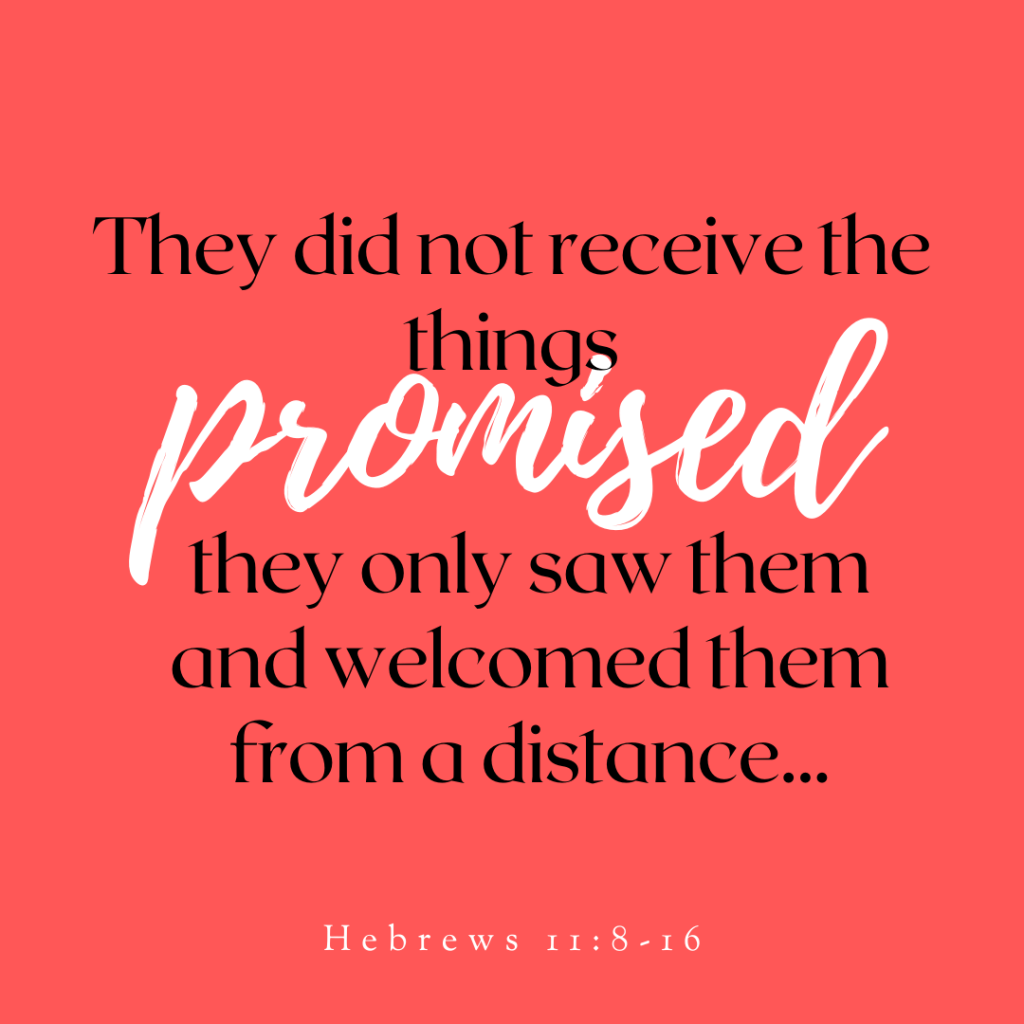
8 By faith Abraham, when called to go to a place he would later receive as his inheritance, obeyed and went, even though he did not know where he was going. 9 By faith he made his home in the promised land like a stranger in a foreign country; he lived in tents, as did Isaac and Jacob, who were heirs with him of the same promise. 10 For he was looking forward to the city with foundations, whose architect and builder is God. 11 And by faith even Sarah, who was past childbearing age, was enabled to bear children because she[b] considered him faithful who had made the promise. 12 And so from this one man, and he as good as dead, came descendants as numerous as the stars in the sky and as countless as the sand on the seashore.
13 All these people were still living by faith when they died. They did not receive the things promised; they only saw them and welcomed them from a distance, admitting that they were foreigners and strangers on earth. 14 People who say such things show that they are looking for a country of their own. 15 If they had been thinking of the country they had left, they would have had opportunity to return. 16 Instead, they were longing for a better country—a heavenly one. Therefore God is not ashamed to be called their God, for he has prepared a city for them.
They were longing for a better country.
These forefathers of faith trusted in the vision that God had presented to them and did what they knew to be right. And even though they never lived long enough to see it all come to fruition, they trusted that their efforts led them toward a brighter future.[3] The Scripture says to us, “they only saw them and welcomed them from a distance.” The things God promised to the people of Israel and by extension to all of us was not something they could tangibly touch or experience, but they honored God with their efforts even though they didn’t know how it would all work out and that pleased God. God is future-oriented. Think about it. It was the same in the Old Testament as it is in the New Testament. God promised Abraham that his people would spread throughout the Earth and even though as long as Abraham lived he didn’t see it, that promise came true. God promised Moses that he would lead his people to the promised land and even though Moses didn’t live to see it, that promise came true. Jesus promised us that when he returned to Heaven the Holy Spirit would come upon us and fulfill God’s promise to us and when he left that promise came true. God is always looking ahead to the future. Jesus trained up his disciples because he knew one day he would no longer be there. He could have done all the work himself, but instead he trained the disciples to insure the future of the church after he wasn’t with them. He pulled them aside and taught them. He explained the parables to them, because they didn’t understand it any better than anyone else. He had them do the work of passing out bread and fish when he fed the 5,000, even though he could have just made it rain down manna from Heaven because he wanted to train them to do the work and to participate in the miracles themselves. Jesus was constantly working toward a future that he wouldn’t be alive to see.
As a parent, that makes sense to me.

I want to help build a foundation of strength to support Emma her whole life. I want to give Emma the best education possible because a time will come when I am not here and I want her to have as many opportunities to pursue her dreams long after I’m gone. I want to make sure Emma knows how much I love her so that even when I’m not around, she will never doubt that I am still looking after her and sending my love to her even if she can’t touch me or see me. And I want her to be grounded in faith because I want my child to know the love of God for when times get rough (and they will get rough) so that even if I’m not there she will know she can turn to God and trust in him. I try to teach Emma practical things, too. Not that I always get it right myself, but I hope I am helping to build up her future. I hope and pray that I am here for a very long time and will get to see many of these things come to pass, but I am constantly helping to prepare her for whatever comes. My actions today will help build a brighter tomorrow.
That’s why it is so important to keep striving to make things better.
Human beings love the path of least resistance, so it’s tempting to stop when things are just the way we like it. After all, most of have seen what happens when people mess with a good thing. Sometimes it turns out disastrous. Like New Coke. That fear of failure prevents us from doing something amazing. We tend to look at failure as a waste instead of a learning opportunity. But failure is the greatest teacher there is. It’s only when we refuse to learn from the past that we truly fail. But when we succeed! We can make an impact that lasts for generations. The reason Disneyland can afford to keep Tomorrowland around is because it DOES invest heavily in the future. Cars Land and the entire remodel of Disney California Adventure. Star Wars: Galaxy’s Edge. And all of Disneyland Paris were risks that paid off big. By the way, our church was a risk. Ninety plus years ago, the Methodist church decided to invest in reaching out to Japanese immigrants and for over nine decades because of that risk we exist today. That’s why it is so important to continue to work toward the future. The possibilities that come about because of those risks are worth far more than the failures along the way.
There is a grace consequence to the flip side of it all, too.
When we stop becoming oriented to the future, we become oriented to the finish line instead. We go into survival mode. We are constantly trying to extend the time we have instead of working to create a better future. But all that does is delay the inevitable. It’s like a sinking boat. If we only concentrate on bailing out the water, we’ll stop from sinking for a while, but eventually the hole will get bigger and the water will overwhelm us. But if we let in a little water while we fix the boat, we can keep going for untold distances into the future. This pandemic has given us an opportunity to fix the boat. So many churches all across the nation were stuck in the 20th century and suddenly got thrust into the 21st. Online worship, social media, digital outreach are new to so many people. And even though every indication was this was where we were heading, the pandemic pushed us to move forward faster. Will we take this momentum and keep going? Or will we revert to the way we always did things? Looking around at the new faces that have joined us since the pandemic started, going backward hardly seems an option, but can we steel ourselves for a new future?

Jesus was a futurist.
Walt Disney was a futurist. Martin Luther King, Jr. was a futurist. Most of the great leaders and innovators of our nation and our world were futurists. They were always looking ahead to what was possible and trying to work toward THAT. How can the church do anything different? As Robert Kennedy once said (paraphrasing George Bernard Shaw), “Some people see things as they are and say why? I dream things that never were and say, why not?”[4] What is your why not? What is something you have held back from daring to dream? What is something you would like to accomplish but haven’t done so? Now ask yourself, why not? The Autopia is great. But it’ll never be more than it is unless someone does the work to make it better. In the name of the Father and of the Son and of the Holy Spirit. Amen.
[1] https://en.wikipedia.org/wiki/Autopia
[2] http://grumpymickey.com/tag/plussing-it/
[3] This section was inspired by Thom Rainer’s book Autopsy of A Deceased Church, Chapter 3.
[4] https://www.jfklibrary.org/Research/Research-Aids/Ready-Reference/RFK-Speeches/Remarks-of-Robert-F-Kennedy-at-the-University-of-Kansas-March-18-1968.aspx
Stay In Love With God: The Third Rule

5.53 seconds.
That’s the world record. 5.53 seconds.[1] At my very best, I could do it in under 30 and that’s when I was in junior high. Today, I’m lucky to solve a Rubik’s Cube in 30 minutes let alone 30 seconds. But the world record holder came in five times faster than me at under six seconds. There’s a great documentary on Netflix called The Speed Cubers. It’s a wonderful story about two of the best competitors out there – Felix Zemdigs, the world record holder in the 3×3 and one of the nicest guys you’ll meet and Max Park, au autistic savant from my hometown of Cerritos, CA who holds the records in the 4×4, 5×5, 6×6, 7×7, and one-handed categories. Yes, one-handed. 9.42 seconds. Behind it all is a very touching story about two friends from different backgrounds who bonded over speed cubing, but what amazed me is the speed at which they can solve this complex puzzle that for most of us is confusing just to look at. There were hundreds of competitors from around the world and they were solving cubes one-handed, with only their feet, BLINDFOLDED, it was dazzling. Max’ dad made a comment that stuck with me as we talk about Wesley’s Third Rule. He said most cubers top out in their 20’s because life gets in the way. The best of them are constantly solving the cube. Every free moment they are working their cube and trying to get faster and faster. It trains their mind to instantly recognize patterns and solutions. And as they get older, other things start to take priority like jobs and relationships and they simply have less time to devote to cubing. Part of being so good at solving the cube is talent, but the other part is practice.
Practice makes perfect.
That philosophy holds true no matter what you’re trying to do. Whether it’s the Rubik’s Cube or chemistry or basketball or playing music you need to practice over and over to improve on your skills. Talent alone only gets you so far. Practice is what takes you over the top. And the same is true for our faith. Practice makes perfect. In our passage this morning, Paul was writing to the church because he was worried they might drift away from their faith. Someone could come along and convince them to turn away from Christ. Not that hard to believe considering the stories they already knew from their own history (like Aaron building the idol when Moses went on the mountaintop to pray). Christianity was in its infancy and they were still trying to figure everything out. False prophets were likely everywhere and it would have been especially hard for Paul to guide them from far away. They didn’t have things like ZOOM worship to rely upon, so Paul wrote this letter to encourage them and to offer them a way to stay grounded in their faith. This is what he shares with the church in our passage this morning.
6 So then, just as you received Christ Jesus as Lord, continue to live your lives in him, 7 rooted and built up in him, strengthened in the faith as you were taught, and overflowing with thankfulness. 8 See to it that no one takes you captive through hollow and deceptive philosophy, which depends on human tradition and the elemental spiritual forces of this world rather than on Christ.
The Word of God for the people of God and the people said, “Thanks be to God.” Please be seated.

Sometimes it’s hard to believe how little we’ve changed.
Human beings that is. Paul had to battle the same concerns we do today and this topic is no different. He was worried people would drift away from Jesus and his teachings. That they would be “wowed” by something more appealing, something that fit their lifestyle better and would abandon everything they were taught. Again, not hard to believe considering we still do this today. We gravitate toward whatever new trend or philosophy lets us do what we want regardless of whether or not we should do it. Human beings love to find ways to beat the system. Kind of like me and the Weight Watchers Fat and Fiber Plan. I was following the traditional Weight Watchers plan for a long time and doing pretty well, when they suddenly offered this new Fat and Fiber Plan that said you could eat whatever you want as long as you stayed below a certain amount of fat per day and above a certain amount of fiber. I could eat half a bag of Snackwell cookies (which still had tons of sugar and carbs and processed ingredients) and as long as I had a bowl of refried beans (super high in fiber), I was good for the day. Seriously. That’s what I did. Even though in my head I KNEW this was too good to be true, I was like, “Trust in the experts.” Especially when it let me eat as many cookies as I wanted. Sure enough, even though I stayed faithful to the plan, I GAINED a ton of weight. Who would have guessed that any eating plan that includes eating half a bag of cookies daily might not be good for you?
Paul had to deal with this basic human frailty.
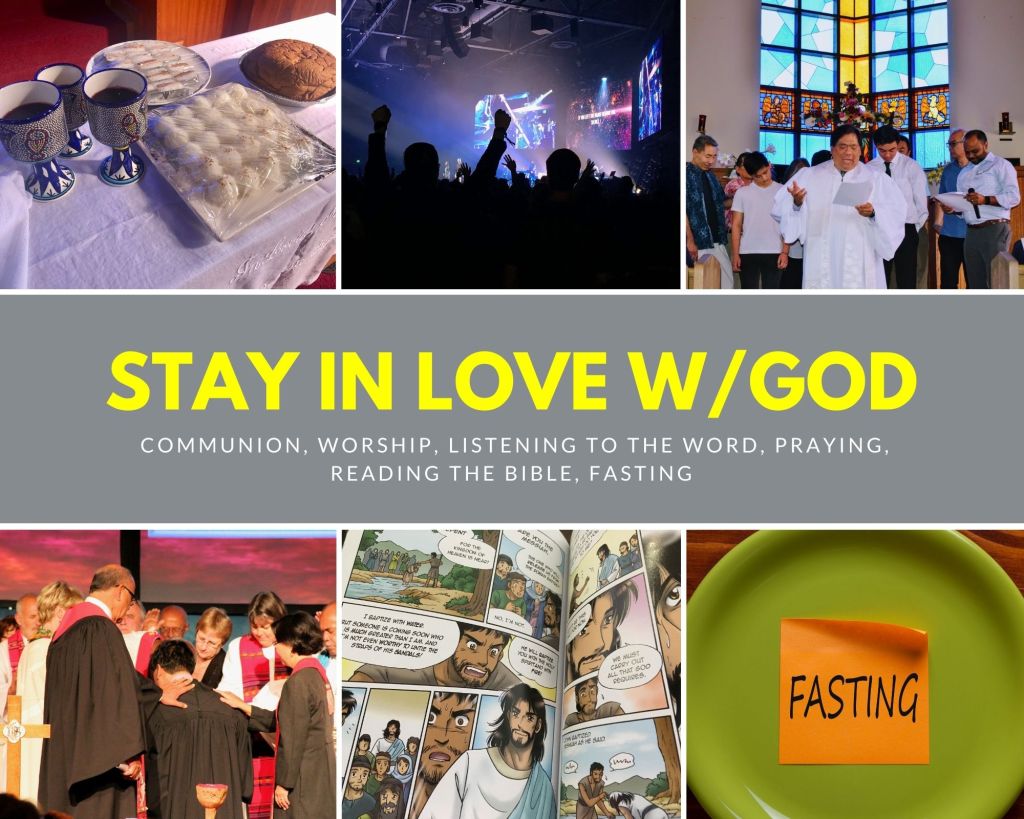
Finding ways to beat the system. Looking for loopholes instead of long-term benefits. Paul wasn’t there to help them in person, to guide them and remind them on a regular basis, so instead he did the only thing he could do. He encouraged them to remember the teachings, to be “rooted” in Christ, to build each other up and strengthen each other’s faith, to remind one another of the truths they had been taught and believed. In essence Paul was trying to teach them to “stay in love with God,” Wesley’s Third Rule. Do no harm, do good, and stay in love with God. For John Wesley, who taught these three rules as the foundation of Methodism, staying in love with God was vital to our faith. If “do no harm” is preventative and “do good” is proactive, then “staying in love with God” requires practice. Like Paul, John Wesley taught this same basic principle. To draw closer to Christ and to maintain your faith, John told those who became part of the Methodist societies they needed to regularly attend to all the ordinances of God. By that he meant they needed to do those everyday things, those regular things, over and over again to infuse God into their lives. That when God became an integral part of who we are, our faith would have a firm foundation. Wesley told them they needed to pray. They needed to read their Bibles. They needed to be in small groups together. They needed to take communion. They needed to go to worship. It’s those everyday routines Wesley felt were most important to keep us connected to God and to one another, and Paul in this passage stresses the same thing. Paul encourages the church to “continue to live your lives in him, rooted and built up in him, strengthened in the faith as you were taught, and overflowing with thankfulness.”

Science backs them up.
Their assumption that maintaining these patterns of behavior would help to make God a part of our everyday lives is true. In different studies, it has been shown that through consistency and repetition over a period of time we can form new ways of doing things. But it takes time. You may have heard that it takes 21 days to form a new habit, but the truth is it takes much longer. Studies show it takes an average of 66 days.[2] 66 days and that’s just an average. It can take as long as 8 or 9 months. But it can be done. If you want to get in the habit of relying on God, if you want to learn to put your faith and trust in him, you have to make God a part of your everyday life. Things like praying and reading the Bible and going to worship need to be more than a chore but a way of life that you embrace and then it will take hold in you in a deep and meaningful way. And once you have this foundation at your core, you will be open to an even deeper relationship with God. One that opens you up to that “peace that passes all understanding” Paul promises we can have. Staying in love with God, or as Wesley put it, “attending to all the ordinances of God,” takes time but the investment is well worth it.
When I first started praying with others, I hated it.
Not because I didn’t think it was important and not because I didn’t think it was helpful. But because I felt so inadequate about it. It seemed everyone I knew could pray better than I could. But after my Walk to Emmaus, I joined a Day Four group and we’d meet once a week and took turns praying for each other. They were SO eloquent with their prayers. Thoughtful. Not the kind where they just repeat the word “Lord” 40 times in one sentence, but from the heart, sincere, deep prayer. By comparison, I felt my prayers were more along the lines of “God is great, God is good, thank you God for this food.” But they encouraged me regularly and gave me confidence as I kept working on it. And as I kept it up, I felt more comfortable. I was less self-conscious. I worried less about doing a “good” prayer and came to realize it’s not about how fancy my words were or how articulate I was or whether or not I repeated myself a dozen times. It was all about my heart for the Lord. That’s all God really cares about. And at least in that, I am confident. To do anything well takes practice. Like with the Rubik’s Cube, the more we work at it, the better we will be. In our marriages, in our work, as parents – even in our faith. Practice makes perfect. In the name of the Father and of the Son and of the Holy Spirit. Amen.
[1] https://www.worldcubeassociation.org/results/records
[2] http://www.huffingtonpost.com/james-clear/forming-new-habits_b_5104807.html
Do No Harm: The First Rule

What does it mean to be Berkeley Methodist United Church?
The church part is obvious. We believe in Jesus Christ and in the ideas he challenges us to live up to everyday. Ideas like mercy, forgiveness, love, justice, and compassion. “Berkeley” because our roots are here. We have been part of this community since the church began. When we first started, this area was racially segregated. Developers and real estate agents refused to show homes to non-White people outside of the area south of Dwight Way and west of what was then called Grove Street but we know now as Martin Luther King, Jr. Way.[1] It only made sense when it came time to build a church to do it in the heart of the Japanese community since we began as a Japanese-speaking, immigrant church. Today, our neighborhood has changed drastically and our congregation has, too. But we remain in the heart of the Berkeley community. “United” came about because back in 1929 we joined together with the Japanese Christian Church from the Disciples of Christ and ever since, the word “united” has been part of our identity.[2] But what does it mean to be Methodist? Lots of people have no idea what it means to be Methodist, even if they’ve been part of the church most of their lives. But it is an important part of our history and the foundation of our beliefs as a church. Once in a while, it’s a good idea to remind ourselves what we believe in, why we are gathering, and what it’s all about. With that in mind, we’re going to share from Matthew 26:47-54. Now this passage takes place right after Jesus was praying in the Garden of Gethsemane and after the Last Supper. We’re nearing the time of Jesus’ death on the cross. He’s about to be betrayed by one of those closest to him, a man who sold him out for money. Judas has arranged for Jesus’ capture by an angry mob and as these events play out, pay close attention to what Jesus does.

47 While he was still speaking, Judas, one of the Twelve, arrived. With him was a large crowd armed with swords and clubs, sent from the chief priests and the elders of the people. 48 Now the betrayer had arranged a signal with them: “The one I kiss is the man; arrest him.” 49 Going at once to Jesus, Judas said, “Greetings, Rabbi!” and kissed him.
50 Jesus replied, “Do what you came for, friend.”
Then the men stepped forward, seized Jesus and arrested him. 51 With that, one of Jesus’ companions reached for his sword, drew it out and struck the servant of the high priest, cutting off his ear.
52 “Put your sword back in its place,” Jesus said to him, “for all who draw the sword will die by the sword. 53 Do you think I cannot call on my Father, and he will at once put at my disposal more than twelve legions of angels? 54 But how then would the Scriptures be fulfilled that say it must happen in this way?”

Primum non nocere
That’s a Latin phrase meaning, “First, do no harm.” Every medical professional in the world is familiar with that tenet, so it’s kind of weird it is also the first rule of Methodism. Or is it weird? Maybe it’s the most important rule of all. When we think of great leaders who preached about non-violent social change, some amazing people come to mind like Dr. Martin Luther King and Mahatma Ghandi. Although one was a Baptist minister and one was a Hindu lawyer, both found inspiration in the life and work of Jesus Christ. Jesus taught and lived the principles of non-violence as we read about in this passage. Even though he knows, HE KNOWS, he is about to be taken to his death, he stops Peter from defending him and says, “…for all who draw the sword will die by the sword.” In this one moment, Jesus makes crystal clear that the people of God must live by higher ideals. As he taught the disciples elsewhere, it isn’t enough to offer an eye for an eye, you have to go beyond that. You have to turn the other cheek. When you offer forgiveness, it isn’t just once or twice, but seventy times seven times! Because if we are really going to be the people of God, if we are going to show the love of Christ to a hurting world, we have to be the first ones to offer forgiveness. We have to be the first ones to come to the table. We have to be the first ones to show there is a better way. We must resist the temptation to return tit for tat, violence for violence because that is the trap that leads us away from God.

The foundation of the entire United Methodist Church is found in three simple rules.
Do no harm, do good, and attend upon all the ordinances of God or as Bishop Reuben Job said it, “Do no harm, do good, and stay in love with God.”[3] When John Wesley formed the first Methodist small groups (or “classes” as he called them), this was how they agreed to live. To show the sincerity of their faith and their desire to live a Christ-like life, they committed themselves to these three rules – do no harm, do good, and stay in love with God. It sounds simplistic because it is, yet still so hard to do. That’s why these small groups would meet every week, to help keep each other accountable; to remind each other of their promise to live this kind of life. Because even though in our heads we know what we SHOULD do, we are not immune to the impulses of our human nature. We all need reminders of our potential, not to condemn one another but to support one another. And to give us a quick kick in the rear when we need it, too. But for Wesley, “do no harm” meant more than just not kicking puppies (who would do that?!). Wesley wants us to consider the broader implications of what that means.
“Do no harm” is a broader idea than most of us really consider.
Wesley wanted to make it clear so he explained in some detail exactly what he meant. When he wrote the General Rules for those small group classes, of course, he included things you would expect. No fighting, no quarreling, no brawling. I’m not sure why John felt the need to call out brawling separate from fighting but he did. And then he put in other stuff. No getting drunk. No suing your brother. No cheating the system. No working on the Sabbath. Mostly stuff you and I would agree with. My favorite, of course, is not saying anything bad about your pastor. Seriously. He put that in there. Then he added stuff to the list we might not immediately think of as “doing harm” – wearing gold or fancy clothes, needless self-indulgence (as opposed to self-indulgence we need), and singing songs which do not tend to the knowledge and love of God.[4] Does that mean no more One Direction songs? We could argue about some of these all day, but that would be missing the point. The point Wesley was trying to get to is to challenge us to go beyond thinking of harm as something physical and force us to take a step back and think, “Am I doing something to hurt someone else?” Sometimes that hurt can be completely unintentional.
At one of the churches I used to serve, they had a strong youth group.
But before my time, there was a pretty big clique amongst some of the kids. Without realizing it and unintentionally, they started to exclude those who didn’t fit in with them, and slowly but surely some of the kids, the ones who didn’t fit in, dropped away. Nobody even noticed because it was still a large group, but the parents of those kids knew. I happened to talk to one of those parents after I had become the pastor. She told me how alone and isolated it made her daughter feel to never really be included. Her daughter wasn’t asked to help or invited to be part of the group. She wasn’t often invited to be involved in their activities. She told me how her daughter tried to fit in, but just couldn’t crack that shell. And how eventually she told her mom she needed to find another church. As a fellow parent, that made me so sad. Of all places, you would think a church would be the one place where everyone was welcome, but that isn’t always true. These kids weren’t intentionally mean, just thoughtless as we all can be from time to time. So focused on ourselves that we neglect to see what should have been obvious. Everyone does this. Kids and adults alike. The trick is to be mindful in what you do and what you say. Train yourself to consider others and not just yourself. We can avoid a great deal of the world’s problems if we learn to have an eye beyond what we want and what we like.

Be thoughtful.
I think that’s it in a nutshell. Be thoughtful. Consider others before yourself. Think about how your actions AND your words will hurt others. Take time to pause before uttering something painful. Maybe the person you’re talking to said something hurtful or painful or plain stupid and you are so tempted to lash out, but consider before speaking, because the other person probably didn’t. I’ve found in my own life and in the experiences of others, that when people say hurtful things, it’s rarely with careful planning that they do it. Usually, they react because they are angry, mad, or hurt. And we can probably all agree that’s not the best place to react from. Sometimes, stepping back from a situation and taking two seconds before reacting is the best possible medicine. I’ve never forgotten the advice Emma gave me one day. I was upset about something and Emma looked at me and said, “Daddy, my teacher told me that when we’re upset we should take three deep breaths and count to ten.” Of course I followed her advice, and by golly it worked. Will that solve every problem? No. I’m sure it won’t. But it probably will avoid a good many more. Of course there will be times when harm seems inevitable. But in those instances, wouldn’t it be best to be thoughtful – to be intentional about how to do the least amount of harm? I was thinking about the Hippocratic Oath and how part of it is to always remember “warmth, sympathy, and understanding may outweigh the surgeon’s knife or the chemist’s drug.” Sometimes we need those things more than anything else: warmth, sympathy, and understanding. Consider others before yourself and we can turn the world into the kind of place God would be proud of. Primum non nocere. First, do no harm.
[1] Robert Yamada, The Japanese-American Experience: The Berkeley Legacy, 1895-1995, Berkeley Historical Society, 1995, p.34
[2] From Toshi Tekawa’s article, “A Summarized History of Berkeley Methodist United Church” published in the 75th and 90th anniversary celebration booklets for BMUC.
[3] As he summarized in his book Three Simple Rules.
[4] https://www.umc.org/en/content/the-general-rules-of-the-methodist-church
Craig’s Kitchen – Simple Kalua Pork

Many dishes in one!
What a deal. Kalua pork is ridiculously simple to make but it’s taste depends mostly on how you cook it and the ingredients you use. This is one of my favorites to make because of its taste and utility. Then you can use the leftovers in egg drop soup! Which tastes great by the way. The saltiness of the kalua pork adds some depth to the soup beyond what is already there and turns it into a meal. I also love using it to make omelettes! The saltiness again adds some OOMPH to the dish.

Kalua Pork Three Ingredients:
- Pork butt – I always find that term funny and totally inaccurate. Pork butt is actually the shoulder portion of the pig. But it’s great for cooking down into kalua pork (and a bunch of other stuff). Make sure to get a boneless portion. It makes it easier. I use about 3 lbs for our family and always have left-overs.
- Liquid smoke – I like to use hickory as it seems to deepen the overall flavor of the dish, but I’ve used applewood before and it tasted great. Just a little less savory and a little more fruity (as you would imagine).
- Hawaiian Pink Sea Salt – Definitely want to get the thicker grains of salt (almost like small pebbles) and really rub that in. It breaks down better and gives it that salty taste you expect from this dish.

Putting it together:
- Before putting it into the crock pot, pierce the pork butt with a fork multiple times on each side of the meat. You want to basically create pockets for the liquid smoke to get into and spread into the meat.
- Pour about 1 tbsp for each 3 lbs evenly over the whole portion of pork butt. I rub it in as I’m going. If you like it extra smoky, go ahead and use more. Our family likes it with a less intense smoky flavor. You want enough to cover the surface as you spread it.
- Use about 1 heaping tbsp of sea salt for every 2-3 lbs. One recipe I tried said 1 tbsp per pound but that was TOO salty for us. Still use liberally over the surface of the meat. You want to rub it in so it mixes into those nice holes you made and also settles into the meat so it melds the flavors well.
- Put it in the crock pot with the fat side up (I like the melting fat to drip down the meat and continue to keep the meat moist). Set it on high for 8 hours or low for 12 hours. Generally, it’s actually done before the time is up, but judge for yourself. About 75% in I use two forks and start to break it up. By then, there is a sizeable amount of juice in the bottom of the crock pot and you want it to really soak in the fat juices! Shred the meat while it is in the pot and you’re pretty much done.
- (optional) Our family likes it when I then fry the kalua pork in a pan. It turns crispy because of the fat content and has a great crust on it. I create a layer of it on the bottom of the frying pan and let it sizzle on a medium high heat until it crisps up and then serve it either by itself, in an omelet, or with some egg drop soup. All taste great.
What If?…

What if?
We have probably all asked that question at some time during the last five months. It’s natural to wonder how things might have turned out if only we had done something different. And not just during the pandemic. What if you went to a different college? What if you had moved to a different city? What if you turned left instead of right? Our life is filled with choices and each one makes a difference. Growing up, one of my favorite comic books was titled “What If?” and every month they would explore this idea about how the choices we make can affect our lives. Sometimes the differences were huge. Sometimes the differences were small but meaningful. Sometimes the differences were just…different. It was always interesting to explore new possibilities, but was also a reminder that every day of our lives are important. What we do and say MATTERS! God has given us, but we only get to do it once so how can we make the most it?

God wants us to be BOLD in life!
Nowhere in the Bible is there a story about a guy who played it safe and was told by Christ, “Good job! Who needs to take risks? Play it safe.” Instead, it’s quite the opposite. In the story of the Parable of the Talents, God rewards those who have taken a chance with the gifts they are given and punishes the guy who plays it safe. In the book of Acts, we read about Ananias and Sapphira who withhold a portion of their profits for themselves instead of giving it to God and they die on the spot! Not that God would literally kill us for playing it safe, but instead a part of us dies when we hold back. A part of our ability to trust withers away. We were put on Earth to serve God in BOLD ways, to dare to make this world a better place. And that takes BOLD people. There was a scene in the movie Dead Poets Society that reminds me of God’s call to boldness. In it, Mr. Keating is teaching his students about poetry, and the kids are used to studying about rhyme and meter and iambic pentameter – all the forms and functions of poetry. But Mr. Keating wants to inspire them, to go beyond just studying about it and understanding it and he says to his students, “We don’t read and write poetry because it’s cute. We read and write poetry because we are members of the human race. And the human race is filled with passion. Medicine, law, business, engineering, these are all noble pursuits, and necessary to sustain life. But poetry, beauty, romance, love, these are what we stay alive for. To quote from Whitman: ‘O me, o life of the questions of these recurring, of the endless trains of the faithless, of cities filled with the foolish. What good amid these, o me, o life?’ Answer: that you are here. That life exists, and identity. That the powerful play goes on, and you may contribute a verse. That the powerful play goes on and you may contribute a verse. What will your verse be?” What will YOUR verse be?
God is never short of inspiration either.
There’s a great passage in Malachi that I want to share with you today. Malachi is the last book of the Old Testament. It was written to the Jews who had returned from Babylon after the temple had been rebuilt. The people had become spiritually apathetic. They didn’t turn to false gods or other deities, but were “disillusioned about their future and skeptical of God’s promises.”[1] They had the form and function of a church, but really had turned into nothing more than a country club for Jewish people. They stopped being a church. And in the beginning of this chapter, Malachi foretells the coming of Christ and asks the important question, “…who can endure the day of his coming? (Malachi 3:2)” Who can endure the day of his coming? And he follows it up with the section we are about to read this morning.
8 “Will a mere mortal rob God? Yet you rob me.
“But you ask, ‘How are we robbing you?’
“In tithes and offerings. 9 You are under a curse—your whole nation—because you are robbing me. 10 Bring the whole tithe into the storehouse, that there may be food in my house. Test me in this,” says the LORD Almighty, “and see if I will not throw open the floodgates of heaven and pour out so much blessing that there will not be room enough to store it. 11 I will prevent pests from devouring your crops, and the vines in your fields will not drop their fruit before it is ripe,” says the LORD Almighty. 12 “Then all the nations will call you blessed, for yours will be a delightful land,” says the LORD Almighty. – Malachi 3:8-12
Test me in this!
“Test me in this…and see if I will not throw open the floodgates of heaven and pour out so much blessing that there will not be room enough to store it…” Are you willing to take God up on that offer? All we need is two things – faith and trust. When we have faith in God’s promise and trust him to be faithful to us, he promises a flood of blessings. Instead, we often choose to rob God of what is already rightfully his. God doesn’t ask you to give everything you have (even though he could). He only asks for your trust enough that you would give at least 10% of what you earn to help what God is doing in the world. When we fail to give that to God, we are not only robbing God, but robbing ourselves of this opportunity to experience God’s blessing in our lives. Now, you might be tempted to get this image of a mighty God holding back this wonderful blessing as a punishment for our failure to be more faithful or trusting. But the curse we are under is one we’ve made ourselves, not one that God wants for us. It’s just that when we hold back from giving all we can, we are also holding back the chance for God to work in our lives in the most powerful of ways. God WANTS to do this for us. He invites us to “test him,” but that requires us to have faith in God’s promise.
How many of you have ever played “penny roulette” in Vegas?
Don’t be shy. No one is going to condemn you for gambling. But if you’ve ever played penny roulette in Vegas it’s pretty fun. For about a dollar, you can play for hours on end. The first time I went to Vegas was right when I turned 21. Living in Southern California, it’s just a day trip to the Strip and what better way to express your newfound freedom than to test your boundaries. So my friends and I went to Vegas and in about two minutes, lost nearly all the money I had set aside for gambling. Blackjack is a cruel and harsh game. So with limited funds and a whole lot of time left, I found penny roulette. I turned in a dollar and after playing for about three hours, I walked away with a fortune. Five whole dollars. I was good. You’ve all heard of saying, “you’ve got to bet big to win big,” or “you’ve got to spend money to make money.” It’s true. It was easy to bet “big” when you’re only playing for pennies, but you have to really have faith to go all in. God wants you to go “all in.” It’s only when we allow ourselves to be that open to God’s blessing that we can really receive it.
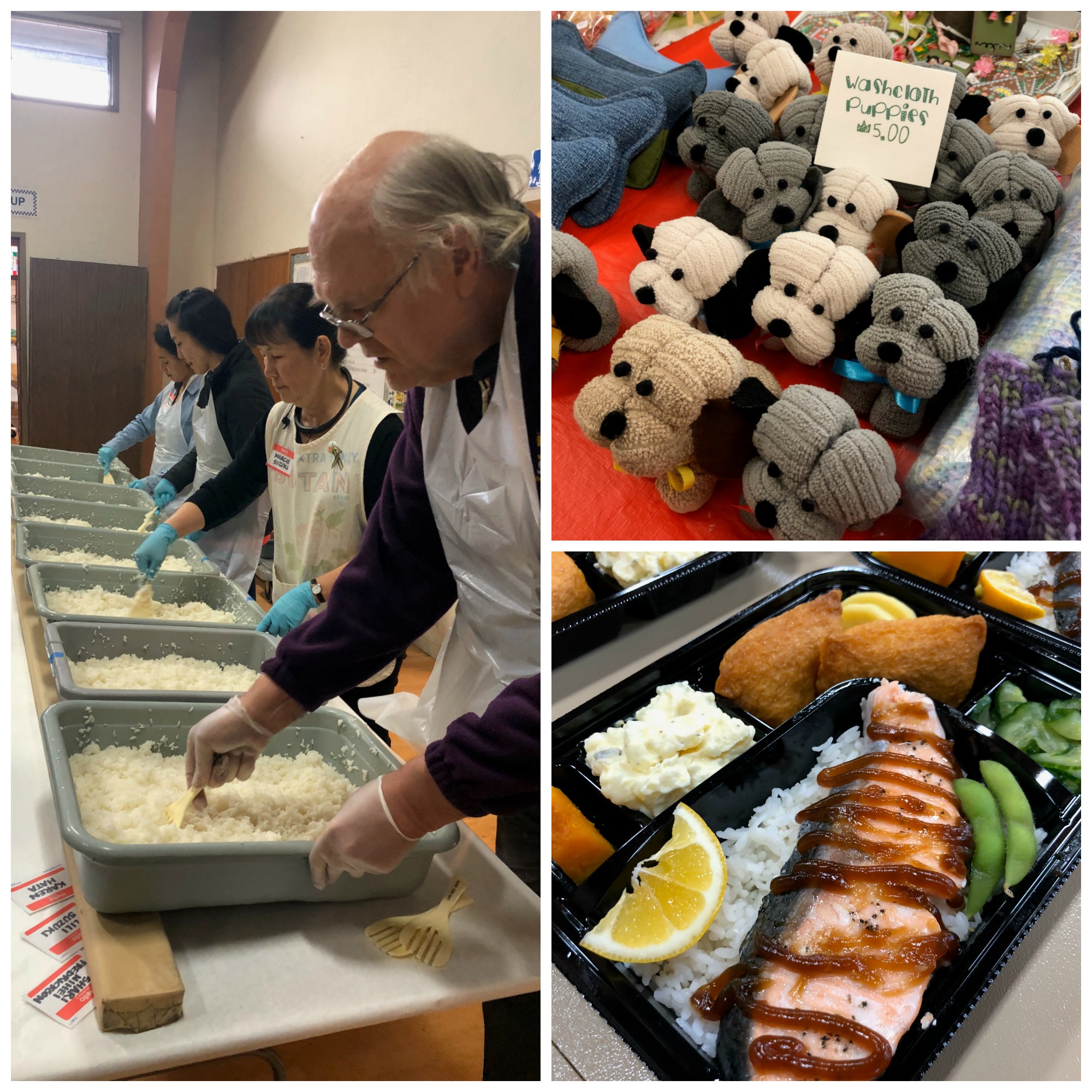
So the big “What If?” I have for our church is what if we didn’t need fundraisers?
What if we didn’t need fundraisers? Or special giving? What if instead of giving to get, we were giving to give? Instead of giving by buying a bento box or buying cookies from the bake sale or giving to buy some cool arts and crafts, we were giving just to give and trusting that God could do some mighty things with our giving. We give a LOT every year in memorials, holiday donations, and church fundraisers. And this year more than most is teaching us how tenuous that can be. So what if instead of giving to get stuff from the church, we dedicated ourselves to giving just for the sake of giving? What if we increased our giving even just by the amount we typically spend on fundraisers and bento boxes and everything else? Then when we do a fundraiser, we could dedicate that money directly to things we believe in to show the love of Christ.
That’s my big “What if?”
Could we challenge ourselves to make this shift in the time of the pandemic? Think about what we could do instead! The lives we could change and the faith we could grow if we were able to dedicate every fundraiser to a cause we believed in. We could provide computers to kids who need them. We could feed the hunger and the homeless for months. We could support different Black-owned businesses in the community every month. We could send our own kids and adults on international mission trips. And people would give. People love giving to things they think are worthy. Our fundraisers would be even more successful than ever before. We could do some wildly creative outreach events and make our presence felt deeply in our community. I think of the words of Bobby Kennedy when he said, “There are those who look at the way things are and ask why? I dream of things that never were and ask why not?” “There are those who look at the way things are and ask why? I dream of things that never were and ask why not?”
Fundraising should be about above and beyond giving.
But to be able to do that, we have to fund ministry ourselves. We have to stretch ourselves to give enough to be able to do these amazing things. But how fulfilling would it be to know that our efforts have gone to save lives, to change how someone connects to God, to give a child the chance to know Jesus Christ? These are the fruits of our giving. These are the types of things that we can do when we give ourselves to God. “Test me in this…and see if I will not throw open the floodgates of heaven and pour out so much blessing that there will not be room enough to store it…” We have to have faith and trust to really give what we can to God. And when we do those things, we can help to bring about God’s Kingdom on Earth. Let us be BOLD. Let us ask the big “What if?” Let us truly go all in for Christ. And ask yourself this, “What will your verse be?” In the name of the Father, and of the Son, and of the Holy Spirit. Amen.
[1] Some of this section is taken from The Archeological Study Bible, “Introduction to Malachi,” p. 1545.
Craig’s Kitchen: Seven-Layer Dip
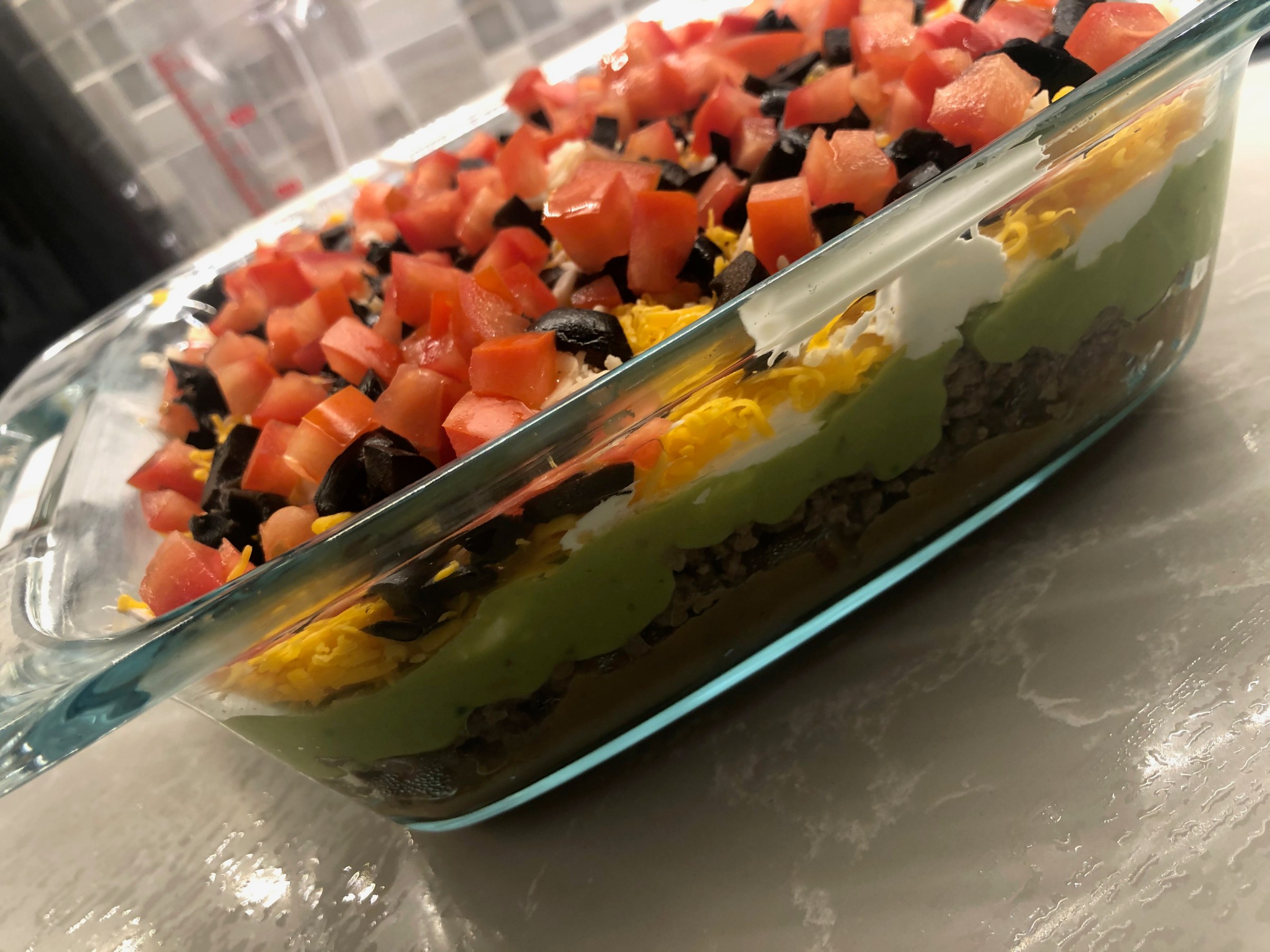
Seven layers of yummy goodness.
I love a good dip. Mom’s classic French Onion Dip made with sour cream and some old-fashioned Lipton’s Onion Soup Mix was always a staple. Something about that combination of savory onion flavor with cool, smooth sour cream on top of a crisp salty chip was tantalizing. I could eat that by the pound (I’m afraid). I think it was that combination of textures and flavors that was so appealing. Mixing multiple things into one scrumptious bite was fun, and when it worked, was the best.
You can imagine how Seven-Layer Dip was something that would grab my attention. Not only did it mix the crispness of a tortilla chip with the soft flavors of a dip, but the dip itself had multiple textures and flavors on its own! Over the years, I’ve worked hard to craft it to my liking and so far its a hit at church potlucks, but you can be the judge. Obviously the fun is creating your own mix of seven layers (or more). I would love to try yours!
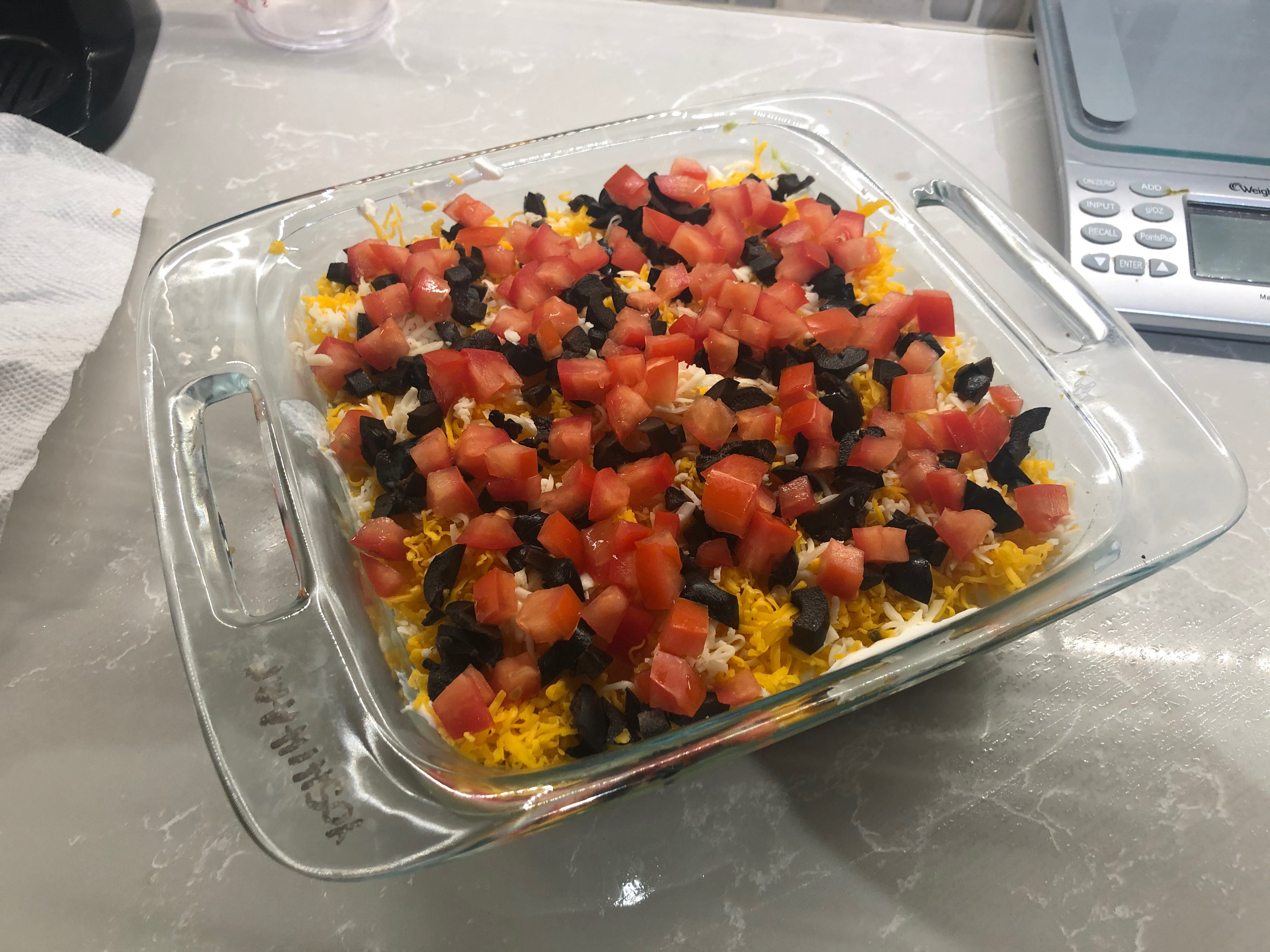 Anyway, my seven layers are (in order from bottom to top):
- Refried beans (1 regular can) – A good base as it holds the rest of the dip steady and makes it a bit easier to spread the guacamole on top of the ground beef. I use Rosarita refried beans (traditional – not any other kind). For me the flavor of Rosarita and the texture when refrigerated is the best.
- Ground beef (1 lb) – Because the goal is to create a harmony of flavors, I don’t use anything more fatty than an 85/15 ground beef. 90/10 works great in this dish because you don’t want tons of the beef juice to make the rest of the dish compromised.
- Guacamole – Something hearty and spreadable. Not an avocado dip since the sour cream has to go on top and ideally each one should be its own layer. I love a small half-pint container of Whole Foods guacamole made in store. Usually I need the whole container.
- Sour cream – Surprisingly I use almost a whole small container of sour cream! Normally, my favorite is Clover Organic, but its so thick its harder to spread. Something like regular Knudsen’s has a good flavor and a desirable thickness.
- Cheddar cheese (1 8oz block) – Please shred your own cheese. And personally, I use the second smallest grater size. I like that the cheese is fine, but not too wispy. A good fine cheese adds a delicate flavor to the mix. I found that sharp cheddar works best since it’s competing with the flavors of all the other ingredients.
- Diced tomatoes – I like Roma tomatoes because they are easy to slice and I tend not to use the mushy middle but just the meat of the tomato nearest the outer skin. Roma tomatoes cut down on wasting the mushy middle.
- Chopped Olives – Whatever you like works here. You just want that olive taste to balance out some of the other flavors and add a little something extra. Here especially is where people get creative and add their own seventh layer. I find the last two layers are open to interpretation.
Putting it together
- If you have two small pans, cook both the refried beans and the ground beef at the same time. If not, beans first. If the ground beef is too wet, I do drain it some. Beans layer first and then ground beef. Set aside and let sit until not quite so hot. You don’t want it heating up the guacamole and sour cream!
- Grate the cheese and chop the tomatoes and olives while you wait for the beans and beef to cool.
- Gently spread the guacamole on top of the ground beef, being careful not to displace the beef too much. Then spread the sour cream gently over the guacamole. You don’t want to mix the two but try to have two distinct layers.
- Cover it all with the grated cheese, then layer the tomatoes and olives together on the top.
- Refrigerate until the whole dish is cool and then remove and serve with your favorite tortilla chip. Here, I favor the thicker tortilla chip or make my own, but something without enough heft won’t carry the dip!
Enjoy!
 Craig's Corner