
The Pick-Up Cart

Who knew that impending doom had four wheels and a canopy?
When we signed up for the Disneyland 5K, I did not know there was a limited amount of time to finish the race. I probably should have guessed it since obviously they weren’t going to let it go on forever. But in order to ensure the race finished in a certain amount of time and they could open the park to guests, there was a pick-up cart that trailed behind all the runners. Like a snail, it kept a slow and steady pace, ever creeping forward. And if you we’re not quite fast enough, it would carry you the rest of the way to the finish line. Now, overall that sounds great! Regardless of what happened, you wouldn’t be abandoned in the middle of nowhere. But it also meant you didn’t finish. And to me it was really important to finish the race. This was my first official 5K and I wanted to make it count. I didn’t want the pick-up cart to finish the race for me. You can guess with my body type and super flat feet, it was a challenge, but I was determined to make it across that line. So even though it was difficult, I trudged on as best as I could. Ultimately running and walking with a lot more walking than running. But when I got to the end I was able to say I made it! The pick-up cart was not going to get me.

When it comes to the COVID pandemic, we need to get to the end.
We can almost see the end in sight, a day when our lives can return to something like normal. I don’t think things will ever be truly the way they were prior to last March, but that’s not necessarily a bad thing. We’ve learned a lot. We’ve grown in our abilities and in our faith. And we’ve seen both horrific stories of people dying of loneliness that motivates us to never go there again, and stories of hope and innovation that gives us confidence we can overcome these obstacles no matter how dangerous or deadly. But we’re not there yet. And to think we are is to let up right before the goal. Speaking of “Lett”-ing up right before the goal, I can still remember Leon Lett’s failed run for a touchdown in Super Bowl XXVII. Lett played for the dominating Dallas Cowboys who had a “commanding 52-17 lead”[1] in the 4th quarter. He had recovered a fumble on the 35-yard line and ran it back toward the goal. He was ALMOST there when he decided to let up and prance around in celebration, showing off to the crowd. And he was stripped of the ball, turning it back over to the Buffalo Bills. While it didn’t stop them from winning the game, it was certainly a lesson for those of us who want to celebrate before crossing the goal line. Literally.
The CDC’s recommendations for the fully vaccinated are a huge step toward the goal.
But they don’t tell the whole story. While it might be safe for MOST people who are fully vaccinated to interact like normal, what we don’t realize is only about 1/3rd of Americans meet that criteria. Less than half have received one dose.[2] Children under the age of 12 still can’t get vaccinated, and while it’s true most of them will not get seriously ill from the virus, the long-term effects of COVID are still unknown and don’t look promising. There are about 50 million children under the age of 12 who are vulnerable. 50 million. While we can’t do much for those adults who refuse to take the vaccine despite all the evidence and encouragement in the world, we must do something for those who haven’t yet been able to or cannot get it. And at least by data provided by the CDC, that’s still over 50% of the population. Then there’s the case of the New York Yankees. Eight members of the team tested positive for COVID despite all of them being vaccinated. The team’s star shortstop, Gleyber Torres not only received the vaccine, but had also already had COVID last December and STILL got infected.[3] Even though none of them have any severe symptoms, it begs the question, “Is now the time to let down our guard?”

We all miss aspects of a pre-pandemic life.
For some of us, we miss being in large gatherings like church or concerts or massive theme parks. For some, we miss giving hugs to our parents and grandparents, our nieces and nephews, our grandkids and even great-grandkids. For some, we miss traveling and the experiences that come with it. And after a year, we’re pretty tired of it all. But there’s something bigger at stake. The costs are higher if we falter. We’ve already seen what happens when we let up too early. Last summer we thought we had turned a corner controlling the infection rate, only to watch it explode and multiply like never before. The United States, even with all of its technological advances, its wide-spread access to the vaccine, and scientific breakthroughs still has by far the largest number of people who have died due to COVID – over 580,000 people and growing. It’s estimated we are still losing about 600 people a day due to COVID and while that’s the lowest number since last April, it’s a reminder we aren’t out of the woods just yet.[4]
Paul’s perseverance is a lesson for us all during the pandemic.
If you have a Bible or a Bible app on your computer and would like to follow along, please got to Acts 20:17. His circumstances were certainly different, but his life was in danger every day like us. Unlike us, his perseverance meant he was putting himself MORE at risk instead of less. He wasn’t wearing a mask or staying socially distant, he had to deal with getting thrown in prison or possibly death for sharing the good news of Jesus. But Paul felt so compelled by the love of Christ, he ignored what would have been easier for him to do and did what he knew would help others. Hear now the Word of God.
17 From Miletus, Paul sent to Ephesus for the elders of the church. 18 When they arrived, he said to them: “You know how I lived the whole time I was with you, from the first day I came into the province of Asia. 19 I served the Lord with great humility and with tears and in the midst of severe testing by the plots of my Jewish opponents. 20 You know that I have not hesitated to preach anything that would be helpful to you but have taught you publicly and from house to house. 21 I have declared to both Jews and Greeks that they must turn to God in repentance and have faith in our Lord Jesus.
22 “And now, compelled by the Spirit, I am going to Jerusalem, not knowing what will happen to me there. 23 I only know that in every city the Holy Spirit warns me that prison and hardships are facing me. 24 However, I consider my life worth nothing to me; my only aim is to finish the race and complete the task the Lord Jesus has given me—the task of testifying to the good news of God’s grace…”
The Word of God for the people of God and the people said, “Thanks be to God.”
Paul could easily have called it a day.
By the time we get to this story in Paul’s life, he’s already gone to Pisidian Antioch, Iconium, Lystra, Derbe, Philippi, Thessalonica, Corinth, and Ephesus creating new believers in each place. He’s already done a stint in prison, been threatened with his life in numerous places, and started a bunch of new churches, so if Paul wanted to hang up his hat, even at that point people would have looked at his ministry as a huge success. But now he felt like God was calling him back to Jerusalem where he was sure to face more opposition by the Jewish leaders who were already plotting against him. Still he wanted to see it through. He wanted to as he put it “finish the race.”
Paul is an inspiration to us to persevere.
If he can keep going under his extraordinary circumstances, surely we can see this pandemic through to the end (or as close to “the end” as we can ever get). We can stay vigilant in wearing our masks where we are supposed to, in respecting other people’s space, and allowing people time to adjust to yet another change in our culture as we shift back toward a vaccinated life. And if you haven’t been vaccinated yet, please do so. It’s free. And what it can do for you and your life far outweighs any side effects from getting the vaccine. Plus, if you consider yourself a Christian, it’s the neighborly thing to do. Christ calls on us to love our neighbor and this is certainly one way for us to live out that calling. We didn’t start wearing masks to prevent us from getting COVID. We did it for other people. We did it out of concern for our neighbor – literally – to prevent the spread of the virus. At the time, no one knew for sure if it helped us at all. But we did know it could stop the disease from spreading. Getting a vaccine is the same. Yes, it definitely protects you. But studies have shown it also helps stop the disease from spreading and that is really important. It protects our elderly. It protects those who are immunocompromised. It protects our children. The more of us that are vaccinated, the better it is for everyone.

It would be so easy to relax.
After all, the CDC says fully vaccinated people can pretty much do anything. Sure they still have to wear masks while taking public transportation or in hospitals, but short of that there’s nothing we can’t do! But as Paul wrote in another letter, just because we have the freedom to do something doesn’t mean we SHOULD do it. He wrote to the church in Corinth, “Though I am free and belong to no one, I have made myself a slave to everyone, to win as many as possible (1 Corinthians 9:19).” There are still 16 states with mask mandates including California (at least for now). There are still major retailers and national companies like Target, Starbucks, and Home Depot asking you to keep those masks on in their stores. And there’s no way to verify if the company you keep has had their vaccine. In the near future, as we continue to find ways to live with this new reality, more restrictions will be lifted, and life will seem much more like it was a little over a year ago. But until then, practice patience for those who may not be ready to abandon all precaution. Show love for one another by encouraging those who haven’t yet been vaccinated to get it done. And be in prayer for how we can finish together. In the name of the Father and of the Son and of the Holy Spirit. Amen.
[1] https://en.wikipedia.org/wiki/Leon_Lett#Super_Bowl_XXVII
[2] https://covid.cdc.gov/covid-data-tracker/#vaccinations
[3] https://news.yahoo.com/yankees-breakthrough-covid-19-infections-235707184.html
[4] https://abc7ny.com/covid-vaccine-european-union-pfizer-coronavirus/10631792/
Craig’s Kitchen: Mochiko Chicken (Japanese Chicken Nuggets)

Flavor comes in bite-sized nuggets.
Chicken nuggets to be precise. Japanese chicken nuggets. I loved these savory bites of goodness for a long time but never knew how to make them until I started to serve at United Japanese Christian Church in Clovis, CA. This historically Japanese church had some of the best lunches anywhere and they did it virtually every week. They also served the homebound once a month with free homemade bento box lunches. They were delicious. What these church chefs could cook up was astounding and it was these ladies that taught me the technique for making these scrumptious Japanese nuggets. I looked up different recipes online and most are similar, but with slight tweaks. Mine is the same. I tweaked it for our taste and added some instructions to help you understand the choices I made.


The nuggets have this lightly sweet, umami-laden juiciness with enough of a crunch to give it just the right texture in your mouth. Just thinking about it makes my mouth start to water! Pairs great with some Japanese sticky rice and the cool thing is you can use the fried crumbs from the batter to flavor your rice (kind of like furikake). The key to the flavor is in the ingredients. While chicken thighs are vastly superior to chicken breast for this recipe (I’ve tried both), it’s the soy sauce that is the star. The right soy sauce will heighten that umami flavor and give it that “umph” you need.

Ingredients
- 4-5 lbs of boneless, skinless chicken thighs – we like to use Mary’s because it’s air-chilled which seems to make a difference. Plus, Mary’s tends to have less fat on it, thus making for more nuggets per thigh.
- 1/4 cup Mochiko sweet rice flour – makes no difference if it’s organic or not, but the Mochiko brand is what you are looking for.
- 1/4 cup cornstarch
- 1/4 cup white granulated sugar
- salt to taste (I use about 1 tsp)
- 2 large eggs
- 5 tbsp soy sauce – this is the KEY for me! We use Kikkoman Gluten-Free Soy Sauce. Not tamari. Not regular. Not Aloha Shoyu – all of which I have tried, but the Kikkoman Gluten-Free Soy Sauce. Even if you’re not gluten-free, the taste is richer and deeper and gives it more UMAMI. Of course you can use regular soy sauce, too.
- 2 tsp minced garlic (the kind from a jar, but you can also use fresh garlic)
- 1 bunch of green onions sliced into about 1/4 inch pieces
- sesame seeds to taste (I use about 1 to 2 tbsp and now I like to mix it up with both black and white sesame seeds but either works)

Directions
- Cut green onions and set aside (I do this first to minimize the number of cutting boards I have to use)
- In a bowl big enough to hold your chicken, mix together the Mochiko flour, cornstarch, sugar, and salt
- In a little bowl mix together the eggs, soy sauce, and garlic
- Whisk the wet ingredients into the dry ingredients until smooth and combined well
- Cut chicken into bite-sized pieces – about 1/2 inch to an inch square and add them to the marinade
- Fold in green onions and sesame seeds then cover and refrigerate
- You CAN cook them immediately, but I’ve found if you let them rest at least 1-2 hours, you get better results. You can marinade it overnight if you like also for a deeper, richer flavor
- Deep fry the chicken until golden brown. They will darken slightly more after you pull them out of the oil. I use a non-reactive oil like canola oil but peanut oil works great too. Don’t use olive oil unless you REALLY like that taste because it will absorb
- Remove and let dry on a paper towel coated plate

When prepping the chicken the ladies at UJCC taught me to use a small knife and whittle away the fat. You don’t have to be perfect at it, but cutting the stringy fat especially makes it more meaty and flavorful. Make sure to flip over thigh as you can find fat everywhere. Take note of any pockets of fat too. They like to hide sometimes. While cooking, I like to skim the top of the oil for all those flavorful crumbs to put on my rice afterward. The onions do double duty here – both as part of the flavor in the marinade AND as a rice topping. When all is said and done though, you’ll have a very flavorful and tasty main dish to serve friends and family! Enjoy!
A Mother’s Heart

Children, obey your parents in the Lord, for this is right. 2 “Honor your father and mother”—which is the first commandment with a promise— 3 “so that it may go well with you and that you may enjoy long life on the earth.”

Moms are people, too.
That might seem obvious but take a moment to think about when you finally realized that simple fact. Moms are people, too. When we’re kids, we don’t often see our moms as being like other people. We don’t imagine them with vulnerabilities or feelings like the rest of us. They’re more like SUPERMOM! Able to leap large stacks of toys in a single bound! Then at some point in our lives, our moms seem out of touch. They just don’t understand. Suddenly they transform from knowing pretty much everything to knowing nothing at all. But eventually as we grow and mature, we come to realize mom had a pretty good head on her shoulders the whole time. At least that’s how it was for me. Looking back, I don’t know how much I appreciated my mom until I became a parent myself and all of a sudden that veil over my eyes was lifted and I could empathize with her in a whole new way. I also realized how tough it must have been at times to put up with me.
“Honor your father and mother.”
We all know that commandment, whether you’re religious or not. But how well do you do it? How well do you honor your mother? And not just your biological mom, but the parent figures in your life who acted as a mother to you? Because if you think about it, this mandate to honor your father and mother isn’t exclusive to biology and isn’t just talking about your own mother. It includes the mother of our children, too. Paul writes in Ephesians husbands are supposed to love their wives as Christ loved the church – and since Christ was willing to sacrifice everything including his life for the church, it seems we owe our wives and parenting partners an awful lot.

But what does it mean to honor your mother?
If you read the Bible with this lens in place, different things are revealed under the spotlight, especially when we look to Jesus for a model of what it means to do this. When reading the Bible, we tend to focus on Jesus as the Christ, the Messiah, the Son of God. But what if we were to also look at Jesus as the Son of Man and specifically the son of Mary and Joseph. We don’t read much about Joseph outside of Jesus’ birth, but with Mary we have a lot more to pull from. There were three distinct incidents of Jesus throughout his life that made me realize what it meant to honor your mother. Each one took place at a different moment – when Jesus was a child, when he first began his ministry, and on the cross before he died.
The first was when Jesus was in the temple.
By the way, this is the only incident we read about Jesus’ life as a kid. The only one. His family traveled from his home in Nazareth to Jerusalem for the Passover Festival and after it was over, the whole family was headed home, a journey of about 75 miles.[1] After the first full day of travel, Joseph and Mary realize Jesus isn’t with them and immediately head back to Jerusalem to find him. You might wonder why his parents didn’t notice before, but at his age it was just as likely he was walking with some of his other relatives instead of his parents. Any of you with pre-teens or teenagers can probably empathize with that. I imagine they assumed he was with his cousin John or someone else in the family because the Bible tells us they were all traveling together. But at the end of that first day when they are setting up camp for the night, they can’t find him and immediately Joseph and Mary head back to Jerusalem.

I can’t imagine how worried Mary must have been.
I still have nightmares about the time Emma was trapped on the school bus headed to Visalia and I had to drive after it like a mad man. The bus driver forgot to let Emma off the bus at her usual spot and just started heading out of town. We drove after her, finally catching up to the bus, frantically honking and waving to try and get him to pull over. Finally some kids noticed us and the driver stopped and we got Emma out safely. The next day we bought her a phone – and she stopped taking the bus. We were only missing Emma for a few minutes and that shook us to the core. Imagine how worried Mary must have been to leave her 12-year old all alone in another city overnight, not knowing what was happening to him or if he was even alright. When Joseph and Mary made it back to Jerusalem, Jesus was like a rock star in the temple, dazzling people with his wisdom and insight. But Mary didn’t care about that. She was probably panicked and relieved at the same time. She went up to him and said, “Son, why have you treated us like this? Your father and I have been anxiously searching for you.” Jesus was bewildered and said, ‘“Why were you searching for me? Didn’t you know I had to be in my Father’s house?” Of course, they didn’t understand at that time what he meant, but then Luke writes what happens next, “…he went down to Nazareth with them and was obedient to them. But his mother treasured all these things in her heart.And Jesus grew in wisdom and stature, and in favor with God and man (Luke 2:51-52).” The only passage we have about Jesus’ childhood is one where we focus on Mary and how proud she was of her son.
Then there was that time at the wedding.
It’s the first recorded public miracle in the Bible and it happens because of his mom. Jesus and Mary were at a wedding and the family runs out of wine. Mary turns to Jesus and simply says, “They have no more wine.” Now, I don’t know if Jesus has done this sort of thing before, but I imagine he must have because that’s all she has to say to him and he knows what she expects. Jesus responds with “…why do you involve me? My hour has not yet come.” I guess that’s the 1st century version of “Ah, gee, mom. Do I have to?” But Mary knows Jesus will do it, despite his remark and he tells the servants, “Do whatever he tells you.” And they do. Even though Jesus knows it isn’t time for him to reveal himself openly to the world, he does what his mother asks and he turns water into wine. The first recorded miracle happens because of his mother. He honors her by being dutiful.
And then there’s the moment of his death.
As he hangs on the cross, about to die, his mother, along with John the disciple and some of the other women who were close to Christ come to stand with him and give him their support. And right before he dies, he tells John to take care of his mother and asks his mother to adopt John as her own. Why Mary didn’t go to stay with one of her other children or what happened to Joseph, the Bible isn’t clear. But Jesus wanted to make sure before he died that his mother would be taken care of. In those days, a woman without a husband wouldn’t have the means to take care of herself and would end up destitute and alone so Jesus before he dies asks John to take care of her and he does. Only then does Jesus allow himself to die.
In each stage of his life, Jesus honors his mother.
It’s funny because we have no other story about Jesus’ childhood except this moment in the temple. And while most people remark on Jesus’ wit and wisdom, the bulk of the story is about Mary and Jesus. Not about Jesus’ time in the temple but about the relationship between mother and son. And we read that Mary’s heart becomes full watching her son. Then we see Jesus honoring his mother by doing as she asks despite the fact that it wasn’t time for him to reveal himself. Still, he does what she wants and Mary doesn’t have to say any more. And even at the moment of his death, Jesus makes sure that his mother is taken care of. He doesn’t die before he knows she will be alright. Throughout his life, Jesus never disrespected her, always cared for her, and lived a life that brought her honor. Jesus is the very model for how we should treat the moms in our lives.
I hope the life I have lived fills my mother’s heart.
I know my mom’s proud of me, but I hope I have honored the many sacrifices she has made for me in my life. I hope I properly show my appreciation and love because I know it’s so easy not to. Not on purpose. Not because I mean to disrespect her. But because as a human being, I’m bound to make mistakes. The same is true for my love and appreciation for Cassie. I hope I am the husband she needs me to be, to show her honor and respect for what she does for our family. I hope she knows that even when we disagree, I still love her and am proud she is Emma’s mom. And although I can’t possibly expect to be like Jesus, I can try. Jesus is the model for our lives. He exemplifies for us what we should strive for. On this day, most of all, we should honor the women in our lives who have given so much of themselves to us. And hopefully, we will fill their hearts as they have filled ours.
[1] http://www.christianitytoday.com/history/issues/issue-59/on-road.html
It’s Not Fair!
God isn’t fair. And it’s a good thing he isn’t.
We’ll get back to that. We like it when things are “fair.” It makes us feel like all is right in the universe. But what is “fair?” In the words of one of my favorite characters, Inigo Montoya, “You keep using that word. I do not think it means what you think it means.” The textbook definition of “fair” is “in accordance with the rules or standards; legitimate,”[1] but for us we intertwine that definition with a sense of justice or righteousness. The practical application of “fairness” goes beyond the literal meaning of what is fair. Have you noticed we only call things “unfair” when something doesn’t meet our expectations? When we get MORE than we’re hoping for, we have no problem with “fairness.” It’s only when things don’t go our way we feel life is unfair. Has anyone in the history of America ever complained the IRS gave them back TOO much money? Or demanded an umpire reverse a call that won their team the game? Or complain the grocery store was unfair when they gave you extra change? No. Fairness is only called into question when things don’t go our way. And that’s what we see in this passage from Matthew:
“For the kingdom of heaven is like a landowner who went out early in the morning to hire workers for his vineyard. 2 He agreed to pay them a denarius for the day and sent them into his vineyard.
3 “About nine in the morning he went out and saw others standing in the marketplace doing nothing. 4 He told them, ‘You also go and work in my vineyard, and I will pay you whatever is right.’ 5 So they went.
“He went out again about noon and about three in the afternoon and did the same thing. 6 About five in the afternoon he went out and found still others standing around. He asked them, ‘Why have you been standing here all day long doing nothing?’
7 “‘Because no one has hired us,’ they answered.
“He said to them, ‘You also go and work in my vineyard.’
8 “When evening came, the owner of the vineyard said to his foreman, ‘Call the workers and pay them their wages, beginning with the last ones hired and going on to the first.’
9 “The workers who were hired about five in the afternoon came and each received a denarius. 10 So when those came who were hired first, they expected to receive more. But each one of them also received a denarius. 11 When they received it, they began to grumble against the landowner. 12 ‘These who were hired last worked only one hour,’ they said, ‘and you have made them equal to us who have borne the burden of the work and the heat of the day.’
13 “But he answered one of them, ‘I am not being unfair to you, friend. Didn’t you agree to work for a denarius? 14 Take your pay and go. I want to give the one who was hired last the same as I gave you. 15 Don’t I have the right to do what I want with my own money? Or are you envious because I am generous?’
16 “So the last will be first, and the first will be last.” – Matthew 20:1-16
It’s hard not to feel empathy for the people who were hired first.
Working in a vineyard is not easy labor, and if we had been working all day long and a group of people came at the last instant and got the same pay, we would probably be pretty ticked off, too. The first thought through my mind wouldn’t be, “Oh, what a generous guy.” It would be, “Are you kidding me?” It’s hard not to get self-righteous in those instances. We think to ourselves (and sometimes out loud) they didn’t “deserve it.” And whether that’s true or not, does it matter? Why are we complaining? As long as we get what was promised to us, why do we get so concerned over what someone else gets? It goes back to our sense of expectation. If someone gets a full denarius for one hour of work, we think in our heads our labor should be worth eight denarius. So even if we got exactly what we were promised, we are no longer satisfied. We feel cheated! Someone else got away with working a whole lot less for the same amount of money. But the truth is, the owner was fair to us. We accepted the deal as is and we got exactly what was promised. And if you were one of the guys who came last and received a full day’s wage, you WOULD think the owner was generous. You would even think he was fair. In fact, more than fair.

So why not just goof off until the last minute?
Why put in the time, the hard work, the effort if it doesn’t matter? Some people approach faith with just this attitude. Why bother trying to be GOOD, going to church, and praying if all I have to do is say I’m sorry and I’m instantaneously forgiven? Why not live it up? Party hard. Be selfish. Look out for number one. And then at the end of your life, repent. By the way, that’s not a new idea. A long time ago, people actually did this. It was commonly believed you were only allowed to repent once and if you blew it after that, you would be condemned to an eternity in hell. So people would wait until they were on their deathbed before confessing their sins so it wouldn’t be held against them in the afterlife. But there are two flaws in that logic. The same two flaws that are in my plan for surviving a plane crash. When I was little, I figured out all I needed to do to survive a plane crash is wait by the door as the plane was plummeting and then at the last possible moment I would jump out because then I’d only fall a few feet instead of the thousands I would fall if I jumped out earlier. But there are flaws in that logic. The primary one being, “What if I don’t jump out in time?” That’s the problem with deathbed confessions, if you wait too long, you might be waiting forever. And then there’s the problem of gravity. Jumping at the last second doesn’t account for the speed you are already traveling at. Even if I jumped in time it wouldn’t negate the velocity I had built up by plummeting with the plane. I don’t negate the speed built up by falling thousands of feet, just because I jump at the last second and the same goes for our lives. Asking for forgiveness right before you die doesn’t negate a lifetime of sin if you don’t mean it. It’s just a hollow gesture if you haven’t spent time working on building your relationship with God. Thankfully, we don’t believe that repentance is a one-time thing. And when you realize you need it, it’s best to start as soon as possible.
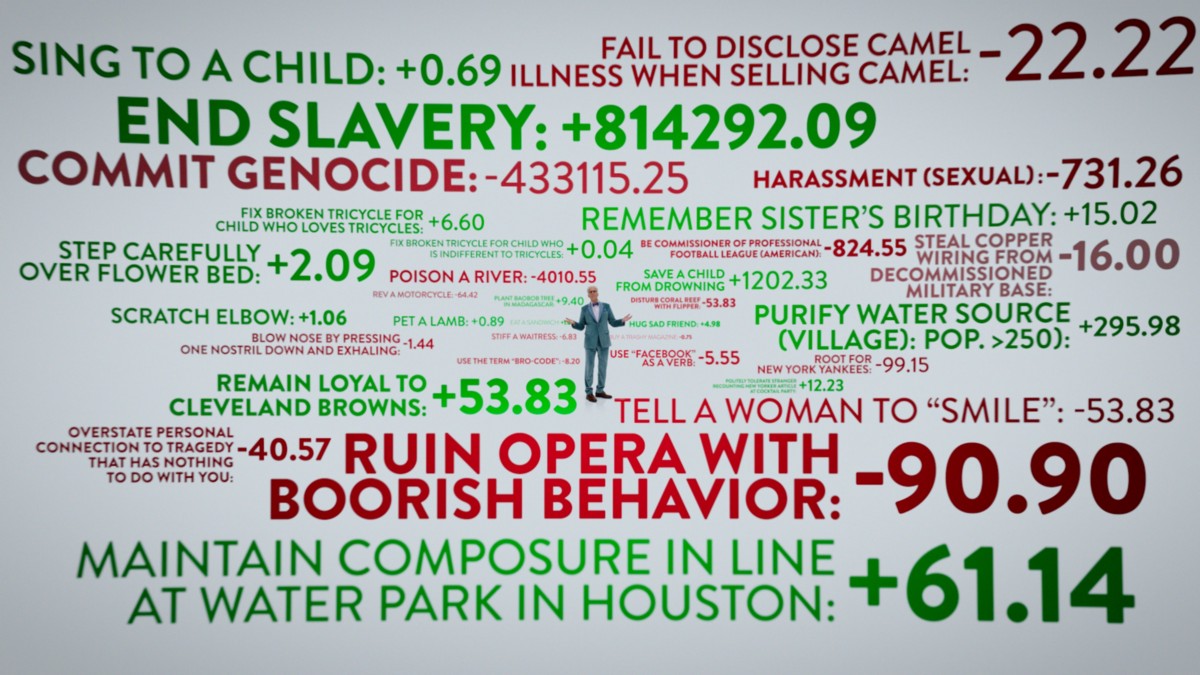
Because of how we grew up, we get stuck on this work/reward concept.
The amount of work you put in should equate to what you get out of it. That’s why we feel like the people who started working at the beginning got a raw deal or ripped off. But that’s missing the point. Jesus’ point here is not you have to work to get into Heaven, but instead it’s never too late to receive God’s forgiveness. No matter when you come to realize you need it, the reward is the same. Jesus is also trying to impress upon us God is fair – in fact, more than fair. It’s only our perception of “value” holding us back from realizing the reward we are receiving is more than generous already. It’s like salaries for professional athletes. When Alonzo Mourning was playing for the Charlotte Hornets, he was bitter because the team didn’t offer him $13 million a year – which at the time would have made him the second highest paid player in the league.[2] It wasn’t because the money wasn’t enough. I mean let’s get real – does anyone DESERVE even a million dollars a year for putting a basketball through a hoop? What he was bitter about was not the actual amount of money, but the money IN COMPARISON to what other players were making. By the way, that $10 million a year would have still made him the second highest paid player in the league. But Mourning isn’t alone. You could say the same for any number of people from movie stars to YouTubers. It’s not the actual value of the service they provide, but their perception of what they deserve and what we are willing to pay. Let’s be honest. If we were paying people by what they contributed to society, teachers, doctors, and 1st responders would be getting endorsement deals by Nike instead. This concept of “value” the workers in the story are pushing back against is a human concept of self-worth instead of anything to do with God’s fairness.
God is unfair. And I’m so glad he is.
Because God looks at us like we look at our own children. We love them, even when they make mistakes. We hope they don’t repeat them, not because we get anything out of it, but because we want them to live life to the fullest! We are willing to pay the price for our children’s mistakes because we love them and want them to succeed. And that is exactly what God has done for us. Christ paid the price for our salvation, not because we deserved it but because he loves us. If our relationship with God were like a business, we wouldn’t survive because what God has to offer is worth more than we could ever afford. Not just in the afterlife but in this one, too. The workers in the parable don’t realize it, but being a part of the work that God is doing IS a reward in itself. Knowing Christ is its own reward. We are often just too blind to see it.

In the book, Andy tells a story that brings all of this home.
He talks about a time when his children were very young and he had bought a new car. It was a used Infiniti but it was the nicest car he had ever owned. It was in mint condition and he had every intention of keeping it that way. His daughter, however, thought it could use some improvement. He was taking out the trash and as he passed his car, he noticed a big letter “A” scratched into the hood. He was furious! He looked around and demanded to know who had done this! His two sons were standing next to him and suddenly got quiet, so Andy looked at them and his son Garrett, all of five years old, said to him, “Allie did it.” He looked over at Allie, his youngest child and only daughter who was just three and a half at the time and pointed to the car. “Did you do that?” he asked her. “Yes, Daddy” she said. Suddenly, all of these different thoughts went through his head. Would a three-year-old even understand what she had done? Would she understand labor cost, renting a car while this one was fixed, the amount of money it would take to fix it, why having the letter “A” scratched into the hood wasn’t a good thing? Of course not. He could demand she repay him for the damages, because that would be fair. Absurd but fair. So what did he do? This is what he wrote, “I did the only thing I could do for someone I loved as much as I loved her. I knelt down and said, ‘Allie, please don’t do that anymore.’ She said, ‘Yes, sir, Daddy.’ Then she hugged me and went back inside. I continued to love her as much as ever. And I paid for the damage she caused. I wasn’t concerned about fairness. It wasn’t appropriate to figure out what was fair. What was more important was grace and mercy. Even if it meant that I had to pay for what she had done.” That’s what God has done for us. God has paid it all so that we can live a life of love and peace in his company. And it’s not about fairness and it’s not about reward, but about the grace and mercy of God’s love.
[1] https://www.google.com/search?q=definition+of+fair&ie=utf-8&oe=utf-8&aq=t&rls=org.mozilla:en-US:official&client=firefox-a
[2] https://en.wikipedia.org/wiki/Highest-paid_NBA_players_by_season#1995-1996 – that was even higher than Michael Jordan that year
Good People Don’t Go to Heaven

How good is “good enough?”
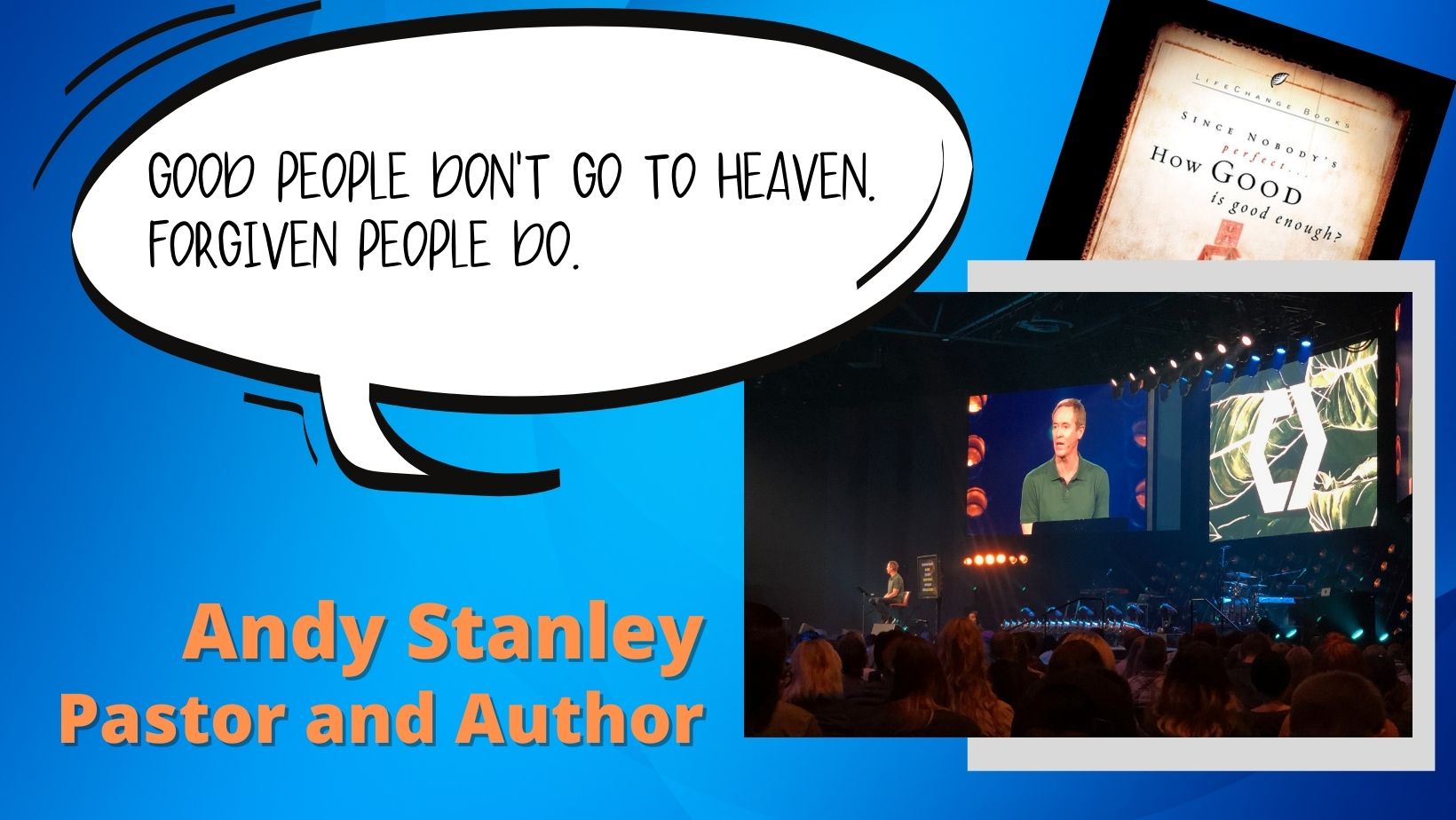
How good do you have to be to get into Heaven? What’s the bare minimum we have to do to sneak into the pearly gates? Because we believe in a good God, its easy for us to believe in the Good Person Theory – that all you have to do to make it in the afterlife is BE a good person. But as we’ve come to discover, there are some serious problems with that theory. There isn’t a standard or rubric God has given us to know how good you have to be or how we can calculate how good we are. Our internal barometer of good and bad isn’t reliable and changes from culture-to-culture and from time-to-time. And the only standard we DO have is to be perfect as Christ is perfect, which is too high a bar for any human being. But Andy Stanley shared something interesting in his book about this topic. He said, “Good people don’t go to heaven. Forgiven people do.”

What does it mean to be a forgiven people?
To showcase this standard of forgiveness and to give us some understanding of the forgiveness of God, we’re going to read a passage from Matthew’s account of the gospel. Right before our passage, Matthew recounts Jesus telling the disciples about resolving conflict with one another. He talks about how important it is to heal those relationships and Jesus gives a step-by-step guideline for how to do that – confront one another personally, bring a friend to help resolve the conflict, bring the matter before the church. Jesus says we must do what we can to bring healing to our relationships. But this gets Peter thinking. And that’s always trouble. He asks Jesus, “Seriously, though. How often do I need to forgive someone? I mean, isn’t there a limit when we just write the guy off?” And that’s where we pick up Matthew’s account of what happened between the disciples and Jesus next.
The Parable of the Unmerciful Servant
Then Peter came to Jesus and asked, “Lord, how many times shall I forgive my brother when he sins against me? Up to seven times?” Jesus answered, “I tell you, not seven times, but seventy-seven times.
“Therefore, the kingdom of heaven is like a king who wanted to settle accounts with his servants. As he began the settlement, a man who owed him ten thousand talents was brought to him. Since he was not able to pay, the master ordered that he and his wife and his children and all that he had be sold to repay the debt.
“The servant fell on his knees before him. ‘Be patient with me,’ he begged, ‘and I will pay back everything.’ The servant’s master took pity on him, canceled the debt and let him go. But when that servant went out, he found one of his fellow servants who owed him a hundred denarii. He grabbed him and began to choke him. ‘Pay back what you owe me!’ he demanded. His fellow servant fell to his knees and begged him, ‘Be patient with me, and I will pay you back.’
“But he refused. Instead, he went off and had the man thrown into prison until he could pay the debt. When the other servants saw what had happened, they were greatly distressed and went and told their master everything that had happened. Then the master called the servant in. ‘You wicked servant,’ he said, ‘I canceled all that debt of yours because you begged me to. Shouldn’t you have had mercy on your fellow servant just as I had on you?’ In anger his master turned him over to the jailers to be tortured, until he should pay back all he owed.
“This is how my heavenly Father will treat each of you unless you forgive your brother from your heart.” – Matthew 18:21-35

Forgiveness is powerful.
Think about a time when you’ve been forgiven when you didn’t deserve it, when a simple, “I’m sorry” was able to mend a relationship. More than anything, you probably remember the feeling of gratitude you had when it happened. Because forgiveness is powerful. It can change your life. When I was young, we used to go to Shi’s Fish Market every week right after Japanese school. My parents would go to shop for Japanese groceries and to talk to friends, but I was in it for the Star Wars cards behind the counter. I would spend my chore money every week filling up on those treasured pieces of cardboard and then would borrow money from my mom to get extra packs, $1.00 here and there. As I got older, my allowance grew bigger but so did the cost of everything else. By then I was collecting comic books, going out with friends to the football game, playing arcade games at the bowling alley, and over and over again I’d “borrow” from my parents. By the time I graduated from high school, I had amassed a debt of about $700 dollars. $700 dollars. My first summer job at Disneyland would mean I was basically working for free to pay back my mom. Which meant the big end of summer trip my friends had planned was something I wasn’t going to be able to join. I was pretty bummed, but I didn’t see any way out. I had after all, promised my mom to pay her back and I hadn’t for way too long. Then one day, my mom calls me over to her desk and asks me when she’s going to see the money I owe her. I tell her I’m working on it but only have about half so far. She looks up at me and says, “That’s okay. You keep it. Consider it a graduation gift from me and dad.” I was SO grateful! By every measure, my mom deserved to get that money. She had every reason to ask for me to repay it. And there was no way I could argue. But she forgave my debt anyway. As a kid, $700 seemed like a vast fortune of money, especially for me. But that debt was gone in an instant. I’m still grateful to her for that tremendous gift.

Naturally, when I read this parable from Jesus, it struck a chord with me.
How similar Jesus’ message was for the disciples as was my mother’s act of forgiveness for me. Peter starts off by asking how many times are we to forgive someone? Seven times? He must be thinking, “Seven? That’s pretty generous.” You can imagine Peter was pretty surprised at Jesus’ answer, “I tell you, not seven times, but seventy-seven times,” Not seven times but seventy-seven times! In fact, some translations say “seventy TIMES seven times.” (For you math whizzes, that’s 490 times – way more than 77). And then Jesus tells them the Parable of the Unmerciful Servant where God is like a king who forgives his servant’s debt of 10,000 talents. But instead of being grateful, instead of being merciful and forgiving like the king was to him, the servant goes out and squeezes someone else who owes him a pittance in comparison and ends up throwing the other guy in jail. As if that wasn’t bad enough, it gets worse when you consider what a “talent” is worth. The king had forgiven the servant the equivalent of $9 BILLION dollars today. Imagine that. Nine BILLION dollars. Forgiven. Just like that. The king knows, as God knows, the servant could NEVER pay back that money and in an act of kindness forgives him his debt, as God forgives us our sins. But instead of remembering the mercy and forgiveness the king just showed him, the servant instead goes out and immediately pesters a fellow servant for what amounts to $40,000. Compare that. Nine BILLION. $40,000. And that’s why God is so angered at the servant. Was the man owed that money? Sure. But given the debt he had just been forgiven, the king was angered the servant couldn’t show the same mercy to a fellow human being. That’s what it looks like to God when we can’t forgive those around us. We look like this unmerciful servant who quickly forgets how much we have been forgiven and we fail to forgive those who need it.
We don’t “deserve” to go to Heaven.
That would be saying somehow we can earn it. But as this parable points out, we have done more to separate ourselves from God than we can ever make up. Like the $9 billion dollars the king forgave the servant, it is really because of God’s grace, mercy, and forgiveness we are able to repair that broken relationship. Without it, we would be lost. We tend to think as long as we aren’t doing anything TOO bad, it’s not a big deal, but we nickel and dime our sins and rack up an unpayable debt sooner than we realize. And we know when we are doing something wrong because we sit there and justify our actions to anyone who will listen. With my mom, that debt hung over me like a weight. I knew I had not done right by her. Whenever the issue of money was brought up, even if it wasn’t about the debt I owed, there was this pang of guilt I felt each and every time. It felt uncomfortable and made me anxious. I needed her forgiveness to make it right. And that’s what happens to us when we turn toward God and ask for forgiveness. God repairs that broken relationship and makes it right so that we can be close to him again. And God calls on us to do the same thing with others. We need to forgive those around us. Whether it’s something small and insignificant or large and difficult, God calls on us to be a forgiving people in the way he has been forgiving toward us. The challenge for us this week is to forgive someone who does something against us. To really let it go. Maybe it’s something small like when your kids forget to put their clothes in the hamper. Maybe it’s something you’ve complained about over and over again like leaving the toilet seat down in the bathroom. Or maybe it’s something big. An argument you had with a sister or brother. A fight you had with a close friend that left you not talking to each other. This week I want to challenge you to let go of the small stuff and forgive all of these minor transgressions like socks and toilets. And I want you to pray about forgiving the big stuff. Because when we fail to forgive, we harbor bitterness, and bitterness grows like a disease. And the longer it grows the harder it is to let go of, and none of us need that in our lives. When we wonder if we have the strength to do that, to forgive as God has forgiven us, remember this story Jesus told us about the unmerciful servant and be reminded of the grace and goodness of a God who has already forgiven you. Because remember, “Good people don’t go to Heaven, forgiven people do.” In the name of the Father and of the Son and of the Holy Spirit. Amen.
God’s Bell Curve

The world came to an end on December 21st, 2012.
Or at least it was supposed to. Once again, we avoided a long-prophesied disaster! How do we do it? There are tons of doomsday prophecies out there, but this one got some serious attention. They even made a movie about it. According to the legend, December 21st, 2012 coincided with the end of the Mayan calendar which was going to trigger a massive apocalypse. Many different theories emerged about how that was going to happen. Some believed the gravitational effects of an alignment between the Sun and a massive super black hole would rip the earth apart. Some believed the Earth’s magnetic poles would suddenly be reversed, releasing energy equal to 100 billion atomic bombs. And some believed the mysterious planet Nibiru would come crashing into our planet.[1] Needless to say, none of those things happened. But “end of the world” hypotheses are a dime a dozen. Everyone from Pat Robertson to Pope Innocent III back in 1284 has predicted the Earth’s demise. Sir Isaac Newton, yes the gravity guy, predicted the end of the Earth would happen in the year 2060 and he based his prediction on Biblical Scripture.[2] The end of the world has special significance for Christians because it’s linked to the return of Christ. Some believe prior to Jesus’ return, God’s chosen people will be taken up to Heaven in an event called the Rapture where literally people will simply disappear. There was even a service that would take care of your pets in case you were taken. It was called Eternal Earthbound Pets USA and they were a group of loving atheists who, for the small fee of $135 dollars to cover travel costs, would take care of your pet in case of rapture.[3] You know, in case God didn’t take pets. You could rest easy knowing your pet would be well taken care of by a loving atheist.[4] Whether you believe in end-of-the-world prophecies or not, they do make us think about two things: Where will you go and how do you know?[5] Where will you go when you die and how do you know you’re going there?

We don’t often like to think about death.
Maybe it’s because we are afraid. Maybe it’s because we don’t really know the answer. But it’s two of the most important questions we could ask because the answer affects how we live our life, both this one and the one after. Now, it could also be we don’t think about it much because we are pretty confident about where we are headed. According to an ABC News poll done in 2005, about 89% of people believe in Heaven and 85% of people believe they are going there.[6] Why are they so sure? It is tied to the belief that good people go to Heaven and most people think they are good. And to be honest, it’s a premise that makes sense. I mean if you live a good life and you do good things then you’ve earned a spot, right? We tend to believe that rule applies to just about everyone, whether or not they are Christian. We figure good is good no matter what your religion and God would recognize that, but there are some real problems with that assumption.
First of all, how good is good enough?
That’s the question Andy Stanley asks in his book of the same title. How good is good enough? What level do we need to achieve to make it into Heaven? Believe it or not God doesn’t tell us. You would think for something as important as this, God would have told somebody or written it down somewhere, but nowhere does God tell us what qualifies as “good enough.” In our heads we have sort of a cosmic balance sheet going on with a running total of good things we’ve done and bad things we’ve done and we feel that as long as we’re in the plus column, we’ll be okay. But is that true? I mean, what’s the percentage? Do you have to be 51% good, you know just barely tip the scales in your favor? Or is it higher, because on most tests 51% would be a failing grade. Is it 70%? If you’re good 70% of the time do you pass? And if we’re all bad anyway, does God grade on a curve? I mean maybe 70% is too hard for most of us to achieve. “Okay, everyone above this percentage, you all get in. Sorry 59%. The cut off was 60%.” When you take a test at the DMV you know they’re not letting you behind the wheel with a score lower than 70% and considering how bad some drivers are on the road, maybe they should raise that score. Seems 70% is too lax. But at least you know. Surely God is more fair than the DMV. But he doesn’t tell us anywhere how “good” we have to be.
Some would argue God gives us an internal barometer of right and wrong.
That we can use that to determine how good we are. But how reliable is that barometer? Some things are pretty obvious. Everyone knows it’s wrong to cheat, steal, lie, and kill. We would argue people sort of instinctually know that across all cultural boundaries. But do they? Are there times when we lie to save someone’s feelings? We don’t seem to have any problem killing animals for food, but in some cultures they eat animals we would never think of eating like dogs. Is it okay to kill them or raise them for food? Our perceptions of right and wrong don’t just differ culturally, but also across time. We’ve labeled everything from being a woman, to being dark-skinned, to being left-handed as bad, evil, or wrong at some point. In the 2000 years Christianity has been around it was only in the last 50 interracial marriage became widely acceptable, and still there are hold outs who haven’t come around. When I was living in Georgia, my friend Jon mentioned he didn’t go to church anymore and it was the “anymore” that caught my attention. I asked him about it and he looked at me, pointed to a mixed race couple sitting a few tables away from us and said, “If they walked into your church and asked you to marry them, what would you say?” I told him, “I’d say that was fine. Why wouldn’t I?” But I already suspected the answer. He told me a friend of his who was black wanted to marry a woman who was white. When they went to her pastor to ask him to perform the ceremony, he told her he wouldn’t do it because it was “an abomination in God’s eyes.” Jon said, “And after that, I wouldn’t step foot in a church.” What we believe is right and wrong isn’t even consistent within cultures let alone between cultures or across time. So how reliable is our internal barometer?
You might say, “Well, at least we can rely on the Bible to tell us what God considers good.”
But let’s look at what God says about us and about his standard of being good. In this letter, Paul addresses a perception among the Jewish Christians that they are somehow a step up or more advantaged than the Gentiles because of their heritage and Paul brings them back down to Earth. He tells them because they ARE Jewish not only do they not have a step up, but they have a greater responsibility toward the law than the Gentiles do. He tells them that just because by birth they are part of God’s chosen people does not make them any different than the Gentiles who have accepted Christ as their savior because both are equally unrighteous. And that’s where we pick up in our reading today.
What shall we conclude then? Do we have any advantage? Not at all! For we have already made the charge that Jews and Gentiles alike are all under the power of sin. 10 As it is written:
“There is no one righteous, not even one; there is no one who understands; there is no one who seeks God. 12 All have turned away, they have together become worthless; there is no one who does good, not even one.”
13 “Their throats are open graves; their tongues practice deceit.”
“The poison of vipers is on their lips.”
14 “Their mouths are full of cursing and bitterness.”
15 “Their feet are swift to shed blood; ruin and misery mark their ways, and the way of peace they do not know.”
18 “There is no fear of God before their eyes.” (Romans 3:9-18)
The Word of God for the people of God and the people said, “Thanks be to God.”
There is no one righteous. Not even one.
Not Jewish or Roman or Greek. Not Mother Theresa. Not Billy Graham. Not the Pope. Paul is trying to impress upon us we are flawed. None of us can escape the fact we are sinners. At one time or another each of us has done something that would disappoint God and that something drives a wedge between us and God. You might think, “Yeah, but I’ve never done anything THAT bad. Sure I might not be perfect, but it’s not like I’m a killer or anything.” But that is God’s standard. Perfection. Jesus tells us that himself in the Sermon on the Mount. He tells the crowds, “Be perfect, therefore, as your heavenly Father is perfect (Matthew 5:48).” That’s why no one can live up to the standard that good people go to Heaven because the standard is just too tough.
So how do we know?
How do we know how good is good enough? If we can’t tell from God’s word, if we can’t use our own internal compass or barometer, and if we can’t even use the Bible, then how do we know how good is good enough? And that’s what God is challenging us to think about today. Despite all the predictions, the world isn’t likely to end any time soon, but we should still keep in mind those two eternal questions – where do you go and how do you know? As we talked about today, the assumption good people go to heaven is riddled with difficulty. So what can we believe in then? Here’s something Andy Stanley wrote, “Good people don’t go to Heaven. Forgiven people do.” We’ll talk more about that next week. But for today, let us come to the realization no matter how “good” we are, we are not perfect. We all need forgiveness. Thankfully we worship a forgiving God who gives us hope in Christ for something more than this life. In the name of the Father and of the Son and of the Holy Spirit. Amen.
[1] http://en.wikipedia.org/wiki/2012_phenomenon#Planet_X.2FNibiru
[2] https://isaac-newton.org/statement-on-the-date-2060/
[3] http://eternal-earthbound-pets.com/
[4] Unfortunately, they didn’t get enough business and had to close up shop.
[5] I’m pretty sure I heard Andy Stanley share this phrase either in his sermon or his book How Good Is Good Enough?
Imagine…

One little spark…
Of inspiration, is at the heart of all creation. Right at the start of everything that’s new, one little spark lights up for you.
Dreamfinder begins our Journey Into Imagination at EPCOT with that little song.
Written by the Sherman Brothers who wrote so many Disney classics, this one celebrates the power of imagination and introduces us to the character of Figment – a “figment” of our imagination. But those words could very well be describing God and the creation of the universe. Think about what kind of imagination had to go into making all of this stuff! What level of brilliance would you have to have to create the thousands of different types of living beings on this planet? From blue whales to the common housefly, God created it all as well as all of the variations we see within each species. It’s fascinating to think about how God put it all together, but to have the genius to envision the millions of species and variations within species is even more remarkable. And not even just living things. No two snowflakes are exactly alike. Who thinks of all the different ways you can make a snowflake? A couple of years ago, I was at a conference listening to pastor Erwin McManus talking about faith, and he told us about a guy who asked him, “Why is it that we grow up believing in lots of imaginary beings but as we grow up we stop believing in them, but we still hold on to God?” And Erwin’s response is what got me thinking about all of this. He asked the guy a question in return, “How do you know it wasn’t God who created imagination?”

That would make sense wouldn’t it? God created imagination.
The power to be able to envision things we can’t see or touch is a gift from God. And maybe the gift of imagination is the means by which we are able to know God at all. God is so far beyond human comprehension even his own name is “a riddle, wrapped in a mystery, inside an enigma.”[1] When Moses asked God to tell him his name, God said “I AM WHO I AM.” I don’t think God was being evasive or cagey. We just can’t simplfy God to a single word like “Bob.” Instead for us to truly know God we have to experience God. It’s why John wrote in his first letter to the church, “No one has ever seen God; but if we love one another, God lives in us and his love is made complete in us.” It’s through these other means like love and faith that we come to know the creator of the universe. Our imagination helps us to bridge the gap between what is seen and what is unseen.
But as we grow older, we tend to drive out imagination in favor of reality.
Or what we call reality. We start to become “realists” instead of “optimists.” But let’s be honest. Often times the word “realist” is code for “pessimist.” It’s not just about seeing the world for what it is, but being limited by it. We tend to let go of what could be and instead turn inward. As Andy Stanley once said, We begin to replace the “wow” with “how.” Meaning we become so fixated on the “how” that we shove the “wow” right out of the church.[2] But that’s not the people God created us to be. He gave us imagination so we could bring to life a world of possibilities that exceeded our reality. As Robert Kennedy once said, “Some people see things as they are and say why? I dream things that never were and say why not?”[3] At this point in Jesus’ life, the Pharisees began to feel threatened by this upstart. Jesus now has a group of dedicated disciples and he has been teaching in the synagogues and miraculously healing people. Obviously there is something different about this man that draws attention to him and the Pharisees don’t like it. They won’t admit it, but Jesus is drawing power and authority away from them and they are desperate to get it back. So they keep picking on him every chance they get. They keep trying to find ways to discredit him and his teachings. And even though it goes against everything God commands of them, they plot to get rid of him – which is code for murder. That’s where we pick up today. The Pharisees already accused Jesus of breaking the law by picking grain on the Sabbath and now they are at it again. We will be reading this morning from Luke 6:6-11.

6 On another Sabbath he went into the synagogue and was teaching, and a man was there whose right hand was shriveled. 7 The Pharisees and the teachers of the law were looking for a reason to accuse Jesus, so they watched him closely to see if he would heal on the Sabbath. 8 But Jesus knew what they were thinking and said to the man with the shriveled hand, “Get up and stand in front of everyone.” So he got up and stood there.
9 Then Jesus said to them, “I ask you, which is lawful on the Sabbath: to do good or to do evil, to save life or to destroy it?”
10 He looked around at them all, and then said to the man, “Stretch out your hand.” He did so, and his hand was completely restored. 11 But the Pharisees and the teachers of the law were furious and began to discuss with one another what they might do to Jesus.
“What they might do to Jesus…”
Sounds pretty ominous. This is of course more code for “plotting to kill Jesus.” They justify it by saying they are doing it in the name of God, but isn’t that always the way with men who want power and influence? Say it’s in the name of God, back it up with some Scripture you’ve taken out of context and people will believe you, even when it flies completely against everything God teaches us. Because of their own human lust for power and control, they refuse to open their minds to the possibility Jesus is truly the Christ – the one the prophets had long said would come. They can’t imagine the possibility that this man could be the Messiah because that would mean they would need to bend their minds to a new reality – a reality where Christ was made real. So even though they see this man do miracles right in front of them, even though they are witnesses to things that no man could possibly do, they haven’t even thought that this man could be the one who was promised. In John 11, we read about how Jesus raised Lazarus from the dead. Now, if you had actually seen this miracle occur, if you knew it was real and there were tons of witnesses, you would hope that would be enough to open up someone’s mind, but it doesn’t. People become so fixated on their own reality, they often miss the miracles right in front of them. The Pharisees call a meeting of all the Jewish leaders and they say, “If we let him go on like this, everyone will believe in him, and then the Romans will come and take away both our temple and our nation.” And Caiaphas, the high priest, says, “You know nothing at all! You do not realize that it is better for you that one man die for the people than that the whole nation perish.” He even prophesied “that Jesus would die for the Jewish nation, and not only for that nation but also for the scattered children of God, to bring them together and make them one (John 11:47-52).”. So although they were doing it for their own selfish reasons, they ended up helping Jesus fulfill the prophecies that would do exactly that.
How amazing would it have been to know you were walking with God!
These people missed out on the opportunity of a thousand lifetimes because they had lost the “wow” and had been focused on the “how.” Miracles were being performed right in front of them and they couldn’t see it! Instead they were laser-focused on the ramifications of allowing this man to continue teaching and saw it as a threat instead of a blessing. But before we become too judgmental about the Pharisees and the Jewish leaders, can we really say we are all that different? Do we really keep our eyes wide open for the ways in which God works in our own lives? True, we may not have seen someone rise from the dead, but do we also sometimes miss the “wow” for the “how?” When I was in college, I worked two summers up in the dorms. The pay wasn’t great, but they covered room and board and it beat having to move back home every year. At night, all of us working on campus would hang out and I remember this guy who said he didn’t believe in love. Having experienced love many times myself – or at least what I thought was love – I was shocked he would say that. I said, “You’re telling me you don’t think love exists?” And he said, “Nope. It’s just a chemical reaction within your body that stimulates different hormones to make you think you’re feeling something we call ‘love’ but that’s all it really is. It’s just a chemical reaction.” So I asked him why this chemical reaction only happened between certain people and not just everyone we met and he told me that it was based on certain physical and mental stimuli hard-wired into our brains as we grew up. Is there some truth to what he said? Sure. Love does create chemical reactions within our bodies that causes us to react in different ways. Are we influenced by our environment and how we grew up? Sure, our choices are always affected by our experiences. But does that mean love doesn’t exist? Talk about taking the “wow” out of life.

But to some degree we all do that.
We all take the “wow” out of life. We forget that we live in a world where God came to earth for the salvation of all humanity. We forget 51 weeks out of the year that Jesus was resurrected after being hung on a cross, stabbed in the side of his body, and placed inside a stone tomb that it took many men to seal. If we constantly lived in the mindset that we walked with a God who could do these amazing things, maybe we would be more open to the possibilities that are right in front of us. Maybe we would be more open to the work of the Holy Spirit within us. And maybe we could truly be the children of God we were always meant to be. I love going to a Disney theme park because they make you feel like you’re walking into a different world – a world that COULD exist. A world of possibilities. It’s a reminder that we are only limited by what we dare to achieve and that we are meant to create a better world. Fifty years ago, Walt Disney World opened its gates for the first time to the public. And on opening day one person commented, “Isn’t it too bad Walt Disney didn’t live to see this?” To which another replied, “He did see it. That’s why it’s here.”[4] Embrace the gift of imagination that God has given you and see where it can take you. Live a life that embraces the possibilities! After all, we live in a world where Jesus lived, died, and rose again. Anything is possible.
[1] A quote by Winston Churchill describing
[2] From a talk I attended at a conference where Andy was speaking.
[3] https://www.americanrhetoric.com/speeches/rfkreclaimingemoralvision.htm Actually RFK was paraphrasing a quote by George Bernard Shaw in a speech at the University of Kansas.
[4] Craig Groeschel, It: How Churches and Leaders Can Get It and Keep It, (Zondervan, 2008) p. 48
The Downfall of John Kreese

“Sweep the leg.”
That scene from The Karate Kid is as iconic of the ‘80s as Darth Vader’s “I am your father” or The Terminator‘s “I’ll be back.” Three simple words that would unravel John Kreese’s life. When Kreese orders Johnny to do this, he’s given up any pretense at being an honorable man. He instantly loses the respect of his prize student and he stands revealed as the villain we all know he is – a man so consumed with winning he would do anything to achieve it. When Johnny hesitates, Kreese sneers at him, “You have a problem with that?” And Johnny, speechless, simply responds, “No, sensei.” Reinforcing his order, Kreese follows up with, “No mercy,” and sends Johnny back onto the mat. Maybe before this moment you could write off Kreese’s mantra as bravado, as something to pump up his students. But there’s no mistaking it now. These aren’t just words. It’s what he lives his life by. To him, you win or you’re a loser. There’s nothing in-between. Even for something as inconsequential as the All-Valley Karate Championship. Because for Kreese, it’s all about pride. In his arrogance, he never imagined young Daniel LaRusso would have been able to make it this far in the tournament, let alone be up two points to none against his prize student in the title match. His whole sense of self-esteem is built on the backs of his students and to see them fail (and to him anything less than the title is failure) is unbearable. And when he does lose, his entire world crumbles around him. He loses his composure, his sense of self, his sanity, his students, and his dojo. All because of pride.
Pride is the anti-God.
C.S. Lewis, the guy who wrote The Lion, The Witch, and The Wardrobe, is also famous for being a great Christian theologian and he describes pride as “…the essential vice, the utmost evil… Unchastity, anger, greed, drunkenness, and all that, are mere fleabites in comparison: it was through Pride that the devil became the devil: Pride leads to every other vice: it is the complete anti-God state of mind.”[1] But is that always true? I’m certainly proud of Emma. When I listen to her playing piano, when she comes home with a good grade, when I find out she did something selfless and nice for another classmate, I can’t help but be proud. Is that bad? Can you be a proud parent and not be a tool of the devil? Turns out you can. If you have a Bible or a Bible app on your phone would you find the Gospel of Luke, chapter 18 beginning with verse 9. Luke 18:9. According to psychologists, there are two types of pride – hubristic and authentic.[2] As you can imagine, hubristic pride is the type of pride often looked down upon. It’s the kind that got John Kreese into trouble. Whereas authentic pride is the kind parents feel for their children or friends might feel for each other or that you might feel for something you accomplished.

I have to admit I was pretty darn proud of myself when I completed the Disneyland 5K.
Being both flat-footed and overweight, I wasn’t sure if I would make it ahead of the pick-up cart. The pick-up cart is a little tram-like vehicle that goes behind the runners, and if you fall too far off the pace, you’ll get “picked up” and won’t get to complete the race. I walked/ran (but mostly walked) slightly out of fear of seeing the pick-up cart behind me, but not only did I finish, I never saw the cart at all. I felt a swell of pride! Not because I beat anyone. God knows my time was nothing to write home about. But because I set a goal for myself I wasn’t sure I could complete. And that’s the main difference between the two types of pride – hubristic pride is competitive by nature. It requires you to “beat” someone. It means that others have to be “less than” for you to feel accomplished. C.S. Lewis, in his book Mere Christianity, put it this way, “Pride gets no pleasure out of having something, only out of having more of it than the next man. We say that people are proud of being rich, or clever, or good-looking, but they are not. They are proud of being richer, or cleverer, or better-looking than others. If everyone else became equally rich, or clever, or good-looking there would be nothing to be proud about. It is the comparison that makes you proud: the pleasure of being above the rest.”[3] Hubristic pride is always felt at the cost of someone else. That’s the lesson we see in the Bible as well.
9 To some who were confident of their own righteousness and looked down on everyone else, Jesus told this parable: 10 “Two men went up to the temple to pray, one a Pharisee and the other a tax collector. 11 The Pharisee stood by himself and prayed: ‘God, I thank you that I am not like other people—robbers, evildoers, adulterers—or even like this tax collector. 12 I fast twice a week and give a tenth of all I get.’
13 “But the tax collector stood at a distance. He would not even look up to heaven, but beat his breast and said, ‘God, have mercy on me, a sinner.’
14 “I tell you that this man, rather than the other, went home justified before God. For all those who exalt themselves will be humbled, and those who humble themselves will be exalted.”
If you thought humblebragging was a 21st century thing, the Pharisees thought of it first.
This guy comes up to the temple and belittles the tax collector in front of God. He probably doesn’t know him from Adam (or Eve for that matter). But he feels the need to elevate himself by making the other guy look bad. You can almost sense the insincerity of this Pharisee as he gives “thanks” to God. We all know in reality he’s just trying to make himself look good. He’d be better off just bragging about himself. According to a study done by Harvard, humblebragging is the most despised form of bragging because it is so insincere.[4] People would prefer you just come out and tell us how wonderful you are than try to disguise your bragging as false humility or a complaint. But nobody is fooling God. Jesus tells us in this parable, it is the tax collector who receives forgiveness in God’s eyes. Like most of us, God sees through this humblebragging easily and isn’t impressed.
The problem with hubristic pride is it constantly needs to be affirmed.
The braggart isn’t bragging because he is so self-confident. He is bragging because he is looking for affirmation that he is worthy. His “self-confidence” rests only on the belief that other people are not as good as he is. That’s why John Kreese feels so threatened by Mr. Miyagi and his student, because to lose to a Japanese handyman and his incompetent student would crush his sense of self-worth. The foundation for his sense of self rests on being better than other people. The thing is, if that is the basis of your self-worth, you are doomed. Around the corner there is always someone who is faster than you, stronger than you, a better marksman than you. There is always someone better. That’s the nature of being at the top. Eventually, you aren’t any more. Someone once wrote, “greatness is indeed on loan temporarily from the Gods (or God, but that’s not what was written).”[5] But sometimes, when pride is at its worst and we become so desperate to maintain our belief in ourselves, we will do unconscionable things to keep ourselves there. Cheat, lie, steal, even harm others all in the name of pride.
Instead, God wants us to be confident in ourselves without needing others to confirm it.
A person with self-esteem tends to have authentic pride. They are people who are confident enough in themselves and don’t need to be constantly affirmed by the outside world that they are worthy. They already know they are. Genuine self-esteem is linked to “successful social relationships and mental health,” whereas people who feel the need to constantly promote themselves or bring attention to their achievements are linked to “aggression and other antisocial behaviors.”[6]
To some degree, we are all probably a little bit guilty of hubris.
The danger is in letting that become how you define yourself. If you’re sense of self-worth is only based on how others see you, if you feel the need to compare yourself to the Joneses, if you care so much about being “the best” that you lose your moral compass, you are in real danger of letting the evil in this world overwhelm you. Jesus once said, “What good will it be for someone to gain the whole world, yet forfeit their soul (Matthew 16:26)?” This is how evil works in the world today, by making you feel unworthy unless you have more than everyone else, unless you’re more powerful than the next guy, when we are already loved by God who values the person you already are. In The Karate Kid, Daniel asks Mr. Miyagi what kind of belt he has, and Mr. Miyagi answers, “Canvas. J.C. Penny, $3.99. In Okinawa, belt means no need rope to hold up pants!” After laughing for a bit, Mr. Miyagi says, “Daniel, karate here (points to head), karate here (points to heart), karate never here (points to belt). Understand?” Mr. Miyagi is telling Daniel what God is trying to tell us, to know your own self-worth and not let it be defined by the outside world. God loves you for who you are and simply wants you to be the best version of you that you can be. In the name of the Father and of the Son and of the Holy Spirit. Amen.
[1] C.S. Lewis Mere Christianity pg 51 (Kindle version)
[2] https://www.psychologytoday.com/blog/the-squeaky-wheel/201407/the-key-difference-between-pride-and-arrogance
[3] Op.Cit., Lewis, p.52
[4] http://time.com/5095144/humblebrag-bragging/
[5] http://thesportjournal.org/article/when-pride-goes-wrong/
[6] https://www.tandfonline.com/doi/abs/10.1080/15298860802505053
Fear is the Mind-Killer


The Bene Gesserit “Litany Against Fear” from the book Dune.
A powerful reminder that fear, as powerful as it can be, isn’t real. Fear can be conquered. Fear is simply a label we put on a feeling we have when our body is warning us about a possible threat. And that’s the key word – “possible.” We can be fearful of things that pose no threat or danger to us at all. But if our minds perceive it as a threat or even a potential threat, we CAN react with fear. We can take a nugget of information and turn it into a snowball of fear that spurs us to do hurtful, irrational, illogical, and sometimes downright stupid things. When I was six years old, my mom told me that laundry detergent could kill you. Technically, she’s right. If I swallowed a box of laundry detergent, and didn’t get help, it could kill me. But there are 20 steps in-between she failed to mention; the result of which had me holding my breath and RUNNING down the detergent aisle every time we went to the grocery store. I’d stand there at the other end, wondering how in the world my mom could so casually walk down this aisle of death! With my little sister Karen no less! I’d be pleading with my mom from the other end to hurry up and get out of there and heaven forbid she should actually BUY a box of death. I’d be holding my breath any time I was near the shopping cart!
Fear is like laundry detergent.
Its purpose isn’t to hurt us, but to help us. Like the cute little guy in the movie Inside Out, Fear is meant to be our body’s warning system. It puts us on high alert to potential danger so we can respond quickly if something turns out to be an actual threat. But if we let fear drive us, if we let fear consume us, it can itself become a threat to us and those around us. It can change us and alter the way we look at the world. The internment of the Japanese during World War II is a prime example of fear running amok. Despite absolutely no evidence of any actual threat by any person of Japanese ancestry, our government decided to lock up every person (including my parents and grandparents) of Japanese heritage. They forced these innocents to move to remote locations in conditions worse than most prisons without any compensation for their loss. And although we were at war against the Germans and the Italians, people with ethnic ties to those countries were not typically rounded up. It was fear that drove that decision, despite the evidence against it. The same thing happened after 9/11 with the Muslim community. Hate crimes against people who looked Arabic (whether they were Muslim or not) skyrocketed. Abuse, violence, and even death all in the name of retribution for 9/11 against American citizens whose only crime was LOOKING Arabic. Similar things have happened in the LGBT community, the Mexican community, and pretty much any group you can think of who have been labeled as “different.” In the “Litany Against Fear,” they describe fear as the “mind-killer” and the “little-death that brings total obliteration.” And that rings true on so many levels. Fear erodes at our being. Fear turns us into the worst versions of ourselves. That person who normally would be kind-hearted and caring, can turn into a rabid hate-monger. It’s the “little-death” because it happens without us consciously being aware of it. It’s a “mind-killer” because it erodes logical thought. We don’t suddenly say, “Today I’m going to be a hate-monger.” Fear gnaws away at our character and we develop prejudices and negative attitudes that don’t align with the truth at all. Instead we develop our own “truth” and convince ourselves that our actions are not prejudiced or hateful but are done for our “protection” or the protection of those around us. But when you peel away the layers of it all, it comes down to fear.

Fear can be overcome.
It does not have to dictate our actions and it does not have to erode away at our character. If you have a Bible or a Bible app on your phone, would you please go to Paul’s second letter to Timothy. We’ll be reading from 2 Timothy 1:7-12. In this letter to Timothy, Paul is trying to encourage him to boldly proclaim Jesus to the world. I don’t know if Timothy actually has a fear about doing this, but since Paul is in jail at the time, maybe he was trying to bolster Timothy’s spirits? Most of us would feel scared or downhearted if our mentor who we believed in was captured and put in jail. So Paul is trying to encourage Timothy to carry on in his absence. After a few pleasantries, this is how Paul begins his letter.
7 For the Spirit God gave us does not make us timid, but gives us power, love and self-discipline. 8 So do not be ashamed of the testimony about our Lord or of me his prisoner. Rather, join with me in suffering for the gospel, by the power of God. 9 He has saved us and called us to a holy life—not because of anything we have done but because of his own purpose and grace. This grace was given us in Christ Jesus before the beginning of time, 10 but it has now been revealed through the appearing of our Savior, Christ Jesus, who has destroyed death and has brought life and immortality to light through the gospel. 11 And of this gospel I was appointed a herald and an apostle and a teacher. 12 That is why I am suffering as I am. Yet this is no cause for shame, because I know whom I have believed, and am convinced that he is able to guard what I have entrusted to him until that day.
We are not a timid people!
At least we weren’t designed that way. God created us to be bold. He created us to be strong, so that we could endure when life was tough. That we would have the strength to hold on to our faith and our beliefs even when the world turned against us. He wanted us to move beyond our fear of the unknown, beyond our fear of the unexpected, beyond our fear of rejection and boldly show the world the love of Christ in tangible, real ways. Not just the people who make us feel comfortable. Jesus said it himself in Luke chapter 6, 32 “If you love those who love you, what credit is that to you? Even sinners love those who love them. 33 And if you do good to those who are good to you, what credit is that to you? Even sinners do that. 34 And if you lend to those from whom you expect repayment, what credit is that to you? Even sinners lend to sinners, expecting to be repaid in full. 35 But love your enemies, do good to them, and lend to them without expecting to get anything back. Then your reward will be great, and you will be children of the Most High, because he is kind to the ungrateful and wicked....”
But how often do we do that?
How often are we willing to step outside our comfort zone to do what’s right? Too often our fears overcome us and make us timid. We don’t do give as generously as we know we should or even could. We don’t speak up when we someone gets bullied or when people are gossiping about them behind their back. We don’t intervene when we see something wrong happening right in front of us and we allow our fear to convince us that it’s too dangerous to get involved or “not our business.” But that is how evil works – through our fear. It erodes our character, diminishes who we are supposed to be, and convinces us that the cowardly, cruel, and mean things to do are the right ones. God did not create us to be a “careful” people. He taught us to be wary of those things that might cloud our judgment or separate us from God, but God did not create us to be “careful.” We are supposed to be a bold people. The true test of a person is not how he or she behaves when things are good, but when things are at their worst. Do they hold onto their beliefs? Or do they give in to fear? When we give in to fear, like we did after 9/11 and during World War II, we give in to the evil that is in the world. If we stand strong in our faith we honor the Spirit God gave to us and we create a better world.
There are ways to fight our fears![1]
According to Dr. Theo Tsaousides, we first have to respect and understand fear. Knowing that our reactions are sometimes based on fear and not on reality can help us make better choices when fear enters into our lives. And we need to understand where our fear comes from. Some things we fear are instinctive like giant bears and poisonous snakes. Sometimes fear comes from our own past experiences. If you nearly drown in water, you’re probably far more likely to be afraid of swimming than someone who has never gone through that experience. And sometimes we can stir ourselves up by the stereotypes, assumptions, and prejudices that lie beneath the surface of our minds. We start projecting what MIGHT happen and the fear of the possible drives us into making poor decisions. We need to be aware of what Dr. Theo calls “forecasting.” Just because something is possible, doesn’t mean it’s likely to happen, and we have to learn to differentiate between the likely and the unlikely.[2] Fear can be conquered, but if we don’t acknowledge our fear, if we don’t work toward overcoming it, we are likely to keep heading down a destructive path. And that is true not just for our lives, but our community, our society, and our country as well. We cannot let fear rule us. And we can be certain that God did not create us that way.

Today, I can walk boldly down the detergent aisle.
I even buy the stuff on my own. That seems to be such a childish thing because it is. But so is being afraid of people because of the color of their skin. Or because they are gay. Or because they eat different foods than you do. Fear isn’t always rational. And for us to be the people God created us to be, we have to recognize our fear and grow beyond it. We cannot allow for fear to dominate our way of thinking. Fear can be a great tool to warn us, to heighten our senses, but it can also be a “mind-killer” and the “little-death that brings total obliteration.” There is nothing wrong with being afraid. The most brave, courageous people in the world are afraid at times like all the rest of us. The difference is they recognize the fear and don’t let it overwhelm them. Stand up to fear. Use it as the tool it was meant to be, but don’t let it use you.
[1] https://www.psychologytoday.com/blog/smashing-the-brainblocks/201512/7-ways-fearless-people-conquer-fear
[2] Dr. Theo actually has “Seven Ways Fearless People Conquer Fear” but we only cover the first few. Definitely encourage you to read the rest. Very insightful article.
The Easy Way Out

Or How I Gave The Next Generation A Chance
We are wired to take the easy way out.
Sad but true. It’s a side effect of our autonomic system that protects us from harm. Think flight or fight responses. We are wired to favor efficiency over conscious thought.[1] And while that might help us when a baseball is being thrown at our head, it is ironically those same systems which hold onto stereotypes, make assumptions, and are resistant to change. That’s why we feel good when we eat comfort food or wear our favorite shirt or watch The Princess Bride for the 1000th time. The familiar is easy on our brain. It brings us comfort. We don’t have to think so hard. But if we’re not careful, it may also close us off to new opportunities and new experiences that could be even better! Take for example my own love of Star Trek. I grew up with Kirk, Spock, McCoy and the rest of the crew and I loved their adventures. But when they announced they were making a NEW show with NEW characters, I vowed not to watch. How dare they? Of course it could never be as good as the original. I didn’t watch the entire first season, despite the praise of the press, the critics, and even fellow Star Trek fans (traitors!). But eventually, I decided to give it a chance. And you know what? It was GREAT! I LOVED it! How stupid I felt for not at least giving it a shot. I missed out on a whole year of amazing episodes (thank God for reruns). But our minds favor comfort and unless we are conscious of it, we could be missing out on a lot of what the world has to offer.

“Comfort is your enemy.”[2]
When we think of evil in the world today, we often come up with the most horrible images we can think of. Images that rattle our very belief in the world around us. The Holocaust. The bombing of Hiroshima and Nagasaki. Serial killers like Charles Manson. Humanity in its ultimate depravity. But those are the extremes. Those may be the most vibrant and visual instances of evil in the world, but they are also (thankfully) very rare. Instead, we need to remember there is evil is around us every single day and if we aren’t careful we could be willful participants in spreading it, and comfort is one of the ways evil works in and through us. It might seem weird to think of comfort as an agent of evil, but have you ever been so snug under the sheets you just didn’t want to get up? That nice warm feeling of being in just the right spot all cuddled up with the fluff of a comforter around you? It feels so safe and so happy that you don’t want anything to change. And that’s how the devil sucks you in. He comes to us in our comfort and says, “You don’t want things to change, do you? It’s all nice and cozy exactly how it is. We should make sure it stays that way.” You get lulled into believing that’s true, that it would be the worst thing in the world to change things up, to do something a bit differently. And you end up in the same rut you’ve always been in.

Even when the alternative is BETTER, we often are blinded by our comfort.
That’s what happens to the young man in our passage today. If you have a Bible or a Bible app would you go to Matthew 19 beginning with verse 16. Matthew 19:16. Leading up to this passage, Jesus has been healing and teaching throughout the region. The Pharisees confront him on the topic of divorce and Jesus has to correct the disciples who are shooing away the children from approaching him. Then this rich young man comes up to him and asks him the key to eternal life.
16 Just then a man came up to Jesus and asked, “Teacher, what good thing must I do to get eternal life?”
17 “Why do you ask me about what is good?” Jesus replied. “There is only One who is good. If you want to enter life, keep the commandments.”
18 “Which ones?” he inquired.
Jesus replied, “‘You shall not murder, you shall not commit adultery, you shall not steal, you shall not give false testimony, 19 honor your father and mother,’[c] and ‘love your neighbor as yourself.’[d]”
20 “All these I have kept,” the young man said. “What do I still lack?”
21 Jesus answered, “If you want to be perfect, go, sell your possessions and give to the poor, and you will have treasure in heaven. Then come, follow me.”
22 When the young man heard this, he went away sad, because he had great wealth.
23 Then Jesus said to his disciples, “Truly I tell you, it is hard for someone who is rich to enter the kingdom of heaven. 24 Again I tell you, it is easier for a camel to go through the eye of a needle than for someone who is rich to enter the kingdom of God.”
The problem for the rich, young man isn’t money.
It’s comfort. When Jesus says it’s hard for a rich person to enter the kingdom of heaven, it’s not because being rich is evil or bad. It’s because having wealth makes you comfortable and it’s hard for us to leave a life of comfort. We’re wired to stick with what works. By all accounts, if we can accept his word as truth, the young man is a pretty good guy by our standards. He keeps all the commandments. He honors his parents. He loves his neighbor. Pretty good guy. But then Jesus challenges him, “If you want to be perfect, go, sell your possessions and give to the poor, and you will have treasure in heaven.” And the guy walks away sad, because it would mean giving up the life he is used to living. Familiarity breeds comfort and comfort is the enemy of progress.
Why change what works?
That’s the reason people are so fond of the saying, “If it ain’t broke, don’t fix it.” But if that were the case, we’d still be using horses for transportation. We’d all be fluent in Morse code. Our houses would be near the river so we could do our laundry every day. Most of us would agree life is better now than it was fifty years ago and better still from fifty years before that. Not only do we have modern conveniences like cars and telephones and washing machines, but Black people are no longer 3/5ths of a person, women are allowed to vote, and children are protected from unfair labor practices. Progress not only makes our lives better but our world better, too. To be sure, some things done in the name of “progress” seem to be a step backward (New Coke comes to mind) and we’re far from perfect, but overall, the world becomes a better place when we step out of our comfort zone and embrace what is possible.
This tendency toward comfort is dangerous for the church, too.
It’s one of the reasons why churches are shrinking and closing. We are unwilling to embrace those ideas that take us out of our comfort zone. But as the world changes, we need to change with it. While the mission and the message stay the same, the way we transmit and deliver it should adapt to the world we live in. Imagine if we were literally delivering the message of God by Pony Express while the world is transmitting in 5G. That’s the danger of staying in our comfort zone. But it happens all the time. One of my friends who used to pastor a small and once thriving church found this out pretty quickly. By all measures, he is a person who has a passion for trying new and innovative ideas to bring people to Christ, but one of his parishioners literally told him he wasn’t interested in growing the church. He liked it the way it was and any new people would mess it up. And this guy isn’t alone. Most pastors have stories like this in their pocket. One time while talking about growing the church, one guy came up to me and said, “I hope it doesn’t grow too big.” And he wasn’t a bad guy. Quite the opposite. A devoted Christian, always thinking of others, willing to give of his time, talent, and gifts. What he was saying in his own way was that he was comfortable with the way things were and didn’t want to lose that feeling. But I hope we trust enough in God to know the difference between our discomfort and our disobedience and that we would choose the first over the second.
Psychologically and biologically there are many ways to explain this phenomenon.
But the important thing to know is that we can overcome it. By intention and discernment we can put aside our tendency toward comfort to do what is best – for ourselves, our community, and for the Kingdom of God. Intention – to do something with purpose by keeping our minds open to new opportunities; and discernment – to carefully examine our feelings when we resist. Otherwise we may miss out on opportunities that can make our lives so much better – like watching Star Trek: The Next Generation. God has in store for you amazing opportunities if only we have the bravery to step forward in faith and embrace it. “For the Spirit God gave us does not make us timid, but gives us power, love and self-discipline (2 Timothy 1:7).” Dare to live a life of discomfort; to boldly go where no one has gone before! In the name of the Father and of the Son and of the Holy Spirit. Amen.
[1] http://www.rowancoaching.com/notes/2016/4/15/your-brain-is-lazy
[2] https://www.huffingtonpost.com/joe-robinson/comfort-hazardous-to-health_b_957788.html

