
The Devil Made Me Do It

Jesus, full of the Holy Spirit, left the Jordan and was led by the Spirit into the wilderness, 2 where for forty days he was tempted by the devil. He ate nothing during those days, and at the end of them he was hungry.
3 The devil said to him, “If you are the Son of God, tell this stone to become bread.”
4 Jesus answered, “It is written: ‘Man shall not live on bread alone.’”
5 The devil led him up to a high place and showed him in an instant all the kingdoms of the world. 6 And he said to him, “I will give you all their authority and splendor; it has been given to me, and I can give it to anyone I want to. 7 If you worship me, it will all be yours.”
8 Jesus answered, “It is written: ‘Worship the Lord your God and serve him only.’”
9 The devil led him to Jerusalem and had him stand on the highest point of the temple. “If you are the Son of God,” he said, “throw yourself down from here. 10 For it is written:
“‘He will command his angels concerning you
to guard you carefully;
11 they will lift you up in their hands,
so that you will not strike your foot against a stone.’”
12 Jesus answered, “It is said: ‘Do not put the Lord your God to the test.’”
13 When the devil had finished all this tempting, he left him until an opportune time. – Luke 4:1-13

What do you think the devil looks like?
During Halloween, when I was growing up, I’d see other kids dress up like the devil for Halloween with the red mask and plastic body suit and it would freak me out! I knew it wasn’t real, but you have to wonder what kind of kid picks the master of all evil as his icon of choice. Probably someone you want to avoid at all costs. Of course, if the devil showed up in person, I don’t think that’s what he would look like. Too obvious. I like the way Aaron described the devil in the film Broadcast News. He says it this way: “What do you think the devil’s going to look like if he’s around? Come on, no one is going to be taken in by a guy with a long, red pointy tail… He will be attractive. He’ll be nice and helpful. He’ll get a job where he’ll influence a great, God-fearing nation. He’ll never do an evil thing, he’ll never deliberately hurt a living thing. He’ll just bit by little bit lower our standards where they’re important. Just a tiny little bit. Just coax along. Flash over substance. Just a tiny little bit…and he’ll get all the great women.”
Would it surprise you to know the devil is never described in the Bible?
At least not in a physical sense. But I think that’s on purpose. Because the devil doesn’t have to take just one form. He could take MANY different forms. Like a chocolate chip cookie. Maybe that’s the devil in disguise, trying to torture me. But in all seriousness, who would be taken in by a guy with red skin, horns and a tail? Wouldn’t it make more sense if the devil took a form we would find appealing? Personally I like the Elizabeth Hurley version, but there’s Al Pacino, Robert DeNero, even Viggo Mortensen.
And does the devil even exist?
Some believe the devil is a physical being. Some believe the devil is a spiritual being. And some believe the devil is the personification of evil in the world. There are a ton of references in the Bible to evil but surprisingly very few specifically about Satan or the devil or any of the other names we’ve come to associate with him. And none of them actually tell us these different incarnations of evil are all the same. But again, maybe that doesn’t matter. No matter what you form you believe the devil takes, we can all agree evil exists and we must resist it whenever it pops up. When Jesus was tempted in the desert by the devil, he was challenged in many ways – and none of them by what we would probably think of as “evil.” The devil didn’t torture Jesus. He didn’t attack him. He simply tempted him with rational arguments and promises of an easier life. That is the real trick of the devil – not to come at us with attacks but to tempt us in our weakest areas.
Sometimes I think it’s better if we don’t believe in the devil.
At least not as some sort of physical being like we read about in this passage. Not that he does or doesn’t exist. Not that he might be a physical or spiritual being. But for us to fight evil in the world around us, we are better off not believing there is one being orchestrating all of it. Because when we believe in the devil as a being we can fight, it relieves us from any personal responsibility for the horrors we either allow to happen or don’t do anything to prevent. It is so easy for us to say “the devil made me do it” when (let’s face it) you did it. Or I did it. Or someone else did it. The devil didn’t make you do it. In fact the devil doesn’t hold any power over any of us. The only way the devil succeeds in his schemes is because we give him the power to do so – either by our actions or inactions. We can justify it any way we want, but it amounts to the same thing. We stood by and allowed to be used to advance the cause of evil.
Humanity loves to avoid responsibility.
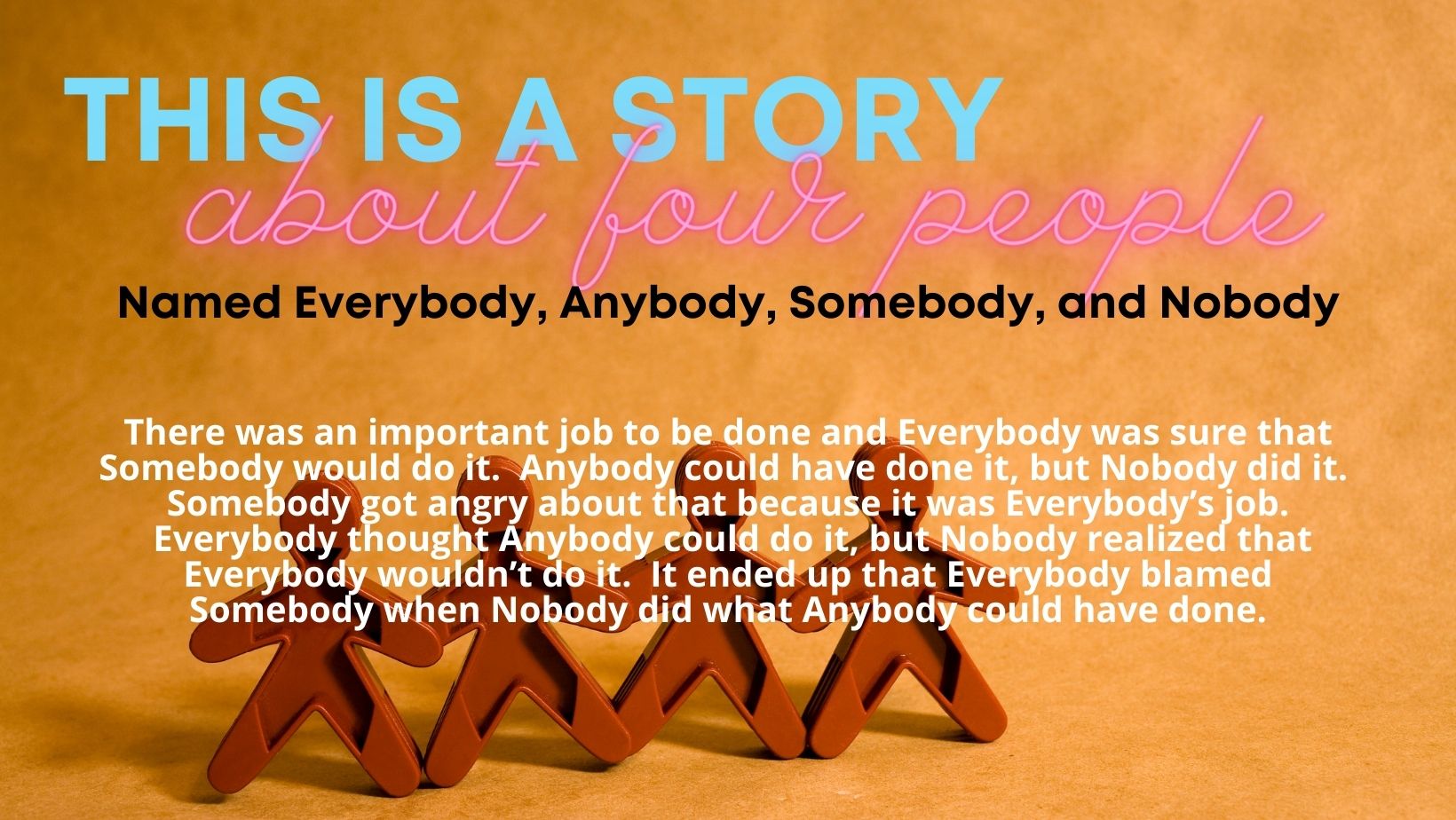
Just turn on the news any day of the week and you can watch the circus of blame as people keep pointing fingers at one another. Whether the issue is healthcare, homelessness, or racism, everyone is blaming someone, but no one is getting anything done. It’s like that poem about four people named Everybody, Somebody, Anybody, and Nobody. There was an important job to be done (insert your favorite cause here) and Everybody was sure that Somebody would do it. Anybody could have done it, but Nobody did it. Somebody got angry about that because it was Everybody’s job. Everybody thought Anybody could do it, but Nobody realized that Everybody wouldn’t do it. It ended up that Everybody blamed Somebody when Nobody did what Anybody could have done.
Every time there’s a mass shooting, I think of this story.
“Everybody blamed Somebody when Nobody did what Anybody could have done.” There were more mass shootings in America last year than ever before – 50% more than last year which was the highest on record until then.[1] A study done in 2019 shows in general more Americans are in favor of stricter gun laws and that number has grown since 2017 from 52% to about 60%.[2] There are some gun laws that almost everybody thinks should happen – banning gun sales to those with mental illness, banning gun sales to people on no-fly lists, and mandatory background checks at gun shows and private sales.[3] These show a popularity of over 84%! There is even wide support for banning high capacity magazines and assault style weapons (67%).[4] Yet we can’t even pass those laws most Americans, both conservative and progressives can agree on because one group of people – the NRA – is able to influence the vast majority of Congress with money and threaten them with losing power. And even though it’s exactly what the people want, the people they are supposed to represent, so many in Congress hide behind excuses to do the right thing because they are afraid of not being reelected. The words of Jesus echo loudly in my ears, “What good will it be for someone to gain the whole world, yet forfeit their soul? (Matthew 16:26)”
Is that the devil’s fault?
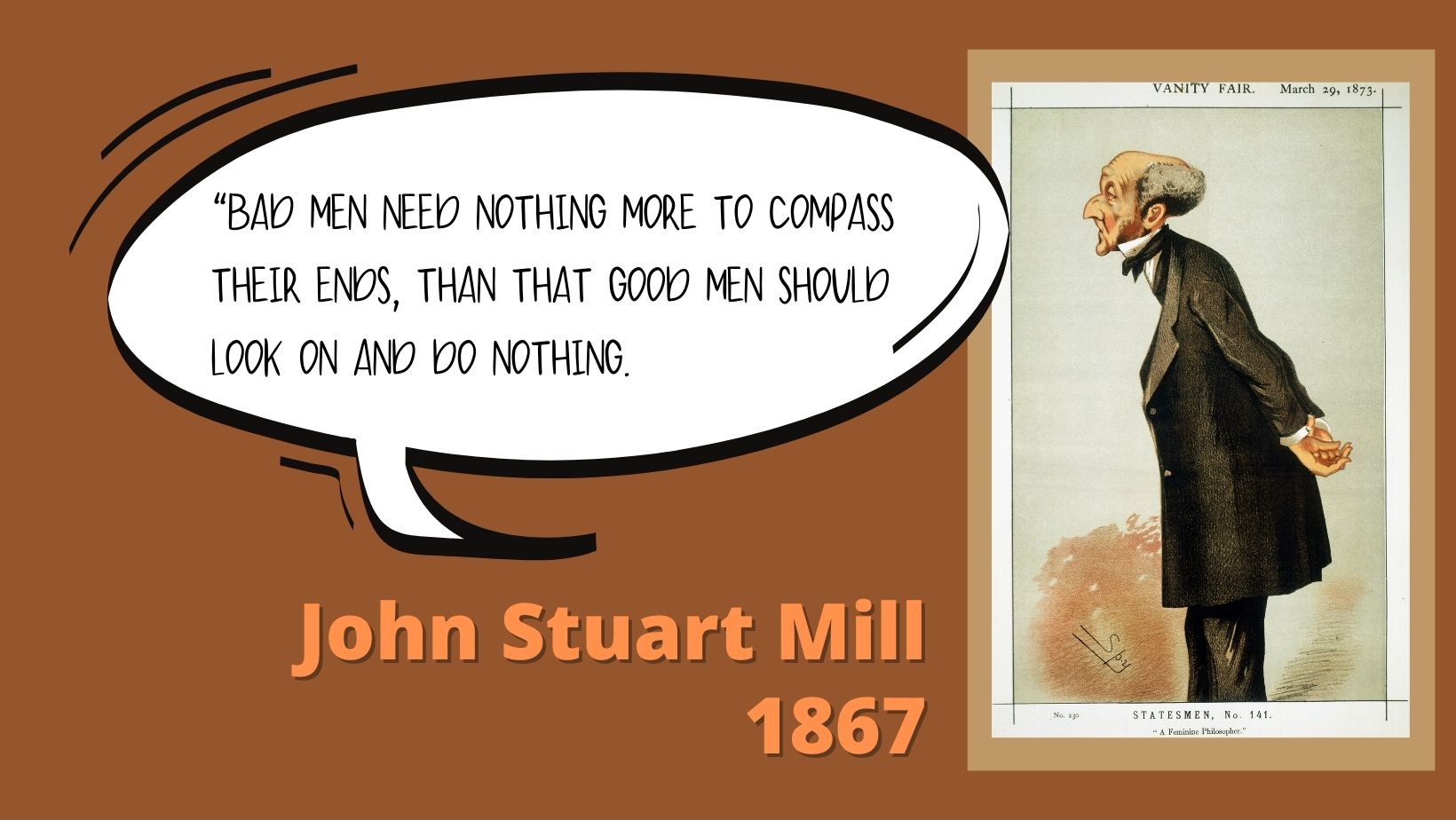
Did the devil make them vote against their conscience? Or is evil as simple as good men doing nothing? John Stuart Mill said it in 1867, “Bad men need nothing more to compass their ends, than that good men should look on and do nothing.”[5] We have to be better. We have to do better. For evil to thrive in the world doesn’t have to be the machinations of some evil being manipulating the world from behind. For evil to thrive is simply good men looking on and doing nothing. We all get caught in situations where it would be easier, simpler, less problematic, less hassle, and less headache for us to do nothing. We’ve all been there when we would rather call in sick, skip church, relax and watch a football game. Challenge yourself the next time you are tempted to sit idly by when you could or should do something, to do it. When you think about the injustice in the world, just remember, we can do something about it. The devil only has power over us when we allow it. The devil’s greatest power is in the willfulness of humankind sitting idly by when we could be doing something to stop the evil in the world.
[1] https://www.cbsnews.com/news/mass-shootings-2019-more-than-days-365/ and https://time.com/5922082/2020-gun-violence-homicides-record-year/
[2] https://www.npr.org/2019/10/20/771278167/poll-number-of-americans-who-favor-stricter-gun-laws-continues-to-grow
[3] https://www.pewresearch.org/politics/2018/10/18/gun-policy-remains-divisive-but-several-proposals-still-draw-bipartisan-support/
[4] Ibid
[5] https://www.independent.co.uk/voices/top-10-misattributed-quotations-a7910361.html
All You Need Is Love

Have you ever traveled to a country where you didn’t know the language?
It can be tough. When Cassie and I got married a little after 9/11, it wasn’t considered safe to travel internationally so we couldn’t go on the trip we originally planned. When our fifth anniversary rolled around, we decided to celebrate by taking that trip we had hoped to go on after our wedding. So we headed to Europe. It was amazing! Cassie indulged my dream of going to Disneyland Paris. We went to the Cathedral of Joan of Ark and traveled through some of the French countryside. Then we headed to Switzerland and visited the Girl Scouts World Centre, Our Chalet. We also went to Venice, Rome, and Florence which were all spectacular. France and Switzerland were fairly comfortable for both of us. We both had taken French in high school and felt pretty good about it. But Italy was a different story. I figured it would be easy enough since I knew rudimentary French, but I was wrong. I thought I at least knew Italian food – spaghetti, lasagna, linguini. But I didn’t know squat. I remember ordering this fried fish plate at this one restaurant near the Colosseum. It was one of those cute little places that come alive only in the evening with the smell of seafood and pasta and the clinking of plates and glasses. We settled in but for the life of me I couldn’t make heads or tails of the menu. The waiter, God bless his soul, tried his best and pointed at something and said “fried fish.” Good enough for me. I at least knew what THAT was. Or so I thought. I was thinking fish and chips but instead this WHOLE FISH came out, head and all! Cassie looks over at me and says, “Oh, yeah. That’s how they serve it here.” And I said, “You couldn’t tell me that BEFORE I ordered it?” Thankfully, most of the people there put up with this ignorant American tourist and helped me out. But it can feel lonely, scary, and unsettling when you can’t communicate with one another. We take it for granted sometimes the language we speak, but have to remember not everyone is as comfortable as we are in our own skin.

But “language” isn’t restricted to just French, Italian, or Japanese.
Language can make up a wide variety of different ways we communicate. Every circle we belong to has its own language. The places we work at, our close circle of friends, even the church has a language all of its own and if you don’t know it, you can be as lost as if you were in Italy. When Cassie and I first started coming to church together, I didn’t know much about church culture or church life. I knew what prayer looked like. I knew kids went to Sunday School. And I knew there was a sermon. But everything else was foreign and strange. The songs we sang weren’t anything like what I listened to on the radio. They would kneel and stand at strange times in the worship service and everyone seemed to know exactly when those times were except for me. I felt really uncomfortable because it was obvious how out of place I was. In worship they used words like “witness” and “passing the peace” and “doxology” and I had no idea what those things were or why we were doing them. But I realized exactly HOW lost I was the first time I tried to find Eve’s Sunday School class. I had volunteered to go get her while Cassie was talking to some friends of ours, but quickly realized I didn’t know where to go so I asked for directions. This really nice man told me, “You just go down the hall to the Sanctuary, when you get to the Narthex turn left, go up the stairs, through Fellowship Hall and it’s right by the Chapel.” I thanked him and went on my way, but in my head, I’m thinking, “Where’s the ‘narthex?’ And isn’t the chapel and the sanctuary the same thing?” I felt embarrassed asking what all these words meant because it seemed like any doofus should have known, and I didn’t want to seem stupid. I FELT stupid because I… didn’t… know… the language. So even without meaning to, even with a good heart, we can sometimes alienate people, make them feel dumb, and label them as an outcast when we don’t speak in a language they can understand.
Communication is the key to good relationships.
But good communication requires truly listening to the needs of the other. It requires us to speak one another in a way the other person can relate to. And not in a condescending or patriarchal way, but with love and grace. To do otherwise is to say we care more about ourselves than them. We would rather do things our way than take the time to listen and learn. We have to learn to speak in the love languages of other people. In the following passage, the Bible tells us about the day of Pentecost, and if you’re unsure of what Pentecost is, it’s the day the Holy Spirit came into the world. When Christ promised we would have a counselor to be with us after he had gone, this is what he meant. It’s not long after Jesus went back to Heaven and the disciples were all gathered together in Jerusalem when our passage begins. Hear now the Word of God.
1When the day of Pentecost came, they were all together in one place. 2Suddenly a sound like the blowing of a violent wind came from heaven and filled the whole house where they were sitting. 3They saw what seemed to be tongues of fire that separated and came to rest on each of them. 4All of them were filled with the Holy Spirit and began to speak in other tongues as the Spirit enabled them.
5Now there were staying in Jerusalem God-fearing Jews from every nation under heaven. 6When they heard this sound, a crowd came together in bewilderment, because each one heard them speaking in his own language. 7Utterly amazed, they asked: “Are not all these men who are speaking Galileans? 8Then how is it that each of us hears them in his own native language? 9Parthians, Medes and Elamites; residents of Mesopotamia, Judea and Cappadocia, Pontus and Asia, 10Phrygia and Pamphylia, Egypt and the parts of Libya near Cyrene; visitors from Rome 11 (both Jews and converts to Judaism); Cretans and Arabs-we hear them declaring the wonders of God in our own tongues!” – Acts 2:1-11

I’ve always wanted a universal translator.
If you are a Star Trek fan, you know exactly what I’m talking about. By the 23rd century, humanity has the technology to instantly translate nearly any foreign language into a language the user can understand. But God invented it first and it happened right here in Jerusalem. It was important for people to hear the Good News of Christ in their own language, to make sure they fully understood about who Christ was. God wanted to make sure nothing got lost in translation. So often the nuances, slang, parts of speech we take for granted can become misinterpreted by people who don’t speak our language that God made sure everyone would hear this news in a way they understood. Plus, there’s the side benefit of it being a miracle to help convince them it was the truth. If we want to understand and to be understood, we need to speak in a way that people can hear us.

Sometimes “speaking” takes more than words.
I’m reminded of one of my favorite passages in the Bible from John’s first letter to the church where he writes, “Dear children, let us not love with words or speech but with actions and in truth. (1 John 3:18)” Sometimes words are exactly what is needed, but there are other times when what we do speaks louder than any words could hope to convey. For each person, it’s different. Each of us has ways that reach us more effectively and if we want to communicate in the best, most effective way to show God’s love, we need to learn not our own love language, but that of others. Dr. Gary Chapman identified five key love languages that we all respond to in varying degrees. When someone tells you they love you or they like what you’re wearing or they’re proud of you, does that give you the warm fuzzies? Maybe “words of affirmation” is your primary love language. If you feel most loved when someone takes the time to simply be with you, to spend time doing things together, you might be responding to “quality time.” If you get all tingly inside when someone holds your hand or touches you on the shoulder or gives you a kiss “physical touch” might be your love language. When someone takes the time to surprise with that perfect present they obviously spent time thinking about you might be someone who appreciates “receiving gifts.” And if you’re a person who sees someone’s love for you by what they do – in even the simple things like cooking a meal or taking out the trash – you respond to “acts of service.” Those are the five love languages Dr. Chapman identified – Words of Affirmation, Quality Time, Physical Touch, Receiving Gifts, and Acts of Service. We respond to each in various ways and to be sure you might have more than one love language, but these five capture the essence of what we respond to. For me, I’m bilingual. I feel most loved by physical touch and words of affirmation. I found out the hard way that Cassie’s love language was acts of service. I just wished her love language didn’t always involve physical labor.
And that’s the hard part.
Not the physical labor but learning to speak someone else’s love language. Most of the time, we respond to different things and we have to learn their love language if we want to really make them feel understood and appreciated. And learning how to speak someone else’s love language is almost as difficult (and for some of us more so) than learning to speak French or Spanish or Japanese. But it is worth it! Even the effort will make them feel better about themselves, about you, and about the world. And it doesn’t matter if you don’t get it. It doesn’t matter if you don’t understand why it’s important for her to have quality time together. It doesn’t matter if you don’t understand why he likes words of affirmation. What matters is that you are willing to give of yourself sacrificially for the other person. Because that is what Jesus taught us, that we need to love one another sacrificially. That we need to put the love of others at least on par or greater than the love we have for ourselves. Because when we do that, when we love each other enough to put the needs of others before our own, when we exhibit sacrificial love, we create a better world. Christ’s final commandment was so simple and yet so hard to do – “Love one another. As I have loved you, so you must love another. By this all men will know you are my disciples, if you love one another.” After all, all you need is love.
The God Test

I’m still not quite convinced Paul isn’t dead.
I’ve been a Beatles fan since I was a kid. I discovered my mom’s albums quite by accident while leafing through my parents’ collection when I was about nine years old. She had both the red and blue albums and I must have listened to each of them a hundred times. It helped that some of my closest friends were also Beatlemaniacs. As we got older we went to Beatles conventions, saw a Beatles cover band, and even collected some of the Apple label Beatles albums. Then one day, I read about this strange conspiracy theory that Paul was really dead. According to the theory, he had been replaced with a guy named “Billy Shears,” the name mentioned in the song “With A Little Help From My Friends.” In fact, all of the clues about Paul’s death came straight from Beatles songs, lyrics, and album covers, most specifically Sgt. Pepper’s Lonely Hearts Club Band. There were a lot of clues in that one. You could almost here John whispering in a creepy voice “I buried Paul.” And when you played the song “Revolution 9” backwards, John could be heard saying, “Turn me on dead man, turn me on dead man.” It was FASCINATING! Paul McCartney was REALLY dead!
But of course he wasn’t.
He’s still alive and well, appearing on television and making new music. His Carpool Karaoke with James Corden was fantastic! And he even just released his 18th solo album this past Christmas season – McCartney III – which made it to number one on the Billboard top rock albums charts. If the guy we think is Paul McCartney isn’t really Paul McCartney, he’s done one heck of a job channeling his talent. After all, this is the guy who wrote “Hey Jude.” So how in the world were so many people convinced it was all a cover up? Why would they believe there was this massive conspiracy that one of the most popular artists the world has ever known would be dead and no one would know except through cryptic messages left on album covers and backward tracking? I don’t know. Maybe Marjorie Taylor Greene would however. She seems to have cornered the market on outrageous, outlandish, and downright false conspiracies. She believed the shootings at Sandy Hook were a “false flag” operation. She believed there is no real evidence for the 9/11 attack on the Pentagon. She believed there is a cabal of powerful Democrats and Hollywood celebrities who practice satanism and pedophilia. And my favorite, she believed the California wildfires were started by a Jewish space laser. By the way, that’s only a few of the many outlandish conspiracy theories she has peddled.

But Marjorie Taylor Greene is just the extreme version of what exists in our daily lives.
Many of us hold onto beliefs that are just plain wrong. But we believe them. Without any factual evidence. We just “believe” they are true. For proof we only have to go back as far as a few weeks ago when thousands of Americans stormed the Capitol building with the belief that the election was stolen from then President Trump. It wasn’t. There was plenty of evidence it was a free and fair election. And absolutely none that it was stolen from him. But people believed that pack of lies so whole-heartedly they defamed our nation’s symbol of freedom and democracy. The long list of things we have believed to be true that absolutely were not is too long to list on a Sunday morning. Whether it’s about race, religion, or politics, there is a conspiracy theory about everything. So how can we protect ourselves from getting caught up in falsehoods and misinformation? How can we make sure we do not become part of the mindless mob and do or say something we will only regret later?
We can take a lesson from the Apostle Paul.
If you think conspiracies are limited to the present day, you need to know they were happening as far back as there were people. Remember when Joseph’s brothers conspired to sell their brother into slavery? Or when Delilah betrayed Samson so the Philistines could enslave him and use them for their entertainment? Or the most famous conspiracy in the Bible, when Judas betrayed Jesus for a mere 30 pieces of silver. But these were ACTUAL conspiracies. What we need to guard against is believing in false ones. Paul knew that people were susceptible to being fooled by those who had agendas of their own. He knew that we needed to be prepared to weed out truth from fiction as we hear in this passage.
In the presence of God and of Christ Jesus, who will judge the living and the dead, and in view of his appearing and his kingdom, I give you this charge: 2 Preach the word; be prepared in season and out of season; correct, rebuke and encourage—with great patience and careful instruction. 3 For the time will come when people will not put up with sound doctrine. Instead, to suit their own desires, they will gather around them a great number of teachers to say what their itching ears want to hear. 4 They will turn their ears away from the truth and turn aside to myths. 5 But you, keep your head in all situations, endure hardship, do the work of an evangelist, discharge all the duties of your ministry.
It sounds like Paul was writing to us.
Today. Here and now. His words could not be more true. “For the time will come when people will not put up with sound doctrine. Instead, to suit their own desires they will gather around them a great number of teachers to say what their itching ears want to hear. They will turn their ears away from the truth and turn aside to myths.” If that doesn’t describe Fox News, I don’t know what does. The same is true for those on the far left of the political spectrum also. They spout beliefs that are completely or at least partially untrue. They emphasize what they want to believe in and deemphasize those things that go against their beliefs. So if we are going to do as Paul instructed and keep our head in all situations, we have to do a better job of sussing out the truth from fiction.
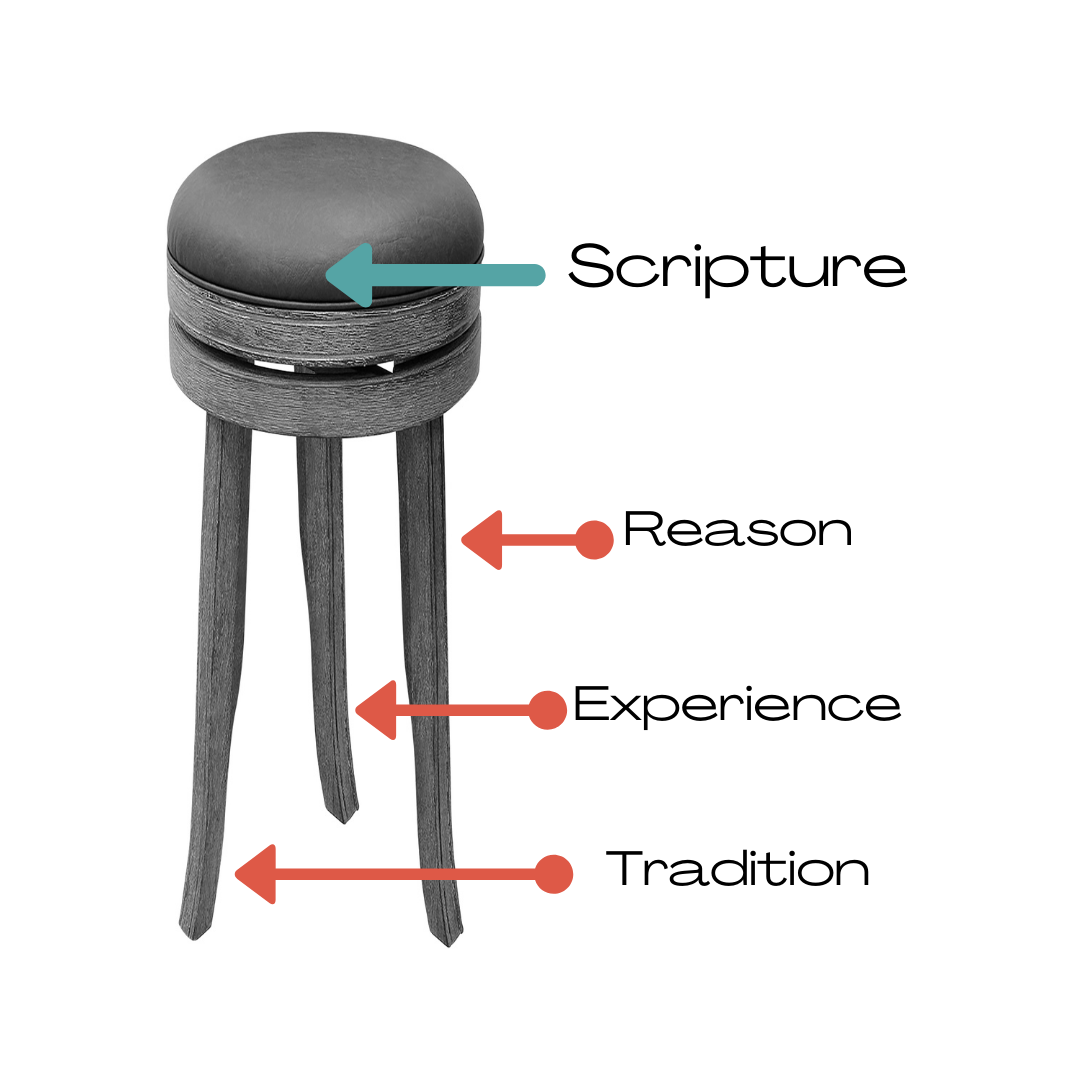
John Wesley used a method that today we call the Wesleyan Quadrilateral.
He believed that if we turned to Scripture and used our powers of reasoning, the experiences we have encountered in life, and our traditions which provide us a sense of grounding in history, then we could better understand the truth of what God is asking from us. We call this the Wesleyan Quadrilateral because it emphasizes a four-fold understanding of God’s will. My Methodism professor in seminary thought it might be better imagined as a three-footed stool where Scripture is the seat upon which everything rests, but it is informed by our reason, our experience, and our tradition. For us and for Wesley, Scripture was always the basis of our understanding of God’s will, but as you can imagine (much like our Constitution), things we encounter today can’t always be found in the Bible. We have to discern from our knowledge of God what God wants for us in those situations we find ourselves that aren’t always covered. Like back then they didn’t have guns, but they had weapons and Jesus told his disciples to put theirs away “for all who draw the sword will die by the sword (Matthew 26:52).” John didn’t have a Facebook account, but he knew you couldn’t just believe everything you heard because he wrote in one of his letters, “Beloved, do not believe every spirit, but test the spirits to see whether they are from God, for many false prophets have gone out into the world.” John’s advice is solid. Test it out in the world. Don’t just rely on your gut or your instinct to see if it’s true because we know those can be highly unreliable. Instead test your theory out and see if it matches up to reality. Just on the face of it, what’s more plausible – that California wildfires are being caused by a warming planet combined with carelessness on the part of companies like PG&E or that there are seriously Jewish space lasers firing at the planet and starting them all? Some of these things are not that hard to figure out, but we need to stop and be mindful of the things we believe in. We need to be open to other points of view. And most importantly, we need to ask ourselves, are my beliefs in line with the kind of person God is calling me to be?
As Children of God and followers of Christ, we are rooted in Scripture.
But our understanding of Scripture has changed over the centuries as we have better understood what God expects from us. No longer are we so narrow-minded as to think that women cannot be teachers of God’s Word. No longer are we so blinded by racial disparity to think that a person is less than another based on the color of their skin. No longer do we think God brings forth the storms to punish the LGBTQ community. Because we have grown beyond that. Or at least most of us have. Sadly, there are still, even now, people who cling to these outdated and wrong ways of thinking. That is why we have to heed the words of Paul (not the dead one, the other dead one) to be wary of those who will not listen to sound doctrine. That is why we need to take an approach like John Wesley and examine our beliefs to discern God’s will for our lives. Because as human beings, we are prone to fall off the wagon from time to time. We have to get up, learn from our mistakes, and do better every time we rise again. We believe we are the Children of God. Let’s act like it.
The Blind Spot

Did you know you have a blind spot?
I don’t mean the area of your car you can’t see in your mirrors. I mean a literal blind spot right in front of your face. Apparently, everyone has one in each eye. It’s the spot where the retina and the optical nerve are joined together. Normally, you don’t notice because your other eye fills in the information to your brain so you think you’re seeing everything, but literally there is a blind spot right in front of your face. They have this simple experiment online so that you can see this for yourself.[1] There are two dots on the screen, a red dot and a green dot. If you cover your right eye and focus on the green dot and move your face toward the screen, there’s a certain distance where the red dot simply vanishes! Move just a centimeter closer or farther away and it reappears. Go to that one particular spot and the dot disappears. Because your mind can’t “fill in” the information for you, it appears white like the color surrounding it. Even though you KNOW it’s red, it fills it in with white. Your mind makes the best guess possible given the information it has. Even when reality is staring us in the face, there are times when we can’t see reality for what it is but instead what we perceive it to be.
We all have blind spots. And not just in front of our eyes, but in our hearts and minds as well.
If we can have literal blind spots, is it so hard to believe we can have intellectual and emotional blind spots as well? Most of us have had a friend or family member who was dating someone they shouldn’t have. We could see it. Everyone around them could see it. But no matter what was said or done, they were blind to it. When we develop a belief about how we perceive reality, it’s tough to let that go, even if the evidence is staring you in the face. We will defend our way of life even beyond reason anut d faith is one of those hardcore beliefs it’s hard for us to shake. At some level, we realize how daunting it is to convince people to abandon their faith in favor of another. With Hinduism and Buddhism, both began long before the birth of Christ and their vision of faith is radically different than our own. People of Islamic faith are a little bit closer. We at least share some of the same fundamental roots of our faith, but still there are some foundational differences where we can see why it would be hard for someone to suddenly believe Jesus was Lord and Savior. But Judaism? What happened there?
Why didn’t the Jews believe in Christ?
Of all the religions we’ve studied over the past month, Christianity and Judaism have the most in common. In fact, we believe in the same God, we have the same ancestors, and up through the Old Testament, we even have the same Scripture. So why did the people of Israel not believe Jesus was the Son of God? First, we have to dispel that notion because obviously many of them did. There would be no Christianity if the Hebrew people didn’t believe in him. In fact, Hamilton estimates that 1/3rd of all Jewish people during that time came to faith in Christ. 33%! When you think how big of a blind spot we develop when it comes to our faith, it’s a miracle in itself so many people believed Christ was the promised savior.

Put yourself in the shoes of an average, everyday Jewish person at the time of Christ.
You are not a free people. You have been conquered by the Roman Empire. And if it wasn’t the Romans, it would have been somebody else. Over the course of the history of your people, you have been conquered time and time again. Your kings have often failed you. But the one hope you cling to is God’s promise that one day…ONE DAY…your people would lead a Golden Age of the world. The prophets speak about a savior who would come and raise the banner of Israel high! He would lead them to become the powerhouse of the world! One day the people of Israel would defeat every enemy and all the people of the world would recognize that only Israel followed the one true God. In your head, you’ve grown up with the image of a savior who was this charismatic, brilliant, military leader, so when this young carpenter comes to your temple in Nazareth, reads the words of the great prophet Isaiah, and proclaims that the Scriptures are fulfilled in him, you’re probably thinking, you’ve got to be kidding? Isn’t this Mary and Joseph’s son? Who does he think he is? He doesn’t seem to be some brilliant, charismatic military leader. He’s just a carpenter’s son. Even if you had kept up with the goings on of Jesus, even if you had heard about some of the miracles, you probably would have dismissed them as being made up or fictitious unless you were there. Even the feeding of the 5,000. It’s not as if people saw this mountain of bread and fish fall from the skies. If you were in the crowd, you probably would have just seen these baskets being passed around and with twelve full baskets left over assumed they just had more than you thought. Only a very few saw the water turn into wine. Only those present saw Lazarus was actually dead and rose again. Sure, Jesus was a great teacher, but the savior? He couldn’t even save himself! We often talk about the radical nature of Jesus’ ministry, but this is how radical it was. It defied nearly everything they believed in. Their understanding of good works, their understanding of the law, their understanding of God, and most importantly their understanding of their savior. Nearly everything Jesus taught was different from what they believed.
As if that wasn’t enough, his disciples began accepting Gentiles into the faith.
If Israel was God’s chosen people, then what does it mean when you let in a group of people who don’t follow the law, who aren’t circumcised, and who don’t study the Torah? The passage we’re about to read takes place after the Roman centurion Cornelius sends for Peter to come visit him. Cornelius is a man who despite being a Gentile was a devout follower of God. He obeyed God’s commandments and lived a life that honored God. So God sent an angel to Cornelius’ house to share with him how his actions have proven his faith and he tells Cornelius to send for Peter the Apostle. So he does. He sends two servants to ask Peter to come to his house. Before Cornelius’ messengers arrive at the place Peter is staying, Peter receives a vision from God making it clear that only God has the right to judge what is pure and impure. So when the messengers arrive, Peter who normally would refuse to be in the company of Gentiles agrees to go with them. When he gets there, it’s obvious why God sent him and he begins to tell Cornelius about the truth of Jesus. This is where we pick up in our reading.
44 While Peter was still speaking these words, the Holy Spirit came on all who heard the message. 45 The circumcised believers who had come with Peter were astonished that the gift of the Holy Spirit had been poured out even on Gentiles. 46 For they heard them speaking in tongues and praising God.
Then Peter said, 47 “Surely no one can stand in the way of their being baptized with water. They have received the Holy Spirit just as we have.” 48 So he ordered that they be baptized in the name of Jesus Christ. Then they asked Peter to stay with them for a few days.
The Word of God for the people of God and the people said, “Thanks be to God.” Please be seated.
For us, when we hear this message, it seems obvious that God is reaching out to the Gentiles.
But this was a huge revelation for Peter and the other disciples. This was groundbreaking. It meant that Jesus had come not just for the Israelites, but for the entire world. That God’s message of salvation was meant for everyone. Even among the Jews who were followers of Christ, this was astonishing because it went against everything they had believed for so long. So not only did Jesus not herald a Golden Age for Israel the way they imagined it. Not only did Jesus not raise the banner of Israel as they expected. But now God was telling them that this message of salvation was meant for everyone? As Hamilton pointed out, this likely alienated most of the Jewish community. If there was a chance of some of them being brought to Christ, this would have shoved them the other way. So when we wonder why it is that the early Jewish people didn’t all believe Jesus was the Savior, these are some of the reasons. Jesus upended their entire concept of salvation. Jesus came for a spiritual conquest not a military one. Jesus defeated his enemies not with a sword but with his love. And Jesus promised salvation in Heaven, not on Earth.

We all have blind spots.
They just take different forms. Even today there are some bizarre ones that stand out. At last count there were still 420 people who belonged to the Flat Earth Society, including the famous rock musician Thomas Dolby.[2] As late as 1994, there were about 6% of Americans who believed that the Apollo moon landings never happened.[3] That would be approximately 19.7 million people today. 19.7 million people who believe we never landed on the moon. And there are actually people who believe that the Holocaust never happened. You and I live in a world where these things are a reality. We can prove the Earth is round. We can prove we landed on the moon. And we even have first-hand accounts of the horrors of the Holocaust. How people can live in such a state of denial is unfathomable. So to think there are people who didn’t and still don’t accept Jesus as our Lord and Savior isn’t a stretch of the imagination. But that doesn’t mean we should stop trying to share God’s love with them. The only way for us to show the reality of Christ in the world is to be Christ-like ourselves. We have covered a wide variety of different religious beliefs over the past month together and they are all very different. All roads do not lead to the same God. Some roads don’t lead to God at all. But most people are trying to find answers to life’s deepest questions – Why is there suffering? What’s the meaning of existence? Who am I and do I matter? We must be prepared to answer these questions for ourselves. I want to challenge you to go deeper into your own faith and find these answers for yourself. Come to one of our Bible studies. Pick up one of the books we offer. Pray daily and ask for answers. But actively engage in your faith. We become the best witnesses for Christ when we know what and why we believe. As Peter writes, “Always be prepared to give an answer to everyone who asks you to give the reason for the hope that you have (1 Peter 3:15).”
[1] http://www.cycleback.com/eyephysiology.html
[2] http://en.wikipedia.org/wiki/Flat_Earth_Society
[3] http://en.wikipedia.org/wiki/Moon_landing_conspiracy_theories
He or Me

Let me tell you a story.
Once upon a time, there was a prince who was sheltered all his life from the outside world. His father the King sought to protect him from the suffering and pain he might encounter, hoping that would be enough to insure his son would inherit his throne. Prophets had come to him and predicted that the young prince would either one day become a great king or a great spiritual leader and the king wanted his son to follow him on the throne. So he gave his son everything any man would want and more. But the son became more and more curious about what was on the other side of the wall and one day he decided to go and explore. He took his charioteer, Channa, with him and together they rode through the countryside. As they were riding, they encountered an old man. The prince was shocked, having never seen an elderly person before and he asked his charioteer, “Is this the fate of all people?” “Yes,” Channa replied. “All people suffer from aging.” The prince had much to think about. On their second journey, they encountered a man who was ill and sickly. The prince asked his charioteer again, “Is this the fate of all people?” “Yes,” Channa replied. “All people suffer illness.” And again, the prince had much to think about. On their third journey, the prince saw a funeral procession. It was the first time he had looked upon the body of a person who had died and he asked his charioteer, “Is this the fate of all people?” And Channa replied, “Yes, all people eventually suffer from death.” This created a lot of angst in the prince and he began contemplating the meaning of all this suffering. He went out once more with his charioteer and on the way they encountered an ascetic monk who seemed quite at peace with the world and it gave the young prince hope. He decided to leave his life of luxury and pursue the answers that would bring him the peace he saw in this monk and eventually became the great spiritual leader the prophets had predicted.

It sounds like a fairy tale, but this is the traditional story of how the Buddha began his quest.
Siddhartha Gautama was a great spiritual leader born about 500 years before Christ. He was the son of a wealthy man, most say he was a king or at the very least a tribal leader. But in the caste system of his day, Siddhartha was born into the warrior class, ranked just below the priests and holy men and in comparison he indeed led a life of luxury. However, after venturing out among the people, Siddhartha was disturbed by the suffering he saw and felt compelled to find the answers to some of the questions we still seek today. Why is there suffering in the world? What purpose does it serve if any? And so on the night of his son’s birth, he gave his newborn the name Rahula (which means “fettered”) and left his family for his spiritual quest. He named him Rahula because he felt his son would become an attachment that would prevent him from understanding suffering. Those journeys in the story that propelled him on his quest are called the Four Sights[1] and they were the beginning of what would eventually become Buddhism. One common misconception is that the Buddha is worshipped by Buddhists. He is not. He is revered for his work and for his insight and he is thought to be a spiritual model for his followers, but he is not worshipped. Buddhists do not worship anyone or anything. It’s part of the centrality of their belief system. Buddhism is the only major religion that is non-theistic meaning they neither confirm or deny the existence of God. Buddhism is the only major religion that is non-theistic meaning they neither confirm or deny the existence of God. Whether or not God exists is outside the scope of Buddhism because in the Buddhist scheme of things God doesn’t matter. There may be a God, there may not be a God, but God has nothing to do with enlightenment. Enlightenment comes from within one’s self.
Despite their differences, Buddhism and Christianity share a lot in common.[2]
The Buddhist way of life is very similar to the Christian way of life. They believe you shouldn’t lie, cheat, or steal; you shouldn’t covet what someone else has; and you shouldn’t take a life. They believe you should be compassionate and kind. That you should think before you speak to avoid saying something you would regret. They believe human beings become too attached to the things of this world – money, fame, power, objects – and that by ridding ourselves of these things we can become the persons we were meant to be. But there are some very big fundamental differences as well as we will see in our passage this morning. This is the story of the rich man who comes to Jesus and asks him, “Teacher, what good thing must I do to get eternal life?” And Jesus responds by saying he must keep the commandments. And the man says, “All these I have kept. What do I still lack?” And then Jesus responds with what we hear in our passage today.

21 Jesus answered, “If you want to be perfect, go, sell your possessions and give to the poor, and you will have treasure in heaven. Then come, follow me.”
22 When the young man heard this, he went away sad, because he had great wealth.
23 Then Jesus said to his disciples, “Truly I tell you, it is hard for someone who is rich to enter the kingdom of heaven. 24 Again I tell you, it is easier for a camel to go through the eye of a needle than for someone who is rich to enter the kingdom of God.”
25 When the disciples heard this, they were greatly astonished and asked, “Who then can be saved?”
26 Jesus looked at them and said, “With man this is impossible, but with God all things are possible.”
27 Peter answered him, “We have left everything to follow you! What then will there be for us?”
28 Jesus said to them, “Truly I tell you, at the renewal of all things, when the Son of Man sits on his glorious throne, you who have followed me will also sit on twelve thrones, judging the twelve tribes of Israel. 29 And everyone who has left houses or brothers or sisters or father or mother or wife[e] or children or fields for my sake will receive a hundred times as much and will inherit eternal life. 30 But many who are first will be last, and many who are last will be first.
“With man this is impossible, but with God all things are possible.”
This is the key phrase for us this morning and it’s what differentiates us the most from our Buddhist friends. Humanity is not able to save itself. We rely on the grace of God through the actions of Jesus Christ. Buddhists believe that by meditation, following a series of precepts and paths, you can attain enlightenment by yourself and be free of the eternal cycle of samsara – life, death, and rebirth. Christianity focuses on “He” and Buddhism focuses on “me.” Christianity focuses on “He” and Buddhism focuses on “me.” In this passage, there is much that both religions would agree on. Jesus tells the man to sell his possessions and give it to the poor. He implies that it is his attachment to these material things that is holding him back and the Buddha would agree. The Buddha would say that it is the attachment to things – all things – that holds us back. When Jesus says that everyone who has left houses, family, and fields for the sake of Christ will receive a hundred times as much, the Buddha would agree, again saying that our attachments are what get in the way. But in the way of what? For us as Christians, the material things of this world keep us from really understanding God, and we see this as an essential part of our faith lives. We believe as we grow closer to God, we are better able to live to our potential and be the kind of people God hoped for. It’s not that God wants us to abandon our family and friends. On the contrary, God calls us to live in community. But in this passage, God is warning us that there will be many obstacles in life as we journey in faith and if we are unwilling to leave them behind, we’ll never receive the full reward that God has in store for us. Not as punishment, but simply because there will always be a part of us that relies on something other than God. For the Buddhist, the things of this world, ALL things including family and friends, can be impediments to our journey toward enlightenment. Our fallacy, according to the Buddhist tradition, is that our faith on anything is false because all things are transient. God. The world. Even the concept of “you.” “You” do not exist. “You” are simply a consciousness residing in a body that has experienced the world in a certain way based on your previous life experience. But there is no real “you” out there. Enlightenment comes from learning these things and accepting them as part of life. Christians and Buddhists hold something in common. We are both searching for the truth. We are both searching for the Truth. But we see truth very differently. Buddhists believe that the only truth is impermanence. Impermanence. That nothing lasts forever. But isn’t a belief in the permanence of impermanence itself a contradiction? Christians, however, believe that the truth lies in Jesus Christ who is the “same yesterday, today, and forever.” We believe that God is eternal. Many people believe that Christianity and Buddhism are very much alike, but our concepts of the world are very different. Buddhists believe in self-reliance. Christians believe in reliance on God.

Maybe part of the appeal of Buddhism, especially in America is the idea we can do it ourselves.
There’s an element of control that you are the master of your own destiny, which appeals to people. We like to feel in control. We like to feel like we determine what happens to us despite the changes that occur in everyday life. We have a hard time giving that up, to let go and to accept the fact that a great many things are out of our control. We struggle with change. We don’t like to rely on others. And it’s hard for many of us to admit that we need help or that we cannot do it alone. Think about all of the idioms we use in our lives. “Pull yourself up by your bootstraps.” “Look out for #1.” “To the victor goes the spoils.” And the erroneous, “God helps those who help themselves.” But we in fact believe the opposite. We believe Christ came to save those who needed it the most. He came for the lost, the sinners, and the hopeless. And we thank God everyday for that. Because we are those people. We are the ones who need God. And knowing God is in control and that God has a plan for our lives gives us a peace and joy that can only come from Him. In the name of the Father and of the Son and of the Holy Spirit. Amen.
[1] http://en.wikipedia.org/wiki/Four_sights – this is only one of many websites with the retelling of this ages old story. A version of it appears in Adam Hamilton’s book Christianity and World Religions.
[2] Other than Adam Hamilton’s book Christianity and World Religions some websites that have produced useful background information are www.buddha101.com, www.buddhanet.net, and http://en.wikipedia.org/wiki/Gautama_Buddha
Truly Holy Cows

Could Robin the Boy Wonder have been Hindu?
Holy Eastern Religions, Batman! Robin used to call EVERYTHING holy. Holy cow, holy guacamole, holy hole in a doughnut, and my favorite – Holy Haberdashery! In fact, Burt Ward who played Robin on TV said he used the “Holy” phrase about 378 times which came out to around three times per episode.[1] The belief that everything is holy or that everything has part of the divine essence of God within it, is consistent with Hindu beliefs. Hinduism, like Christianity believes there is only one God. They call God, Brahman. But a Hindu person believes God is manifest in every aspect of creation while Christians believe that God is separate from creation. On TV and in the popular media, people have joked about the Hindu worship of cows as gods, but that misrepresents the complexity of the Hindu religion. It would be like saying Christians are cannibals because we feast on the body and blood of Christ. It reduces something we believe to be holy to be a mockery of those beliefs. Knowing what others believe helps us to become more understanding, more accepting, and more loving toward people of other faiths. And at the same time, it helps us better understand why our own faith is important to us.
Call it the Progressive Insurance Method of Christianity.
You’ve seen those commercials on TV where Progressive Insurance offers you quotes from other insurance companies. The person in the commercial always looks on in disbelief, as if Progressive Insurance is crazy for showing you what other companies offer. But they are so confident in what they have to offer, they are not afraid of the others. In a way, that’s what this is. We are exploring different faiths to come to a better understanding of our own, and through that understanding build a solid foundation for our own faith to rest upon (Matthew 7:24-29). Our faith is strengthened when we understand what others believe. Bad theology begins by an incomplete understanding of OUR faith, not the faith of others. Hopefully, our exploration of other faiths will help us grow even closer to God. Today, we’re going to explore the Hindu faith.
Again I need to preface this by saying I am not an expert in Hinduism.
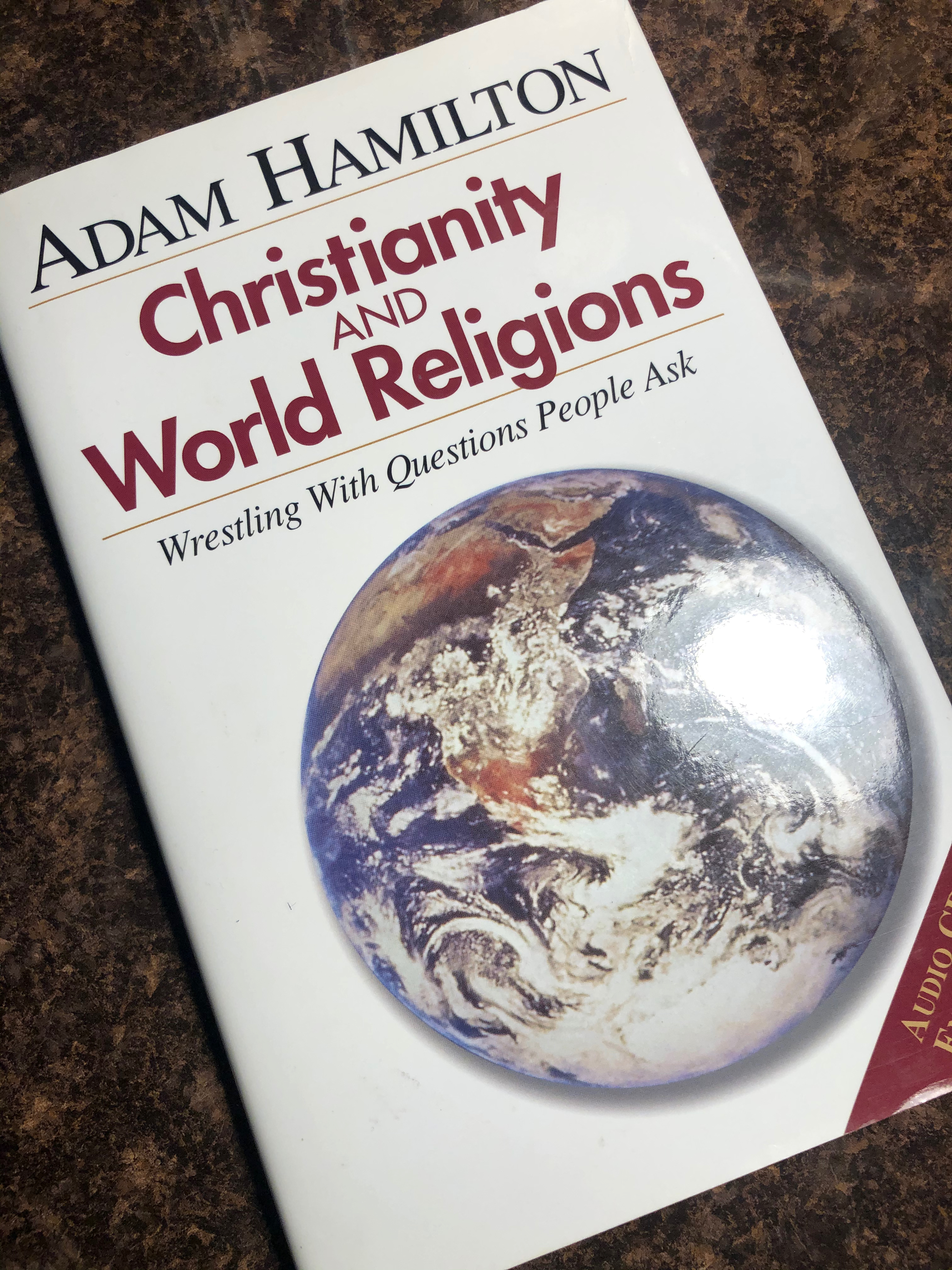
These are some of the very raw basics about the Hindu faith and we need to realize there are many different variations in Hinduism just as there are different variations of Christianity. As the basis for our study together, we’re looking at Adam Hamilton’s Christianity and World Religions. In it Hamilton tells us that there are three fundamental characteristics of understanding the Hindu faith – dharma, karma, and samsara. Dharma, karma, and samsara. Dharma is the idea that good works coupled with spiritual knowledge sets us free. Hinduism teaches that dharma or “duty” is needed to be done to build up good karma. Karma literally means “deeds.” At the end of our lives if we have built up more good karma than bad, then we will be better off in the next life. If not, then we will be worse off and we will suffer more for it. Suffering, however, is not seen necessarily as punishment, but a tool to help us gain spiritual knowledge so we can obtain a state of self that frees us from this cycle of life, death, and rebirth. This cycle is called samsara. Samsara. And we are not free from this cycle until we have emptied ourselves of bad karma. When we do, we reach nirvana. But nirvana is not a place. It’s not like the heaven we often imagine in our Christian faith. Rather it is the condition of the divine within us rejoining with Brahman. We become part of the divine once again.
These concepts are part of what separates us from one another in our faith.
We’re going to take a look at a reading from Scripture that helps us better define our own faith. This passage captures the essence of our ideas of salvation and how we obtain it. When you read it, think about how our view of salvation is very different from the view Hinduism shares with us and think even about how our definition of what salvation is is very different from theirs.
As for you, you were dead in your transgressions and sins, 2 in which you used to live when you followed the ways of this world and of the ruler of the kingdom of the air, the spirit who is now at work in those who are disobedient. 3 All of us also lived among them at one time, gratifying the cravings of our flesh[a] and following its desires and thoughts. Like the rest, we were by nature deserving of wrath. 4 But because of his great love for us, God, who is rich in mercy, 5 made us alive with Christ even when we were dead in transgressions—it is by grace you have been saved. 6 And God raised us up with Christ and seated us with him in the heavenly realms in Christ Jesus, 7 in order that in the coming ages he might show the incomparable riches of his grace, expressed in his kindness to us in Christ Jesus. 8 For it is by grace you have been saved, through faith—and this is not from yourselves, it is the gift of God— 9 not by works, so that no one can boast. 10 For we are God’s handiwork, created in Christ Jesus to do good works, which God prepared in advance for us to do.
As Christians, we believe we are sinners.
It defines who we are. It is the building block from which we understand our relationship to God. A fundamental aspect of who we are is that we are sinners seeking redemption. From Adam and Eve to the modern day, every aspect of our lives as Christians is to seek this redemption in the eyes of God. And we believe this is only accomplished by the life, death, and resurrection of one man – Jesus Christ. Not in the cycle of life, death, and reincarnation of all men, but by the life-giving actions of the Son of God. We don’t believe Jesus was just another human who was more in touch with his divine self. We believe that Jesus and only Jesus was fully human and fully divine. He truly embodies the name Immanuel – God with us. And only by the grace of a loving God are we offered salvation, “not by works, so that no one can boast.” We are saved by God’s grace alone.
This is one of the fundamental differences between Christianity and Hinduism.
We cannot save ourselves. There is no amount of “good karma” we can earn that will help us obtain salvation, because we believe humanity is inclined to sin. In Hinduism, we are not seeking redemption but awareness – awareness of the divine within us. In the Hindu faith, spiritual knowledge and karma help us obtain that awareness. But it is propelled by the individual. It is through the individual’s actions they break the cycle of samsara. As Christians, we need the grace of God – not the divine god within us, but the one who created us. We believe human beings are a separate creation from God, that each of us is unique. And while we do believe the Holy Spirit resides within us to guide us and journey with us, we are not the Holy Spirit ourselves. Our relationship to God is like our children’s relationship to us. Part of who we are goes into making them and we feel an instant connection to them because a part of us is within them, but they are not us. They are distinct, unique, wonderful creations separate from us. And when we die, we believe there is a place we go to be with God. We don’t believe we actually join with God. Instead, we get to ENJOY being in the presence of God.
There are a great many valuable teachings in the Hindu faith.
Most people who follow Hinduism are good, loving, interesting people who are out to make the world a better place. They have families they love and strive to take care of. They worship earnestly the revelation of God in their lives. But for us as Christians, what God has revealed to us through Scripture, the prophets, and ultimately through Jesus Christ himself, is at times at odds with the tents of the Hindu faith. This does not make us enemies. This does not mean they don’t earnestly seek God. It simply means our understanding of God is different. We believe that we are God’s creation, that we are his children. We are not part of the divine, but we live in a state of sin. We need the grace of God for our redemption and that is only possible because of the resurrection of Jesus Christ. We do not believe we can save ourselves or that any amount of good work can redeem us. We seek redemption through resurrection, not release through reincarnation. Those differences are why we view the world from a different perspective.
Something Hamilton wrote in his book made me think deeply.
He talked about how different it would be to approach a family with these two different faith backgrounds and as a pastor what you would say. In our faith tradition, we have hope for the life that comes after because of Jesus and the promise he shares of a home in Heaven. We can feel comforted knowing that our Creator waits for us with loving, open arms, and those we have cherished in this life who have gone before us will be there when we arrive. It wouldn’t be much comfort to me to think we simply come back over and over again, throughout time, hoping to do a little better each pass through this life. After centuries and millennia of existence, I can see why Hinduism looks at the ultimate goal of life not as a new beginning but as an ending. I can see the appeal of a release from suffering if you think you had to return to the grind and the pain of being in the world until you got it right. As Christians, we believe God is our Creator. That he is knowable. That he loves each and every one of us. And that in the end, we are saved because of the grace and mercy of our savior and for that we can truly be grateful. We are a people who live in hope for a brighter tomorrow. See you next week. Same Bat-time. Same Bat-channel.
[1] https://www.cinemablend.com/television/1580210/the-crazy-number-of-times-robin-said-holy-something-in-the-original-batman-series
The 12th Day of Christmas

Christmas is not what you think it is.
Everyone, whether they are religious or not, knows December 25th is when we celebrate the birth of Jesus. Except he likely wasn’t born then. I’ve heard two different theories about why that date was picked, but neither involved Jesus ACTUALLY being born on that date.[1] And although most nativity scenes show Jesus born in some kind of barn or stable, it’s just as likely he was born in a cave where many Israelites kept their animals.[2] . Speaking of animals, most of us picture sheep, cows, donkeys, maybe even some camels at the birth of Christ, but if you read it carefully, there is no mention of any animals present at Jesus’ birth. But perhaps what trips up people the most is the song “The 12 Days of Christmas.” It sounds like a countdown song to Jesus’ birthday, but ACTUAALY, December 25th is the FIRST day of the 12 days of Christmas. The twelve days after Christmas are considered Christmastime. So, on Christmas you would have received the LEAST number of gifts, not the most. And at the end of it all, was the Christian holiday of the Epiphany. Believe it or not, Epiphany used to be bigger than Christmas and was one of the most celebrated days of the year. But now, it’s a little-known Christian observance instead of one of the most pivotal moments in the Christian calendar.
But what is Epiphany?
Epiphany is the day when the magi arrived to honor the Christ child. We often think the magi arrived on Christmas Day, but if the star they saw in the sky was indeed the Star of Bethlehem that rose at Jesus’ birth, it would have been much later that they would have arrived. Some speculate that it could have been as much as two years later.[3] Adam Hamilton in his book Christianity and World Religions writes these magi were not “kings” but Zoroastrian priests – followers of a completely different faith who believed the stars revealed certain truths about the universe.[4] Zoroastrianism was originated in what is now modern-day Iraq[5] – about 1,200 miles away from where Jesus was born. That trip would have taken two to three months if they left the moment they saw the star, but it’s more likely they would’ve prepared for the journey before undertaking it.[6] They would have had to round up their supplies, the animals, the gifts, and their families or staff. That only three of them went on this massive journey would have been unlikely. So where did the number three come from and why did people assume they were kings? Let’s listen to the source itself. The story of the magi is only in Matthew’s version of the Gospel so we’ll read that passage this morning.

After Jesus was born in Bethlehem in Judea, during the time of King Herod, Magi from the east came to Jerusalem 2 and asked, “Where is the one who has been born king of the Jews? We saw his star when it rose and have come to worship him.”
Herod upon hearing this, became frightened because he believed like most other Jews, that the savior would come and take control of Israel. That would mean Herod and his family would lose power if this child ever came to claim the throne. Fearful for his crown, Herod secretly met with the magi and sent them to Bethlehem to search for the Christ child, with every intent of killing this possible threat. The story continues.
9 After they had heard the king, they went on their way, and the star they had seen when it rose went ahead of them until it stopped over the place where the child was. 10 When they saw the star, they were overjoyed. 11 On coming to the house, they saw the child with his mother Mary, and they bowed down and worshiped him. Then they opened their treasures and presented him with gifts of gold, frankincense and myrrh. 12 And having been warned in a dream not to go back to Herod, they returned to their country by another route.
The Epiphany is about the revelation of Christ to the world.
And the reason this is so significant is that it proves God’s intention to include ALL of humanity in his plan for salvation. It was the first time people outside the Israelites saw Christ and believed He was the Messiah! It was the moment God’s covenant in Christ was extended to everyone. Paul understood this as he proclaimed the Word of God to the Romans. He says in chapter 3, verse 29, “Is God the God of Jews only? Is he not the God of Gentiles too? Yes, of Gentiles too…” And then in Romans 10:11-13, Paul continues, “As the Scripture says, “Anyone who trusts in him will never be put to shame.” For there is no difference between Jew and Gentile—the same Lord is Lord of all and richly blesses all who call on him, for, “Everyone who calls on the name of the Lord will be saved.” Most of the Jewish people believed God was the God of the Jews, that God would only be revealed to the people of Israel and those who did not follow the faith according to Torah would never be accepted by the Lord. Even most of the Gentile converts believed they had to become Jewish according to the law for Christ to accept them. Men were having adult circumcisions to comply with Jewish tradition and Paul had to write to the churches in Rome, Corinth, Galatia, and Colossae to tell them to stop! Not only was it extremely painful, but it could result in infection or even death. Paul had to overcome that gut reaction to tradition and explain that it wasn’t necessary. Christ accepted them as they were. In Galatians 5:6 he wrote, “For in Christ Jesus neither circumcision nor uncircumcision has any value. The only thing that counts is faith expressing itself through love.”
What it meant to be a “chosen people” radically changed with Jesus.
Instead of it being a “Jews only” club, the Israelites found out it was the polar opposite. They became God’s ambassadors to the world. It was going to be up to them to bring people into the fold. I’m sure it was a shock to many of the Jewish people. To so radically have your understanding of God flipped on its head must have been tough to process. But God knew these were the right people to share his message. And God didn’t stop there. God was reaching out to the rest of the world in ways that the rest of the world would understand – like these Zoroastrian priests. He didn’t bring this collection of Zoroastrian priests to Christ DESPITE their faith in another religion, but THROUGH their faith. It might seem like a contradiction if you read other parts of the Bible. After all, these Zoroastrian priests relied on astrology to figure out Jesus was the Christ child. And in the book of Deuteronomy, Moses tells the people of Israel, “Let no one be found among you who sacrifices their son or daughter in the fire, who practices divination or sorcery, interprets omens, engages in witchcraft, 11 or casts spells, or who is a medium or spiritist or who consults the dead. 12 Anyone who does these things is detestable to the Lord… (Deuteronomy 18)” Yet, God uses the priests’ belief in astrology to bring them to Jesus. Why were the Israelites forbidden from things like astrology and other sorts of divination when it worked for the magi? It’s because once you know Christ as Lord, to rely on these other forms of faith is to lose faith in Christ. But to those who do not know Christ as Lord, God reaches out to them in ways they can understand.

It’s continued evidence of God’s love for all of creation.
Epiphany is such an important part of our Christian calendar because it opened up our idea of salvation to be for everyone. And just as God has opened up his love for us, we too can open up our love for others, for not only do we gain hope from this day, but an example of the kind of love God wants us to express to all of those around us. Because when you understand how God loved us despite all our faults and failings and how God continues to reach out to the world despite so many who reject him, you begin to see how great God’s love is for us. And you also begin to understand how our own prejudices set us against one another when God wants us to instead reach out in love. We have to continually challenge ourselves to put aside our own biases and our own misconceptions about others and learn to love each other. That is the true meaning of the Epiphany. God’s acceptance of us all. Dennis Bratcher summarized these thoughts in a simple but beautiful prayer that I’d like you all to join me in as we close our message today. Please bow your heads.
“Father, we thank you for revealing yourself to us in Jesus the Christ, we who once were not your people but whom you chose to adopt as your people. As ancient Israel confessed long ago, we realize that it was not because of our own righteousness, or our own superior wisdom, or strength, or power, or numbers. It was simply because you loved us, and chose to show us that love in Jesus.
As you have accepted us when we did not deserve your love, will you help us to accept those whom we find it hard to love? Forgive us, O Lord, for any attitude that we harbor that on any level sees ourselves as better or more righteous than others. Will you help us to remove the barriers of prejudice and to tear down the walls of bigotry, religious or social? O Lord, help us realize that the walls that we erect for others only form our own prisons!
Will you fill us so full of your love that there is no more room for intolerance. As you have forgiven us much, will you enable us with your strength to forgive others even more? Will you enable us through your abiding Presence among us, communally and individually, to live our lives in a manner worthy of the Name we bear?
May we, through your guidance and our faithful obedience, find new avenues in ways that we have not imagined of holding the Light of your love so that it may be a Light of revelation for all people. We thank you for your love, praise you for your Gift, ask for your continued Presence with us, and bring these petitions in the name of your Son, who has truly revealed your heart. Amen”[7]
[1] The first and most popular theory is that the church wanted to find an alternative to the merry-making around a celebration of Saturnalia and devised Christmas to focus people on something more holy. The second and less well known theory involves the supposition that Christmas Day was about nine months after Passover and thus links the two dates together. Jesus’ death and Jesus’ Second Coming – although why they didn’t instead make Christmas nine months before Easter would be a mystery.
[2] A cave provided better shelter and didn’t require much construction other than a fence.
[3] Stephen M. Miller, The Jesus of the Bible, p.60.
[4] Adam Hamilton, Christianity and World Religions, p.27.
[5] https://en.wikipedia.org/wiki/Zoroastrianism
[6] OpCit., Miller, p.60.
The Unreliable Bible

A long time ago, in a galaxy far, far away.
Those iconic words have become part of Star Wars lore as much as Darth Vader’s breathing. When you see them come up on the screen, you are instantly transported to another time and place. And that’s the point. Those words immediately give you a sense of where and when. A very VAGUE sense, but a sense nonetheless. It’s a technique storytellers use in every medium, whether that’s radio or film or good ol’ fashioned books. It helps people feel a sense of authenticity when you can root a story in history. That’s especially true if you’re trying to tell a story about something that actually happened. Think of a film you’ve watched based on true events. Gandhi; “New Delhi India, 30th January 1948.” Generally, those movies start off with some kind of indication of where and when they happened. All the President’s Men, “June 1, 1972.” Guess they figured you would guess right away it was happening in Washington, D.C. People want specifics. “In the fifteenth year of the reign of Tiberius Caesar—when Pontius Pilate was governor of Judea, Herod tetrarch of Galilee, his brother Philip tetrarch of Iturea and Traconitis, and Lysanias tetrarch of Abilene— 2 during the high-priesthood of Annas and Caiaphas, the word of God came to John son of Zechariah in the wilderness.” That’s how we know that it happened. That’s why Luke was so careful in how he described the events in Jesus’ life. He wanted to root it in history. He wanted to give it authenticity. He wanted us to be able to verify it actually took place.

We don’t have faith because of the Bible.
You might have seen bumper stickers with the phrase, “The Bible said it, I believe it, that settles it.” But the problem with that kind of bumper sticker theology is it’s too simple. One of my Bibles says that Ted Cabal is the general editor. Does that mean Ted was around in the 15th century when they printed the first ones? Because if “the Bible said it,” it must be true. Unless it’s not. If you’ve read the Bible, you know there are contradictions. In fact, there is something contradictory in the very first chapter. The story of creation. The first chapter tells us that God created the Heavens and the Earth. Then he created the seas and the land. Then he created the plants and after that the animals. And only after everything else was created did he make people. The Bible is very clear on the created order of things. But in the very next chapter of Genesis, it says God made man and breathed life into him before any other living thing. When Adam was created, there were no plants or animals. Just him. Only one of these stories can be true. They are contradictory and inconsistent. So what does that mean for our faith? It means there must be something stronger and better supporting it. Our faith does not rest on the Bible. Our faith rests on the life, death, and resurrection of Jesus Christ. As Paul wrote to the church in Corinth, “If there is no resurrection of the dead, then not even Christ has been raised. 14 And if Christ has not been raised, our preaching is useless and so is your faith. If only for this life we have hope in Christ, we are of all people most to be pitied (1 Corinthians 15:13-14, 19).”
Christianity does not exist because of the Bible. The Bible exists because of Christianity.
Christianity does not exist because of the Bible. The Bible exists because of Christianty. We do not believe in Jesus because it’s in a book. We believe in Jesus because he was born to a virgin, lived amongst us, performed miracles only God could perform, died for our sins, and rose from the dead. And while the Bible chronicles the life and teachings of Jesus, the Bible is not why we are Christian. Andy Stanley used this example in a sermon. He said you don’t exist because of your birth certificate. If something happened to your birth certificate, you wouldn’t cease to exist. Your birth certificate documents something that happened.[1] In the same way, the Bible documents something that happened. And this is exactly why Christianity spread, because the early disciples believed that Jesus rose from the dead and died for their sins. We see this in our reading this morning.
13 When they saw the courage of Peter and John and realized that they were unschooled, ordinary men, they were astonished and they took note that these men had been with Jesus. 14 But since they could see the man who had been healed standing there with them, there was nothing they could say. 15 So they ordered them to withdraw from the Sanhedrin and then conferred together. 16 “What are we going to do with these men?” they asked. “Everyone living in Jerusalem knows they have performed a notable sign, and we cannot deny it. 17 But to stop this thing from spreading any further among the people, we must warn them to speak no longer to anyone in this name.”
18 Then they called them in again and commanded them not to speak or teach at all in the name of Jesus. 19 But Peter and John replied, “Which is right in God’s eyes: to listen to you, or to him? You be the judges! 20 As for us, we cannot help speaking about what we have seen and heard.”
21 After further threats they let them go. They could not decide how to punish them, because all the people were praising God for what had happened. 22 For the man who was miraculously healed was over forty years old.

Peter and John weren’t putting their lives on the line because of the Bible.
The Bible didn’t exist and would not exist until hundreds of years after their death. In fact, some of the most important letters and teachings of the Bible were written or said to be written by them. But Peter and John put their lives on the line because they believed Christ was the risen Savior, and they believed because they witnessed him after his death. They said to the Jewish elders who were putting them on trial, “As for us, we cannot help speaking about what we have seen and heard.” It didn’t matter their lives were being threatened, they could not deny their own experience and so eventually the Sanhedrin had to let them go. They believed because of what they knew. Not because of something they read or some theory they heard. They believed because of what they knew and eventually they wrote it down and it became part of what we know to be the Bible today.
But no one in the first century came to believe in Christ because of the Bible.
They didn’t believe because of the Bible in the second century either. Or the third. It wasn’t until Easter in the year 367 that Athanasius, the Bishop of Alexandria, first issued the 27 book list that we call the New Testament.[2] It didn’t become officially canon until the Council of Hippo in 393.[3] And during that time, Christianity grew BEFORE there was a Bible. Despite persecution, their numbers went from a dozen men to thousands of people to literally millions, until by the year 300 they accounted for 10% of the population of the Roman Empire.[4] In the year 313, Emperor Constantine made Christianity legitimate and by 380, Emperor Theodosius made it the official state religion of the Empire.[5] So for the first 360 years of its existence, Christianity grew from a small group of followers to a Jewish sect to the official state religion of the biggest empire in the known world, and that whole time they didn’t have a Bible. How in the world did they come to believe?

People believed in Jesus Christ because of the transformative power of faith.
People believed in Jesus because of the transformative power of faith. It wasn’t because of a book. It was because they saw for themselves how faith in Christ changed those around them. I’m sure the same is true for you. Although you may have read the Bible as a kid or sung that song we all know and love (“Jesus loves me this I know, for the Bible tells me so…”), that’s not why you believed in Jesus. It’s because you trusted whoever it was that took you to Sunday School. It’s because you thought your pastor knew what he was talking about. It’s because your grandmother had such overpowering faith that you felt compelled to learn more about God. No matter how it happened, you came to have faith in Christ because of the people around you who in either overt or subtle ways convinced you this was something worth believing in. But you didn’t come to faith because of a book. You came to faith in Christ because it was made real to you through the love of those around you, just as it did for Peter and John and Matthew and Luke and Mark and Paul who were so overwhelmed by the love of Christ they had to write about it and tell it to everyone they knew. Love became real for them and through that love they had faith.
The Bible is important.
Please don’t misunderstand that point. I do believe the writers of the Bible were inspired by God. I believe that the words within it are useful to teach, rebuke, and correct as Paul wrote to Timothy. But I also believe that human beings are incredibly fallible and we have often read the words contained inside of it wrong. I believe that human beings even with the best of intentions interpret the Bible in ways that do NOT reflect God’s will. And I know the Bible contains contradictions we cannot resolve. And if the Bible has been used in your life to make you afraid; if the Bible has been used against you as a weapon; if the Bible has been the justification for causing you pain and anguish, I am so sorry. Because that was not why the Bible was written. To quote Jesus’ disciple, John, “Jesus performed many other signs in the presence of his disciples, which are not recorded in this book. 31 But these are written that you may believethat Jesus is the Messiah, the Son of God, and that by believing you may have life in his name.” The Bible was meant to tell the story of God’s great love. A love so great that Jesus gave himself up on the cross for us as a sacrifice for our sins. A love that moved dozens and then thousands and then millions of people to love one another so radically that it convinced others to do the same, and hopefully it has or will do the same for you. The next time you read the Bible, keep that in mind. If you have given up your faith in Christ because of the Bible, please come back. If you have stayed away from believing in Jesus because of the Bible, please give it a chance. And if you have doubts because of the Bible, please feel free to share and ask about it. But know that we believe in Jesus not because of a book, but a book was written because we believe so strongly and wanted to share that love with the world.
[1] Andy Stanley in his sermon, “Who Needs God?: The Bible Told Me So,” August 27, 2016.
[2] https://en.wikipedia.org/wiki/Development_of_the_New_Testament_canon#Muratorian_fragment
[3] https://gotquestions.org/canon-Bible.html
[4] https://en.wikipedia.org/wiki/State_church_of_the_Roman_Empire
[5] https://en.wikipedia.org/wiki/Christianity_in_the_4th_century
Where Do Babies Come From?

Where do babies come from?
Depending on when you asked that question you probably got a different answer. Parents have been answering that question in different ways since time began. There’s the stork story, the cabbage patch story, the story of the birds and the bees, you get the picture. Different kids at different ages can handle different stories. A lot of it has to do with how ready your child is and how ready YOU are to share. I remember vividly the day I found out – February 16, 1977, the day they aired the ABC Afternoon School Special, “My Mom’s Having A Baby.” We plopped down in the family room and watched it with my mom. The cartoon parts were hilarious and they at nine years old, that was enough for me. When I got into eighth grade we had “sex ed” with Mr. Reller and Mr. Reller took the more direct approach to learning. He let us ask any questions we wanted and there were some doozies. I found out more in that one day of class than in the whole rest of eighth grade! But if nine year old me was in that room, it would have been too much. I wasn’t ready for it. It took time for me to gain the maturity, knowledge, and level of understanding to process the things we were talking about. I think I’m STILL processing some of what we talked about that day.
The same is true for our faith.
We need time to mature in our faith as we ask more and more complex questions. That’s a fundamental truth for anything we want to learn about. We start with the basics, build a good foundation, and then go on from there. Nobody starts with the LEGO Expert set. We don’t talk about God the same way to a 5-year old as we would a teenager or an adult. They have different levels of understanding. But what happens when you grow older and your faith doesn’t grow with you? When we leave our faith in childhood, our God stays there, too. Lots of people leave the church in their teens and don’t come back until something draws them back. Whether that’s getting married, raising children, or noticing a hole in their life they are hoping to fill, they come back to church with only the tools they left with. So whatever God we believed in back when we left the church is often the God we still believe in when we come back. The problem is our adult ideas don’t match up with our Sunday School God. Sometimes people never come back because they can’t reconcile the God they believe in with the life they know. But it’s not God that doesn’t make sense, it’s that our ideas about God haven’t changed as we have. And this isn’t a new problem either. If you have a Bible or a Bible app on your phone, would you please go to Hebrews 5 beginning with verse 11. Hebrews 5:11. You’ll find that most of the problems and issues we come up with today are the same problems and issues we’ve had all along. Even the 1st century church had these problems. You’d think being so close to the time when Jesus actually lived, they might have an advantage, but they struggled with faith just as much as we do today. Maybe even more so because everything was so new.

We have much to say about this, but it is hard to make it clear to you because you no longer try to understand. 12 In fact, though by this time you ought to be teachers, you need someone to teach you the elementary truths of God’s word all over again. You need milk, not solid food! 13 Anyone who lives on milk, being still an infant, is not acquainted with the teaching about righteousness. 14 But solid food is for the mature, who by constant use have trained themselves to distinguish good from evil. – Hebrews 5:11-14
Is your faith still in its infancy?
Just because you’re going to church doesn’t mean your faith is growing. It needs to be nurtured and tended to and fed like any other living thing. For a garden to bloom, you can’t just plant seeds in the ground. You have to water it, position it to get the right amount of sun, give it good soil to take root in, and tend to it. If you don’t, you might get lucky but usually, you just have a bunch of seeds buried in the ground. In the same way, faith needs to be nurtured. Without care, it just withers away and that’s what has Paul frustrated. He’s writing to this group of believers who he feels have grown lax in their spiritual growth. He’s so frustrated he insults them, “You need milk, not solid food!” He tells them they should be teaching this stuff, but they still haven’t mastered the basics. And he says, “But solid food is for the mature, who by CONSTANT USE have trained themselves to distinguish good from evil.” Constant use. If we don’t practice our faith it becomes stagnant. We grow up, our ideas of the world become more complex, but our vision of God remains rooted in our childhood.

As you get older, you don’t believe the stork brought you to your family.
But a lot of us hold on to childhood beliefs about God unless our faith grows with our understanding of the world. In one of his sermons, Andy Stanley mentions some of these versions of God from our childhood.[1] One of them he calls Bodyguard God. Bodyguard God is the God that always protects us from harm. This is the God who never lets bad things happen to good people. We tell children if they listen and obey then God will keep them safe, but to a child this means nothing bad will ever happen to me as long as I believe. But that is just not true and it leads people to abandon their belief in God the moment things go bad because they have based their understanding of God on something that isn’t true. God never promises us a life free from harm. He even says it out loud. Jesus told them flat out, “In this world you will have trouble.” I don’t know how much more plain he could be. “In this world you will have trouble (John 16:33).” Then he goes on, “BUT (my emphasis) take heart! I have overcome the world.” Jesus doesn’t promise us a life free from trouble. In fact, he guarantees it! It’s just we don’t have to lose hope when trouble comes our way because we know God is with us. But Bodyguard God? That God doesn’t exist.

Then there’s Blanket God.[2]
Blanket God is the God of comfort, the God who is always present. He reminds me of Linus from the Peanuts gang because his blanket is always with him. But there are times in our lives where we are distant from God. There are times in our lives where we not only don’t feel his presence but instead feel his absence. And this poses a big problem for Blanket God believers because they feel abandoned and sometimes it leads them to abandon their faith. What they don’t understand is God is still there. Even in those moments where we can’t feel his presence, God is constantly reaching out to us. There’s just something that is blocking our vision of him. Sometimes that means we have to weather the storm until the fog clears from our eyes. This is when we need a deeper faith to hold on even when we can’t see God for ourselves. A friend of mine from Georgia gave me the best advice one time when I was going through my own period of doubt and it’s stuck with me ever since. He told me when he looks back on his life he can see all the ways where God helped him through the valleys. He couldn’t see it at the time because he was stuck in his own grief or anger or depression or whatever he was feeling at the time. But afterward, he would look back and see how God was present for him and when he was going through another valley, that’s how he could keep his faith in God, knowing that even if he seems absent God is still at work in his life.
There’s also Gap God.
Gap God is the God who fills in the gaps of our faith. This God is the God who explains the unexplainable. Whenever something happens when we don’t understand or can’t explain, we say, “It’s a God thing.” And while that might seem to be giving God his props, it’s really undermining our faith. Because God becomes a crutch for the unexplainable when we start to use God in that way. Remember when the AIDS epidemic first began and there were people like Pat Robertson who said it was caused by God to rid the world of homosexuality? Then they had to backtrack when heterosexual people started getting it too. Or when Hurricane Katrina hit in 2005 and those same God pundits declared it was God’s wrath upon a sexually promiscuous society? As if that one area of the world was the only den of ill repute. Using God to fill in the gaps of our knowledge is not only small-minded but denies the real power of God. We don’t believe in God because of the mystery of God. We believe in God because of his revelation in Jesus Christ. We don’t believe in God because of the things we can’t explain, but because of the things we have experienced ourselves.
If you have lost faith because of one of these versions of God, I implore you to come back.
These are simplistic views of God that were meant for a time when we didn’t have the life experiences we have now. I want to challenge you to open your heart up to the possibility that it isn’t God that’s the problem, but instead our outdated views of him. Get to know God again. And if you are solid in your faith, I challenge you to keep studying, praying, and looking for God in your life because God doesn’t disappear overnight, but in the slow erosion of our faith. God vanishes because we allow life to chip away at our vision of God until there isn’t enough for God to rest upon and it all collapses beneath us. Question God. Question your faith. Don’t be afraid to put God to the test but be open and willing to listen to the response he returns. Don’t outgrow your faith, but instead nurture it, feed it, protect it and let it grow with you.
[1] From Andy’s sermon to North Point Community Church, “Who Needs God? Gods of the No-Testament.”
[2] Andy called him Boyfriend or Girlfriend God, but I think this description fits God better.
The Truth Is Out There

Chocolate is good for you.
Before we found out that chocolate was good for you, it was just a sin we lived with because we liked it so much. So when studies came out saying it provided real health benefits, it gave us every excuse to indulge in this tasty treat. But consider this. How many of you read the fine print? Most chocolate you buy in the store ISN’T good for you. It’s highly processed, contains way more milk and sugar that you don’t need, and doesn’t contain the nutrients that make it good for you in the first place.[1] If you’re going to have chocolate at all it should be at least 70% cocoa, taken in moderate amounts, and still contain flavonoids which often get stripped away in the process of making your favorite chocolates. It’s the flavonoid epicatechin that is the active ingredient doing all the hard work to help your body.[2] Without it, it’s just a sugar pump your body doesn’t need. Remember when wine was good for you? First it was bad, then it was good, and now it’s bad again. You know why? Because they found out that in all of these studies that said drinking in moderation was good for you, they never studied the people behind the study. Turns out there was a reason moderate drinkers showed positive health results – reasons that had nothing to do with having a glass of wine each day. Scientists unwittingly fell victim to selection bias which tainted the results. The new results are in and it says that the safest amount of alcohol is zero drinks per day.[3] Most of you probably hadn’t heard about this new study until today. It doesn’t grab your attention like the one that says having a glass of wine a day is good for you. Now that’s a headline! The truth is often buried behind a stack of half-truths and untruths. We don’t take the time often to dig out the truth. Because what we are really after is validity rather than verity. We are looking for validity instead of verity. The truth may be out there, but we aren’t all that interested in finding it.

The same is true with our faith.
We are interested in finding out whatever it is that supports our view of faith, but aren’t all that interested in finding out information that may challenge it. If you believe in predestination, you aren’t all that concerned about passages where God tells us we have the freedom to choose (Joshua 24:15). If you believe women don’t belong in the pulpit, you aren’t interested to hear about Paul supporting women who taught Scripture to men (Acts 18:26). If you believe that every word in the Bible is the literal word of God, you don’t want to hear about two different creation stories or two accounts of the flood even though they are right there in the first book of the Bible.[4] Because these things challenge your system of beliefs. That’s even true for people who don’t believe in God. If you’ve made up your mind God doesn’t exist, no amount of evidence is going to convince you otherwise. You might say you have a bunch of reasons why you don’t believe, but I have to challenge you to ask yourself, “Is my objection to God really about God’s existence or my resistance?”[5] Is my objection to God about His existence or my resistance?

How open are you to the truth?
Are you more interested in being right or finding out what’s real? Because if you only care about being right, all you’ll see in front of you are the things that confirm your own beliefs, but you’ll forever live in a world of your own making and we’ve seen what that can do. Denying the reality of the coronavirus, claiming an election was fixed without any evidence, even something as simple as believing you had the biggest crowd on Inauguration Day despite how obvious it was you didn’t. When we give up on the search for truth, we give up on one another. We make assumptions based on lies and so our conclusions miss their mark. The truth is important if for no other reason than it pushes our boundaries of knowledge and expands our world. It’s one of the reasons travel makes us better people.[6] It expands our worldview and challenges our preconceptions. If not for the search for truth, doctors would still be doing lobotomies to free us from evil spirits and bloodletting to balance out our humours.[7] I’m still amazed people believe the Earth is flat. NBA player Kyrie Irving went on a podcast and told the world he believed the Earth was flat. He said, “They lie to us.”[8] There’s always a “they” but no one knows who “they” are or why “they” would benefit from spreading these falsehoods, but that’s the kind of world we create when we stop searching for the truth and instead feed our own view of the world. What’s more shocking and disturbing are the number of people who deny the Holocaust ever happened. After a survey of 53,000 people in 100 countries, the Anti-Defamation League found that over half of the world’s population had never even heard of the Holocaust.[9] And of those who had, nearly a third (or about 1 BILLION people) believe it never happened.[10] One billion people living in denial of reality. That’s how history ends up repeating itself.
What is it in us that leads us to deny the truth?
How is it that we remain willfully ignorant of the facts no matter how obvious they are? And this is a question for all of us. It would be hypocritical to look around and think, “Well, I hope all of them are reading,” because I am sure there is something in your life that you are denying right now. Whether it’s the way you are living, the way you are caring for your body, the way you are practicing your faith, there is probably something you are living in denial about, and if you say, “That’s not true” there’s perfect evidence right there. Now, whether you believe in the Bible or God or any of it, you’ll find that this problem of truth denial can be found all throughout history. Even Jesus had to deal with this particular problem.
31 To the Jews who had believed him, Jesus said, “If you hold to my teaching, you are really my disciples. 32 Then you will know the truth, and the truth will set you free.”
33 They answered him, “We are Abraham’s descendants and have never been slaves of anyone. How can you say that we shall be set free?”
34 Jesus replied, “Very truly I tell you, everyone who sins is a slave to sin. 35 Now a slave has no permanent place in the family, but a son belongs to it forever. 36 So if the Son sets you free, you will be free indeed. 37 I know that you are Abraham’s descendants. Yet you are looking for a way to kill me, because you have no room for my word. 38 I am telling you what I have seen in the Father’s presence, and you are doing what you have heard from your father.”

Pride. That’s what gets in the way of the truth.
Pride. It is the poison that gets in the way of healing, of good relationships, of reconciliation, and the truth. Pride. Did you hear how the other Jews answered Jesus? He said, “If you hold to my teaching, you really are my disciples. Then you will know the truth, and the truth will set you free.” But instead of absorbing those words, instead of thinking about what Jesus had to say, they responded. “We’ve never been slaves of anyone. How can you say that we shall be set free?” Pride made them blind to the fact they were slaves to their own sin. You’ve probably heard kids say, “You’re not the boss of me!” Well, this is the adult version of that very same sentiment. “We’ve never been slaves of anyone! You’re not the boss of me! You can’t tell me that I need to be set free.” Andy Stanley brought this up in one of his podcasts. How many times have you been in the middle of an argument and it dawns on you the other person is right. And even though you know they are right, you keep on fighting anyway. Because it’s no longer about two people or two sides trying to get to the truth, now it’s all about winning. It’s all about being able to say that you’re right. That’s pride. We think pride makes us strong. We think pride is an admirable trait. But we would be wrong. Strength lies in humility.
There’s a reason people use the expression “puffed up with pride.”
Pride inflates our ego to the point where we devalue others. Pride swallows up the room and pushes out space for new ideas and new learning. Pride forces us to continue down a path even when it’s clear it’s the wrong path. Humility on the other hand keeps us grounded. Humility opens us up to new ideas and new ways of thinking. And it takes a great deal more strength of character to be humble than to be filled with pride. Pride is for the weak, not the other way around. C.S. Lewis wrote in Mere Christianity that pride was the great sin, the one from which all others stem. He describes pride as “spiritual cancer: it eats up the very possibility of love, or contentment, or even common sense.”[11] There was a study done on the quality of humility as a competitive advantage in the workplace and the researchers came to the conclusion, “Humility is frequently associated with shyness, lack of ambition, passivity, or lack of confidence. We argue quite the opposite—that humility offers strategic value for firms by furnishing organizational members with a realistic perspective of themselves, the firm, and the environment. In fact, we propose that humility is a critical strength for leaders and organizations possessing it, and a dangerous weakness for those lacking it.”[12] Another study showed that humble people make the best leaders.[13] And even the FBI believes that humility is essential for success. In an article on leadership they wrote, “Humility often can be overlooked or, even, viewed as weakness. It is not. It is vital. Allowing yourself to be humble and to express your humility openly allows for others to grow. There is nothing more powerful than that.”[14]
Commit yourselves to the pursuit of truth instead of your own righteousness.
For it was Jesus himself who told us the truth would set us free. This week, challenge yourself to keep an open mind. Try a new food. Try a different detergent when washing your clothes or a different shampoo for your hair. We often get into routines without ever challenging if there might be better ways of doing things. Don’t blindly pick something, but actually think about it, ask for opinions, look something up. Open up your horizons to a world of possibilities (please keep in mind I am NOT telling you to do something dangerous or illegal – certainly you don’t have to go that far to do something different). If you’re on the fence about faith, I want to dare you to open your mind to the possibility there is a God. That he actually loves you. That he really did send his Son to Earth to die for you. And that he wants a relationship with you even if you don’t want one with him. If you have honest objections to faith, that’s totally reasonable and also healthy for any strong journey towards the truth. But be open to a world where God exists and has been searching for you for your entire life. Open that door a crack and watch the love that will pour in. In the name of the Father and of the Son and of the Holy Spirit. Amen.
[1] http://www.cnn.com/2016/02/10/health/chocolate-health-benefits/
[2] https://www.webmd.com/diet/news/20040601/dark-chocolate-day-keeps-doctor-away#1 The study done by Engler through the UCSF School of Nursing used 1.6 oz. per day of Dove Dark Chocolate.
[3] https://www.popsci.com/moderate-drinking-benefits-risks/
[4] http://faculty.gvsu.edu/websterm/cflood.htm
[5] From Andy Stanley’s sermon “Who Needs God? I do” https://whoneedsgod.com/message-gallery/2016/10/4/who-needs-god-part-6
[6] https://www.forbes.com/sites/bishopjordan/2017/09/05/science-says-travel-makes-you-smarter/?sh=57c8f852719a
[7] https://theconversation.com/five-bloodcurdling-medical-procedures-that-are-no-longer-performed-thankfully-75818
[8] https://www.espn.com/nba/story/_/id/24863899/kyrie-irving-boston-celtics-apologizes-saying-earth-flat
[9] http://www.theatlantic.com/international/archive/2014/05/the-world-is-full-of-holocaust-deniers/370870/
[10] http://www.usnews.com/news/blogs/at-the-edge/2014/05/23/did-the-holocaust-exist-scary-number-of-people-say-no-or-not-even-aware
[11] C.S. Lewis, Mere Christianity, p. 125.
[12] http://www.sciencedirect.com/science?_ob=PdfExcerptURL&_imagekey=1-s2.0-S0090261604000506-main.pdf&_piikey=S0090261604000506&_cdi=272151&_orig=article&_zone=centerpane&_fmt=abst&_eid=1-s2.0-S0090261604000506&_user=12975512&md5=65d0f6fc48d7e81535608d991b99f331&ie=/excerpt.pdf
[13] https://www.entrepreneur.com/article/238328
[14] https://leb.fbi.gov/2014/march/leadership-spotlight-humility-a-leadership-trait-that-gets-results

