
Amazing Grace

I’ll never forget the time I got to see Mikhail Baryshnikov dance in person.
He was with the White Oak Dance Project, which was a modern dance company he founded. The year was about 1995 and they were doing a series of four dances, only one of which Baryshnikov himself was in. He was already 47 or 48 years old at the time, and I wondered what I would see. Most of the dancers on the stage were much younger than him, about 20 to 25. Would he still be able to keep up with the other dancers, or would he be a sort of pale version of his former self? I guess I was about to find out. The first three acts were admittedly kind of dull. Maybe if you were a modern dance enthusiast you would have appreciated the performance, but I thought it was pretty boring. Had it not been for the fact that I had a crush on the girl who I took to the performance, I probably would have fallen asleep. But then I would have missed Baryshnikov. When he took the stage, he completely captured the attention of everyone in the room. He danced circles around the kids who were nearly half his age. It was as if they were props in a dance routine made just for him. I’d never seen anyone move like that before or since. If there was anyone who epitomized grace, it would have been him.

Funny thing about that word “grace” though.
It’s used in so many different ways. When I share with you the grace that Baryshnikov showed that night, you all know exactly what I mean. But if we were talking about Mark McGwire’s fall from grace over his steroid use, you’d know what that meant too even though they are completely different definitions. We say grace over a meal. The credit card company offers us a grace period to pay our bills. A person shows grace by admitting to their faults. So what does this word really mean? And what does it mean to talk about the grace of God? For anyone who’s been in church for any length of time, you know we talk constantly about God’s grace, but this is another one of those church words that gets thrown out there without any real explanation of what it means. We don’t do a good job of letting people know what grace IS. Many of us assume that everyone knows what we’re talking about, but with so many different interpretations of grace, what do we really mean? Our passage from John will help us shed a little light on the subject. If you would please rise for the reading of the Gospel according to John 1:9-18. Hear now the Word of God.
9 The true light that gives light to everyone was coming into the world. 10 He was in the world, and though the world was made through him, the world did not recognize him. 11 He came to that which was his own, but his own did not receive him. 12 Yet to all who did receive him, to those who believed in his name, he gave the right to become children of God— 13 children born not of natural descent, nor of human decision or a husband’s will, but born of God.
14 The Word became flesh and made his dwelling among us. We have seen his glory, the glory of the one and only Son, who came from the Father, full of grace and truth.
15 (John testified concerning him. He cried out, saying, “This is the one I spoke about when I said, ‘He who comes after me has surpassed me because he was before me.’”) 16 Out of his fullness we have all received grace in place of grace already given. 17 For the law was given through Moses; grace and truth came through Jesus Christ. 18 No one has ever seen God, but the one and only Son, who is himself God and is in closest relationship with the Father, has made him known. – John 1:9-18
The first part of the passage, sets up the last.
By that I mean that when John is describing to us the person of Jesus in those first few verses (9-13), he is setting us up to more fully understand what grace is. Let’s look at the beginning of that passage again. 9 The true light that gives light to everyone was coming into the world. Here John is describing Jesus as the bringer of hope and life – the “true light that gives light to everyone.” You’d think that was pretty good, but John then writes, “the world did not recognize him. He came to that which was his own (the Jewish people), but his own did not receive him.” Despite the fact that Jesus was the one long prophesied about, few people recognized him when he came among them. He was the Word made flesh, meaning Jesus was truly God incarnate, God on Earth, and yet we failed to see him. But even though we failed to see him, John tells us, “Out of his fullness we have all received grace in place of grace already given.” We have all received grace in place of grace already given. God had already given humanity the gift of life. God had given humanity relief in the desert when Moses led his people to freedom. God had blessed the people again and again and even though we had done nothing to deserve it, God then gave us his son Jesus Christ. And that is the meaning of grace. Grace is the unmerited favor of God for a group of people who didn’t deserve it. Grace is the unmerited favor of God for a group of people who didn’t deserve it. Despite the fact that we wander away constantly; that we turn to worshipping other idols like power, money, beauty, and fame; despite the fact that we fail to give thanks to God for the life we have, God still sent Jesus to redeem us. God forgives us our sin. God still offers us salvation. That is the meaning of grace.

But let’s not mistake grace for mercy.
Grace and mercy are two totally different things. We often pair the two words together, mostly because they go hand-in-hand, but they have very different meanings. As one writer put it, “Mercy withholds a punishment we deserve; grace gives a blessing we don’t deserve.”[1] Mercy withholds a punishment we deserve; grace gives a blessing we don’t deserve. That’s what makes the grace of God so amazing. It’s more than simply God not punishing us for what we’ve done, but then God takes it to a whole other level! God offers us salvation! By that we mean that God offers us an opportunity to not only wipe our slate clean of our sins, but to ask us to join him in Heaven when we pass from this Earth. He asks us to reenter into paradise even though we don’t deserve it. THAT is the God we follow. Everything else pales in comparison. I like what Andy Stanley said here about grace. Andy Stanley is the lead pastor of North Point Community Church out in Georgia and he’s a very prolific author, and in his book on grace he says, “To say that someone deserves grace is a contradiction in terms. You can no more deserve grace than you can plan you own surprise party…the minute you think you deserve it, the it you think you deserve is no longer grace. It is something you have earned. But grace can’t be earned.”[2] That’s the whole point. That grace can’t be earned.
The reason so many people are opposed to the church is that we often don’t extend that grace ourselves.
We do a great job receiving grace, but not as good of a job extending it. We do a great job of receiving grace, but not as good of a job extending it. We tend toward becoming a “graceless religion.” To use Andy’s words, “Instead of defining itself in terms of what it stands for, the church often takes the less imaginative and easier path of defining itself in terms of what it is against.”[3] We like to tell people what we are against. Throughout the church’s history we have made bold statements about what we are against, only to later realize how much we were wrong. We’ve stood against interracial marriage. For that matter we stood against racial equality. We’ve stood against women in leadership positions in the church. Again, we’ve stood against gender equality. But instead of focusing on the things we are against, why don’t we focus instead on the things we believe in. Instead of condemning people for being different than we are, why don’t we embrace them for the things we hold in common, like being human beings. Christianity didn’t become the world’s largest religion because of what we stood against, but because of what we stood for. Christianity didn’t become the world’s largest religion because of what we stood against, but because of what we stood for. We stood for caring for the sick, so we built hospitals. We stood for helping people get ahead in life, so we built schools and universities. We stood for people deserving affordable houses so we started Habitat for Humanity. We stood for helping the poor and the needy so we built shelters and places like Open Gate. We helped others, not because they paid us to. Not because they did something for us. But because there was a need and we filled it. THAT is what it means for us to extend the grace of God – helping others not because they deserve it, but because we want to show them the grace that God has given to us by offering grace ourselves. We can talk about grace in so many ways – in the arts like with Mikhail Baryshnikov, in finance where it’s really mercy more than grace – but this is the greatest grace there is.
 One of my favorite stories of grace comes from Francis Chan.
He’s another pastor and writer and I was at a conference where he gave this tremendous story about grace. It was about his daughter. His daughter had done poorly on a test. She had gotten a “C” and I love the way he described it. He said, “It’s like getting an Asian ‘F.’ Asian kids aren’t supposed to get “C’s.” So his daughter’s friends were asking her, “So what’s he going to do to you?” “What’s he going to do to you?” as if he was going to take her out behind the woodshed or something. So when he picked her up from school that afternoon, she got in the car and told him about the grade. And instead of getting mad, or getting upset, or giving her a punishment, he said, “Okay. Let’s go get some ice cream.” Instead of punishing her or lecturing her as she felt she deserved, he not only forgave her, but then added on top of that the ice cream! The next day at school when she told her friends about what had happened, the other kids all said, “I wish I had your dad.” This week, I want to challenge you to show the grace of God to someone in your life. Someone who maybe deserves your wrath, your anger, or your justice, like the guy who cuts you off on the highway or the knucklehead who gets your coffee order wrong or maybe one of your kids or your spouse who makes a mistake that maybe they should have known better. Instead of giving them “justice,” not only show them mercy but extend to them God’s grace. Go above and beyond what’s needed or expected to do something out of kindness and love and thereby passing the grace of God forward. Sometimes we are like Francis Chan and we are put in situations where we can show justice, mercy, or grace, and it’s up to us to choose. Any of those things would be technically right, but only one is going to make people say, “I wish I had your dad.” Some times we need to share about the grace of God with others so that they CAN say that and realize that the Dad we have in Heaven is a pretty awesome dad indeed.
[1] http://www.gotquestions.org/grace-of-God.html
[2] Andy Stanley, The Grace of God, p. xiii-xiv.
[3] Ibid, p.xiv.
Two Masters

19 “Do not store up for yourselves treasures on earth, where moths and vermin destroy, and where thieves break in and steal. 20 But store up for yourselves treasures in heaven, where moths and vermin do not destroy, and where thieves do not break in and steal. 21 For where your treasure is, there your heart will be also.
22 “The eye is the lamp of the body. If your eyes are healthy,[c] your whole body will be full of light. 23 But if your eyes are unhealthy,[d] your whole body will be full of darkness. If then the light within you is darkness, how great is that darkness!
24 “No one can serve two masters. Either you will hate the one and love the other, or you will be devoted to the one and despise the other. You cannot serve both God and money. – Matthew 6:19-24
 When is enough, enough?
Did you know that 66% of Americans support stricter gun control laws, from both sides of the aisle?[1] I was surprised to find out 67% support an assault weapons ban, 83% support a mandatory waiting period, and a whopping 97% of Americans support universal background checks. I guess that last 3% are officers of the National Rifle Association. What’s more surprising is that despite the overwhelming numbers the Senate won’t even bring up the subject.[2] At all. In the face of both overwhelming factual evidence on the efficacy of gun control laws, the number of studies that prove gun control to be effective, AND the overwhelming support of the American people, enough Senators in the United States Congress are able to stem the tide against even talking about the subject. This in the wake of yet another high school shooting. Just this year alone we have had 370 mass shootings, 441 deaths, and 1,466 injuries.[3] That’s just this year. So when is enough, enough?
What does it take for people to simply do the right thing?
When will our lust for money, power, and fame be overcome by doing the decent, right, and honorable thing? In a world of “alternative facts” it isn’t enough to have the Truth to convince people to do the right thing. Scientists have warned about the effects of global warming since 1988 when record temperatures, drought, and wildfires spread across the United States.[4] Yet we have not taken the threat of climate change serious enough to prevent global catastrophe.[5] Tobacco companies knew for decades that cigarettes were causing people to die, but they continued to peddle them to little kids with cute mascots and idealized pictures of people living “the good life.” And now we have companies like San Francisco based JUUL trying to get kids addicted in a new way! They have aggressively marketed to children who have never smoked before and appealed to them through slick and misleading advertising.[6] Children as young as 13 are suffering from lung injury related to vaping. Of the over 2,000 reported cases of injury, 14% of patients are under 18 and 79% are under 35. Most of the 42 deaths have been older people ranging in age from 17 to 75. Ironically, a friend of mine who is a pastor knows one of the Vice Presidents at JUUL and both have children who are in the same class. My pastor friend’s daughter did a report on the health effects of vaping and the Vice President came up to my friend and said he was very concerned and would like to know what JUUL could do to help. I don’t know. Maybe stop selling these products to kids? Maybe stop selling these products with fruity flavors? Maybe stop selling things that are harmful and addictive? Seriously, what does it take to do the right thing?

But these are massive problems.
They seem overwhelming to each of us. What can we do as the people of God? We can stand up for what’s right. We can help one another. We can lift one another up. We can be there for each other and make the tough choices to make the world a better place. Mario Teyacheya was the Draco Malfoy of my elementary school days. He was the local bully and he liked to pick on other kids in our class. He always hung out with these two thugs, kind of like Crabbe and Goyle in the Harry Potter books. Mario was a punk kid with a skinny frame and long wavy hair, and he liked to punch people. He’s the kid in class who knew the principle on a first name basis. He’d challenge other boys to meet him after school and if you didn’t show up, he’d tell people you were a chicken or a wimp. As you can imagine, his prowess at beating people up grew, even though I don’t know of anyone he actually fought. Well, I avoided Mario as much as possible, but finally, Mario cornered me and challenged me to a fight. I was pretty worried, but I didn’t want to be labeled a chicken, so I showed up wondering how bad it was going to be. Sure enough, Mario shows up with his two goons, picking at his teeth as he approached. Word had got around about our fight and a couple of kids showed up to watch. No one offered to help, they just wanted to watch the carnage. So there I stood as Mario walked up, getting ready to punch me when suddenly, my friend Greg Pillioglas came out from the door next to me and yelled at Mario, “Back off or you’ll have to fight me, too!” The three of them just looked up at Greg, turned around, and ran off. See, Greg was about a foot taller than me, and in 3rd grade, a foot is a big deal. He was stronger than anyone in the class, and everyone knew it, and he was my friend. Greg and I didn’t hang out or anything, but I always helped him do his math. Math was always one of my strong subjects so I would help him out. He was always grateful and once told me, “If you ever need anything, you just let me know and I’ll help you out.” I thought that was a nice thing to say, but on that day, I knew Greg meant it. He asked me if I was alright, and I told him “Yeah, just mad was all.” And he said to me, “If anyone gives you trouble again, you tell me and I’ll come beat them up for you.” No one ever bothered me again. Greg was a hero, and not because he was tough, because really he wasn’t. Greg was one of the nicest guys I’ve ever known. But he was a hero because he stood up for me when I needed it. He could easily have done what every other kid including my friends did and stayed away, but he didn’t. He got involved. He did what he thought was right even though that meant putting himself at risk. And that’s what Christ calls on us to do every day – to make the tough choices and do what’s right. We tend to think of standing up for what’s right on these grand scales of global consequences, but the most effective changes, the ones that change the world, are often the ones that start in the hearts and minds of people like you and me simply doing the right thing instead of what’s easy or convenient.
Daniel was like that.
As we heard in his story (above), Daniel could easily have given in to the king’s demands. After all, they weren’t unreasonable and Daniel was hand-picked as being among the best of Israel’s people. He was on the fast track to a career as a civil servant. He was even being fed food from the King’s table! But Daniel didn’t want to violate the commitment he had made to God. His faith was that important to him so he refused to eat what the others were eating and his friends followed suit. The official in charge of taking care of them told Daniel, “Hey, I get it, but I don’t want to die just because you won’t eat the King’s food. Can’t you give me a break?” So Daniel made a deal with him. “Give me ten days to show you what living a life like my God has asked me to live can do and if we aren’t at least as healthy as everyone else, you can turn us in.” It would have been so easy to follow along with what everyone else was doing. It would have been so easy to just eat the King’s food and drink the King’s wine. But instead, Daniel stood up for what he believed in. Not with disrespect but with bravery and boldness, willing to accept the consequences. And God was there for him.

Standing up for what’s right isn’t easy.
It’s often very difficult. It’s always tempting to take the easy way out. Or the expedient way. Or the way that profits us in the short term. But doing the right thing can change the world. Not doing the right thing can also change the world, sometimes in tragic ways. I’m reminded of Martin Niemoller’s famous poem. Martin was a Lutheran pastor in Germany during World War II. At first he supported the Nazis as did many Germans, until the Third Reich decided to take control of the churches. He spoke out frequently against the Nazi regime, often landing him in prison and eventually in a concentration camp. He was liberated in 1945, and is most well known for a poem he wrote in response to a student who asked “How could it happen?”[7] Indeed, you would think that it would be impossible for an entire country to stand by and watch this horror occur, but we all know it did. “How could it happen?” Niemoller responded by writing his famous poem:
“First they came for the Communists, but I was not a Communist so I did not speak out. Then they came for the Socialists and the Trade Unionists, but I was neither, so I did not speak out. Then they came for the Jews, but I was not a Jew so I did not speak out. And when they came for me, there was no one left to speak out for me.”[8]
When we see the problems in the world today, the problems that we could and should be able to solve, it’s hard to imagine why we haven’t done more. It’s hard to imagine why people would ignore climate change. It’s hard to imagine why people don’t do something about the proliferation of guns in America. It’s hard to imagine why people would willingly let people die just to make a profit. But it happens. And we can do something. Your voice might only be one voice, but together we can be a mighty force that cannot be ignored. Don’t be afraid to speak up. Don’t be afraid to step out on that ledge, because when you commit to doing what is right, God is with you in a powerful way. God loves you. And God will use you in mighty ways if you but follow where he leads. So when the time comes, stand up for what’s right and put your faith and trust in God.
[1] https://www.newsweek.com/massacremitch-trends-after-santa-clarita-school-shooting-hes-had-background-check-bill-his-1471859
[2] https://www.usatoday.com/story/news/politics/2019/08/04/mass-shootings-what-congress-doing-gun-control/1916451001/
[3] https://en.wikipedia.org/wiki/List_of_mass_shootings_in_the_United_States_in_2019
[4] https://www.history.com/topics/natural-disasters-and-environment/history-of-climate-change
[5] https://www.nbcnews.com/news/us-news/more-americans-believe-global-warming-they-won-t-pay-much-n962001
[6] https://www.cnn.com/2019/09/10/health/vaping-outbreak-2019-explainer/index.html
[7] http://www.jewishvirtuallibrary.org/jsource/Holocaust/Niemoller_quote.html.
[8] http://www.jewishvirtuallibrary.org/jsource/biography/niemoeller.html.
Planting Seeds

What is it worth?
I’ve loved comics since I was about six or seven years old. My dad used to bring home issues of the Incredible Hulk from time-to-time. He would come home after work, lean around the doorframe of my room and just say, “Here, buddy,” and hand me a new one. I loved those old books. Part of it was because of the bond between me and my dad, but part of it was because the stories were fascinating. I didn’t have many, just whatever my dad brought home, but it was the beginning of a life-long love of comics. I didn’t take particularly good care of them. To me, they were books to be loved and read over and over. But I went from being an occasional reader to a true comic book fan with one particular issue – Uncanny X-Men #147, “Rogue Storm”. I was fascinated by the X-Men and wanted to read more, so slowly I began collecting older issues which led me to more issues and more interesting stories, and pretty soon, I was visiting my local comic book store with my dad every week. That’s where I learned there were actually two types of comic book people – those like me who actually read the books and those who plopped them in plastic bags for the sole purpose of collecting them for future profit. To this second group of people, comic books were an investment in the future. These guys would come into the store and just walk down the new comic book aisle, picking up one of every issue, two if it was a first issue, and immediately place them into plastic bags and put them into a storage box. And there they would sit. In a bag, in a box, on a shelf. Neatly labeled, but for no real purpose. Never read or opened, but sitting there useless. I know these collectors thought one day they might be worth a lot of money, but when the bottom dropped out of the comic book market, they were left with boxes upon boxes of useless comics. And they never even got to enjoy them. In that way, our faith is like a comic book. We can either enjoy it as it was intended, or we can put it on a shelf, condemned to never live out it’s true purpose. The love of God is meant to be cherished. Our faith is meant to be explored. Our hope in Christ is meant to be shared. It isn’t supposed to be hidden away.

We often feel unprepared, unworthy, and ill equipped to do the work God has called us to do.
But that’s because of our own lack of faith instead of an actual inability to do what God wants us to do. You have all the tools you need to share your faith and the love of God, because the work of God is more about attitude instead of aptitude. The work of God is more about attitude than aptitude. Jesus talks about that in the parable we are about to share. This story we are about to hear from Jesus is known as the Parable of the Sower and it’s one you’ve likely heard before if you’ve been in church for any length of time. You could read it from two different perspectives – as the seed or as the sower. As the seed, Jesus is calling on us to be responsive to his Word; to be the ones planted in good soil that produce a crop, but as the sower we have a different perspective. As we read the passage, I want you to picture yourself in the story as the sower that Jesus talks about, and picture in your mind that this is a task God empowers us to do.

Again Jesus began to teach by the lake. The crowd that gathered around him was so large that he got into a boat and sat in it out on the lake, while all the people were along the shore at the water’s edge. 2 He taught them many things by parables, and in his teaching said: 3 “Listen! A farmer went out to sow his seed. 4 As he was scattering the seed, some fell along the path, and the birds came and ate it up. 5 Some fell on rocky places, where it did not have much soil. It sprang up quickly, because the soil was shallow. 6 But when the sun came up, the plants were scorched, and they withered because they had no root. 7 Other seed fell among thorns, which grew up and choked the plants, so that they did not bear grain. 8 Still other seed fell on good soil. It came up, grew and produced a crop, some multiplying thirty, some sixty, some a hundred times.” 9 Then Jesus said, “Whoever has ears to hear, let them hear.” – Mark 4:1-9
You are the sower.
YOU are the sower. The seeds that God is referring to are the bits of knowledge and wisdom that we have gained from listening, reading, and studying God’s Word. They are part of the fruit that he produces in us. Now it’s our turn to use those seeds to grow new fruit, which will produce even more of a harvest for God. But without us spreading his seeds, for certain no new fruit can be grown and the harvest ends with us. Without us spreading his seeds, no new fruit can be grown and the harvest ends with us. We are important to God’s plan. But you might be timid about it. You might worry about wasting your time, energy, and effort if you can’t produce results. You don’t want people to think you’re foolish. You might be embarrassed to share your faith. All of these things play into our minds as we think about becoming the kind of farmers God wants us to be. But in this parable, Jesus is encouraging us to plant everywhere. We cannot become better harvesters if we don’t ever attempt to do what needs to be done. We can’t tell what will work and what won’t unless we try. We learn best by DOING. The point Jesus is making here is about our faithfulness to the planting process. When we do what we are supposed to, not every seed we plant in someone’s heart will take root. Not every effort we make will bear fruit. But when it does, it is worth it.

But the process IS important.
The act of planting seeds in people’s hearts is vital to growing our collective faith. People who aren’t Christian aren’t walking around saying to themselves, “Oh, I wish I were Christian.” “If I were Christian, my whole life would be better! If only someone would show me how to BE a Christian!” No. Most people are not simply one step away from accepting Christ. Most people don’t know that they need Jesus and are just looking for someone to show them the way. For the most part, they’re walking around thinking life is pretty good – or not. Some are happy, some are sad, but they don’t KNOW that there’s another kind of life waiting for them. They don’t know that there is a whole different kind of existence when you have Christ in your life. They don’t know how GOOD it can be! It’s like Indian food. There’s nothing like a good bowl of dal or a good pot of chicken tikka masala and there are times I CRAVE, absolutely CRAVE masala dosa. I’ve searched all over the Central Valley and haven’t found one restaurant that has it. Cassie and I will make a point of going to Little India when we visit my parents just to eat it. But before I TRIED Indian food, I never knew what I was missing. I could take it or leave it, and honestly I preferred to leave it. I never had it, never saw it, never smelled it, and frankly never wanted it. I was happy enough in my life without it and I wasn’t all that interested in trying something new, but when Cassie asked me to I loved it! I wish I hadn’t waited so long to try it, and I always encourage people to eat it. If you like Chinese food or just kind of spicy food, you’ll love the flavors of Indian food. But had Cassie not come along and invited me to try it, I would have lived life perfectly happy, not knowing what I was missing. Christianity is like that. It’s this awesome, incredible, wonderful part of life that makes life more meaningful and more worth living, but unless you know you need it, you can just go on without it.

That’s why it’s so important for us to share our faith instead if hiding it away on a shelf.
Because we have the power to change lives. Through God’s grace and God’s love, we have the power to change lives. And it doesn’t take any more knowledge or power than what God has already given you. Think about the ways in which God has changed your life. Think about the difference God has made in the way you live. Think about how you approach life differently because God is a part of it. Those are the seeds you have to share. Biblical knowledge is great and you should be encouraged to involve yourself in growing deeper in your faith, but if you’re waiting to have “enough” Biblical knowledge to answer every question or counter every argument, you’ll never get there. Learning about God is a lifelong project. You won’t graduate in this life. But you have enough to share your faith, whether you believe it or not. You have enough. The seeds God has put in your pouch are enough. Now who are you going to share them with?
I know that fear is a big part of not sharing your faith.
Fear of failure, fear of being inadequate, fear of your own lack of knowledge – but fear should never stop you from planting seeds. In fact, it should do just the opposite. It should inspire you and encourage you and motivate you to go out there anyway. Fear of the number of lives you fail to change because you chose NOT to share your faith. Fear of what God will say when you die and he asks you what you did with your faith. Fear of knowing you had the power to change people’s lives and didn’t do it. I was visiting with a woman at one of the churches I served, and I’ll never forget the story she told me. She said that although she went to church every week and it was important to her, she didn’t want to force her faith on her children. She wanted them to choose for themselves what path they would follow. So after they reached a certain age, she didn’t encourage them to come to church. She let them choose. Naturally, they chose to stay home. They chose to go out with friends. They chose a life away from God. And they often floundered in life, struggling with fear, worry, anxiety, and insecurity. Later in life, her daughter started to come to church again. In it, she found many of the answers that had eluded her for so long. One day, she asked her mother why it was she never shared about her faith. When her mother told her she wanted her to find out for herself, the daughter said, “I wish you had told me all of this years ago. You should have told me why you believed. If it was that important to you and to me, you should have told me why you believed. It would have saved me from years of pain and frustration.” Her story really touched my heart. While I do believe ultimately we have to choose whether or not to follow God, how can we choose when we don’t even know what the choices are? Is our lack of faith that profound that we can’t even share it with those closest to us? Fear shouldn’t hold you back. Fear should make you stronger and bolder in your faith.
Be bold in your faith.
You may not have all the answers, but no one does. Not me, not you, not any one except God. So if you’re waiting to be “ready” you’ll never get there. Like riding a bike, like learning to walk, like planting seeds, like anything in life we gain knowledge in the doing. Some of our seeds may land on infertile ground, but we learn from it. Some of our seeds may start to bloom and then wither under the weeds, but we learn from it. Some of our seeds might get taken away, but we learn from it and in each instance we learn how to be better at sharing our faith. We learn what works for us and what doesn’t. If fear is holding you back, it’s because you don’t fear the consequences enough to do something about it. And if you feel like you’ve tried and failed, just remember, the one who plants the seeds isn’t always the one who harvests them. The one who plants the seeds isn’t always the one who harvests them. Don’t be frustrated in your attempts. Don’t worry that you don’t see fruit right away. There are plants that take years to harvest. The fig trees that Jesus always seems to be talking about take anywhere from three to five years to produce any figs.[1] A traditional apple tree can take anywhere from six to seven years to give any fruit.[2] And olive trees can give fruit as early as three and sometimes as late as 12 years.[3] You might be the one to plant the seed, but it might take a team of people to finally harvest it. So do not be discouraged by a lack of results, but instead be faithful to the planting process. It’s the planting of the seeds that honors God. If we don’t share our faith, it’s like putting a comic book into a bag without ever reading it. An unread comic is a wasted comic. An unsowed seed is a wasted seed. And a life without Christ is a mere shadow of what it could be.
[1] http://www.ehow.com/facts_7472639_long-fig-tree-produce-fruit.html
[2] http://www.gardenguides.com/86431-many-years-apple-tree-produce-fruit.html
We Create Happiness

What is the key to success?
People all over the world since time began have tried to figure tbat out, but most never do. Did you know that eighty percent of businesses fail in the first 18 months?[1] And while churches do better, after only four years 32% of them close their doors. And those numbers don’t reflect churches that are stagnant in their growth or never get off the ground. Still, nearly a third close in the time it takes between one Olympics and the next. But Disney… well they seem to have found the magic formula. Despite downturns in the economy when other similar business are struggling, Disney continues to be stronger than ever. Not only do they seem to keep adding new parks, but the ones they do have continue to bring in visitors by the millions – 157 million to be exact.[2] At the end of the 2018 fiscal year, the theme park division alone made over 20 BILLION dollars thanks to those visitors.[3] When I started as a cast member, the cost to get in the park was just under $18.00. Thirty years later that cost has risen over 600%, and yet there are more people coming to the park each day than when I worked there all those years ago. So how do they do it? When most businesses and even most churches seem to be struggling, how does Disney keep attracting more and more people every year? The funny thing is they don’t even keep it a secret.
What IS the Disney Key to Success?
Believe it or not, it’s happiness. I know it sounds hokey. I know it sounds unbelievable. But it’s true. Disney’s key to success is happiness. The foundation for their existence centers on this one idea. When Walt first made movies, he wanted to tell stories that would reach the hearts of everyone. When he created Disneyland, he wanted a place where families could build memories together. When he was planning Epcot, it was in the hope that he would build a city of tomorrow that would bring happiness and harmony to all of its citizens. He believed so much in this vision, it fueled everything he did and he was successful because it tapped into a deep seated need of all people – to find happiness. But after Walt died, the company focused not on innovation, but on keeping Walt’s legacy alive. Without realizing it, they changed the dynamics of the entire company and plunged it into mediocrity. They were so concerned about keeping things the way Walt left them, they didn’t realize Walt himself would never have left it that way. Overnight, they went from being a dynamic company of innovators to a company of mediocrity and it nearly killed them. If it weren’t for Michael Eisner, an innovator and visionary like Walt, and Walt’s nephew Roy, who understood Walt’s passion, the company would have been bought out. Instead they turned things around by reinvigorating the company behind Walt’s singular principle – We Create Happiness.

“We Create Happiness” is the goal and the vision for the Walt Disney Company.
Their full statement of purpose is “We create happiness by providing the finest in entertainment for people of all ages, everywhere.”[4] It’s a pretty bold statement, but it is the fuel that drives the entire machine. Disney is in the business of meeting people’s needs. That’s the simple version of it. It’s far more complex in its execution, but it’s often a simple philosophy that drives most successful ventures. And when you lose sight of what is at the heart of any movement or group or company, you lose momentum. You lose direction. And you lose that driving force that compels people to want to be a part of what you are doing. And you have to be constantly vigilant about keeping your focus on the vision because success can be such a fragile thing. John Hench who worked for the company and created some of the most iconic attractions in the park once said, “…for all its success, the Disney theme show is quite a fragile thing. It just takes one contradiction, one out-of-place stimulus to negate a particular moment’s experience…Tack up a felt tip brown paper sign that says, ‘Keep Out’… take a host’s costume away and put him in blue jeans and a tank top…place a touch of artificial turf here…add a surly employee there…it really doesn’t take much to upset it all.”[5] So they focus on it. They make it the central core of what they do. And they do it well.

The same is true for the church.
The reason we’re talking about this is because this fundamental key to success is as true for us as it is for Disney. If we want to be successful, if we want to make an impact on our neighborhood, on our community, and on our society, we have to know who we are, what our community needs, and keep that at the heart of everything we do. And by community, I don’t mean the people who are already part of our church, but the larger community outside of our walls that we serve. We have to answer the question, “What do people need that they can’t get somewhere else?” What is it that people can only get from the church? The answer is the love of Jesus Christ. The fullest expression of Christ’s love lives within the body of Christ and we are that body. We are the hands of feet of Jesus to the world. That’s why our vision is, “Transforming lives through Christ’s love.” As a church we believe that life is better with Christ. We know that the love of Christ can sustain us through hard times and can make us into better people. We know that living a life modeled after Jesus not only makes the world a better place to live in, but gives us a sense of peace and joy that honestly can’t be found elsewhere. And that’s why our focus has to be “Transforming lives through Christ’s love.”
13 Once again Jesus went out beside the lake. A large crowd came to him, and he began to teach them. 14 As he walked along, he saw Levi son of Alphaeus sitting at the tax collector’s booth. “Follow me,” Jesus told him, and Levi got up and followed him.
15 While Jesus was having dinner at Levi’s house, many tax collectors and sinners were eating with him and his disciples, for there were many who followed him. 16 When the teachers of the law who were Pharisees saw him eating with the sinners and tax collectors, they asked his disciples: “Why does he eat with tax collectors and sinners?”
17 On hearing this, Jesus said to them, “It is not the healthy who need a doctor, but the sick. I have not come to call the righteous, but sinners.”
Jesus went where he was needed.
It was a central aspect of his teaching and it’s what he did in day-to-day life. He sat down with his disciples and taught about it like in the parables of the Lost Sheep and the Lost Coin. And he lived it like in this passage where he had dinner with the tax collectors and the sinners. But the Pharisees didn’t get it. They looked down on people they thought weren’t worthy or who weren’t like them and thought Jesus shouldn’t be bothering with “those people.” But Jesus told them, it is for those very people he was here. People who were right with God, who knew God, who felt God’s love didn’t need him. It was for the people who were distant from God who needed him the most. He didn’t wait for them to come to him. He went to them. He came to them where they were, ate with them, got to know them, spent time with them so that they would know the love he had for them. He didn’t force them to adapt his ways. Instead, he met them where they were in life. There are tons of stories about this in the Bible. Like the story of Peter seeing the image of Christ who told him not to judge the Gentiles because they didn’t live by Jewish standards. Or the story of Paul who said he became like those around him so that he might win some to the heart of Christ. It was a strategy that worked then and still one that works now.

Walt’s philosophy was simple – find out what the people want.
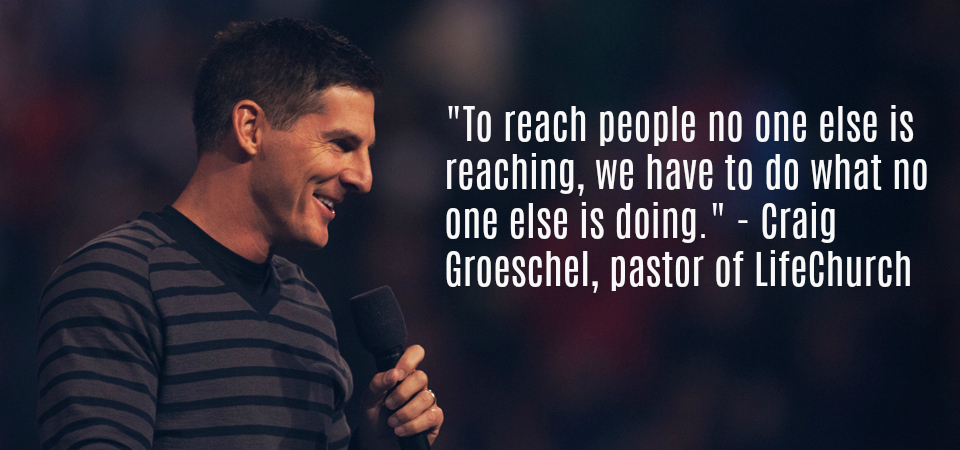
He once said, “You don’t build it for yourself. You know what the people want and you build it for them.” And the way he did that was by paying attention to others, learning what they wanted, and really listening to their needs. One time when Disneyland was first open, some of his team noticed that people were walking through the flower bed. They were creating their own path and the people around him were saying, “I guess we need to build a fence here to make sure people don’t walk through the flower bed.” Walt said, “No, what we need to do is tear out the flower bed and create a better walkway. People are telling us what they need with their actions. We need to listen to them.” And he did. How well are we listening to our community? How well are we responding to the needs of those around us? I often think of something another Craig said (Craig Groeschel of LifeChurch.tv), “To reach people no one else is reaching, we have to do what no one else is doing.”[6] We have to be innovative and break barriers to reach people with the love of Christ. We have to have extravagant generosity and abundant kindness and patience. We have to meet people where they are at and find ways to show the love of Christ.
We provide something unique.
Something you can’t find anywhere else – the transformative power of Jesus Christ through his love. With a gift so extraordinary, you have to wonder why the whole world isn’t Christian. It’s because we have not always done a good job of meeting people where they are. Because we have at times been judgmental and condescending. Because our own comfort and our own desires have often outweighed our one true goal – to help others know the love of Christ. We have to stay focused on who we are and what we have to offer. We have to believe whole-heartedly in our purpose as a church, because it’s good and true and worthwhile. And the rest will come. When I went to a Disney Institute class on leadership, they told us the key to their success was this focus on purpose – We Create Happiness. As long as they hold on to that, everything else that the world measures as a success – money, influence, etc. – will all follow. Other companies, other organizations, start worrying about the bottom-line, about how much their stock is worth, about how they stack up to the other theme parks and movie studios. But Disney focuses constantly on making people happy. They know that if they do a good job with that, the rest will follow. The same is true for the church. When we start worrying about how much money is in the bank or how many people are in the seats over how many people know the love of Christ, we will certainly lose our focus. But if we keep in the forefront of our minds how best to show the love of Christ, how we can be relevant to this generation and the next, we won’t ever have to worry because our impact will shine.
[1] http://www.forbes.com/sites/ericwagner/2013/09/12/five-reasons-8-out-of-10-businesses-fail/#755787b95e3c
[2] https://www.wdwinfo.com/news-stories/global-theme-park-attendance-grew-5-in-2018-with-disney-still-on-top/
[3] All park income figures from the WDC report from https://www.themeparkinsider.com/flume/201811/6396/
[4] Disney’s Approach to Customer Service, Disney Institute, p.21.
[5] Ibid, p.29.
[6] From Catalyst West many years ago
Glass Houses

Lefties are people, too.
But you may not know it from how the world has treated us. Centuries of prejudice and discrimination have dogged those of us who use our left hand. Art, literature, cultural traditions – these have all been geared toward right-handed people. Try playing a guitar or almost any musical instrument and you’ll find that it’s always harder for us lefties. Scissors, desks, notebooks – almost all geared toward the right-handed people of the world. For most of history, being left-handed meant there was something wrong with you. It’s even reflected in our language and in our culture. Did you know that the word for “right” in Latin is “dexter?” As in “dexterity” or “ambidextrous.” Usually it means someone who is versatile, limber, or skilled. All good things. You know what the Latin word for “left” is? “Sinister.” I don’t think I even have to explain that one. Do you know why people wear wedding rings on their left hands? To fend off evil.[1] You know why we throw salt over our left shoulder? To fend off evil. It took until the 20th century in America let alone the rest of the world, to understand that being left-handed did not mean that you were wrong, evil, or sinister.

It was even common to try and “convert” left-handed people.
As if you could train the left-handedness out of them. Why you would want to is beyond my understanding, but it happened to me. When I was little, we’d go and visit my grandparents, and anytime I picked up a fork, a pencil, or a pen; anytime I picked up anything with my left hand, my grandmother would take it from my left and put it in to my right. She grew up believing being left-handed was a bad thing. Now, I don’t know if she thought it was bad simply because it made life harder and she was trying to save me from the suffering, or if she thought it was bad because evil spirits would inhabit my body and take control of me, but she would try to train the left-handedness out of me. My mom had to keep telling her that it was alright, that it was natural for me to be left-handed, but sometimes I wonder if I’m ambidextrous because of my grandmother always trying to get me to use my right hand. Now, of course, we know those of us who are left-handed are more creative and intelligent than you poor right-handed people. We are, after all, the only ones in our “right minds.” But seriously, centuries went by and most of society believed left-handed people were evil or under the influence of evil spirits just because we were different.

As a society, we are quick to pass judgment on those who are “different.”
Those who look different, think different, or act differently than we do often get treated as pariahs. And whether we realize it or not, we treat them much like we used to treat lefties – as if there was something wrong with them instead of simply people who were different. If you look at the long stretch of history, society has done this to pretty much every group of people on some level. We have a horrible track record with people of color, with women, with gender and sexual identity; we’ve been nasty to children, the elderly, and to those who don’t ascribe to “our” religion. If there’s a group of people out there that we can name as the “other,” you can bet history hasn’t been kind to them. And that’s what we are about to see in our reading today.
1But Jesus went to the Mount of Olives. 2At dawn he appeared again in the temple courts, where all the people gathered around him, and he sat down to teach them. 3The teachers of the law and the Pharisees brought in a woman caught in adultery. They made her stand before the group 4and said to Jesus, “Teacher, this woman was caught in the act of adultery. 5In the Law Moses commanded us to stone such women. Now what do you say?” 6They were using this question as a trap, in order to have a basis for accusing him.
But Jesus bent down and started to write on the ground with his finger. 7When they kept on questioning him, he straightened up and said to them, “If any one of you is without sin, let him be the first to throw a stone at her.” 8Again he stooped down and wrote on the ground.
9At this, those who heard began to go away one at a time, the older ones first, until only Jesus was left, with the woman still standing there. 10Jesus straightened up and asked her, “Woman, where are they? Has no one condemned you?”
11“No one, sir,” she said.
“Then neither do I condemn you,” Jesus declared. “Go now and leave your life of sin.” – John 8:1-11
We have all been this woman.
Maybe we haven’t committed adultery, but we’ve all done something wrong and been called on the carpet for it, and we pray that someone will have mercy on us for our mistakes. And here, Jesus shows that mercy. He shows his love and compassion for her and forgives her. We are all in need of forgiveness. But here’s what’s really interesting. When you read the story, you’re tempted to think it’s the woman caught in adultery that is on trial, but actually it’s not. It’s Jesus. HE’S the one they are trying to condemn. If you read verse six it says, “They were using this question as a trap, in order to have a basis for accusing him.” They were hoping Jesus would say something so over the top that they could justify arresting him and accusing him of heresy, and if you notice, in the Bible, they do this over and over again. In fact, they were so overzealous, they didn’t even follow their own laws, the laws they were mad at Jesus for breaking. Deuteronomy 19:15 says you need at least two or three witnesses to convict a person, but they didn’t bring forth any witnesses against this woman. Deuteronomy 22:22 says that any man caught in adultery must die alongside the adulteress, but again, they never brought him forth either. They were so blinded by their own prejudices against Jesus they violated the very thing that made them mad at Jesus to begin with and they broke the law.
And that’s the danger.
You can become so blinded by your fear, by your anxiety, by your unwillingness to accept things that are different, that you miss out on opportunities in life. You miss out on the important things like love, forgiveness, and peace, and instead get wrapped up in the petty small things that in the scope of it all are really unimportant. The Pharisees and the church leaders missed out on the coming of the Messiah. They were so consumed by their fear of Jesus and their anxiety about what he did, they couldn’t see that the Christ they had been praying for was standing in their midst. The church of today still does this. And unfortunately, more often than not. One of my pastor friends told me about this woman who was coming to visit the church. She was dressed in clothes that were a bit ragged and worn but you could tell she was dressing in the best clothes she had, and her children were wearing regular kid clothes. Nothing fancy, just shirts and pants. As she walked up to the church doors, the usher turned to the woman and said, “At THIS church, we dress up for God.” Red-faced, she turned away and left and as far as I know, she never came back. That was a person looking for the love of God and realizing it wasn’t in THAT church. I hope she found it in another, but would you be surprised if she never came back? Sometimes we stand in judgment of others without recognizing the circumstances. If that usher had simply taken the time to notice that this woman might not have any other “nicer” clothes or had thought about the fact that God doesn’t care what you wear to church, maybe he wouldn’t have been so harsh. Honestly, that’s one of the reasons I don’t wear a suit to church every week. I want people who are visiting with us to know it doesn’t matter how you dress for worship, but what does matter is that they are here. Because more than anything, God wants our presence. God wants us to be a part of a loving, worshiping community of people so we can grow in our faith together. And too often we get hung up on how we dress and what we say and how we act when what matters to God are people who are actively seeking him and want to know him. We need to actively remove barriers that stand in the way of people who are trying to come to him. he doesn’t care how you dress. But I am always cognizant of how visitors and people who haven’t been to church in a while think about “church.” I don’t want their clothes or anything else to be a barrier between them and God. I don’t want them to feel “unworthy” to be in church just because they aren’t dressed to the nines. So I dress nicely – polo shirt and khakis, nice shoes – but I hope that my love of God and my love for all of you comes through more in my words and my actions.

There’s an old saying, “People who live in glass houses should not throw stones.”
That comes from this passage we read today. And it’s a reminder that we are just as vulnerable and just as flawed as the people we want to criticize and we need to look at ourselves first before condemning others. That is not to say you may not have a legitimate complaint or gripe against someone else. That is not to say someone didn’t hurt you or harm you in some way. And that is certainly not a justification for blaming the victim. It’s simply a reminder that we need to be careful not to treat others as objects. We need to remember they are people, too. When we see others as people, as children of God who deserve God’s love despite whatever it is they’ve done, it is easier to let go of the anger, the spite, the fear, and the anxiety that comes with labeling someone as the “other.” We make the world a better, healthier place for others and for ourselves. Just think about all the missed opportunities in life, all the hardship, all the pain, all because we couldn’t treat others as people. There are people who could have been the greatest friends, the best business partners, and potential soul mates that we’ve passed up because we never gave them a chance. Think of all of the great left-handed people in the world – Paul McCartney, Bill Gates, Oprah Winfrey, Scarlett Johansson, Clayton Kershaw, and President Obama just to name a few. Think about a world without them because people still thought being left-handed meant you were evil or possessed. How many people in the past did we miss out on because people couldn’t see past that one thing? Give people a chance. Whether they are your friend, your arch rival, your teacher or even your pastor and see them for the human being they are. Give them a chance to show you that God is working in them, too. And hug a lefty today. They are the only ones in their right minds.
Quo Vadimus?

Quo Vadimus – Where are we going?
The first time I heard that phrase was on SportsNight. It was one of my favorite TV shows and it was the title of one of my favorite episodes. In it, this mystery man comes up to one of the characters from the show, Dana, and tries to cheer her up. He says to her, “I’m what the world would consider to be a phenomenally successful man, and I’ve failed much more than I’ve succeeded. And each time I’ve failed, I gather my people together and I ask them, ‘Where are we going?’ And it starts to get better.”

It’s a question we need to ask ourselves every once in a while, because if you don’t know where you’re headed, how do you know when you get there? We spend so much time on the day-to-day, we seldom take time out to really think about the future; about what we hope to accomplish and where we hope to be. Then one day, the future shows up on our doorstep and the past is history. How many people spend their lives wandering aimlessly from job to job, from place to place, without any idea of where they are headed? In that way, we’re a lot like Alice from Alice’s Adventures in Wonderland. Alice bumps into the Cheshire Cat early on and asks him, “Would you tell me, please, which way I ought to go from here?” The Cat replies, “That depends a good deal on where you want to get to.” “I don’t care much where – “ said Alice. “Then it doesn’t matter which way you go,” said the Cat.[1] We have to stop from time-to-time to figure out which way we are headed and then stop once in a while again to see if we’re still headed where we want to go. Otherwise it doesn’t matter and our lives lack purpose and meaning. What we need is a vision.

“Where there is no vision, the people perish.”
That’s the King James Version of Proverbs 29:18. “Where there is no vision, the people perish.” The guy who wrote this must have come from the Central Valley because he probably wrote this on a “fog day.” Don’t be surprised if you don’t know what a “fog day” is. I certainly didn’t when we first moved to Fresno, but schools in the area have built in “fog days” in the schedule. Back in Georgia we would have “snow days” and those were few and far between, but whoever heard of being held up by fog? Well, it only takes one time experiencing it before you become a believer. You can literally be driving along and your visibility goes from miles in front of you to nearly zero in seconds. It only happened to me a couple of times, but it’s scary. To have absolutely no idea if there’s a car in front of you, or worse there’s a car coming the opposite way that perhaps drifted over the line without knowing it? Pulling over doesn’t help because you’re just as likely to get rear-ended. You just have to keep going, hoping you’re headed in the right direction and not knowing what’s around you. That’s what our lives are like when we don’t have a clear idea of where we are headed. Without vision, we won’t get far.

“Vision is the bridge between the present and the future.”[2]
It’s the connecting link between where we are and where we want to be. It provides us direction, focus, drive, passion, and so much more. It sustains us in times of doubt and in times of trouble. Vision gets us out of bed in the morning and makes us excited about the day. It can change your perspective and inspire you to see the ordinary in extraordinary ways. Back in 1671, the famous architect Christopher Wren, was commissioned to rebuild St. Paul’s Cathedral in London. He observed three bricklayers working on the project, one was crouched down, one was half-standing, and one was standing tall. He asked all three of them what they were doing. The first man said, “I’m laying bricks.” The second man said, “I’m building a wall.” The third man, who was by far the most productive of the three and eventually would become the team leader said, “I’m building a cathedral to the Lord.”[3] That’s the power of a vision. It gives meaning to life. It helps us to realize we’re part of something bigger, something worthwhile. That third man didn’t see himself as menial labor or making a living wage. He saw himself as part of a grander vision and it motivated him, made him more productive, and made him happier about his life. And that’s what people want, a purpose in life, something to wake up to and say, “Gee, I’m about to do something worthwhile today.”

It’s no secret I loved working at Disneyland.
Sure the perks were great – getting to go into the park every day for free is amazing. But that isn’t why I worked there and it wasn’t why I stayed. I stayed because I liked being part of something that brought happiness to people’s lives. I stayed because I wanted to be part of something that was doing good in the world. I stayed because I felt like I was part of something bigger than just myself. The Disney motto is “We create happiness.” And who doesn’t want to be part of that? If you looked at what I did on a day-to-day basis, it certainly didn’t look all that grand and it certainly wasn’t all that magical. Some days, I’d be scrubbing trash cans from the inside out. Some days, I spent eight hours scraping off refried beans off of people’s plates. Some days, I would have to stand there and get yelled at by a guy who swears he didn’t have to show ID when he wrote a check, like suddenly he got his law degree because he read about it in the paper. But you were willing to take the menial moments and the embarrassing moments and the harsh moments for the moments when you put a smile on a kid’s face. When you made a parent happy. When you helped to make someone else’s day. Some of these people spent their life savings just to be able to come to Disneyland and they’ll go home and they’ll remember all the magical moments they saved up from being there and YOU get to be part of that. THAT’S what made it all worthwhile.

It’s also why I do this.
It’s why I became a pastor. Because one day it dawned on me that my life was so much better because Christ was a part of it and I wanted to do that for someone else. I wanted to help others know the love of Christ so that they too could know what I know and feel what I feel. I wanted to help others find out about God’s love so they wouldn’t have to go through life without knowing there is a God who loves them and can be there for them and help them make it through the tough times not so alone and not so afraid. Life is simply better with Christ! If you’re a Christian you know that to be true! And if you’re not, I’ve got a secret for you. Life is better with Christ! P.S. It’s not a secret.
So “Quo Vadimus?”
Where are we going? God has already given us the vision. “To make disciples of all nations, baptizing them in the name of the Father and of the Son and of the Holy Spirit (Matthew 28:19).” But that’s massive. That’s a vision for the world. What can we do in our little part of it? We can once again become a neighborhood church. We can make an impact on our community the same way we did when we first started. We can utilize our cultural heritage, our gifts, and our graces to reach out in love to those around us. Did you know that at one time BMUC was once a community church? It just happened to be a community of Japanese people. Due to land laws at the time, Japanese and Japanese-Americans were restricted to living within specific boundaries of the city. We were literally forbidden to live anywhere else in Berkeley, and as atrocious as that is to us now, it also opened the door of possibility. It concentrated a group of people bound by culture and heritage into one targeted area. The Methodists decided this was an opportune place to begin a Christian ministry to the Japanese, and with the help of our Issei and Nisei founders and dedicated pastors, it was the beginning of what would become Berkeley Methodist United Church. But its roots, its origin was as a neighborhood church. Eventually, the restrictions were dropped and our parents and grandparents began to spread out. But this place remains rooted in this community, and the community has changed. We have not.
Imagine for a moment what it might be like if we became a neighborhood church once again.
Not to abandon our cultural roots, but to embrace them; to use them as the basis for ministry in this area. We have a lot to offer our neighborhood. Berkeley is a city known for its willingness to accept the “other;” and who better than us to embrace that philosophy? For those of us of Japanese ancestry, we all know someone if not many people who were thrown into internment camps. We know what it’s like to be shunned or despised based on the color of your skin, the way you speak the language, the food you eat, or the people you associate with. We know what it’s like to be victims of prejudice and hatred for simply being YOU! Who better than us to reach out to the community and say to this city of “others,” “Come into this place where you will be accepted just as you are?” Who better than us to reach out to the disenfranchised and say, “You are a beloved child of God?” Everyone is looking for a place to belong. Everyone is looking for a place where they matter. We can be that place, right here, right now. Our cultural heritage isn’t a barrier to our community, it is the backbone of our strength that will help fuel our vision to reach out and show the love of Christ. It is because of our cultural heritage that we should feel compelled to reach out and help others grow in their faith. We are uniquely equipped to do just that.

Within a one-mile radius of our church live 53,307 people.
Most of whom are not involved in a church or faith community. Only 26.3% are projected to be involved leaving 73.8% not involved at all. That’s almost 40,000 people in a one-mile radius of our church not involved in a faith community. Of all the people likely to become active in a church or faith community? Not quite 4%. Almost four times as many people are likely to become inactive than active. Those numbers seem to be depressing. Almost daunting. But consider this, 4% are likely to become active in a church. In an area within just one mile of our church 4% of people would move from inactive to active faith, that would be over 2,000 people. Could you even imagine over 2,000 people coming to worship here at BMUC? Let’s say of that 4% we only aimed for 1%. That would still be over 500 new people in worship with us, connecting to God with us, and finding strength in their faith with us. Last year, when our leadership team envisioned what they would like to see BMUC look like in five years, almost all of them had us growing as a church. Why can’t that be our vision? Why can’t we utilize the strength of our cultural heritage to fuel our passion and desire to reach out to a new generation? Imagine if this place was filled with people of all different colors, and all different cultures, and all different gender identities, and all different backgrounds, united by a desire to reach out to our community and embrace them for their unique being. Imagine if we became known as the church who loved others just because of who they are because we know what it’s like not to be loved just because you are different. Why don’t we bring THAT vision into our community?
[1] From Lewis Carroll’s Alice’s Adventures in Wonderland (Penguin Classics), p.36.
[2] https://jesusculture.com/posts/1450-the-power-of-a-vision/
[3] https://www.thecathedralinstitute.com/2012/05/13/the-recovering-bricklayer/
The Principle of Inaction

Procrastination can be deadly.
In some cases, literally. When I was in high school, I would put off doing my term papers until the night before they were due. If it was a particularly tough assignment, maybe I would start it that week. But I put it off as long as I could. Then it was a mad dash to the finish! I’d work all day and sometimes all night to get it done. There were days I literally stayed up all night long. One time, I was printing the last page right before my mom had to take me to school. When my mom would ask me why I waited so long to do it, I told her I thrived under pressure. How many of you have used that same excuse? I THRIVE under pressure! And there was some truth to that statement. There’s nothing like having a deadline looming in front of you to get you to produce something quickly. But was it always my best work? Probably not. When I look back, I can see that my failure to plan ahead was mostly a result of avoiding what I didn’t want to do. Not that schoolwork wasn’t important. I had big plans after all. But that as long as I was still getting the grades I wanted, why change? Why disrupt the way I was used to doing things? It wasn’t until I got to UCLA that I realized my lack of planning had some real-world consequences. Like not getting the grades I expected. In high school, I was near the top of my class. I graduated in the top 5%, but at UCLA everyone graduated in the top 5% or they wouldn’t be there and suddenly I found myself struggling in school. But did I immediately turn things around? Did the realization I wasn’t getting the results I wanted enough to make me change my ways? Nope.

Psychologists believe that procrastination is largely avoidance behavior[1].
There’s something we know we should be doing, but we don’t really want to do it. It could be for any number of reasons, but whatever the reason, we’re not doing it. Maybe for you it’s doing the dishes. For others, it’s getting that monthly report in to your boss. Some of you might be putting off something really important like going to the doctor or starting an exercise routine. I know too many people who avoid going to the doctor because they are afraid of what they doctor is going to say. But why? Better to hear it early when you can do something about it than too late when there’s nothing left to do. Some of you have put off God. God is important to you, but you don’t spend any time with God. You don’t spend time developing your faith. You figure you have all the time in the world, until you don’t. Whatever it is, you’re procrastinating. You’re making up excuses for not doing what needs to be done. On some gut level, you know what you have to do, but you’re still not doing it. We’re going to read about someone very much like us in our Bible reading this morning so if you have a Bible or a Bible app on your phone would you find Matthew’s Gospel and go to chapter 25 beginning with verse 14. Matthew 25:14. What we want to avoid is going so far down that road that it’s too late. Whatever it is. Whether we procrastinate about the simple stuff like doing dishes or the really important stuff like our health or our faith, we don’t want to wait so long that there’s really nothing we can do. The guy in our story waited and for him there were dire consequences.
14 “Again, it will be like a man going on a journey, who called his servants and entrusted his wealth to them. 15 To one he gave five bags of gold, to another two bags, and to another one bag, each according to his ability. Then he went on his journey. 16 The man who had received five bags of gold went at once and put his money to work and gained five bags more. 17 So also, the one with two bags of gold gained two more. 18 But the man who had received one bag went off, dug a hole in the ground and hid his master’s money.
19 “After a long time the master of those servants returned and settled accounts with them. 20 The man who had received five bags of gold brought the other five. ‘Master,’ he said, ‘you entrusted me with five bags of gold. See, I have gained five more.’
21 “His master replied, ‘Well done, good and faithful servant! You have been faithful with a few things; I will put you in charge of many things. Come and share your master’s happiness!’
22 “The man with two bags of gold also came. ‘Master,’ he said, ‘you entrusted me with two bags of gold; see, I have gained two more.’
23 “His master replied, ‘Well done, good and faithful servant! You have been faithful with a few things; I will put you in charge of many things. Come and share your master’s happiness!’
24 “Then the man who had received one bag of gold came. ‘Master,’ he said, ‘I knew that you are a hard man, harvesting where you have not sown and gathering where you have not scattered seed. 25 So I was afraid and went out and hid your gold in the ground. See, here is what belongs to you.’
26 “His master replied, ‘You wicked, lazy servant! So you knew that I harvest where I have not sown and gather where I have not scattered seed? 27 Well then, you should have put my money on deposit with the bankers, so that when I returned I would have received it back with interest.
28 “‘So take the bag of gold from him and give it to the one who has ten bags. 29 For whoever has will be given more, and they will have an abundance. Whoever does not have, even what they have will be taken from them. 30 And throw that worthless servant outside, into the darkness, where there will be weeping and gnashing of teeth.’” – Matthew 25:14-30
What did the servant with one bag of gold do wrong?
Technically nothing. But that’s also what he did wrong. He did nothing. He kept the money safe, but he did nothing to make it grow. He knew what was expected, but instead of risking failure, he chose to risk nothing. Sure, he didn’t lose any money, but he lost an opportunity. He lost time and as any person who is running short of it could tell you, time is more precious than gold. When we squander it, we are doing a disservice, not only to ourselves but to God, because it’s God who has given us these gifts. In the story we just read, it’s why the servant who buried the money is sent packing. He has squandered the gifts he was given. My dad had a saying, “You’ve got to spend money to make money.” I don’t know if that was really his saying or something he just believes in, but it was something he said to me when I was a child and it stuck with me ever since. You’ve got to spend money to make money. And he was right. He was trying to tell me you had to invest in something if you really wanted it to get something out of it, no matter what it was. If you wanted results, you had to be willing to put in the time, energy, and effort to make it happen. Does that mean every time you put in time, energy and effort things will work out the way you want? Not at all. But it’s guaranteed you won’t get the results you want if you do nothing. We need to realize inaction IS an action. Not doing anything is a choice we make like any other, and like our other choices it has consequences, too. And that’s what the lazy servant found out when he told the man what he did. The servant thought he was playing it safe by doing nothing, but instead it cost him everything.

Take a moment and think about something you know you should be doing.
And then forgive yourself for it. Sometimes we dwell too much on our mistakes. We dwell too much on our faults and that alone holds us back from doing the right thing. We wonder if we’ll compound out mistakes. We worry about making the same mistakes again, and then we end up putting it off for fear of failure. Which of course guarantees we won’t get anything done. The second thing you can do is DO SOMETHING. Dr. Tim Pychyl who has been studying procrastination for over 20 years says that too often we wait until we’re “in the mood” before doing what needs to be done. We use our feelings as an excuse for not doing what we know needs to be done. Instead, he suggests taking a task, breaking it down into bite-sized chunks, and then doing that first step. And then the next one. It’s hardly ground-breaking knowledge, but again how often do you still put off doing something you know you should do? So it may not be ground-breaking but obviously we need reminders to do it.
This applies to organizations as much as it does to people.
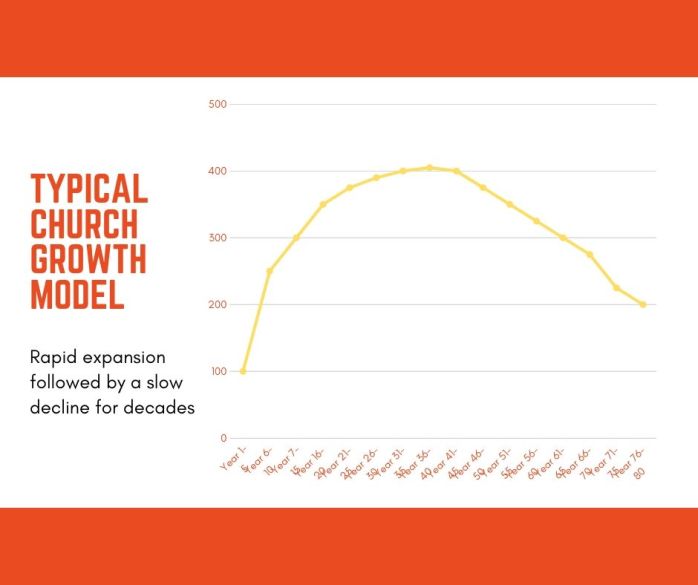
So many churches are in decline. Mostly because they are unwilling to change. They like things the way they are and even though year by year, week by week, they can see the congregation aging and fewer young people in worship, they fail to realize it’s because they stopped changing a long time ago. They stopped innovating. They stopped trying new things. Most churches explode during their first 15 to 20 years and then they taper off over the next few decades. At a certain point, they start to go into decline. At first it’s slow, but as time continues, the decline becomes more noticeable until it becomes so rapid that a church is barely hanging on. At that point, they start to make excuses for their lack of growth, pointing instead to the past or to programs they are doing to grow in their faith. But rarely do they use the metric that Christ himself gave us – to make disciples for Jesus Christ for the transformation of the world.

As we celebrate the past, let us also look into the future.
Because if we don’t take care of the future, the past is made irrelevant. Every church enters into a season of decline. The churches that are successful in coming out of it are the ones that constantly reinvent themselves. They make change part of their DNA and embrace it. They don’t wait for something not to work before doing something different. They realize how important it is to stay ahead of the times instead of behind them. We are a strong and vital church, and we can continue to be one. We just have to embrace change as part of who we are and realize we do it to help others know a God who loves them. The same is true in our personal lives. We know there are things we’ve been avoiding and we know what we need to do. We just need to do them. Stop avoiding it and get it done. We need to remember that inaction IS an action and it has consequences like anything else. The good news is we can do something about it. In the name of the Father and of the Son and of the Holy Spirit. Amen.
[1] https://www.washingtonpost.com/news/wonk/wp/2016/04/27/why-you-cant-help-read-this-article-about-procrastination-instead-of-doing-your-job/
Communion 2.0

All are welcome at Christ’s table – unless you have Celiac disease.
Holy Communion is one of the most important rites and rituals of the church. Since the church was established, we have hearkened back to the Last Supper through this important sacrament – one of only two that we celebrate. For us it is more than simply a reminder of Christ’s call for us to remember him. We feel there is a holy mystery around communion that draws us closer to God. We don’t know how exactly, but even John Wesley, the founder of Methodism, believed it to be one of the ordinary means of grace – meaning it is one of the simple ways Christians can deepen their faith and draw closer to God. Except if you have Celiac disease or are gluten-free. Add them to the growing list of people who are not welcome at the table of Jesus. As of 2017, the Pope announced that all bread at the communion table must be made with at least some element of gluten. According to the “rules” the bread must be “unleavened, purely of wheat, and recently made.”[1] For what purpose? Just because Christ used what we assume to be bread with gluten. But do we really think Jesus would see this as a necessity for communion? Where is God’s legendary grace and mercy in this?

By the way, there is a list.
The Catholic Church has a list of people who can’t come forward for communion. Not an actual list of names, but of deeds deemed to be unworthy. If you ever been divorced, had an abortion or participated in one, had sex outside of marriage or even deliberately had impure thoughts, you can’t come forward. If you haven’t fasted for at least one hour prior to receiving communion you can’t come forward. If you haven’t gone to confession since your last grave sin, and there’s a list you need to memorize, you can’t come forward. If you aren’t Catholic, you can’t come forward. If you are Catholic but don’t believe the wafer and the wine ACTUALLY turn into the literal body and blood of Christ, you can’t come forward. There are literally billions of people not welcome at Christ’s table.

I always assumed we were all brothers and sisters in Christ. But I was wrong.
The first time I found out about “the rules” was when one of my friends was getting married. He asked me to be best man at his wedding and as part of the ceremony each of us – the groom, the bride, the maid of honor, and myself – were all to receive communion. The priest asked me if I was Catholic and I innocently told him I wasn’t. He smiled and just said, “That’s okay, we just won’t tell anyone.” I was grateful for the grace, but had to ask why that was even a question and that’s when I found out – Catholics only. Sounds pretty exclusionary for a faith that claims to be for everyone. I read a Catholic blog that says the rules are there for MY well-being. Someone who comes to the table without the proper requirements is putting themselves in “spiritual danger!”[2] I guess billions of people every Sunday are putting their lives and souls at risk.
Before we pile on the Catholics, let us not forget how much WE all love “the rules.”
They may not be as formal as those in the Catholic Church, but that doesn’t make our rules any less real. The words we say, the elements we bless, the way we do communion are all traditions that build up over time and we begin worshipping the WAY WE DO THINGS instead of worshipping God. We forget the meaning behind the traditions and begin to worship the traditions themselves. And Heaven forbid anyone should change those traditions. You’d think we’d brought back stoning. But that kind of thinking has been happening since the Pharisees. And probably before that, too. The Pharisees especially were known for following the rules. They were proud of it. They would remind you if you didn’t follow the rules, and tell you what the consequences were because they had memorized the list. But when Jesus came he pointed them out as an example NOT to follow, because they had become so obsessed with the rules themselves, they had forgotten the purpose behind them. They had forgotten that tradition was only important as long as it continued to draw us closer to God. That’s what happens to us in worship and in particular communion. We praise the form and functions of communion instead of our Lord who we came to praise in the first place. Part of that focus on the rules comes from this short passage in the Bible we’re going to read from this morning.
53 Jesus said to them, “Very truly I tell you, unless you eat the flesh of the Son of Man and drink his blood, you have no life in you. 54 Whoever eats my flesh and drinks my blood has eternal life, and I will raise them up at the last day. 55 For my flesh is real food and my blood is real drink. 56 Whoever eats my flesh and drinks my blood remains in me, and I in them. 57 Just as the living Father sent me and I live because of the Father, so the one who feeds on me will live because of me. 58 This is the bread that came down from heaven. Your ancestors ate manna and died, but whoever feeds on this bread will live forever.”
The flesh and blood of Christ.
Personally, I wouldn’t want to eat the literal flesh and blood of Christ. Sounds a bit like the zombie apocalypse. But this belief is what is called transubstantiation – that the elements of communion literally turn into the body and blood of Jesus. There must be some kid who has reached into his mouth during communion to see if it was true. Jesus often talked in hyperbole. He did not literally mean that it was easier for a camel to go through the eye of a needle than for a rich man to enter the kingdom of Heaven (Matt 19:24). He did not literally mean that when you give to the needy you shouldn’t let your left hand know what your right hand is doing (Matt 6:3). And he did not literally mean that the Kingdom of God is like a mustard seed that turned into a tree (Luke 13:19).[3] So why is it that some people take this passage as (excuse the pun) gospel? When Jesus declared himself the Bread of Life, no one thought he was made out of wheat. As one writer put it, “He was simply comparing himself to food in general, the most common staple of the diet. Just as bread is the basis of physical life, Jesus is the basis of eternal life.”[4] Most of us inherently understand that interpretation. Jesus is trying to emphasize the things of this world are fleeting. But if we nourish ourselves by living a Christ-like life then we are feeding our eternal soul which is much more valuable to us and to God. He didn’t literally mean we should eat and drink him.

By the way, did you now that the word “communion” isn’t in the Bible?[5]
The King James Bible used the word to translate a portion of 1 Corinthians 10:16, but it means “sharing” or “participation” which is the essence of what communion is. We sometimes refer to it as the Eucharist, but this too is a translation of the Greek word eucharisteo in 1 Corinthians 11:24 meaning to “give thanks” something that is also an essential part of what we do in communion. We share and we give thanks. When Jesus said, “Do this in remembrance of me” (something by the way that is only in Luke’s recounting of the Gospel story), he wasn’t big on the details because the details weren’t important. It was the sharing and the gratitude that were the main focus of the meal. It was a time to draw closer to Christ. Yet, somehow we develop these unwritten “rules” and then hold everyone to them as if THEY were the focus of the sacrament. Yet we feel free to ignore some of the other details. Jesus didn’t use wafers for one. Yet some churches use wafers instead of a loaf of bread. We use grape juice instead of wine and no one seems to have a problem with that. Why we get hung up on some details instead of others says more about us than about Christ.

What we need to do is be open to different ways of doing things.
“Different” doesn’t mean “wrong.” It just means “different.” As long as we keep to the meaning behind what we do, then we can still honor God and find new ways to communicate Christ’s love for us. We’re able to tell his story in different ways so more people can understand what it means to know that love. In one of his letters, Paul was being critical of those who came to communion in an “unworthy” manner, but he wasn’t criticizing the rituals of communion. He was criticizing those who were using communion for their own purposes. Basically, they were having a big party and labeled it “communion” but it had nothing to do with Jesus or honoring what Christ did for us. My hope is that in our effort to reach people for Jesus, we are open to interpret everything with fresh eyes including our most sacred traditions like communion. Not to upset the apple cart, but to try things that might help others understand Christ in new and different ways. I hope we will constantly be introspective about our own ideas of “right” and “wrong” and be open to the Spirit and the heart of what we are doing.
Communion is important.
It is an opportunity for the people of God to gather together in worship and to lift up thanks for God’s work in us and in the world. Communion is important as a reminder of Christ’s sacrifice on the cross and to help keep us humble when we are tempted to think more of ourselves and less of others. But there is something special and sacred about communion that is more than just a shared meal. As John Wesley himself once said, “I haste to this Sacrament for the same purpose that St. Peter and John hasted to His sepulchre; because I hope to find Him there. I come then to God’s altar, with a full persuasion that these words, This is My body, promise me more than a figure; that this holy banquet is not a bare memorial only […] in what manner this is done I know not; it is enough for me to admire. And thus His body and blood have everywhere, but especially at this Sacrament, a true and real presence.”[6] Those are very important words for us as we understand communion. More than any other ritual, ceremony, or liturgy we perform, this one for us brings forth the “real presence” of Christ. It is, as John said, a mystery. One we do not fully comprehend but we experience by faith. Let us come to the table then, with gratitude in our heart, praise for the love of Christ, the memory of his great sacrifice for us on the cross, and open to the movement of the Holy Spirit.
[1] http://en.radiovaticana.va/news/2017/07/08/letter_to_bishops_on_the_bread_and_wine_for_the_eucharist/1323886; https://www.washingtonpost.com/news/acts-of-faith/wp/2017/07/11/the-catholic-church-says-no-to-gluten-free-communion-heres-why/
[2] http://www.aggiecatholicblog.org/2014/06/why-cant-non-catholics-receive-communion/
[3] Examples from http://www.equip.org/PDF/JAL014.pdf
[4] https://www.gci.org/church/lordssup/qanda#elder
[5] https://www.gci.org/church/lordssup/qanda#elder
[6] https://christianity.stackexchange.com/questions/42615/what-was-john-wesleys-view-of-the-lords-supper
Tabula Rasa

What was it like your first time?
Doesn’t matter what it was. Your first kiss. Your first award. Your first time riding a roller coaster. What was it like? Hopefully, it was a great experience. Sometimes it’s not. But our first time experiencing anything is like painting on a blank slate. That’s what tablua rasa means – “blank slate.” It’s like watching colors unfold onto an empty white canvas, a sudden burst of color on a pristine background. It just pours out in a brilliant rainbow of moments and you get to experience the world through fresh eyes, see things in a brand-new way, or sometimes we see things we’ve taken for granted in a new light. We had the chance to do that when we welcomed Kristina into our home. She was an exchange student from Russia we hosted back in 2010 and we were so blessed to have her! She was sweet and thoughtful, always polite, and open to all the different experiences we were able to share with her. We took her horseback riding at Pismo, brought her to Georgia for a traditional Thanksgiving dinner (Southern style), traveled for the weekend up to San Francisco, took her to Las Vegas for the New Year, and of course to Disneyland. We’d been to each of those places many times ourselves, but for Kristina it was all so new! Everything was exciting! Everything was a new adventure! Even things we might think were ordinary were extraordinary in her eyes. And being able to see things from her point of view helped us to appreciate even more the blessings we have. But I also admired her bravery and strength of character. Can you imagine what it must have been like to travel half way across the world and spend nine months in a foreign land? Away from family and friends, away from what is familiar and comfortable, for the chance to experience life somewhere else. It must have been a strange mix of both excitement and anxiety, of hope and of fear all at the same time.

I imagine that’s what it’s like for people coming to church for the first time.
Whether they have been a part of church before and are just coming back or if they’ve never been at all, it must be a mix of both hope and fear at the same time. On one hand, it’s an adventure. On the other, it’s a place where you don’t know the customs, the people, or what to expect. There’s a tension from the moment you walk in. And just as if you were welcoming someone new into your home for the first time, you wouldn’t just be friendly at the door, but you’d want to make it nice and clean and comfortable for them. You’d try to anticipate what might make them feel welcome. Maybe have their favorite drink on hand or a favorite snack. You’d also want them to feel safe. The obstacle course you normally live in would be picked up, things put in their place. Nice and welcoming is great, but it’s that extra step that can really make a difference. The same thing is true as we prepare for new people walking in the door. We want to be more proactive than reactive; to anticipate their needs BEFORE so they feel this is a safe space to explore their faith. It’s been so long since many of us have been new to church we don’t often think about the little things that might make people feel out of place or unwelcome. The words we use, the assumptions we make, why we stand up and sit down are all concepts that are unknown to new visitors. I’m hoping we will take a step back and try to see things from their perspective. Not from the perspective of someone who comes to church or is familiar with church but from someone for whom worship is a new experience. Like my family’s experience with Kristina, we can’t assume that what we might consider “normal” is at all normal to those who are visiting for the first time.
The apostle Paul thought about this a lot.
Maybe Paul was drawing on his own experience being one of the newest of Jesus’ disciples and the only one (that we know of) who was recruited by Christ AFTER he died. But for Paul it seemed vitally important to find ways to reach out to those who did not know Jesus or who were starting to explore a life of faith with Christ. He probably also remembered clearly what it took to convince him. It literally took a miracle. So he knows how tough it is for someone unfamiliar with Jesus beyond Christmas ad Easter to suddenly become a follower, and he determined to do whatever it would take to get people to listen to him.
19 Though I am free and belong to no one, I have made myself a slave to everyone, to win as many as possible. 20 To the Jews I became like a Jew, to win the Jews. To those under the law I became like one under the law (though I myself am not under the law), so as to win those under the law. 21 To those not having the law I became like one not having the law (though I am not free from God’s law but am under Christ’s law), so as to win those not having the law. 22 To the weak I became weak, to win the weak. I have become all things to all people so that by all possible means I might save some. 23 I do all this for the sake of the gospel, that I may share in its blessings. – 1 Corinthians 9:19-23
Paul is speaking to us.
His message is clear. It is OUR responsibility to bring the Gospel to others. It is not THEIR responsibility to come and get it. We sometimes act as if it is. We act as if it is the responsibility of other people to come and seek the Gospel. But a man who doesn’t know he’s lost isn’t going to ask for directions. Before a person looks for help, they have to be convinced that help is needed. That’s where we come in. There is a whole world out there chock full of people who don’t know why they should bother to follow Jesus if they even know who he is, and we have to be willing to do whatever it takes to bring the Gospel message into their hearts. That’s what Paul did. He became whatever he needed to become to bring people the Word of God. To his Jewish friends, he practiced all the Jewish customs. He celebrated the Jewish festivals. He worshipped with them and loved them and helped them so that they would come to trust him when he shared God’s word with them. He obeyed the traditional religious laws even though he didn’t have to. Jesus had set him free, but in order to reach those who still held to those laws, he followed them so they knew he was one of them, so that he could speak to them and they would listen. He showed empathy to the weak even though he was emboldened by Christ so that in his weakness, in his vulnerability, he could make a connection with others they felt they could trust. As Paul said, he became all things to all people so that he might save some.
Hospitality literally means the love of strangers[1]
Hospitality literally means the love of strangers. We are called upon to offer love to everyone, even those we don’t know. Maybe especially to those we don’t know. More radically, we are meant to be self-sacrificial when it comes to showing love to others. When we exhibit THAT kind of hospitality, when we show love for others with our gifts, our words, and our service, we honor God and we become a living testimony to his work in the world today. You matter. While a pastor plays a big role in getting people to stay with a church, it’s the congregation who decides if a visitor is coming back in the first place. Did you know that a person decides whether or not they are going to come back to your church within the first seven minutes? A person decides whether or not they are coming back to your church within the first seven minutes. Generally, that’s long before they ever meet the pastor and certainly before they hear if he can even preach anything meaningful. It’s in the little things that make a difference. How they are greeted, how easy was it to find parking, whether or not it was obvious where they could find out what was going on; these are all important to people who have finally made the decision to come to worship. That alone is a huge deal.

What happens before a person enters those doors is more than we’ll ever know.
If someone makes the choice to come to church after years of being away or if they’ve never come to church and decide there might be something here for them, there is likely a story behind that. I remember taking a seminar on communication and our leader told us people are like icebergs. What we see on the surface, the things people say with their mouths, are often only 10% of what’s really going on. The other 90% is all hidden beneath. We are not going to know the 90% on their first visit or even their fiftieth. What we need to do is realize they didn’t come to this decision easily or quickly, but with some serious thought. And we have to make the adjustment to worship as painless and as comfortable as possible. We need to offer grace. We need to offer understanding. We need to exhibit patience and kindness. And we need to be self-sacrificial. They are probably already wondering as they walk in the door if they made a mistake. Whatever we can do to help can make a big difference.

When Kristina first came to stay with us, we hoped we made her feel safe.
As a host family we wanted her to feel like this was home as much as it could be thousands of miles away. We wanted to make her feel welcome and wanted. And we tried to imagine being in her shoes and what would make her feel like this was a safe space. I hope we did this well. We probably learned as much from her as she learned from us. I believe that is the vision God has for our church, too. And every church like it. To make our spaces feel like home to those who wander in. To remember the courage it takes for people to enter through those doors. And to look at the world through their eyes, to better help them know the love of Christ. There can be no greater reward for us as followers of Christ than to be a part of what God is doing in the world. There can be no greater reward than for us to see the paint spill onto that blank canvas of someone’s faith and to be a part of that moment when they know deep in their heart that there is a God who loves them.
Be The Change

Self-fulfilling prophecies can be deadly.
If you haven’t heard the term before, A self-fulfilling prophecy is a belief or expectation that an individual holds about a future event that manifests because the individual holds it.[1] It’s scary, but sometimes we create our own reality. Our minds are remarkably powerful tools, and like any tool it can be used for harm or for good. But we still get to choose how we use it. Over the course of our lives, our minds get bent and twisted, molded and remade over and over. Outside forces teach us false truths about who we are and what we are capable of. We have notions planted in our heads that tell us we can achieve only so much, rise only so far, do only so little. Sometimes, we’ve lost the battle before it even starts. Self-fulfilling prophecies. Eventually, we start to believe in these limitations so we stop trying. Or we don’t even start. And our self-fulfilling prophecy comes true. We look around and we take a perverse sense of pride in being right without realizing that our own preconceptions helped to bring about this reality in the first place.
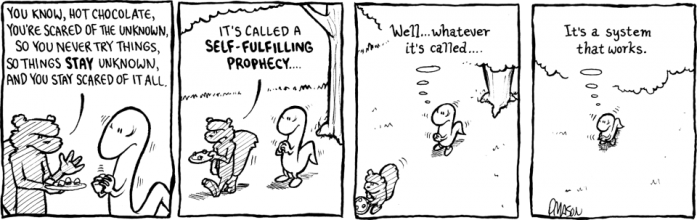
Our church will die in ten years.
I’ve heard that three times since I’ve been here in just one year. “Our church will die in ten years.” Well, not if I can help it and I know many of you share that same passion I have for growing God’s church. But it’s that kind of negative thinking that turns into a self-fulfilling prophecy. Because if you really believe that the church is dying you start going into “turtle mode.” “Turtle mode” is when we hunker down, withdraw into our shell, and do our best to survive as long as we can. Like a turtle. When there is a perceived threat, a turtle will withdraw into its shell and wait it out until the danger has passed. But when churches go into “turtle mode” there usually is no coming out. They stop reaching out. They stop inviting. They let the building go. They save as much money as they possibly can so the church will be around to bury them. Literally. I had someone say that to me once about another church. I just want it to be around long enough that they can bury me. I once served a church that had barely any money in its operating fund, but they had over $300,000 in the cemetery fund. They paid a caretaker to mow and weed the grounds out of the interest they earned on that money. The church was on the verge of financial collapse, but someone would be there to take care of the graveyard even if the church itself was dead. “Our church will die in ten years.”

Here’s the thing about self-fulfilling prophecies – they work the other way, too.
We can believe in something so completely it seems we almost will it to happen. Jesus once told his disciples, “Truly I tell you, if you have faith as small as a mustard seed, you can say to this mountain, ‘Move from here to there,’ and it will move. Nothing will be impossible for you. (Matthew 17:20)” Often, the key ingredient we need is faith. Which doesn’t mean we aren’t allowed to have doubts. One of my favorite stories in the Bible is about Jesus and the dad who brings his son to him for healing (Mark 9:17-23). The father says to Jesus, “…if you can do anything, take pity on us and help us.” And Jesus responds, “If you can? …Everything is possible for one who believes.” And the dad responds by saying, “I do believe; help me overcome my unbelief!” For as many stories there are of people who had the strongest faith, there are stories about people who had doubts, too.[2] People like Gideon who told the angel he was just the weakest member of his clan and his clan was the weakest among all the clans and how could God want to use him? Or someone like Abraham who pointed out to God that nobody as old as he was ever had a child so how could he? Yet these same people had faith, maybe even when there was no real reason to have any.

Now faith is confidence in what we hope for and assurance about what we do not see. 2 This is what the ancients were commended for.
8 By faith Abraham, when called to go to a place he would later receive as his inheritance, obeyed and went, even though he did not know where he was going. 9 By faith he made his home in the promised land like a stranger in a foreign country; he lived in tents, as did Isaac and Jacob, who were heirs with him of the same promise. 10 For he was looking forward to the city with foundations, whose architect and builder is God. 11 And by faith even Sarah, who was past childbearing age, was enabled to bear children because she considered him faithful who had made the promise. 12 And so from this one man, and he as good as dead, came descendants as numerous as the stars in the sky and as countless as the sand on the seashore.
13 All these people were still living by faith when they died. They did not receive the things promised; they only saw them and welcomed them from a distance, admitting that they were foreigners and strangers on earth. 14 People who say such things show that they are looking for a country of their own. 15 If they had been thinking of the country they had left, they would have had opportunity to return. 16 Instead, they were longing for a better country—a heavenly one. Therefore God is not ashamed to be called their God, for he has prepared a city for them. (Hebrews 11:1-2, 8-12)
They were longing for a better country.
Abraham and Sarah and Isaac and Jacob were longing for a brighter future, a future God had promised to them. They didn’t know for sure what this would look like, but they trusted in the vision that God had presented to them and held true to their faith in God. And even though they never lived long enough to see it all come to fruition, they trusted that their efforts would lead them toward a brighter future.[3] The Scripture says to us, “they only saw them and welcomed them from a distance.” The things God promised to the people of Israel and by extension to all of us was not something they could tangibly touch or experience, but they honored God with their efforts even though they didn’t know how it would all work out and that pleased God. Even if they DOUBTED, they still carried on. And by their efforts, they didn’t achieve their dreams, but they unknowingly were part of something bigger and more amazing in the end. We can’t always see where God is leading us, but we need to have faith that it is toward a brighter future.
God is future-oriented.
If you look in the Old Testament or the New, you’ll find evidence of it through the writings of so many different people. God promised Abraham his people would spread throughout the Earth. Abraham surely thought God meant then and now. He couldn’t imagine the scope of what God truly meant or how that would come to be true. Today there are over 2 BILLION Christians in the world, probably far more than in Abraham’s wildest dreams. God promised Moses, he would lead his people to the promised land and even though Moses didn’t live to see it, that promise came true. It would be Joshua who would lead God’s people to that place. These are just a couple of examples of how God’s vision is so much better than ours. Our vision is often limited, but God is future-oriented.
We need to be future-oriented, too.
We need to approach life with a goal and a vision and live into that reality. You need to be the change you want to be. What do I mean by that? There’s an old saying that you should dress for the job you want, not the job you have. And there’s some real truth to that. Not just because you make an impression on the people you’re hoping to impress, but it gives us a sense of self-confidence by doing so. When you feel confident, you radiate that confidence, and it’s that confidence more than anything that people are inspired by. There was an interesting study done at Northwestern University where they had three groups of people do a task where they had to spot the differences between two pictures.[4] One group was told they were wearing lab coats, one group was told they were wearing painter’s smocks, and one group was simply shown a lab coat. All three groups saw or wore the same exact coats, but as you probably already guessed the group wearing “lab coats” did significantly better. The research concluded that wearing certain clothes could improve your performance. The clothes really do “make the man.”
We can also “dress” our attitudes.
Has anyone ever told you to “turn that frown upside down?” Did you want to hit them at that moment? Me, too. But maybe, they were doing us a favor. Scientific studies have shown that putting on a smile actually makes us happier, whether we were happy to begin with or not.[5] The physical manifestations of a smile have effects beyond the muscles in our mouth. They also release chemicals into the body that reduce stress, depression, and aggression. And various studies have shown that smiling can lower your heart rate, lower your blood pressure, and may even lead to a longer life.
These principles can be applied to our community as well.
Whether it’s your workplace, your family, or our church. If we behave like a thriving, successful church we might start feeling like a thriving, successful church. And if we start feeling like a thriving, successful church, we might very well BE a thriving, successful church. We need to ACT as if every Sunday we are going to have visitors come in through those doors. I want us to develop the mindset of successful church growth. A church with a mindset of growth prints extra bulletins because they don’t question IF they’re going to have 1st time guests, but HOW MANY. A church with a mindset of growth sits closer to the front because they know 1st time visitors will feel more comfortable sitting in the back. Churches with a mindset of growth are always aware of how someone new might feel, how intimidating that might be, and does whatever it can to make them feel comfortable, welcome, and at ease. We live into the reality of what we hope to see. I don’t want us to fake it ‘til we make it. I want us to FAITH it ‘til we make it. I want us to live in faith into the reality we hope to see in our church and to be open to where God is leading us. Just remember, our vision for success may be different than God’s vision for success. Let us provide our best effort and allow for the Holy Spirit to do with it what God needs it to be.
When John Wesley was struggling with his faith, this was the attitude he adopted.
As he was on board that old creaking boat in the midst of a storm, he saw this group of Moravians singing on deck. In the middle of a storm! He had been going through a difficult time in his own faith so he asked them for their secret. How could they be so happy in the midst of this disaster? They told him to have faith. When he asked what to do if he didn’t have faith, the Moravians told him to keep soldiering on until the faith he preached was felt in his heart once again. He wasn’t being told to fake it. He was being told to have faith IN it. John knew that God was out there, but he was having a hard time feeling his presence and the Moravians inspired him to have faith that it would one day come back. And it did. My hope for our church is that whether we are 50 or 500, we will always be future-oriented; that we will live with the expectation that God is doing something great in us right now. And that we simply need to be prepared for whatever that is. We can’t afford to live lives of meekness and timidity. We need to live lives of boldness and audacity, because we serve a God we know can do the impossible. Let us live into the vision of the church God wants us to be. Let us take a step out in faith and BE the church we want to create – a place that welcomes those and loves those who do not yet know the love of God.
[1] https://positivepsychology.com/self-fulfilling-prophecy/
[2] From the BibleGateway blog: https://www.biblegateway.com/blog/2012/08/three-bible-heroes-who-doubted/
[3] This section was inspired by Thom Rainer’s book Autopsy of A Deceased Church, Chapter 3.
[4] http://mentalfloss.com/article/74310/8-fake-it-til-you-make-it-strategies-backed-science
[5] https://www.nbcnews.com/better/health/smiling-can-trick-your-brain-happiness-boost-your-health-ncna822591

