
Wired to Find Meaning In Life

What is the meaning of life?
It’s a question most of us have asked ourselves at one time or another. In fact, 75% of Americans believe that there is a higher purpose and meaning for their lives and nearly 70% believe that finding that deeper purpose is a high priority.[1] This isn’t 75% of Christian-Americans or religious Americans, this is 75% of all Americans. An even higher number believe “there is more to life than the physical world and society.”[2] 88%! Even a surprising number of atheists ponder the meaning of life. In a Pew Gallop poll, 35% said that they often think about the higher purpose of their life.[3] Over a third of atheists OFTEN think about this! That’s amazing! They don’t believe in God or an afterlife, but they do believe there is a higher purpose for their life. Why would they think that? Why would people who don’t believe in God or an afterlife or divine providence hold on to this fiction that there is any meaning to life at all? Unless it’s not. Fiction that is.

As a kid, I thought I had it all figured out.
When I was five years old, I had to have a tonsillectomy. I don’t know what it was about my tonsils, but they would get infected seemingly every other week. Dr. Thom and Dr. Crehan knew me very well. One look down my throat and about 10 minutes later I was getting a shot in the rear. The only good part was that afterward, my mom would take us to Tommy’s Hamburgers, the original one in downtown LA and I’d get a burger and a soda and eat it while sitting on the floor of our car. I had a lot of Tommy’s Hamburgers. But going to the doctor inspired me, even at five years old to want to do something to help other people and I decided I wanted to be a doctor. I went through all of elementary school, junior high, and high school with the same goal in mind, but when I got to college that all changed. I realized that being a doctor wasn’t going to be the path for me. But I still felt this pull on my life and I couldn’t quite figure out what it was. When I finally heard God’s call on my life to enter into ministry, I realized that earlier when I thought for sure I was going to be a doctor, it was really a call to find a way to help people. My calling, my meaning in life was to help others in whatever way I could.

Apparently, I’m not alone.
Teens who are notorious for drifting away from church and for feeling disheartened by traditional means of faith have a deep sense they were created for something more. Eighty-seven percent report they believe there is an overall purpose to life. 87%! When asked what they thought that purpose was, the two most common answers were to help people and to be a good Christian.[4] Number three was to be a good person. Nearly 50% of teens thought that one of these answers was the meaning to life. Helping others. Being good. A 17-year old in Kentucky said, “I think that my purpose in life is to help people. I’ve gone through hard times myself, and I can’t even imagine the situations some kids are in — much worse even than the life that I’ve had growing up. I think that as long as I have the ability, and want to help people, that’s what I should do.” A 17-year old from Utah said, “Everyone is here to fill in the holes in other people’s lives, whether little or big holes. Not everybody is the same, and we all need to share our talents and strengths to uplift other people.” And a 15-year old girl from CA said, “I am here to mourn with those that mourn, help those in need, comfort those who stand in need of comfort, and to stand as a witness to God at all times and in all things and in all places. I am here to stand for faith, divine nature, individual worth, knowledge, choice and accountability, good works, and integrity.”[5] But what is it that inspires us to believe these things? What is it we hold in common between believers and non-believers, in church-goers and non-church-goers, in young and old that tells us we are made for a purpose? It’s God. God created us to search for meaning. We are wired to find the meaning of life.
 Whether or not you believe in God, you are wired to search for the meaning of life.
There is something within us that compels us to search for life’s meaning. There’s something within us that craves to know why we are here, what purpose we are meant to serve. And God gives us that deeper purpose. With God we understand what Jesus tells the Pharisee when he’s asked about the Greatest Commandment. Jesus tells him, “‘Love the Lord your God with all your heart and with all your soul and with all your mind.’ 38 This is the first and greatest commandment. 39 And the second is like it: ‘Love your neighbor as yourself.’” It’s this idea of loving God and loving others that helps us to better understand why we are here and it’s fulfilling this commandment that gives us meaning. There are so many ways to show your love of others. It could be with your cooking or your singing or your writing or your gardening or your teaching. It could be how your talents make life easier or better or more meaningful for others. There isn’t just one way to love your neighbor. There are as many ways to help others as there are talents in the world. More actually. And it’s in the process of loving others and helping them that we have meaning in our lives.
But you don’t have to take my word for it, or even God’s.
From a purely scientific point of view, helping others gives us a sense of purpose. Researchers have studied this and have found that helping others gives us a sense of free will, it helps us to feel like we are good people, and it strengthens our relationships to others both in a specific and a general sense.[6] But it also gives us a general sense of purpose. Helping others makes us feel that life has meaning.[7] And if you’re a Christian that all makes sense. Most of what the prophets and the disciples record for us tells us to help others and to build one another up. Whether it’s in the New Testament or Old Testament. It doesn’t matter. The prophet Micah tells us we are “to do justice, and to love kindness, and to walk humbly with your God (Micah 6:8).” Paul wrote in his letter to the church in Galatia, “…do not use your freedom as an opportunity for the flesh, but through love serve one another. For the whole law is fulfilled in one word: ‘You shall love your neighbor as yourself (Galatians 5:13-14).’” And God himself tells us in Leviticus, “The foreigner residing among you must be treated as your native-born. Love them as yourself, for you were foreigners in Egypt. I am the LORD your God.” Helping is a part of who we are and who were created to be. And here’s why.
14 “You are the light of the world. A town built on a hill cannot be hidden. 15 Neither do people light a lamp and put it under a bowl. Instead they put it on its stand, and it gives light to everyone in the house. 16 In the same way, let your light shine before others, that they may see your good deeds and glorify your Father in heaven.
We are meant to be a city on a hill.
We are meant to point the way to God. As Christians we understand God has already done so much for us that we are compelled to do good things for others. We know Christ sacrificed everything so that we might have eternal life and so we dedicate ourselves to helping others receive God into their lives too. We join together in God’s quest to bring as many as possible to him. So for us, doing good, helping others is not only what we feel compelled to do to love our neighbor, but is our way of honoring what God has done for us. Anybody can do good, but knowing why we do good and where this drive comes from gives us a sense of peace and wholeness that comes from nowhere else.
 But there’s more to it than that.
Knowing God is at the heart of all things and believing he is are two different ideas altogether. Finding that peace in your life doesn’t come from the head but from the heart. And most people don’t spend enough time thinking about God for it to really sink in to their heart even if they do a bunch of good stuff. When asked how often they think about the deeper meaning of their lives, 38% of people barely think about it if at all. When asked if they thought about going to heaven the results were worse. Only 11% thought about it yearly and a whopping 46% never thought about it at all. And it gets worse still. When asked if they “think often about what I must do to experience peace in the afterlife,” 50% of people said they didn’t.[8] As a society, we pay lip service to knowing God and finding the meaning of life, but too often we don’t think about it much at all. Part of that is the hectic nature of life. But part of it is that we just don’t make it a priority.
If there is an afterlife and God is a part of that, this really is the single biggest question of our lives.
We owe it to God and we owe it to ourselves to work on this and to make it a part of who we are. So if you are a Christian and you do believe in God, I want to ask you to do two things. One, think about this way more than once a year. And two, make it a priority to know God better. I promise that if you do, you’ll be even more at peace than you already are and you’ll feel more fulfilled than you already do. Help others with the mindset that we do so to honor God and to light the way for him. And if you don’t believe in God or you have doubts, please at least consider that this desire you have to find the meaning of life might just perhaps really come from God. That this deep longing you have to figure out they “whys” and “wherefores” of life have to do with something beyond this world. And then open your heart to the possibility of more.
[1] http://www.lifeway.com/Article/Research-Ultimate-purpose-and-meaning
[2] Ibid
[3] http://www.pewresearch.org/fact-tank/2016/06/01/10-facts-about-atheists/
[4] Data about teens comes from http://www.gallup.com/poll/11215/how-many-teens-see-purpose-life.aspx
[5] http://www.gallup.com/poll/11215/how-many-teens-see-purpose-life.aspx
[6] http://greatergood.berkeley.edu/article/item/can_helping_others_help_you_find_meaning_in_life
[7] Ibid.
[8] All data in this section comes from http://www.lifeway.com/Article/Research-Ultimate-purpose-and-meaning
Wired to Search For God

Why are people sending us “good thoughts?”
I know it’s meant with the best of intentions, but what does that mean? I see this a lot on Facebook, mostly from non-religious friends but occasionally from religious ones, too. Usually it’s in response to a friend going through a hard time. Whether it’s a health situation or the loss of someone close to them or getting fired from a job, if you scroll down the comments you’ll usually find someone who will say, “Sending you good thoughts” or “My thoughts are with you.” At first, I thought this was nice, a way for people to invoke solidarity with someone they care about, but the more I thought about it, the more it seemed like an empty platitude. “Sending you good thoughts.” What does that mean? Are they facing the general direction of the person when they are sending these good thoughts? What is the person on the other end supposed to be doing with these good thoughts? It would be better to send money. After all thoughts are only worth a penny.

When people make these comments, I know it’s only meant in the best way.
But without God what does it really mean. When people are offering their prayers, they are offering something tangible. You might be thinking that prayers are about as tangible as good thoughts, but when we offer a prayer for people, we are offering our commitment. We’re offering our time, we’re offering our reputation by appealing to God on behalf of someone else, we’re offering our humility by bowing before God and asking him if not downright begging him for some kind of intervention. We are putting ourselves in front of the Creator of the Universe and saying, “Pay attention! This person is worthy of your help.” And people understand that idea. Whether they are religious or not, people appreciate your prayers. Because even if they don’t believe, there’s a part of them that understands the commitment you are making on their behalf. But here’s the thing. I think, deep down, most people believe in God. I don’t think there are as many atheists as we commonly believe. They might not believe in God the way we understand God, but most people have this inclination to something higher than themselves. And that’s why they say things like “sending good thoughts.” They may not believe in God, they may not believe in the power of prayer, but they believe there is something out there they can appeal to even if they don’t know what that something is.
 That’s because we are wired to search for God.
When God created humanity, he put within us this longing to search for him. We want to know God. We might refer to God in different ways, we might understand God in different ways, but we are all pointed in our lives toward God. Does that mean every religion is true? No. Does that mean we all believe in the same God? No. But it does mean that people encounter the Holy Spirit whether or not they believe in it or call it by that name. It means that God is constantly revealing himself to us in and through the world around us. But our hearts have become hardened. Like the callous at the bottom of your big toe or on your writing hand. Remember that? When people used to write for a living and they would develop a callous on whatever hand they used for writing? We don’t have that anymore because of computers. Now, I’m sure we’ll get something else. But like that callous that naturally forms over time by being constantly rubbed the wrong way, our hearts get hardened too and it makes it more difficult for us to see God. That’s why Jesus told the disciples that Isaiah’s prophecy has come true. We have eyes to see and ears to hear, but can’t seem to do either. But despite this callousness of life, despite our own hard-heartedness, despite all of that, we can’t help but seek God.
24 “The God who made the world and everything in it is the Lord of heaven and earth and does not live in temples built by human hands. 25 And he is not served by human hands, as if he needed anything. Rather, he himself gives everyone life and breath and everything else. 26 From one man he made all the nations, that they should inhabit the whole earth; and he marked out their appointed times in history and the boundaries of their lands. 27 God did this so that they would seek him and perhaps reach out for him and find him, though he is not far from any one of us. 28 ‘For in him we live and move and have our being.’[b] As some of your own poets have said, ‘We are his offspring.’[c]
29 “Therefore since we are God’s offspring, we should not think that the divine being is like gold or silver or stone—an image made by human design and skill. 30 In the past God overlooked such ignorance, but now he commands all people everywhere to repent. 31 For he has set a day when he will judge the world with justice by the man he has appointed. He has given proof of this to everyone by raising him from the dead.” – Acts 17:24-31
God created us and gave us life and in doing so hoped we would one day seek him and find him.
It’s simply part of who we are. It’s built into our DNA. If there was ever a way to dissect the spiritual part of our lives, we would find that God put us together in a certain way and that this desire to know him and to seek him is built into every strand within us. God isn’t something you leave behind at church. Instead God is always with us. That’s why Luke wrote in this book that God does not live in temples built by human hands. Because God lives within us! We are just very good at ignoring him. Instead we turn to other things to fill that part of our lives. We turn to other gods and other goals and other desires to fulfill this basic need to search for the divine. It’s so much a part of us that we don’t even realize how it bleeds into how we act and behave. That’s where phrases like “sending good thoughts” or “my thoughts are with you” enter into our vocabulary. There’s a part of us that wants to pray, to communicate with God, but we just don’t know it or understand it. Maybe we’re just flat out opposed to it. Maybe all your life you were told that if you prayed and believed, God would answer and he just flat out didn’t. And so you gave up on prayer. But there’s a part of you that yearns to communicate again. There’s a part of you that wants to appeal to something greater than ourselves either individually or collectively to do something. But we just can’t bring ourselves to do it.
I have found that most people are not truly atheists.
They may not believe in God the way we talk about God in church, but they are not truly atheists. To be sure there are some out there, but most people object to God not because the thought of God is stupid or childish or immature. But because they have found fault with him. God wasn’t there for them in their moment of crisis. God didn’t keep his promises. God allows evil to exist in the world. The God in the Old Testament and the God of the New Testament don’t add up to the same God. And if our understanding of God crashes head long into our experiences in life, God often is the victim. If God can’t uphold his end of the bargain, then he must not be real. But those objections are more about religion than the existence of God. Most people’s objections to faith are more about religion than God. They are more about our understanding of God rather than if he exists. I’ve heard horror stories about people who have a deep misunderstanding of God who are self-professed Christians and sometimes even pastors and church leaders, and if they were my experience with the God of Christianity, I wouldn’t believe in him either. My friend Jon from when we lived in Atlanta was so turned off by the church because of the hypocrisy and outright racism he found there. His friend and her fiancé went to her pastor to be married…and the pastor refused. She was white and was in love with an African-American man and the minister refused to do the ceremony because he said it was unbiblical. I don’t know where he got that from, but I know for a fact it doesn’t say that anywhere in the Bible, but he used the Bible as a defense to justify his own racism. If that was your experience with religion, maybe you wouldn’t believe either. I had a friend who used to be a pastor. He was consoling a grieving mother whose son had committed suicide. They were talking after the memorial service when one of his parishioners came up and told this bereaved woman that her son was going to hell for what he did. By the way, also not in the Bible. These are simply outdated untruths that a few ignorant people never bothered to question. And if that were typical of your experience with God, you probably wouldn’t believe in him either.
Instead people turn elsewhere to connect with God.
They turn to other religions or to other philosophies like Buddhism. They turn to material things like money. They put their faith instead in science. Because people are yearning to connect with SOMETHING even if they can’t put their finger on it. People everywhere are searching for answers. They are searching for meaning in life. They are hoping to find the answer to the eternal question, “Why am I here?” And if they really didn’t believe in something more, if they really didn’t believe in God, they would stop searching because without God there is no meaning. Without God, life simply is. There is no good and evil. Those are just constructs of the human mind. There is no love. That is just a chemical reaction within the body responding to external and internal stimuli. There is no soul or inner self. It’s all just an illusion. And most people just can’t go that far. They believe in love. They believe in the soul or something like a soul that defines who they are. They believe in good and evil. So their objection isn’t to the possibility of God but in how we’ve come to understand him. But this search. This search for answers. This search for meaning. These are things that God put within the DNA of our soul to make us curious so that even the most jaded people amongst us might be tempted to seek him out.
I was watching The Big Bang Theory the other day.
And there was this episode where the guys are trying to buy tickets to the new Star Wars movie. Leonard finds out that tickets went on sale but when they try to buy them, they are all locked out. They try refreshing their screens, they try different websites, but nothing is working so Sheldon – a self-proclaimed atheist – announces that “desperate times call for desperate measures” and he drops to his knees to pray. “Lord, this is Sheldon Cooper. You’re good friends with my mom. I know I’ve spent my whole life denying that you exist.” Suddenly Wolowitz shouts out, “Got it!” And Sheldon concludes, “And I will continue to do so!” There is something in us that believes in something more, even if we are only willing to believe for the moment. There is something in us that hopes for something more. If you’ve never fully explored what that something is; if you’ve felt that pull in your life but haven’t really done much about it, I want to consider that maybe, just maybe God did wire you this way. That he has been tugging at your thoughts because he wants you to be connected to him. And I ask that you simply open up your heart to the possibility of God in your life. I’m going to ask you to take some time to really think about God and to actively search for him in everything you do. I’m hoping you will develop that desire to have eyes that see and ears that hear because I know God wants you to be a part of what he has in store for you. If you’ve already made that choice to open up to God, I challenge you to open your life to him even more. To allow him access to those areas you have always been resistant to, and only you and he know what those areas are. God made you to be naturally curious about life because he wants you to find him. But I won’t be sending any good thoughts your way. Instead, I’ll be saying a prayer.
The Year of Jubilee

Extraordinary kindness.
Love. Generosity. There are people in your life who go above and beyond what’s expected. People who impact you in an extraordinary way. I feel blessed to have more than my fair share of people like that in my life. My friend Lyn is one of those people. We worked at Disneyland together and would hang out often. She was one of the sweetest and nicest people I’ve met and her good nature really stood out one day while I was up at UCLA during my undergraduate days. There was a girl I had a serious crush on at school and things weren’t going so well. I called Lyn up and just poured out my heart to her and as she listened to my frustration and sadness, she told me everything was going to be okay and then said, “Don’t go anywhere. I’ll be right there.” I waited in my room when there was a knock at the door about an hour or two later. I opened it up to see Lyn there, holding this Pooh Bear she bought just for me. She gave me a hug, said “I thought you could use a friend,” and just sat with me for a while before heading back home. That one act of kindness has stuck with me ever since. That was about 30 years ago now and it still feels fresh in my mind. Who does that? Not only did she make the long drive up from Anaheim to UCLA (no small feat in itself), but she made time to stop at Disneyland, get me a big Pooh Bear, brave the traffic, and find parking on a campus notorious for little to no parking. Not to mention we were both college students on a budget. Still she did all of that just for me.

In times of need, it’s good to know you have friends you can count on.
Back when I was in seminary, I had the extraordinary opportunity to attend a seminar in France about Methodism in Europe. We were going to stay for a week at a Christian retreat center in the small city of Sete on the French coast and would meet up with fellow pastors from all over Europe. To go would cost quite a bit of money and Cassie and I were not as well off then as we are now. It was a struggle just to send me to seminary. Even now, it would still have been a stretch to pay for it, but Cassie agreed this was too good of an opportunity to pass up so we committed to figuring out the finances along the way. As part of the curriculum, the school had us send out ten letters to friends and family to ask for their help in deferring the cost. I did it to fulfill my obligation to the class, but I didn’t want to. I didn’t want to be a burden to family and friends or make them think I was abusing our relationship to get something out of it, so I also sent a separate note to everyone to explain all of that and let them know we weren’t expecting anything. But one of my friends did. My buddy Lance gave me $500. I was flabbergasted. Up to that point, I don’t think Cassie and I had given $500 in one lump sum to anyone or anything so to receive that gift was extraordinary. And it’s not like Lance was rich. He didn’t own a mansion. He was just making a living like everyone else so $500 was a very significant amount of money. But he said he wanted to help and knew this was important. It was. To this day, the things we saw and talked about during that week have impacted my life and my ministry. It was the first time ever I had the chance to travel abroad. It was the first time I had the chance to experience God in a different country through different eyes. It really was life changing and I have been so grateful for that opportunity.


When people show extraordinary love, it changes your life.
And you don’t have to travel across the world for it to have that kind of effect on you. If you have your Bibles or a Bible app on your phones, I want you to find the book of Leviticus 25:8-10. Leviticus 25:8-10. Think back to a time when someone in your life did something like that for you. Think of a time when someone was there for you just when you needed them. Maybe they were there to comfort you when you were feeling like the world was coming to an end. Maybe they took care of you at the hospital and came to visit when you were scared or lonely. Maybe you were in need and someone reached out with a helping hand. That is humanity at its best, when we behave like the people God is hoping we will be. And when we do that, we can change the world. Lance helped me out about 15 years ago and Lyn came to my side almost 30 years ago and I still remember both like they happened yesterday. When people show extraordinary love, you can’t help but have it affect you. It influences you. It changes you. And that’s exactly the way God planned it. God WANTS us to be extraordinary givers of compassion and kindness. God WANTS us to overwhelm people with our love and generosity. Because that’s how we are going to change the world.
8 “‘Count off seven sabbath years—seven times seven years—so that the seven sabbath years amount to a period of forty-nine years.9 Then have the trumpet sounded everywhere on the tenth day of the seventh month; on the Day of Atonement sound the trumpet throughout your land. 10 Consecrate the fiftieth year and proclaim liberty throughout the land to all its inhabitants. It shall be a jubilee for you; each of you is to return to your family property and to your own clan. – Leviticus 25:8-10
Every fiftieth year was proclaimed by God to be a Year of Jubilee!
It is a time of extraordinary forgiveness, compassion and kindness. God tells the Israelites, “proclaim liberty throughout the land to all its inhabitants.” But these aren’t just words. God tells the Israelites to set his people free. If someone was in debt, their debt was to be forgiven. If someone had to sell their land, their land was given back. If someone was a servant, they were released from service. It was complete freedom and forgiveness. God wanted his people to be free to serve only God. He knows when we are bound to someone else and could not take care of our basic needs, we could not truly devote ourselves to him. So just as we observe the Sabbath once a week to free ourselves for worship and rest, God wants us as a society to be restored and renewed. Restoration is important to God and thus it should be important to us. At the end of the chapter, God proclaims, “‘Even if someone is not redeemed in any of these ways, they and their children are to be released in the Year of Jubilee, 55 for the Israelites belong to me as servants. They are my servants, whom I brought out of Egypt. I am the Lord your God.” We are his people and we cannot be free to serve God when we are obliged to serve others. The key to free us to be God’s people is this form of radical forgiveness, compassion, and kindness.
 We’ve been talking about basic needs for the past month.
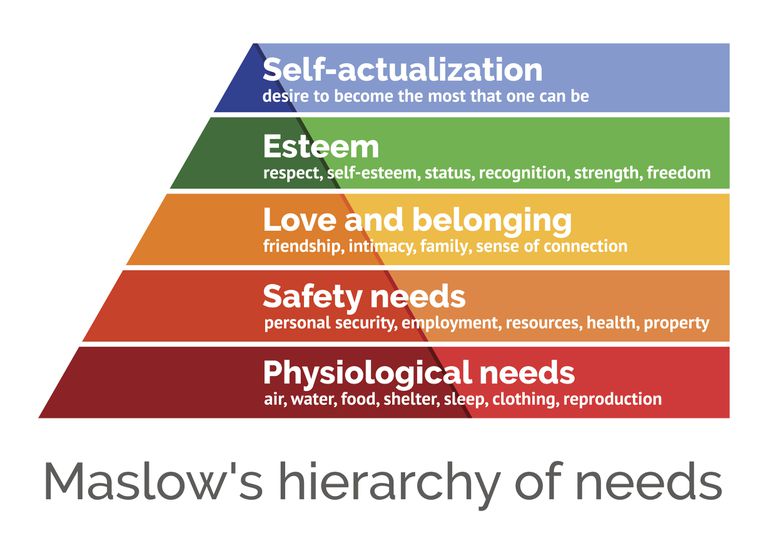
And how vital it is to have those needs met. We’ve talked primarily about physiological needs so far – food, water, shelter, clothing – but we’ve moved beyond those into what Maslow would refer to as higher needs. The need for security, the need for love, the need for kindness and acceptance. These are important needs also, every bit as important as the physical ones. Because like our physiological needs, when they aren’t filled we are inhibited from being the people God created us to be. And that’s why God demanded we celebrate this “Year of Jubilee,” to free us from whatever might be holding us back in this life. This idea of the Year of Jubilee is found embodied in the life of Christ. Christ came to liberate us from our sins, to free us from the shackles of rulers and teachers who stressed form and function over love and acceptance. Christ came not to tear down the law, but to free us from the yoke it had become and to help us realize the law was there to help us become our best selves. It wasn’t meant to be a tool of oppression as it had become. The Pharisees would use the law as a bludgeoning tool instead of a guide to right living. And we see that same attitude in our world today. People use the law to get what they want, to hurt those who aren’t like themselves, and justify their actions with “the law.” But they are not using the law as it was intended. Instead they are abusing the law for their own desires. Look at the immigration detention centers across the country. Horrific stories of abusive conditions have been reported and the governments only response is “they shouldn’t break the law.” Does that give us the right to treat them with cruelty and abusive behavior? Does that make it okay to separate siblings and only allow them to see one another once a week?[1] Does that mean it’s alright to give them rotting food and broken bathrooms? The kind of behavior we would not find acceptable among our own citizens we somehow find acceptable for those who are not? Many of our leaders like to proclaim we are a Christian nation. Then how can we blatantly ignore God’s call on us to care for the alien in our midst? How can we ignore God’s call on us to take care of the poor and those in need and still say we are God’s children?

The next Year of Jubilee is in 2025.
The Catholic Church celebrates it every 25 years instead of 50. In fact, when needed, the Pope calls for special Jubilee years like in 2015 when Pope Francis declared the Extraordinary Jubilee Year of Mercy. But why wait? Why wait for the Catholic Church or for the Jewish calendar to align with the values behind the year of Jubilee? Why not instead take steps to live our lives in such extraordinary ways that we make an impact on the world around us constantly? Especially during the Christmas season as we are reminded of the great gift God bestowed upon the world through his son, Jesus, let us remind the world that Christianity is founded on the ideas of forgiveness, mercy, and redemption and act accordingly. Do one extraordinary act this year. Just one. Ponder upon the ways you can do something to impact the life of another. It doesn’t have to be with money. Look at how my friend Lyn was there for me with her presence and her thoughtfulness and what a long-lasting impact that had on my life. You can do the same. You can offer to let someone stay in your home. You can forgive a debt someone owes you. You can forgive someone for something they did to you when you have every right to be upset. There are lots of ways to be an extraordinary person. Sometimes it’s in doing the little things without complaint and with a smile day after day. The idea that God loves a cheerful giver does not just mean with money, but with everything we do. Let’s make this year and every year a chance to show the extraordinary love of God.
[1] https://www.wbur.org/onpoint/2019/06/20/immigrant-detention-centers-us-mexico-border
The Rice of Life
What does Jesus look like to you?
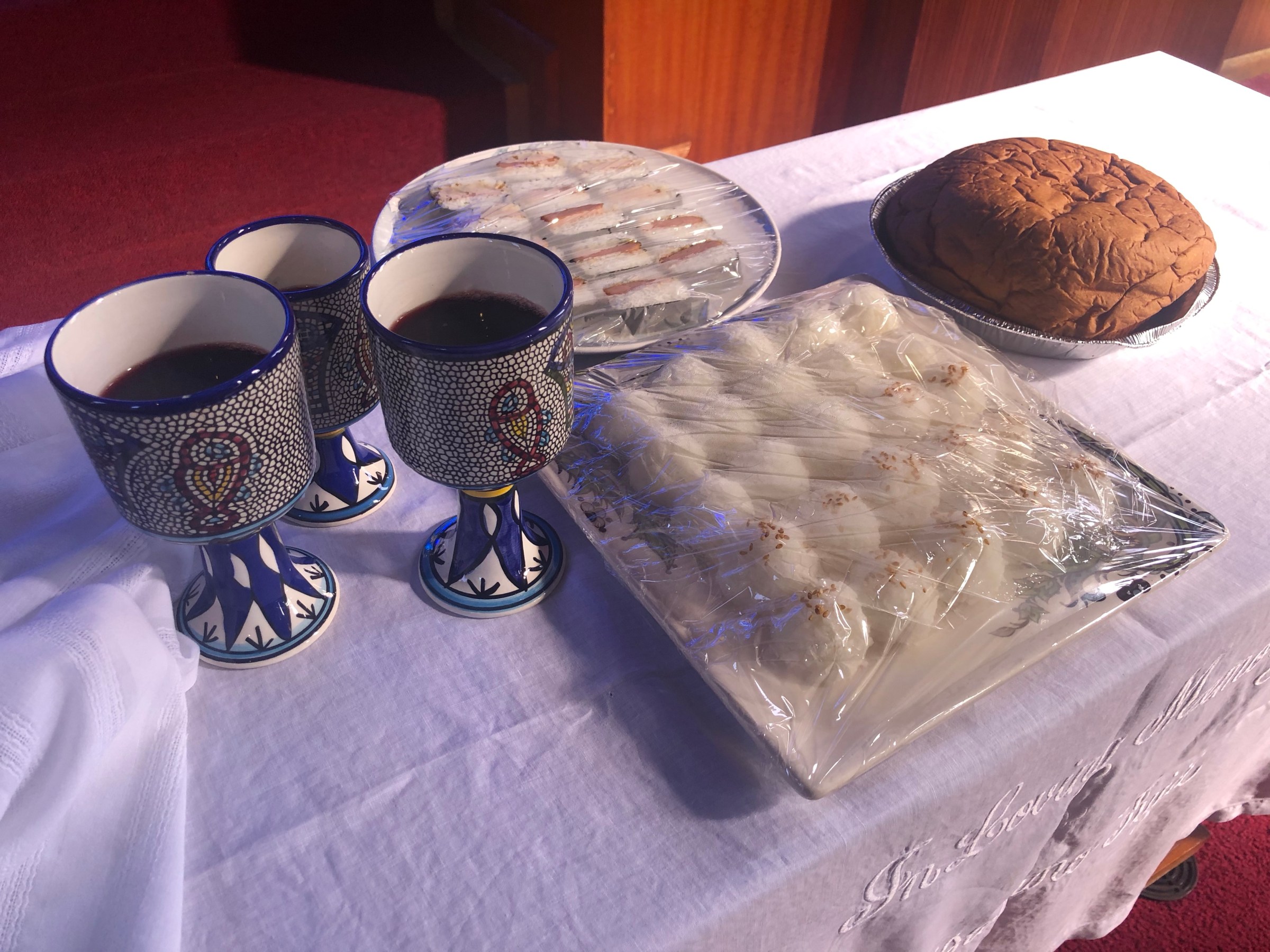
Close your eyes for a moment and imagine Jesus was sitting next to you in the pews. What would he look like? Think about the color of his eyes, the color of his hair, the color of his skin. In your image, is Jesus wearing a robe or is he dressed in something more modern? Try to picture how tall he is, the size of his foot, the sandals on his feet. Take that in for a moment and then open your eyes. If each of us had a sketch artist sitting with us and brought those pictures of Jesus up to the front, there would likely be many different versions to see. That’s because each of us pictures Jesus in our own way. Sometimes those images are remarkably similar, sometimes wildly different, but all with our own unique perspective. I went to a conference on multi-cultural ministry and the pastor asked us a great question, “If we hung up a picture of Jesus in the church, what would Jesus look like?” I hadn’t thought of that before. I guess in my mind, I thought of the same white robe, brown hair, brown-eyed, bearded Jesus most of us have seen. But he noted when you asked different people from different cultural backgrounds about how they picture Jesus, they often saw Jesus as black or Asian or Hispanic and that in his church they celebrated that diversity by having lots of different images of Christ so people could find images they relate to. It reminds me of a story I heard when I took Alpha Course for the first time. A Japanese woman was explaining the difference between European culture and Japanese culture. She told the man she was talking to, “What most people don’t understand is that rice is central to the Japanese way of life. Japanese people have two stomachs – one for rice and one for regular food. Even if you filled the one with regular food all the way, a Japanese person would still be hungry if they didn’t have any rice.” She said, “If Jesus had come to the Japanese people first, I’m convinced he wouldn’t have said, ‘I am the Bread of Life.’ He would have said, ‘I am the Rice of Life.’”

It is important to understand that Jesus enters into our lives in different ways.
The way I’ve encountered Jesus won’t be the same as the way you encountered Jesus or even the same way your kids encountered Jesus. God seeks us out wherever we are in life. He reaches out to us through the people, places, and things that surround us and for everyone that’s different. One of the great rewards of being a pastor is getting the opportunity to hear how Christ has changed the lives of each person, how God has worked in and through that person’s life. I can’t tell you the number of different stories I’ve heard and yet how similar each one is. One man who came to Christ told me it was because of the time he spent with his grandmother driving around in her van. She used to pick him up from school as a child to help out his parents, and when she did, she would often be playing Christian music on the radio or talking to him about things happening at her church. Something about her, about the life she led, made him curious about who Jesus was and how he could be dead for thousands of years and still have this impact on her life. That curiosity stuck with him all of his life until he decided to give it a try and dedicate his life to Christ. Then there was the man who wandered away from God most of his life. His mother prayed for him every day, but he pretty much ignored the pull on his life. Different people would bring up God during the decades he wandered away, and it would intrigue him that Jesus kept coming back into his life. Finally, a friend convinced him to pick up a Bible and caused him to ask some real questions about life for the first time. It led him down a road where he finally decided it was time to come back and accept Jesus into his heart and just weeks before his mother died, he was baptized. He was so glad his mother had lived long enough to know he made that choice for himself. For me, I think I’ve told you, but it was because God surrounded me with people who kept funneling me towards him. They kept giving me glimpses, kept nudging me gently. My mom, my friends like Mark and Steve, my girlfriend/fiancée/wife Cassie were all people God used to reach out to me. And even though I knew God and prayed since I was a kid, it wasn’t until my 30’s that I really felt God working deep inside me and lighting a fire in me that has stayed going ever since. Another friend named Steve who was in our men’s group back in Alpharetta gave me some wise advice. He said that in his darkest moments God was always there, but that he didn’t always see him when he was going through it. But knowing that would help sustain him through the next one. He would simply look back on his life and all the times God showed up and it would give him strength.
I am convinced that more than anything this world needs God.
When you think about all of the violence, the mass shootings, the terrorists, and every sort of evil happening all over the globe and in our own backyard, I can’t help but wonder if these things would have happened if people really and truly knew God. And I don’t mean religious nuts who claim to be Christian and then commit acts of rage. I mean if we had the peace in our hearts that only God can provide. This passage goes to the heart of what people are truly craving in the world today. Despite all of the rhetoric, diatribe, and posturing, people are looking for purpose, hope, and meaning in the world – the kind that can only be given by God. We might substitute other things in place of it, but only in Jesus do we find the authentic source of what we need the most.
5 Then Jesus declared, “I am the bread of life. Whoever comes to me will never go hungry, and whoever believes in me will never be thirsty. 36 But as I told you, you have seen me and still you do not believe. 37 All those the Father gives me will come to me, and whoever comes to me I will never drive away. 38 For I have come down from heaven not to do my will but to do the will of him who sent me. 39 And this is the will of him who sent me, that I shall lose none of all those he has given me, but raise them up at the last day. 40 For my Father’s will is that everyone who looks to the Son and believes in him shall have eternal life, and I will raise them up at the last day.” – John 6:35-40
When we think of hunger, we think of food.
But food isn’t the only thing we are hungry for. Sometimes we are hungry for attention. Sometimes we are hungry for knowledge. Sometimes we are hungry for affection. There was a study done by Harvard University testing the theory that parents should let their babies cry and they found that doing so has long-lasting traumatic effects on the baby’s life. It influences how they socialize and how they are able to build loving relationships in the future. Americans in particular tend to dismiss these medical findings because society has told us for so long that letting a baby cry was the right method to create independent, self-reliant children, but it ends up having the opposite effect. On the other extreme, Rene Spitz studied infants raised in hospital institutions compared to those raised by mothers who were imprisoned and the difference was shocking. More than a third of the babies in the hospital died while none in prison passed away. Another study showed that babies raised in orphanages compared to foster homes were 30% more likely to develop mental illness, had IQs nine points lower on average, and were less happy than their counterparts.[1] Food isn’t the only thing we are hungry for.
 Jesus addresses that in this passage.
When he declares “I am the bread of life” he is telling us that he is as important to our health and well-being as any amount of food we consume. Just as we are hungry for food, we also have a spiritual hunger that simply cannot be fully satisfied in any other way than with Jesus in our lives. He promises that all who seek him will always be able to find him and will no longer suffer from spiritual hunger. And so many people in the world today seem to be starving for both. The World Food Programme estimates there are about 1 in 9 people who “go to bed on an empty stomach” and about 1 in 3 that are malnourished.[2] UNICEF estimates that nearly half of all deaths of children under 5 are caused by malnutrition.[3] Those numbers are astounding 1 in 9 people don’t have enough food and nearly half of child deaths under 5 are from undernutrition. Do any of us really think any child should die from malnutrition? Should any person die from lack of food? If we want people to come to Christ it has to start by helping provide for the world’s needs. As we talked about last week, no one can achieve their full potential when they are suffering from a lack of basic needs. I can’t help but think of that passage from Matthew where Jesus tells the disciples, “If anyone causes one of these little ones—those who believe in me—to stumble, it would be better for them to have a large millstone hung around their neck and to be drowned in the depths of the sea. 7 Woe to the world because of the things that cause people to stumble! Such things must come, but woe to the person through whom they come!” Ask yourself, what are you doing to help meet these basic needs? Just because you are not withholding food from babies who are dying doesn’t mean that you don’t have some part to play in their deaths. It’s not a comfortable thing to think about, but it’s something we need to place in our minds to remind us of both our blessings and our obligations.
Remember the story of the Good Samaritan?
Luke shares with us the story Jesus told to his disciples of these three people who saw this man lying by the side of the road. He had been robbed and stripped of everything. The priest walks by and does nothing. The Levite (who also does priestly work) does nothing. And it’s only the Samaritan who is often cast out by society that does something for the man. Jesus asks the expert in the law, “Who was the neighbor?” and the expert says, “The one who had mercy on him.” Jesus tells him, “Go and do the same.” So which one are you? Are you the priest and the Levite in the story, or are you the neighbor who does something for those in need? We have to do more than simply talk about Jesus. A man cannot hear you when the grumbling from his stomach drowns out your words. A man cannot hear you when the grumbling from his stomach drowns out your words. We must all do whatever we can to meet the needs of others so they might have the opportunity to see and hear from Jesus.

The point is YOU are the rice of life.
YOU are the rice of life. Or the cookie of life. Or the King’s Hawaiian Bread of life. Or whatever metaphor works for you. The point is that God is calling upon you to meet the needs of his people. Like he told Peter to feed his sheep, God is telling us all to feed his sheep. You might be exactly what that person needs at just the right time. God might be using you to reach someone for Christ and you never know how that might happen. We just continually have to be vigilant in doing as Christ commands and when we do, we can be the bread of life for someone else. I wouldn’t know Christ if it wasn’t for the many people in my life who made it easier for me to see him. Will you be one of those people for someone too?
[1] http://www.forbes.com/2010/04/20/russia-orphanage-adopt-children-opinions-columnists-medialand.html
No Room at the Inn

In those days Caesar Augustus issued a decree that a census should be taken of the entire Roman world. 2 (This was the first census that took place while Quirinius was governor of Syria.) 3 And everyone went to their own town to register.
4 So Joseph also went up from the town of Nazareth in Galilee to Judea, to Bethlehem the town of David, because he belonged to the house and line of David.5 He went there to register with Mary, who was pledged to be married to him and was expecting a child. 6 While they were there, the time came for the baby to be born, 7 and she gave birth to her firstborn, a son. She wrapped him in cloths and placed him in a manger, because there was no guest room available for them. – Luke 2:1-7

What happens when you’re suddenly homeless?
We all need a place to call home. A home provides protection from the weather, a place to rest in relative safety, and a retreat from the outside world. But a home is more than that. A home is an anchor. A home gives us a sense of security. It is a place we make our own. Think about your own home for a moment. Imagine your favorite place to sit. Think about the comfort of your bed. Picture in your mind the inside of your refrigerator and where you keep your favorite things to eat. Now imagine all of that suddenly GONE. That’s what happened to my family about six years ago. We were living in Dinuba at the time serving two smaller churches in that quaint, rural town. One Sunday after worship while I was cooking in the kitchen, the oil in the pan burst into flame! Without realizing it, I had left the burner on high for too long in a shallow pan and it suddenly caught on fire. I tried turning off the stove or just moving the pan off the burner, but the flames kept attacking me like they were alive. I couldn’t get close enough without risking getting burned. I immediately opened the doors under the sink to grab the fire extinguisher, but in just those few seconds the flames had risen high enough to catch the wooden cabinets next to the stove and they caught on fire. The flames raced toward the ceiling and I knew it was moving too fast for me to stop it. Instead, I shouted out to Emma to get out of the house. I opened the back door for the dogs and rushed to Emma’s room to make sure she was safe outside. I went back inside, got my lockbox with our passports, and a watch Cassie gave me for my birthday a few years ago and threw them on the lawn. Then I asked Emma what her favorite stuffed animals were and grabbed what I could. But as I was leaving the house that second time, I knew I couldn’t go back in. The smoke, if you could call it that since it looked black as tar, had come down to head level and already I was having trouble breathing. I could hear a loud CRACK and something exploding which later I found out was the microwave. And within the space of five minutes, we went from having a home to not having a home. That’s how quick you can go from having a home to being homeless. Five minutes.

It’s scary to think about how many people are homeless in America today.
According to reports from 2016, more than half a MILLION people are looking for a place to sleep every night.[1] What is more sad is about 138,000 of them are children. And that is just a very woeful underestimate of the overall problem. When you include children living in other people’s homes, waiting for foster care placement, living in cars, parks, and bus stations, the number rises to about a MILLION homeless children.[2] By far the leading cause of homelessness among women is domestic violence. About 90% of homeless women are escaping from physical and/or sexual abuse.[3] And it’s a mistake to believe that most homeless people are suffering from mental illness. While it’s true that the proportion of mental illness among homeless people is about 3 or 4 times that of the general population, still about 75-80% of homeless people are just like me and you – normal, everyday people caught up in extraordinary circumstances.[4] Our neighborhood suffers from some of the highest concentration of homelessness in America. In the past two years, the number of homeless in Berkeley shot up 13% which is far better than the 30% increase in San Francisco and the 47% increase in Oakland.[5] Needless to say, the situation is pretty bad. California already has nearly a quarter of all homeless people in America, by far the most of any other state.[6] High rent, mortgage foreclosures, and lack of affordable housing are just some of the causes of this epidemic. And while we attempt to bandage up the problem, we seem to be doing little to address the root cause. It’s thanks to the Women’s Daytime Drop-In Center and places like it that seek to find solutions to this crisis that we have hope for one day finding a solution. But we all need to help in some way.

But homelessness is hardly an American problem.
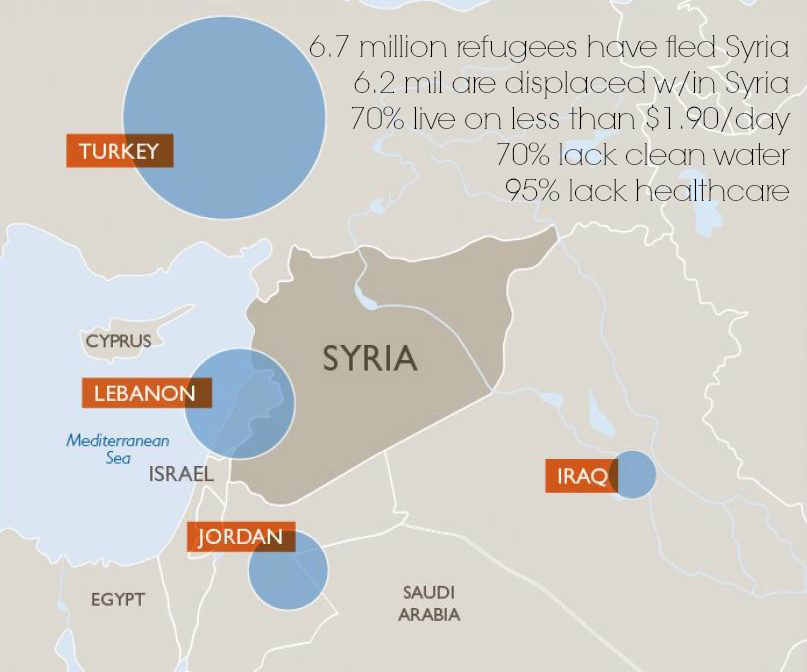
As bad as it is here, I cannot even imagine what it’s like in places like Syria where over 12 million people are refugees either inside or outside of the country. According to WorldVision, 6.7 million refugees fled Syria while 6.2 million are displaced inside the country, effectively homeless, but more than that they are often without food, medical care, or even drinkable water.[7] They estimate that nearly 70% live on less than $1.90 a day, 95% lack healthcare, and 70% don’t have access to clean water. Children are being especially harmed. Not only are they subject to disease and malnutrition, but instead of going to school they are being forced to work demeaning or dangerous jobs for little pay. Some are forced into the war. Nearly 40% of school-age children don’t go to school, either because they are working, forced to serve in the war, or because their schools have been destroyed or hijacked by military groups or refugees. And yet, our of our fear, out of our lack of faith, countries all over the world are limiting the number of refugees they are willing to help out including our own. The United States used to be a world leader in refugee resettlement. We used to help more refugees than all other countries combined and did so for decades.[8] Since 2017, our refugee resettlement rate has dropped drastically. In that entire time, nearly three years, we’ve admitted fewer refugees than we did in 2016 alone. For the first time in decades, we no longer lead the world in resettlement and will drop our numbers to an all-time low of 18,000. This is amidst a crisis that is only growing year-by-year. We’ve told the world, “There’s no room at the inn.”
Fear has gripped the world.
Fear of the other. Fear of something different. Fear of the unknown. Fear of change. These are not new fears. These are fears we fight with every day and not just on an international scale, but on a personal one, too. Fear is the lynchpin of evil. It drives many of us to do irrational and harmful things to one another. It creates an atmosphere of anger and rage. It causes separation from God and division among communities of people. And it seems to be growing under the banner of nationalism. So much hatred of “the other.” It is the exact opposite of what Christ challenges us to do – to love others. One of the apostles, Luke, records Christ sharing these thoughts, “If you love those who love you, what credit is that to you? Even sinners love those who love them. 33 And if you do good to those who are good to you, what credit is that to you? Even sinners do that. 34 And if you lend to those from whom you expect repayment, what credit is that to you? Even sinners lend to sinners, expecting to be repaid in full. 35 But love your enemies, do good to them, and lend to them without expecting to get anything back. Then your reward will be great, and you will be children of the Most High, because he is kind to the ungrateful and wicked. 36 Be merciful, just as your Father is merciful. (Luke 6:32-36).” We are not meant to only love the people who love us. We are not meant to only do good to those who first do good to us. And we are not supposed to expect payment for services rendered, but instead do it out of mercy and love. With the world in crisis, how can we call ourselves Christians if we don’t do something about it?
We are sometimes so sheltered from suffering we don’t realize how deep the need is.
Trevor Noah became host of The Daily Show after Jon Stewart left with Jon’s blessings, and Trevor tells the story about how they had to force him to move into Jon’s office. He said he was really happy with the little office he had been given. It was simple. There was a little brown desk with a skylight and he was good with it. But (I assume the producers) wanted him to move into Jon’s office which had exposed brick but he was not a fan of exposed brick. He said, “Exposed brick is a classic example of privilege in my world, because coming from South Africa (coming from any poor country to be honest) exposed brick displays that you do not have the ability to plaster your walls and paint them. You don’t have enough money to do that. So all we had growing up was exposed brick. And then you move to a place that says, ‘We have so much plaster and so much paint, in order for me to be different I’m going to expose the bricks in my walls.’ And everyone says, ‘That is so fantastic! I will pay more for that.’ (Listen to the full insightful and funny podcast) We are fortunate NOT to know the hardships of long-term homelessness. Even for our family, that short bit of time where we lost almost everything we had, we had enough resources to recover, and even still it’s something that haunts us to this day. It’s hard to imagine having that BE your existence, and what kind of lifelong impact that has on a young child and a family. For millions of people around the world it is the reality they are living. How can we expect the world to know the love of God when they struggle with simply existing? But it is also an opportunity for us to show the love of God to a world that is hurting. There are so many ways to help. Not only are we supporting the Women’s Daytime Drop-In Center during the Advent season, but there are numerous organizations all across the Bay Area from Ruby’s Place in Castro Valley, to Back on My Feet in the City, to the Berkeley Food and Housing Project right here in town. We’ve listed some of these here and below, but there are so many more. No matter how you choose to give to this crisis – whether it is with your time, talent, gifts, service, or witness – find your own way and your own means to help. Because Mary and Joseph aren’t the only ones without a room during this Advent season.
Places to Give Your Time, Gifts, and Service
- Women’s Daytime Drop-In Center (our Advent focus charity)
- Berkeley Food and Housing Project (local charity helping the homeless and those in need)
- Refugee Response through UMCOR (helping refugees all over the world including Syria)
- SF Homeless Project (compilation by the SF Chronicle of ways to help fight homelessness)
- Border Angels (just one of many groups helping those on the US / Mexico border)
[1] https://nationalhomeless.org/about-homelessness/
[2] https://www.huffpost.com/entry/ten-facts-about-homelessn_b_5977946
[3] Ibid.
[4] Ibid.
[5] https://www.berkeleyside.com/2019/07/23/berkeleys-homeless-population-jumped-13-in-past-two-years
[6] https://nationalhomeless.org/about-homelessness/
[7] https://www.worldvision.org/refugees-news-stories/syrian-refugee-crisis-facts#why-flee
[8] https://www.pewresearch.org/fact-tank/2019/10/07/key-facts-about-refugees-to-the-u-s/
Clothes Make the Man

“Clothes make the man.”
You’ve probably heard that saying before. Clothes are a status symbol in our society. The shoes on your feet, the clothes on your back, the watch on your wrist all seem to MATTER. At least to some. Your clothes say something about the person you are. Wearing the “right” clothes can place you firmly with the “in” crowd, or definitely “out.” When I was in high school, the things to wear were Air Jordan shoes, Members Only jackets, and Guess jeans. But it changes with every generation. Every new group of kids has their own set of clothes that make them cool. The same is true for adults. This isn’t a youth only movement. What you wear and when you wear it goes across all generations. But fashion is fickle. It’s here one day and gone the next. Sometimes it comes back – whether we want it to or not. Bell-bottom jeans and neon sweatshirts have both made a reappearance in my lifetime. For what reason, I don’t know if anyone knows. Interestingly, what you wear not only affects how other people perceive you but even how you perceive yourself. Some researchers did an interesting experiment involving a white lab coat where participants were asked to either wear one or not wear one while doing a task. Now a white lab coat is often a symbol of authority, discipline, and knowledge worn most often by doctors and scientists, but the researchers were curious if it would affect not just the people who interacted with the white lab coat, but the people who wore them as well, and what they found out was that the people who wore the lab coat did significantly better at the task than the people who didn’t. They not only LOOKED more studious and professional, but putting on the coat actually MADE them more studious and professional.[1] The kind of clothes we wear seemingly affects not only other people’s perceptions of us, but our own perception of ourselves.

Interestingly, God talks a lot about clothes in the Bible.
He talks about it in both a spiritual way and a material way. For God, it isn’t important what kind of clothes you wear. It doesn’t matter how good you look or how much money you spent on a pair of shoes. Those things don’t measure a person’s worth. James, the brother of Jesus, wrote about this. He said, “My brothers and sisters, believers in our glorious Lord Jesus Christ must not show favoritism. 2 Suppose a man comes into your meeting wearing a gold ring and fine clothes, and a poor man in filthy old clothes also comes in. 3 If you show special attention to the man wearing fine clothes and say, ‘Here’s a good seat for you,’ but say to the poor man, ‘You stand there’ or ‘Sit on the floor by my feet,’ 4 have you not discriminated among yourselves and become judges with evil thoughts? (James 2:1-4)” James is warning us that this is not how Christians are supposed to behave. We’re not supposed to place value on someone based on their clothing or jewelry or anything they put on. We’re supposed to love everyone equally. Jesus tells his followers they shouldn’t worry about clothes at all. He tells his disciples in Matthew 6, “And why do you worry about clothes? See how the flowers of the field grow. They do not labor or spin. 29 Yet I tell you that not even Solomon in all his splendor was dressed like one of these. 30 If that is how God clothes the grass of the field, which is here today and tomorrow is thrown into the fire, will he not much more clothe you—you of little faith?” Jesus isn’t an advocate for nudist colonies. He’s not saying that people should walk around without clothes. Jesus wore clothes. What he’s trying to get his followers to understand is that they shouldn’t focus their life on these things. That there are far more important things to focus your life on than what shoes someone is wearing or what designer made that dress. Jesus wanted us to stop worrying about the inconsequential things and focus on what’s really important.

But there is a type of clothing that IS important to God.
Clothing yourself in Christ. In Paul’s letter to the Romans, he writes, “12 The night is nearly over; the day is almost here. So let us put aside the deeds of darkness and put on the armor of light. 13 Let us behave decently, as in the daytime, not in carousing and drunkenness, not in sexual immorality and debauchery, not in dissension and jealousy. 14 Rather, clothe yourselves with the Lord Jesus Christ, and do not think about how to gratify the desires of the flesh (Romans 13).” Paul writes again to the church in Corinth, “53 …the perishable must clothe itself with the imperishable, and the mortal with immortality. 54 When the perishable has been clothed with the imperishable, and the mortal with immortality, then the saying that is written will come true: ‘Death has been swallowed up in victory (1 Corinthians 15).’” And in his letter to the church at Colossae, he writes, “12 Therefore, as God’s chosen people, holy and dearly loved, clothe yourselves with compassion, kindness, humility, gentleness and patience (Colossians 3).” In each of these instances, Paul is using a metaphor for clothing. He’s telling us that we need to “put on” the likeness of Christ. We need to act as Christ does with compassion, kindness, humility, gentleness, and patience. We need to put aside the things that will lead us astray or take us away from our faith, but instead protect ourselves by being covered with Jesus’ teachings. Because Paul knows that as human beings we are prone to go astray. And just as clothing protects us from the weather and from the elements, clothing ourselves in Christ protects us from everything that seeks to pull us away from God.
 Not that physical clothes are meaningless.
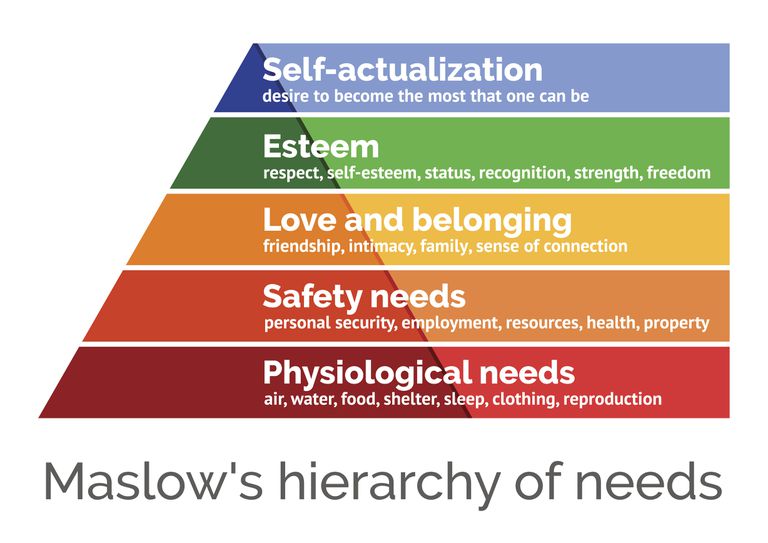
It’s one of our basic needs and over this Advent season, that’s what we will be focusing on – basic needs that everyone has and how we can meet them. We need air to breathe, food to eat, and water to drink. We need shelter to keep us safe from the elements and wild creatures that go bump in the night. Like we said earlier, we need clothes to protect us from the weather and from things we want to keep away from our bodies. And those are just our physiological needs. We also have the need to be loved, the need to feel safe from harm. Albert Maslow hypothesized that before we can become the people God created us to be, we had to fulfill those basic needs first. He called this the Hierarchy of Needs.[2] It’s gone through a number of revisions over the years, but the basics of his hypothesis have pretty much stayed the same since he shared it back in 1954. Did you know Maslow’s hypothesis wasn’t new? God thought of it first. If you remember from our earlier reading, each of these basic needs is called out by God. He challenges us to stand up for others, to feed the hungry, to provide shelter for the poor, to clothe those without clothes, and never to turn our backs on our family. In essence to fulfill the basic needs of all human beings. But it’s not just in the Old Testament that we hear about this call, but in the New Testament as well. In this passage we hear the words of Jesus’ cousin John who has been preaching to anyone who will hear it that we need to have our sins cleansed from us and to repent before God. The earlier prophets predicted that someone would come as a herald for Christ, a guy who would pave the way for Christ’s coming. Sort of like the stand-up comedian that comes out before the main act, except in this case, John is giving a preview of exactly why Jesus has come to Earth.
7 John said to the crowds coming out to be baptized by him, “You brood of vipers! Who warned you to flee from the coming wrath? 8 Produce fruit in keeping with repentance. And do not begin to say to yourselves, ‘We have Abraham as our father.’ For I tell you that out of these stones God can raise up children for Abraham. 9 The ax is already at the root of the trees, and every tree that does not produce good fruit will be cut down and thrown into the fire.”
10 “What should we do then?” the crowd asked.
11 John answered, “Anyone who has two shirts should share with the one who has none, and anyone who has food should do the same.”
John is a passionate preacher.
He’s not afraid to tell it like it is and he’s warning the people of Israel that they shouldn’t assume God’s favor. That just because they are the children of Abraham doesn’t mean they do not need to ask for forgiveness the same as anyone else. I like how John tells the crowd, “And do not begin to say to yourselves, ‘We have Abraham as our father.’ For I tell you that out of these stones God can raise up children for Abraham.” He’s telling them not to be smug in their heritage. Being a child of Abraham is nothing to a being who can create life from the rocks around them. He’s warning them that they have become too complacent in their faith and when someone asks him what they should do, his first answer is this: “Anyone who has two shirts should share with the one who has none, and anyone who has food should do the same.” Even before Jesus would come and basically say the same thing, John told the people of Israel that they needed to provide for one another. They needed to attend to the basic needs of their brothers and sisters. And the first reference he makes is to clothing.
We tend to take clothing for granted.
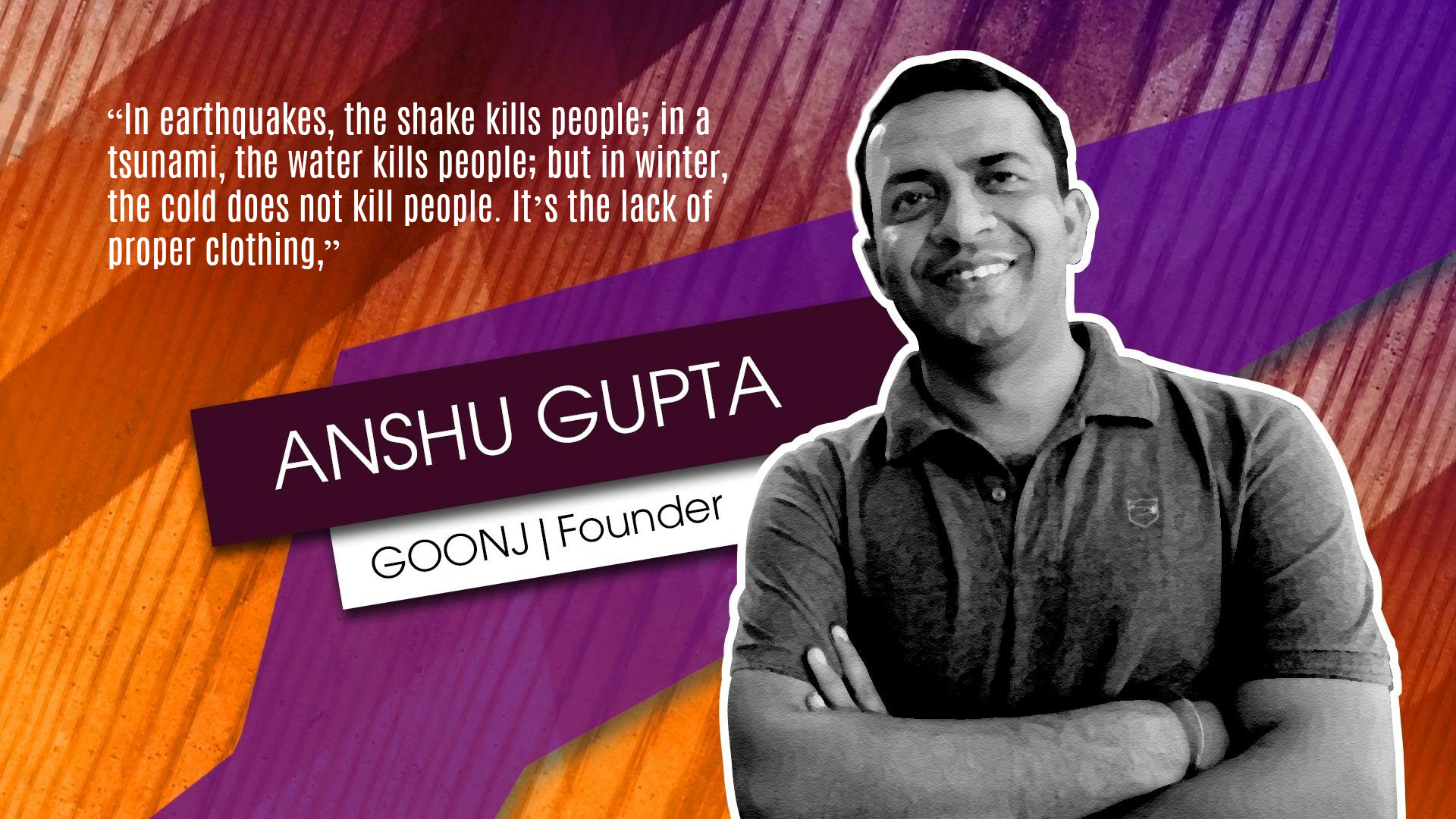
We don’t worry about HAVING clothing, but about what KIND of clothing we have. But we are so privileged. The New York Times estimated that between 40% and 80% of people in the world live on subsistence income, barely making 50 to 60 cents per day.[3] 40-80%! And even though there are tons of programs to help with other needs, clothing tends to get overlooked. Anshu Gupta, a freelance reporter in India, looked around and saw how in need of clothing so many people in his country were. He said to a reporter for the Times, “In earthquakes, the shake kills people; in a tsunami, the water kills people; but in winter, the cold does not kill people. It’s the lack of proper clothing,” says Gupta. “Why don’t we consider lack of clothing a disaster?”[4] Even in America, many people lack enough clothing just to protect themselves. As part of our ordination process in North Georgia, we took a tour of different Methodist facilities all over the area, but the one that stuck out to me the most was our trip to the United Methodist Children’s Home. Two of my friends have now served as director of this great place that does so much to children in need. They house kids from broken homes or kids in need of protection or kids who have no place to go from all over, but the story I’ll never forget is the one we were told when we visited. The director at the time told us that most of the kids who arrive on their doorstep come with nothing more than a virtually empty backpack that the home often provides. Not only do they lack toys and games and other things we normally associate with kids, but sometimes they don’t even have a change of clothes. Sometimes they don’t have a jacket or a sweater or anything to protect them. Sometimes they don’t have clean underwear. They literally come with the clothes on their backs with no home, no family, no friends. It’s hard to imagine that in a country like ours, we have kids in need like that. That we have ANYONE in need like that. If we are truly Christian, we can’t stand by and do nothing. We must heed God’s call and do more. We must put on the clothing of Christ and reach out to clothe the world. When we help one another take care of our basic needs, we can all grow closer to Christ together. In the name of Father and of the Son and of the Holy Spirit. Amen.
[1] https://www.psychologytoday.com/blog/brain-babble/201208/clothes-make-the-man-literally
[2] https://en.wikipedia.org/wiki/Maslow’s_hierarchy_of_needs#Esteem
[3] http://opinionator.blogs.nytimes.com/2012/10/03/clothing-the-poorest-for-survival/?_r=0
[4] Ibid
Amazing Grace

I’ll never forget the time I got to see Mikhail Baryshnikov dance in person.
He was with the White Oak Dance Project, which was a modern dance company he founded. The year was about 1995 and they were doing a series of four dances, only one of which Baryshnikov himself was in. He was already 47 or 48 years old at the time, and I wondered what I would see. Most of the dancers on the stage were much younger than him, about 20 to 25. Would he still be able to keep up with the other dancers, or would he be a sort of pale version of his former self? I guess I was about to find out. The first three acts were admittedly kind of dull. Maybe if you were a modern dance enthusiast you would have appreciated the performance, but I thought it was pretty boring. Had it not been for the fact that I had a crush on the girl who I took to the performance, I probably would have fallen asleep. But then I would have missed Baryshnikov. When he took the stage, he completely captured the attention of everyone in the room. He danced circles around the kids who were nearly half his age. It was as if they were props in a dance routine made just for him. I’d never seen anyone move like that before or since. If there was anyone who epitomized grace, it would have been him.

Funny thing about that word “grace” though.
It’s used in so many different ways. When I share with you the grace that Baryshnikov showed that night, you all know exactly what I mean. But if we were talking about Mark McGwire’s fall from grace over his steroid use, you’d know what that meant too even though they are completely different definitions. We say grace over a meal. The credit card company offers us a grace period to pay our bills. A person shows grace by admitting to their faults. So what does this word really mean? And what does it mean to talk about the grace of God? For anyone who’s been in church for any length of time, you know we talk constantly about God’s grace, but this is another one of those church words that gets thrown out there without any real explanation of what it means. We don’t do a good job of letting people know what grace IS. Many of us assume that everyone knows what we’re talking about, but with so many different interpretations of grace, what do we really mean? Our passage from John will help us shed a little light on the subject. If you would please rise for the reading of the Gospel according to John 1:9-18. Hear now the Word of God.
9 The true light that gives light to everyone was coming into the world. 10 He was in the world, and though the world was made through him, the world did not recognize him. 11 He came to that which was his own, but his own did not receive him. 12 Yet to all who did receive him, to those who believed in his name, he gave the right to become children of God— 13 children born not of natural descent, nor of human decision or a husband’s will, but born of God.
14 The Word became flesh and made his dwelling among us. We have seen his glory, the glory of the one and only Son, who came from the Father, full of grace and truth.
15 (John testified concerning him. He cried out, saying, “This is the one I spoke about when I said, ‘He who comes after me has surpassed me because he was before me.’”) 16 Out of his fullness we have all received grace in place of grace already given. 17 For the law was given through Moses; grace and truth came through Jesus Christ. 18 No one has ever seen God, but the one and only Son, who is himself God and is in closest relationship with the Father, has made him known. – John 1:9-18
The first part of the passage, sets up the last.
By that I mean that when John is describing to us the person of Jesus in those first few verses (9-13), he is setting us up to more fully understand what grace is. Let’s look at the beginning of that passage again. 9 The true light that gives light to everyone was coming into the world. Here John is describing Jesus as the bringer of hope and life – the “true light that gives light to everyone.” You’d think that was pretty good, but John then writes, “the world did not recognize him. He came to that which was his own (the Jewish people), but his own did not receive him.” Despite the fact that Jesus was the one long prophesied about, few people recognized him when he came among them. He was the Word made flesh, meaning Jesus was truly God incarnate, God on Earth, and yet we failed to see him. But even though we failed to see him, John tells us, “Out of his fullness we have all received grace in place of grace already given.” We have all received grace in place of grace already given. God had already given humanity the gift of life. God had given humanity relief in the desert when Moses led his people to freedom. God had blessed the people again and again and even though we had done nothing to deserve it, God then gave us his son Jesus Christ. And that is the meaning of grace. Grace is the unmerited favor of God for a group of people who didn’t deserve it. Grace is the unmerited favor of God for a group of people who didn’t deserve it. Despite the fact that we wander away constantly; that we turn to worshipping other idols like power, money, beauty, and fame; despite the fact that we fail to give thanks to God for the life we have, God still sent Jesus to redeem us. God forgives us our sin. God still offers us salvation. That is the meaning of grace.

But let’s not mistake grace for mercy.
Grace and mercy are two totally different things. We often pair the two words together, mostly because they go hand-in-hand, but they have very different meanings. As one writer put it, “Mercy withholds a punishment we deserve; grace gives a blessing we don’t deserve.”[1] Mercy withholds a punishment we deserve; grace gives a blessing we don’t deserve. That’s what makes the grace of God so amazing. It’s more than simply God not punishing us for what we’ve done, but then God takes it to a whole other level! God offers us salvation! By that we mean that God offers us an opportunity to not only wipe our slate clean of our sins, but to ask us to join him in Heaven when we pass from this Earth. He asks us to reenter into paradise even though we don’t deserve it. THAT is the God we follow. Everything else pales in comparison. I like what Andy Stanley said here about grace. Andy Stanley is the lead pastor of North Point Community Church out in Georgia and he’s a very prolific author, and in his book on grace he says, “To say that someone deserves grace is a contradiction in terms. You can no more deserve grace than you can plan you own surprise party…the minute you think you deserve it, the it you think you deserve is no longer grace. It is something you have earned. But grace can’t be earned.”[2] That’s the whole point. That grace can’t be earned.
The reason so many people are opposed to the church is that we often don’t extend that grace ourselves.
We do a great job receiving grace, but not as good of a job extending it. We do a great job of receiving grace, but not as good of a job extending it. We tend toward becoming a “graceless religion.” To use Andy’s words, “Instead of defining itself in terms of what it stands for, the church often takes the less imaginative and easier path of defining itself in terms of what it is against.”[3] We like to tell people what we are against. Throughout the church’s history we have made bold statements about what we are against, only to later realize how much we were wrong. We’ve stood against interracial marriage. For that matter we stood against racial equality. We’ve stood against women in leadership positions in the church. Again, we’ve stood against gender equality. But instead of focusing on the things we are against, why don’t we focus instead on the things we believe in. Instead of condemning people for being different than we are, why don’t we embrace them for the things we hold in common, like being human beings. Christianity didn’t become the world’s largest religion because of what we stood against, but because of what we stood for. Christianity didn’t become the world’s largest religion because of what we stood against, but because of what we stood for. We stood for caring for the sick, so we built hospitals. We stood for helping people get ahead in life, so we built schools and universities. We stood for people deserving affordable houses so we started Habitat for Humanity. We stood for helping the poor and the needy so we built shelters and places like Open Gate. We helped others, not because they paid us to. Not because they did something for us. But because there was a need and we filled it. THAT is what it means for us to extend the grace of God – helping others not because they deserve it, but because we want to show them the grace that God has given to us by offering grace ourselves. We can talk about grace in so many ways – in the arts like with Mikhail Baryshnikov, in finance where it’s really mercy more than grace – but this is the greatest grace there is.
 One of my favorite stories of grace comes from Francis Chan.
He’s another pastor and writer and I was at a conference where he gave this tremendous story about grace. It was about his daughter. His daughter had done poorly on a test. She had gotten a “C” and I love the way he described it. He said, “It’s like getting an Asian ‘F.’ Asian kids aren’t supposed to get “C’s.” So his daughter’s friends were asking her, “So what’s he going to do to you?” “What’s he going to do to you?” as if he was going to take her out behind the woodshed or something. So when he picked her up from school that afternoon, she got in the car and told him about the grade. And instead of getting mad, or getting upset, or giving her a punishment, he said, “Okay. Let’s go get some ice cream.” Instead of punishing her or lecturing her as she felt she deserved, he not only forgave her, but then added on top of that the ice cream! The next day at school when she told her friends about what had happened, the other kids all said, “I wish I had your dad.” This week, I want to challenge you to show the grace of God to someone in your life. Someone who maybe deserves your wrath, your anger, or your justice, like the guy who cuts you off on the highway or the knucklehead who gets your coffee order wrong or maybe one of your kids or your spouse who makes a mistake that maybe they should have known better. Instead of giving them “justice,” not only show them mercy but extend to them God’s grace. Go above and beyond what’s needed or expected to do something out of kindness and love and thereby passing the grace of God forward. Sometimes we are like Francis Chan and we are put in situations where we can show justice, mercy, or grace, and it’s up to us to choose. Any of those things would be technically right, but only one is going to make people say, “I wish I had your dad.” Some times we need to share about the grace of God with others so that they CAN say that and realize that the Dad we have in Heaven is a pretty awesome dad indeed.
[1] http://www.gotquestions.org/grace-of-God.html
[2] Andy Stanley, The Grace of God, p. xiii-xiv.
[3] Ibid, p.xiv.
Two Masters

19 “Do not store up for yourselves treasures on earth, where moths and vermin destroy, and where thieves break in and steal. 20 But store up for yourselves treasures in heaven, where moths and vermin do not destroy, and where thieves do not break in and steal. 21 For where your treasure is, there your heart will be also.
22 “The eye is the lamp of the body. If your eyes are healthy,[c] your whole body will be full of light. 23 But if your eyes are unhealthy,[d] your whole body will be full of darkness. If then the light within you is darkness, how great is that darkness!
24 “No one can serve two masters. Either you will hate the one and love the other, or you will be devoted to the one and despise the other. You cannot serve both God and money. – Matthew 6:19-24
 When is enough, enough?
Did you know that 66% of Americans support stricter gun control laws, from both sides of the aisle?[1] I was surprised to find out 67% support an assault weapons ban, 83% support a mandatory waiting period, and a whopping 97% of Americans support universal background checks. I guess that last 3% are officers of the National Rifle Association. What’s more surprising is that despite the overwhelming numbers the Senate won’t even bring up the subject.[2] At all. In the face of both overwhelming factual evidence on the efficacy of gun control laws, the number of studies that prove gun control to be effective, AND the overwhelming support of the American people, enough Senators in the United States Congress are able to stem the tide against even talking about the subject. This in the wake of yet another high school shooting. Just this year alone we have had 370 mass shootings, 441 deaths, and 1,466 injuries.[3] That’s just this year. So when is enough, enough?
What does it take for people to simply do the right thing?
When will our lust for money, power, and fame be overcome by doing the decent, right, and honorable thing? In a world of “alternative facts” it isn’t enough to have the Truth to convince people to do the right thing. Scientists have warned about the effects of global warming since 1988 when record temperatures, drought, and wildfires spread across the United States.[4] Yet we have not taken the threat of climate change serious enough to prevent global catastrophe.[5] Tobacco companies knew for decades that cigarettes were causing people to die, but they continued to peddle them to little kids with cute mascots and idealized pictures of people living “the good life.” And now we have companies like San Francisco based JUUL trying to get kids addicted in a new way! They have aggressively marketed to children who have never smoked before and appealed to them through slick and misleading advertising.[6] Children as young as 13 are suffering from lung injury related to vaping. Of the over 2,000 reported cases of injury, 14% of patients are under 18 and 79% are under 35. Most of the 42 deaths have been older people ranging in age from 17 to 75. Ironically, a friend of mine who is a pastor knows one of the Vice Presidents at JUUL and both have children who are in the same class. My pastor friend’s daughter did a report on the health effects of vaping and the Vice President came up to my friend and said he was very concerned and would like to know what JUUL could do to help. I don’t know. Maybe stop selling these products to kids? Maybe stop selling these products with fruity flavors? Maybe stop selling things that are harmful and addictive? Seriously, what does it take to do the right thing?

But these are massive problems.
They seem overwhelming to each of us. What can we do as the people of God? We can stand up for what’s right. We can help one another. We can lift one another up. We can be there for each other and make the tough choices to make the world a better place. Mario Teyacheya was the Draco Malfoy of my elementary school days. He was the local bully and he liked to pick on other kids in our class. He always hung out with these two thugs, kind of like Crabbe and Goyle in the Harry Potter books. Mario was a punk kid with a skinny frame and long wavy hair, and he liked to punch people. He’s the kid in class who knew the principle on a first name basis. He’d challenge other boys to meet him after school and if you didn’t show up, he’d tell people you were a chicken or a wimp. As you can imagine, his prowess at beating people up grew, even though I don’t know of anyone he actually fought. Well, I avoided Mario as much as possible, but finally, Mario cornered me and challenged me to a fight. I was pretty worried, but I didn’t want to be labeled a chicken, so I showed up wondering how bad it was going to be. Sure enough, Mario shows up with his two goons, picking at his teeth as he approached. Word had got around about our fight and a couple of kids showed up to watch. No one offered to help, they just wanted to watch the carnage. So there I stood as Mario walked up, getting ready to punch me when suddenly, my friend Greg Pillioglas came out from the door next to me and yelled at Mario, “Back off or you’ll have to fight me, too!” The three of them just looked up at Greg, turned around, and ran off. See, Greg was about a foot taller than me, and in 3rd grade, a foot is a big deal. He was stronger than anyone in the class, and everyone knew it, and he was my friend. Greg and I didn’t hang out or anything, but I always helped him do his math. Math was always one of my strong subjects so I would help him out. He was always grateful and once told me, “If you ever need anything, you just let me know and I’ll help you out.” I thought that was a nice thing to say, but on that day, I knew Greg meant it. He asked me if I was alright, and I told him “Yeah, just mad was all.” And he said to me, “If anyone gives you trouble again, you tell me and I’ll come beat them up for you.” No one ever bothered me again. Greg was a hero, and not because he was tough, because really he wasn’t. Greg was one of the nicest guys I’ve ever known. But he was a hero because he stood up for me when I needed it. He could easily have done what every other kid including my friends did and stayed away, but he didn’t. He got involved. He did what he thought was right even though that meant putting himself at risk. And that’s what Christ calls on us to do every day – to make the tough choices and do what’s right. We tend to think of standing up for what’s right on these grand scales of global consequences, but the most effective changes, the ones that change the world, are often the ones that start in the hearts and minds of people like you and me simply doing the right thing instead of what’s easy or convenient.
Daniel was like that.
As we heard in his story (above), Daniel could easily have given in to the king’s demands. After all, they weren’t unreasonable and Daniel was hand-picked as being among the best of Israel’s people. He was on the fast track to a career as a civil servant. He was even being fed food from the King’s table! But Daniel didn’t want to violate the commitment he had made to God. His faith was that important to him so he refused to eat what the others were eating and his friends followed suit. The official in charge of taking care of them told Daniel, “Hey, I get it, but I don’t want to die just because you won’t eat the King’s food. Can’t you give me a break?” So Daniel made a deal with him. “Give me ten days to show you what living a life like my God has asked me to live can do and if we aren’t at least as healthy as everyone else, you can turn us in.” It would have been so easy to follow along with what everyone else was doing. It would have been so easy to just eat the King’s food and drink the King’s wine. But instead, Daniel stood up for what he believed in. Not with disrespect but with bravery and boldness, willing to accept the consequences. And God was there for him.

Standing up for what’s right isn’t easy.
It’s often very difficult. It’s always tempting to take the easy way out. Or the expedient way. Or the way that profits us in the short term. But doing the right thing can change the world. Not doing the right thing can also change the world, sometimes in tragic ways. I’m reminded of Martin Niemoller’s famous poem. Martin was a Lutheran pastor in Germany during World War II. At first he supported the Nazis as did many Germans, until the Third Reich decided to take control of the churches. He spoke out frequently against the Nazi regime, often landing him in prison and eventually in a concentration camp. He was liberated in 1945, and is most well known for a poem he wrote in response to a student who asked “How could it happen?”[7] Indeed, you would think that it would be impossible for an entire country to stand by and watch this horror occur, but we all know it did. “How could it happen?” Niemoller responded by writing his famous poem:
“First they came for the Communists, but I was not a Communist so I did not speak out. Then they came for the Socialists and the Trade Unionists, but I was neither, so I did not speak out. Then they came for the Jews, but I was not a Jew so I did not speak out. And when they came for me, there was no one left to speak out for me.”[8]
When we see the problems in the world today, the problems that we could and should be able to solve, it’s hard to imagine why we haven’t done more. It’s hard to imagine why people would ignore climate change. It’s hard to imagine why people don’t do something about the proliferation of guns in America. It’s hard to imagine why people would willingly let people die just to make a profit. But it happens. And we can do something. Your voice might only be one voice, but together we can be a mighty force that cannot be ignored. Don’t be afraid to speak up. Don’t be afraid to step out on that ledge, because when you commit to doing what is right, God is with you in a powerful way. God loves you. And God will use you in mighty ways if you but follow where he leads. So when the time comes, stand up for what’s right and put your faith and trust in God.
[1] https://www.newsweek.com/massacremitch-trends-after-santa-clarita-school-shooting-hes-had-background-check-bill-his-1471859
[2] https://www.usatoday.com/story/news/politics/2019/08/04/mass-shootings-what-congress-doing-gun-control/1916451001/
[3] https://en.wikipedia.org/wiki/List_of_mass_shootings_in_the_United_States_in_2019
[4] https://www.history.com/topics/natural-disasters-and-environment/history-of-climate-change
[5] https://www.nbcnews.com/news/us-news/more-americans-believe-global-warming-they-won-t-pay-much-n962001
[6] https://www.cnn.com/2019/09/10/health/vaping-outbreak-2019-explainer/index.html
[7] http://www.jewishvirtuallibrary.org/jsource/Holocaust/Niemoller_quote.html.
[8] http://www.jewishvirtuallibrary.org/jsource/biography/niemoeller.html.
Planting Seeds

What is it worth?
I’ve loved comics since I was about six or seven years old. My dad used to bring home issues of the Incredible Hulk from time-to-time. He would come home after work, lean around the doorframe of my room and just say, “Here, buddy,” and hand me a new one. I loved those old books. Part of it was because of the bond between me and my dad, but part of it was because the stories were fascinating. I didn’t have many, just whatever my dad brought home, but it was the beginning of a life-long love of comics. I didn’t take particularly good care of them. To me, they were books to be loved and read over and over. But I went from being an occasional reader to a true comic book fan with one particular issue – Uncanny X-Men #147, “Rogue Storm”. I was fascinated by the X-Men and wanted to read more, so slowly I began collecting older issues which led me to more issues and more interesting stories, and pretty soon, I was visiting my local comic book store with my dad every week. That’s where I learned there were actually two types of comic book people – those like me who actually read the books and those who plopped them in plastic bags for the sole purpose of collecting them for future profit. To this second group of people, comic books were an investment in the future. These guys would come into the store and just walk down the new comic book aisle, picking up one of every issue, two if it was a first issue, and immediately place them into plastic bags and put them into a storage box. And there they would sit. In a bag, in a box, on a shelf. Neatly labeled, but for no real purpose. Never read or opened, but sitting there useless. I know these collectors thought one day they might be worth a lot of money, but when the bottom dropped out of the comic book market, they were left with boxes upon boxes of useless comics. And they never even got to enjoy them. In that way, our faith is like a comic book. We can either enjoy it as it was intended, or we can put it on a shelf, condemned to never live out it’s true purpose. The love of God is meant to be cherished. Our faith is meant to be explored. Our hope in Christ is meant to be shared. It isn’t supposed to be hidden away.

We often feel unprepared, unworthy, and ill equipped to do the work God has called us to do.
But that’s because of our own lack of faith instead of an actual inability to do what God wants us to do. You have all the tools you need to share your faith and the love of God, because the work of God is more about attitude instead of aptitude. The work of God is more about attitude than aptitude. Jesus talks about that in the parable we are about to share. This story we are about to hear from Jesus is known as the Parable of the Sower and it’s one you’ve likely heard before if you’ve been in church for any length of time. You could read it from two different perspectives – as the seed or as the sower. As the seed, Jesus is calling on us to be responsive to his Word; to be the ones planted in good soil that produce a crop, but as the sower we have a different perspective. As we read the passage, I want you to picture yourself in the story as the sower that Jesus talks about, and picture in your mind that this is a task God empowers us to do.

Again Jesus began to teach by the lake. The crowd that gathered around him was so large that he got into a boat and sat in it out on the lake, while all the people were along the shore at the water’s edge. 2 He taught them many things by parables, and in his teaching said: 3 “Listen! A farmer went out to sow his seed. 4 As he was scattering the seed, some fell along the path, and the birds came and ate it up. 5 Some fell on rocky places, where it did not have much soil. It sprang up quickly, because the soil was shallow. 6 But when the sun came up, the plants were scorched, and they withered because they had no root. 7 Other seed fell among thorns, which grew up and choked the plants, so that they did not bear grain. 8 Still other seed fell on good soil. It came up, grew and produced a crop, some multiplying thirty, some sixty, some a hundred times.” 9 Then Jesus said, “Whoever has ears to hear, let them hear.” – Mark 4:1-9
You are the sower.
YOU are the sower. The seeds that God is referring to are the bits of knowledge and wisdom that we have gained from listening, reading, and studying God’s Word. They are part of the fruit that he produces in us. Now it’s our turn to use those seeds to grow new fruit, which will produce even more of a harvest for God. But without us spreading his seeds, for certain no new fruit can be grown and the harvest ends with us. Without us spreading his seeds, no new fruit can be grown and the harvest ends with us. We are important to God’s plan. But you might be timid about it. You might worry about wasting your time, energy, and effort if you can’t produce results. You don’t want people to think you’re foolish. You might be embarrassed to share your faith. All of these things play into our minds as we think about becoming the kind of farmers God wants us to be. But in this parable, Jesus is encouraging us to plant everywhere. We cannot become better harvesters if we don’t ever attempt to do what needs to be done. We can’t tell what will work and what won’t unless we try. We learn best by DOING. The point Jesus is making here is about our faithfulness to the planting process. When we do what we are supposed to, not every seed we plant in someone’s heart will take root. Not every effort we make will bear fruit. But when it does, it is worth it.

But the process IS important.
The act of planting seeds in people’s hearts is vital to growing our collective faith. People who aren’t Christian aren’t walking around saying to themselves, “Oh, I wish I were Christian.” “If I were Christian, my whole life would be better! If only someone would show me how to BE a Christian!” No. Most people are not simply one step away from accepting Christ. Most people don’t know that they need Jesus and are just looking for someone to show them the way. For the most part, they’re walking around thinking life is pretty good – or not. Some are happy, some are sad, but they don’t KNOW that there’s another kind of life waiting for them. They don’t know that there is a whole different kind of existence when you have Christ in your life. They don’t know how GOOD it can be! It’s like Indian food. There’s nothing like a good bowl of dal or a good pot of chicken tikka masala and there are times I CRAVE, absolutely CRAVE masala dosa. I’ve searched all over the Central Valley and haven’t found one restaurant that has it. Cassie and I will make a point of going to Little India when we visit my parents just to eat it. But before I TRIED Indian food, I never knew what I was missing. I could take it or leave it, and honestly I preferred to leave it. I never had it, never saw it, never smelled it, and frankly never wanted it. I was happy enough in my life without it and I wasn’t all that interested in trying something new, but when Cassie asked me to I loved it! I wish I hadn’t waited so long to try it, and I always encourage people to eat it. If you like Chinese food or just kind of spicy food, you’ll love the flavors of Indian food. But had Cassie not come along and invited me to try it, I would have lived life perfectly happy, not knowing what I was missing. Christianity is like that. It’s this awesome, incredible, wonderful part of life that makes life more meaningful and more worth living, but unless you know you need it, you can just go on without it.

That’s why it’s so important for us to share our faith instead if hiding it away on a shelf.
Because we have the power to change lives. Through God’s grace and God’s love, we have the power to change lives. And it doesn’t take any more knowledge or power than what God has already given you. Think about the ways in which God has changed your life. Think about the difference God has made in the way you live. Think about how you approach life differently because God is a part of it. Those are the seeds you have to share. Biblical knowledge is great and you should be encouraged to involve yourself in growing deeper in your faith, but if you’re waiting to have “enough” Biblical knowledge to answer every question or counter every argument, you’ll never get there. Learning about God is a lifelong project. You won’t graduate in this life. But you have enough to share your faith, whether you believe it or not. You have enough. The seeds God has put in your pouch are enough. Now who are you going to share them with?
I know that fear is a big part of not sharing your faith.
Fear of failure, fear of being inadequate, fear of your own lack of knowledge – but fear should never stop you from planting seeds. In fact, it should do just the opposite. It should inspire you and encourage you and motivate you to go out there anyway. Fear of the number of lives you fail to change because you chose NOT to share your faith. Fear of what God will say when you die and he asks you what you did with your faith. Fear of knowing you had the power to change people’s lives and didn’t do it. I was visiting with a woman at one of the churches I served, and I’ll never forget the story she told me. She said that although she went to church every week and it was important to her, she didn’t want to force her faith on her children. She wanted them to choose for themselves what path they would follow. So after they reached a certain age, she didn’t encourage them to come to church. She let them choose. Naturally, they chose to stay home. They chose to go out with friends. They chose a life away from God. And they often floundered in life, struggling with fear, worry, anxiety, and insecurity. Later in life, her daughter started to come to church again. In it, she found many of the answers that had eluded her for so long. One day, she asked her mother why it was she never shared about her faith. When her mother told her she wanted her to find out for herself, the daughter said, “I wish you had told me all of this years ago. You should have told me why you believed. If it was that important to you and to me, you should have told me why you believed. It would have saved me from years of pain and frustration.” Her story really touched my heart. While I do believe ultimately we have to choose whether or not to follow God, how can we choose when we don’t even know what the choices are? Is our lack of faith that profound that we can’t even share it with those closest to us? Fear shouldn’t hold you back. Fear should make you stronger and bolder in your faith.
Be bold in your faith.
You may not have all the answers, but no one does. Not me, not you, not any one except God. So if you’re waiting to be “ready” you’ll never get there. Like riding a bike, like learning to walk, like planting seeds, like anything in life we gain knowledge in the doing. Some of our seeds may land on infertile ground, but we learn from it. Some of our seeds may start to bloom and then wither under the weeds, but we learn from it. Some of our seeds might get taken away, but we learn from it and in each instance we learn how to be better at sharing our faith. We learn what works for us and what doesn’t. If fear is holding you back, it’s because you don’t fear the consequences enough to do something about it. And if you feel like you’ve tried and failed, just remember, the one who plants the seeds isn’t always the one who harvests them. The one who plants the seeds isn’t always the one who harvests them. Don’t be frustrated in your attempts. Don’t worry that you don’t see fruit right away. There are plants that take years to harvest. The fig trees that Jesus always seems to be talking about take anywhere from three to five years to produce any figs.[1] A traditional apple tree can take anywhere from six to seven years to give any fruit.[2] And olive trees can give fruit as early as three and sometimes as late as 12 years.[3] You might be the one to plant the seed, but it might take a team of people to finally harvest it. So do not be discouraged by a lack of results, but instead be faithful to the planting process. It’s the planting of the seeds that honors God. If we don’t share our faith, it’s like putting a comic book into a bag without ever reading it. An unread comic is a wasted comic. An unsowed seed is a wasted seed. And a life without Christ is a mere shadow of what it could be.
[1] http://www.ehow.com/facts_7472639_long-fig-tree-produce-fruit.html
[2] http://www.gardenguides.com/86431-many-years-apple-tree-produce-fruit.html
We Create Happiness

What is the key to success?
People all over the world since time began have tried to figure tbat out, but most never do. Did you know that eighty percent of businesses fail in the first 18 months?[1] And while churches do better, after only four years 32% of them close their doors. And those numbers don’t reflect churches that are stagnant in their growth or never get off the ground. Still, nearly a third close in the time it takes between one Olympics and the next. But Disney… well they seem to have found the magic formula. Despite downturns in the economy when other similar business are struggling, Disney continues to be stronger than ever. Not only do they seem to keep adding new parks, but the ones they do have continue to bring in visitors by the millions – 157 million to be exact.[2] At the end of the 2018 fiscal year, the theme park division alone made over 20 BILLION dollars thanks to those visitors.[3] When I started as a cast member, the cost to get in the park was just under $18.00. Thirty years later that cost has risen over 600%, and yet there are more people coming to the park each day than when I worked there all those years ago. So how do they do it? When most businesses and even most churches seem to be struggling, how does Disney keep attracting more and more people every year? The funny thing is they don’t even keep it a secret.
What IS the Disney Key to Success?
Believe it or not, it’s happiness. I know it sounds hokey. I know it sounds unbelievable. But it’s true. Disney’s key to success is happiness. The foundation for their existence centers on this one idea. When Walt first made movies, he wanted to tell stories that would reach the hearts of everyone. When he created Disneyland, he wanted a place where families could build memories together. When he was planning Epcot, it was in the hope that he would build a city of tomorrow that would bring happiness and harmony to all of its citizens. He believed so much in this vision, it fueled everything he did and he was successful because it tapped into a deep seated need of all people – to find happiness. But after Walt died, the company focused not on innovation, but on keeping Walt’s legacy alive. Without realizing it, they changed the dynamics of the entire company and plunged it into mediocrity. They were so concerned about keeping things the way Walt left them, they didn’t realize Walt himself would never have left it that way. Overnight, they went from being a dynamic company of innovators to a company of mediocrity and it nearly killed them. If it weren’t for Michael Eisner, an innovator and visionary like Walt, and Walt’s nephew Roy, who understood Walt’s passion, the company would have been bought out. Instead they turned things around by reinvigorating the company behind Walt’s singular principle – We Create Happiness.

“We Create Happiness” is the goal and the vision for the Walt Disney Company.
Their full statement of purpose is “We create happiness by providing the finest in entertainment for people of all ages, everywhere.”[4] It’s a pretty bold statement, but it is the fuel that drives the entire machine. Disney is in the business of meeting people’s needs. That’s the simple version of it. It’s far more complex in its execution, but it’s often a simple philosophy that drives most successful ventures. And when you lose sight of what is at the heart of any movement or group or company, you lose momentum. You lose direction. And you lose that driving force that compels people to want to be a part of what you are doing. And you have to be constantly vigilant about keeping your focus on the vision because success can be such a fragile thing. John Hench who worked for the company and created some of the most iconic attractions in the park once said, “…for all its success, the Disney theme show is quite a fragile thing. It just takes one contradiction, one out-of-place stimulus to negate a particular moment’s experience…Tack up a felt tip brown paper sign that says, ‘Keep Out’… take a host’s costume away and put him in blue jeans and a tank top…place a touch of artificial turf here…add a surly employee there…it really doesn’t take much to upset it all.”[5] So they focus on it. They make it the central core of what they do. And they do it well.

The same is true for the church.
The reason we’re talking about this is because this fundamental key to success is as true for us as it is for Disney. If we want to be successful, if we want to make an impact on our neighborhood, on our community, and on our society, we have to know who we are, what our community needs, and keep that at the heart of everything we do. And by community, I don’t mean the people who are already part of our church, but the larger community outside of our walls that we serve. We have to answer the question, “What do people need that they can’t get somewhere else?” What is it that people can only get from the church? The answer is the love of Jesus Christ. The fullest expression of Christ’s love lives within the body of Christ and we are that body. We are the hands of feet of Jesus to the world. That’s why our vision is, “Transforming lives through Christ’s love.” As a church we believe that life is better with Christ. We know that the love of Christ can sustain us through hard times and can make us into better people. We know that living a life modeled after Jesus not only makes the world a better place to live in, but gives us a sense of peace and joy that honestly can’t be found elsewhere. And that’s why our focus has to be “Transforming lives through Christ’s love.”
13 Once again Jesus went out beside the lake. A large crowd came to him, and he began to teach them. 14 As he walked along, he saw Levi son of Alphaeus sitting at the tax collector’s booth. “Follow me,” Jesus told him, and Levi got up and followed him.
15 While Jesus was having dinner at Levi’s house, many tax collectors and sinners were eating with him and his disciples, for there were many who followed him. 16 When the teachers of the law who were Pharisees saw him eating with the sinners and tax collectors, they asked his disciples: “Why does he eat with tax collectors and sinners?”
17 On hearing this, Jesus said to them, “It is not the healthy who need a doctor, but the sick. I have not come to call the righteous, but sinners.”
Jesus went where he was needed.
It was a central aspect of his teaching and it’s what he did in day-to-day life. He sat down with his disciples and taught about it like in the parables of the Lost Sheep and the Lost Coin. And he lived it like in this passage where he had dinner with the tax collectors and the sinners. But the Pharisees didn’t get it. They looked down on people they thought weren’t worthy or who weren’t like them and thought Jesus shouldn’t be bothering with “those people.” But Jesus told them, it is for those very people he was here. People who were right with God, who knew God, who felt God’s love didn’t need him. It was for the people who were distant from God who needed him the most. He didn’t wait for them to come to him. He went to them. He came to them where they were, ate with them, got to know them, spent time with them so that they would know the love he had for them. He didn’t force them to adapt his ways. Instead, he met them where they were in life. There are tons of stories about this in the Bible. Like the story of Peter seeing the image of Christ who told him not to judge the Gentiles because they didn’t live by Jewish standards. Or the story of Paul who said he became like those around him so that he might win some to the heart of Christ. It was a strategy that worked then and still one that works now.

Walt’s philosophy was simple – find out what the people want.
He once said, “You don’t build it for yourself. You know what the people want and you build it for them.” And the way he did that was by paying attention to others, learning what they wanted, and really listening to their needs. One time when Disneyland was first open, some of his team noticed that people were walking through the flower bed. They were creating their own path and the people around him were saying, “I guess we need to build a fence here to make sure people don’t walk through the flower bed.” Walt said, “No, what we need to do is tear out the flower bed and create a better walkway. People are telling us what they need with their actions. We need to listen to them.” And he did. How well are we listening to our community? How well are we responding to the needs of those around us? I often think of something another Craig said (Craig Groeschel of LifeChurch.tv), “To reach people no one else is reaching, we have to do what no one else is doing.”[6] We have to be innovative and break barriers to reach people with the love of Christ. We have to have extravagant generosity and abundant kindness and patience. We have to meet people where they are at and find ways to show the love of Christ.
We provide something unique.
Something you can’t find anywhere else – the transformative power of Jesus Christ through his love. With a gift so extraordinary, you have to wonder why the whole world isn’t Christian. It’s because we have not always done a good job of meeting people where they are. Because we have at times been judgmental and condescending. Because our own comfort and our own desires have often outweighed our one true goal – to help others know the love of Christ. We have to stay focused on who we are and what we have to offer. We have to believe whole-heartedly in our purpose as a church, because it’s good and true and worthwhile. And the rest will come. When I went to a Disney Institute class on leadership, they told us the key to their success was this focus on purpose – We Create Happiness. As long as they hold on to that, everything else that the world measures as a success – money, influence, etc. – will all follow. Other companies, other organizations, start worrying about the bottom-line, about how much their stock is worth, about how they stack up to the other theme parks and movie studios. But Disney focuses constantly on making people happy. They know that if they do a good job with that, the rest will follow. The same is true for the church. When we start worrying about how much money is in the bank or how many people are in the seats over how many people know the love of Christ, we will certainly lose our focus. But if we keep in the forefront of our minds how best to show the love of Christ, how we can be relevant to this generation and the next, we won’t ever have to worry because our impact will shine.
[1] http://www.forbes.com/sites/ericwagner/2013/09/12/five-reasons-8-out-of-10-businesses-fail/#755787b95e3c
[2] https://www.wdwinfo.com/news-stories/global-theme-park-attendance-grew-5-in-2018-with-disney-still-on-top/
[3] All park income figures from the WDC report from https://www.themeparkinsider.com/flume/201811/6396/
[4] Disney’s Approach to Customer Service, Disney Institute, p.21.
[5] Ibid, p.29.
[6] From Catalyst West many years ago
 Craig's Corner